Co-evolution of the Life Within and the Life Between
and How Conversation Is Where They Still Do
A companion monograph to Nine Transformations for New Conversations, exploring
the long human discovery that personal virtues and social resilience co-evolve
A project of the New Conversations Initiative, Dennis Rivers, MA, Editor,
in collaboration with multiple AI systems
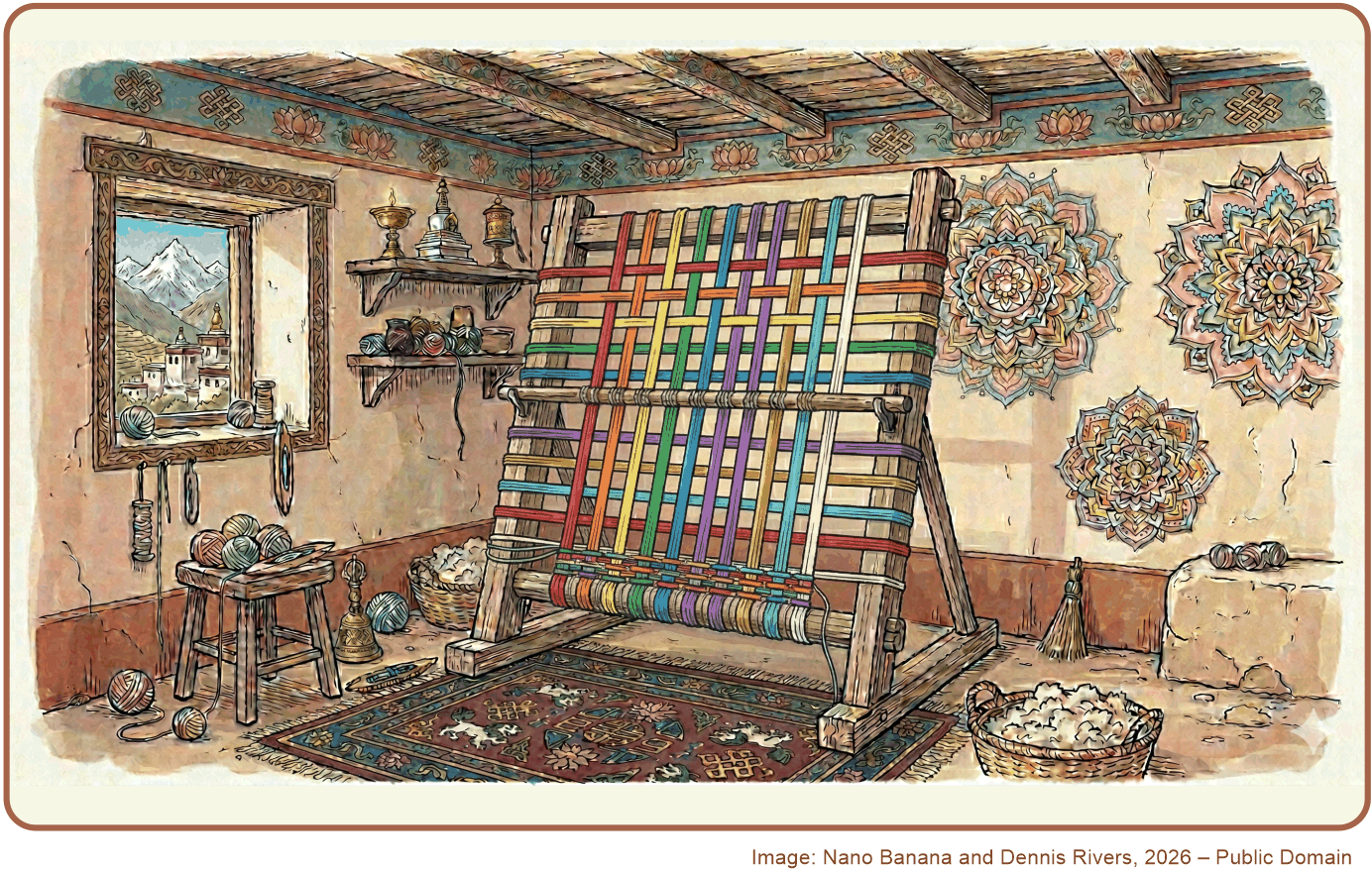
The Loom of Emergence
We weave together words to make sentences.
We weave together sentences, and listening, and turns, to make conversations.
We weave together conversations and actions to make relationships.
We weave together relationships to make families and communities.
We weave together communities to make a shared world.
1. Overview: The Question Under the Question
Every practical book rests on a deeper book that is usually never written. A cookbook rests on unwritten convictions about nourishment and hospitality. A parenting guide rests on unwritten convictions about what a child is and what a life is for. And a communication skills workbook — such as the Nine Transformations for New Conversations, to which this monograph is a companion — rests on a conviction that deserves, at least once, to be brought fully into the light and examined with care. This monograph is that examination.
The conviction is this: you cannot have better conversations and better relationships without also, in one way or another, striving to embody the strengths of character that better conversations require — and, running the other direction, you cannot grow those strengths of character anywhere so directly as in your conversations and relationships themselves. The person and the relationship make each other. The citizen and the community make each other. Neither comes first; they grow together, the way the two sides of an arch hold each other up, the way a river and its banks shape one another over centuries.
When I first began to say this out loud — that the six qualities I call the 6 C’s (conscious, compassionate, creative, curious, courageous, and cooperative) are not merely helpful accessories to communication skills but their living root system — I had a hunch that I was repeating something old. The hunch was correct beyond anything I expected. What I found, when I went looking, was not a footnote or two. What I found was one of the oldest, most widely defended, and most independently rediscovered convictions in the entire history of human thought: a conviction argued by Chinese sages and Greek philosophers, by Roman statesmen and American founders, by Russian novelists and Indian liberators, by rabbis in Lithuanian study halls and biologists reading the deep record of evolution. Across at least three great civilizations that developed the idea with little or no contact with each other, thoughtful people arrived at the same discovery: good persons and good communities can only be grown together, and the growing happens in the daily fabric of how we treat one another.
That is a remarkable convergence, and it deserves to be told as the story it is — not as a survey to be endured but as a family history to be received. Because if you are a person trying to communicate more consciously and compassionately in a difficult time, this history is your family history. The pages that follow are, in a sense, a very long letter of introduction to your ancestors.
Here is the question that will guide the whole exploration, and I invite you to carry it with you as you read: What opens up when we discover that the strengths we practice in our smallest conversations are the very strengths that have carried human communities through every crisis of their long journey — and that in cultivating them, person and community grow each other? The answer, as you will see, opens wider than you might expect — wide enough, by the end, to include the whole living world.
2. A Capacity You Already Possess: The Ordinary Miracle of a Working Conversation
Before we visit the philosophers, let us begin where this workbook always begins: with something you have already experienced.
Think of a conversation in your life that simply worked. Perhaps a neighbor came to you worried about something, and you set aside what you were doing and listened, and the worry loosened its grip. Perhaps two people at your workplace disagreed, and someone — maybe you — asked a genuine question instead of taking a side, and the disagreement turned into a problem the group could actually solve. Perhaps, around a kitchen table, someone told the truth kindly, and someone else received it without armor, and the family found its way through a hard season.
Now look closely at what was actually present in that moment, functioning so smoothly that it became invisible. Honesty was present — someone said what was real. Patience was present — someone let the slow truth take the time it needed. Courage was present — someone risked saying, or hearing, what was uncomfortable. Compassion was present — someone cared how their words would land in another person’s heart. Fairness was present — everyone got a turn; no one was steamrolled. And a kind of practical wisdom was present — someone sensed what this particular moment needed, and supplied it.
These are the virtues. Not marble statues in the museum of ethics; not commandments carved over a doorway; but working parts of a working conversation — as functional, and as invisible when functioning, as the beams inside the walls of your house. And here is the observation on which everything in this monograph rests: the conversation could not have worked without them. Take away the honesty, and the conversation becomes a performance. Take away the patience, and it becomes a collision. Take away the courage, and the important thing goes unsaid for another decade. Take away the compassion, and even true words wound. The virtues are not decorations added to good communication. They are its structural timber.
You already knew this, in the way we know things we have never said aloud. Every time you have thought, of someone in your life, “I can really talk to her — she’s so honest,” or “He’s the one I go to when things are hard — he’s so steady,” you were noticing that conversations rest on character. This monograph will not be installing a foreign idea in you. It will be doing what the Nine Transformations always tries to do: recognizing something already partly alive in your experience, giving it names and a history, and showing you how far it reaches.
And it reaches far. Because the same virtues that hold up a single kitchen-table conversation turn out, when you widen the lens, to hold up everything built out of conversations — which is to say, everything human. Which raises the question that launches our whole inquiry: if virtues are the working parts of shared life, then what exactly is a virtue? Can we say it plainly, in language that a farmer, a biologist, and a philosopher could all accept?
3. Naming the Thesis: Virtues as the Enduring Strengths of Shared Life
Here is the working definition this monograph proposes, and I will spend the rest of these pages showing you how many of humanity’s deepest thinkers have converged upon it from their own directions:
A virtue is an enduring disposition — learned through practice, built upon inherited temperament, and cultivated in community — to act in ways that make shared life work: ways that facilitate cooperation, honest problem-solving, mutual protection, group resilience in hard times, and the nurturing of human development from birth all the way through the life cycle.
Read that definition slowly, because each of its phrases is load-bearing. Enduring disposition: a virtue is not a single good act but a reliable readiness — you can lean on it, the way you lean on a friend’s honesty. Learned through practice, built upon inherited temperament: we arrive with raw materials — some of us more naturally bold, some more naturally gentle — but the finished strength is grown, not issued at birth, which is why every tradition we will visit speaks of cultivation, training, practice. Cultivated in community: nobody becomes patient alone on a mountaintop; we become patient with, and because of, and sometimes in spite of, other people. And then the functional heart of the definition: virtues are the dispositions that make shared life work — that let people coordinate their efforts, solve problems without destroying each other, weather catastrophes together, and raise the staggeringly dependent young of our species into capable adults.
Notice what this definition quietly accomplishes. It takes the virtues out of the museum and puts them back in the workshop. Honesty, on this account, is not admirable because a tablet somewhere says so; honesty is admirable because no group of human beings can plan a harvest, run a hospital, keep a promise, or raise a child on a foundation of mutual deception. Courage is not admirable as a decoration for war memorials; courage is admirable because every community, in every generation, needs some of its members to say the difficult true thing, face the approaching danger, and stand between the vulnerable and the storm. Compassion is not a luxury for the soft-hearted; compassion is the emotional technology by which the strong notice the struggling in time to help — and by which every one of us, who began life utterly helpless, was helped in time.
Notice, too, what the definition implies about direction. If virtues are the strengths that make shared life work, then shared life is also the gymnasium in which they are built. A community rich in trustworthy people generates the trust in which children can safely learn to be trustworthy. A family that practices patience gives its members ten thousand small occasions to grow patient. The causation runs both ways at once — which is exactly what the word co-evolve means, and exactly what makes this subject so much more hopeful than the usual stern lectures about character. We are not being asked to lift ourselves by our own bootstraps. We are being invited into a circulation that is already flowing, and has been flowing since before our species had a name for it.
This is the thesis. But a thesis this large should not be taken on one writer’s word. It should be tested against the deepest thinking our species has produced — and that is where the story becomes genuinely astonishing. Because when we go looking for the advocates of this view, we do not find a school. We find a mountain, with three great roads winding up its slopes from three different homelands, carrying travelers who mostly never met — and all of them arriving at the same summit.
4. Three Roads Up One Mountain: A Map Before the Journey
Because the territory ahead is large, let me hand you the map before we set out — the whole wheel before we walk its rim.
The conviction that persons and communities grow good together has been reached, again and again, along three broadly independent roads.
The first road is the road of the wisdom traditions. It begins earliest and runs longest — through the sages of ancient China, the philosophers of India and Greece, the Stoics of Rome. These travelers reached the summit by contemplative and practical insight: by watching, across lifetimes of teaching and civil turmoil, what actually cultivated human beings and human societies, and what actually corroded them. Their signature discovery is that the cultivation of the person and the ordering of the world form a single continuous chain — and that the chain is forged link by link in daily conduct, including, very specifically, in speech.
The second road is the road of the civic republicans. It runs from Cicero’s Rome through Montesquieu’s France to the American founders — travelers who asked a harder-edged, more institutional question: what does it take for a free, self-governing society to survive? Their signature discovery is that laws and constitutions, however brilliantly designed, are rope bridges anchored in the character of citizens — and that when the anchoring virtue decays, no cleverness of design can hold the bridge up. This road also carries the most serious counter-argument our thesis has ever faced, and we will meet it honestly.
The third road is the youngest and, in some ways, the most surprising: the road of the naturalists and pragmatists. It begins with Darwin himself — not the Darwin of popular caricature, but the actual Darwin of The Descent of Man, who argued that sympathy and conscience are products of evolution because communities of the sympathetic outlasted communities of the selfish. It runs through Kropotkin’s studies of mutual aid, through John Dewey’s reconception of virtues as functional habits of shared living, and into a remarkable twenty-first-century harvest of primatology, anthropology, and evolutionary science. Its signature discovery is that the virtues are not a thin cultural veneer over a savage core; they are among the oldest equipment our lineage carries — the strengths by which a physically unimpressive primate survived at all.
Three roads. Three methods — contemplative insight, political experience, empirical science. Three vocabularies that rarely cite one another. And one summit: good persons and resilient communities are grown together, in the daily practice of how we treat one another. When three independent lines of human inquiry converge on a single conclusion, a thoughtful person is entitled to suspect that the conclusion is not a fashion but a discovery — something true about our kind, found from three sides, like a mountain photographed from three valleys.
So let us walk the roads. We begin with the oldest and, for our purposes, the most precise — because the first road’s greatest teacher stated our entire thesis, twenty-five centuries ago, in a single unforgettable chain.
5. The First Road, Eastern Ascent: The Sages of Cultivation
Confucius and the great chain. Sometime around the fifth century BCE, in a China torn by the collapse of its old order into warring states, a teacher named Kong Qiu — known to the West as Confucius — devoted his life to a question that will sound familiar to any reader of this workbook: how is humane social order actually produced? His tradition’s most concentrated answer appears in the opening of the Daxue, the “Great Learning,” one of the Four Books that formed the core curriculum of Chinese education for some six hundred years. It proceeds as a chain, and I paraphrase its movement: those in antiquity who wished to bring peace to the world first brought order to their states; wishing to order their states, they first regulated their families; wishing to regulate their families, they first cultivated their own persons; wishing to cultivate their persons, they first rectified their hearts and made their intentions sincere. And then the text turns the chain around and draws its immortal conclusion: from the ruler down to the common people, all without exception must regard the cultivation of the person as the root.
Readers of the Nine Transformations will recognize this chain immediately, because a version of it stands in the front matter of the workbook as the poem “The Loom of Emergence”: words woven into sentences, sentences and listening woven into conversations, conversations into relationships, relationships into families and communities, communities into a shared world. I wrote that poem before I had read the Great Learning with adult eyes. The convergence is not plagiarism in either direction; it is two people, separated by two and a half millennia, looking at the same structure of reality.
But Confucius offers us something even more specific than the chain: he locates the workshop of cultivation precisely where this workbook does — in the conduct of everyday interaction, and emphatically in speech. His central virtue, ren — translated variously as humaneness, benevolence, co-humanity — is written with a character combining “person” and “two”: humaneness is what happens between people, or it does not happen at all. And it is cultivated through li, ritual propriety — which sounds stiff to modern ears until we realize that li means, in large part, the small choreography of respectful daily encounter: how you greet, how you listen, how you yield the floor, how you serve tea, how you disagree with a superior without humiliation on either side. Confucius held, further, in his doctrine of the “rectification of names,” that social disorder begins in disordered language — that when words no longer match realities, judgments fail, undertakings collapse, and the people “do not know how to move hand or foot.” A civilization’s health, he taught, can be read in the honesty of its speech. Twenty-five centuries later, in an era of industrialized misinformation, that diagnosis has lost none of its edge.
Mencius and the four sprouts. If Confucius gives our thesis its chain, his great successor Mencius (fourth century BCE) gives it its gardening metaphor — and, I would argue, gives the appreciative stance of this entire workbook its most ancient philosophical charter. Against rivals who taught that human nature was neutral or bad, Mencius argued that every human being is born with four duan — sprouts, or beginnings: the sprout of compassion (proved, he said, by the fact that anyone, seeing a child about to fall into a well, feels alarm before any calculation of advantage), the sprout of shame at wrongdoing, the sprout of courtesy and deference, and the sprout of the sense of right and wrong. From these four sprouts, properly cultivated, grow the four cardinal virtues. Left untended — or worse, trampled — they wither.
Please pause over what Mencius is claiming, because it is exactly the claim on which the Nine Transformations rests. He is not saying people are born virtuous; a sprout is not a tree. He is saying people are born capable of virtue — that the raw material is standard human equipment, and that the difference between a cruel society and a humane one is a difference of cultivation, not of species. Every “Capacity You Already Possess” section in this workbook is Mencian gardening. And Mencius adds a warning our era needs: he tells of the once-forested Ox Mountain, logged and grazed until it stood bare, so that people seeing it assumed it had never held trees. So too, he says, with human goodness under relentless bad treatment — observers mistake the damage for the nature. The appreciative stance is, among other things, a refusal to make Ox Mountain’s mistake about anybody.
Wang Yangming and the unity of knowing and doing. Eighteen centuries later, the Ming dynasty philosopher-general Wang Yangming added the sharpest possible edge to this tradition: the doctrine of the unity of knowledge and action, zhixing heyi. To know a virtue, Wang insisted, is to practice it; a person who claims to know filial devotion but does not practice it simply does not yet know it — the way no one is said to know the taste of a peach who has not tasted one. Every skill-practice exercise in this workbook — every insistence that reading the chapter is the in-breath and practicing it is the out-breath — is Wang Yangming’s doctrine in pedagogical clothing.
The Buddha and Right Speech. Meanwhile, on the Indian subcontinent, and at nearly the same historical moment as Confucius, Siddhartha Gautama was building conversational conduct directly into the architecture of liberation. The Buddha’s Noble Eightfold Path — the core curriculum of Buddhist practice — gives one of its eight limbs to Right Speech: abstaining from false speech, divisive speech, harsh speech, and idle chatter; speaking, as the early texts put it, what is true, beneficial, and timely. It is worth letting the placement astonish you: in one of history’s most rigorous programs for the transformation of the human heart, how you talk stands beside meditation itself as a formal component of awakening. The Mahayana tradition then developed the ideal you have already named in your own reflections: upāya, skillful means — action that heals because it arises from the marriage of prajñā (wisdom) and karuṇā (compassion). A bodhisattva, in this vision, is precisely a being whose inner cultivation and outer helpfulness have become a single motion — the co-evolution thesis embodied in a single life.
The Gita’s purified action. And the Bhagavad Gita — the text Gandhi would later call his spiritual dictionary — contributes the teaching that action in the world and cultivation of the self are not rivals but partners: act, but act from purified intention, without grasping at the fruits; let the quality of the doer become the quality of the deed. We will meet this teaching again, transformed, when Gandhi carries it into politics.
So the Eastern ascent of the first road delivers a complete early version of our thesis: the person is the root of the world (Confucius); the root comes with living sprouts (Mencius); knowing and doing are one (Wang Yangming); speech is a primary site of practice (the Buddha); and inner state flows into outer act (the Gita). But the first road has a Western ascent as well — and there, in the Athens of the fourth century BCE, a philosopher was working out the piece of the puzzle that the Nine Transformations for New Conversations workbook depends on most: the actual mechanism by which practice becomes character.
6. The First Road, Western Ascent: Athens, and the Discovery of Habituation
Plato’s twin structures. Plato’s Republic — the founding masterpiece of Western political philosophy — is built entirely upon an analogy that is really our thesis in architectural form: the city and the soul, Plato argues, have the same structure, and justice is the same harmony in both. A disordered city is a magnifying mirror of disordered souls; a just city both requires and produces just persons. One may quarrel with nearly every detail of Plato’s ideal city — I certainly do — while still receiving the deep gift of the analogy: you cannot finally separate the question “what kind of society should we build?” from the question “what kind of people are we becoming?” They are one question wearing two robes.
Aristotle and the mechanism. It was Plato’s student Aristotle, however, who supplied what I regard as the single most practically important sentence in the entire history of virtue theory. In the Nicomachean Ethics, Aristotle observes that the moral virtues arise in us neither by nature nor against nature: we are constituted so as to receive them, and they are brought to completion by habit — and then comes the sentence: we become just by doing just acts, temperate by doing temperate acts, brave by doing brave acts. Character, in other words, is not discovered like a buried treasure or issued like a passport. It is built, by repetition, out of conduct — the way a house is built out of bricklaying and a harpist out of harp-playing. Aristotle even anticipates the encouragement this workbook offers its awkward beginners: the acts that build a virtue are, at first, performed without the ease and pleasure that will eventually mark the finished virtue. The awkwardness of early practice is not evidence of unfitness. It is simply what the middle of the building process feels like.
Readers of Transformation Eight will recognize this as the ancient original of a line I arrived at through my own decades of teaching: in the short run, our conversations express who we are; in the long run, our conversations create who we are. That is pure Aristotelian habituation, applied to the conversational life. And modern neuroscience — with its documentation of habit formation, overlearning, and the slow consolidation of practiced responses — has, in effect, spent a century confirming Aristotle’s hunch with instruments he could not have imagined.
Aristotle contributes two further pieces. First, he is explicit that his ethics is not a private manual: the Nicomachean Ethics ends by announcing the Politics, because character is formed by upbringing, law, and communal practice, and so the study of the good person leads necessarily into the study of the good community — the co-evolution thesis stated as a curriculum. Second, he defines the human being as a political animal — an animal whose nature is completed only in community — and, in a passage biologists would smile at today, links this to our possession of speech: other animals have voice to signal pleasure and pain, but humans have language to deliberate together about the advantageous and the just. For Aristotle, we are the conversational animal, and our flourishing is a joint production.
The Stoics: the one lever always in reach. The first road’s Western ascent has one more station worth a reverent pause: the Stoics of Rome. Epictetus — born enslaved, later the most influential moral teacher of his age — taught that in a world of vast forces beyond our control, one domain remains genuinely “up to us”: our own judgments, intentions, and responses. And Marcus Aurelius — a man who, as emperor, commanded more external power than perhaps any person alive — filled his private notebooks, the Meditations, with reminders that the only reliable instrument he possessed for improving the world was his own character, exercised in each particular encounter with each difficult particular person, beginning again every morning. There is something permanently moving in this: the slave and the emperor, at opposite poles of worldly power, converging on the same discovery — that the workshop of a better world stands open in every interaction, and its door is always unlocked from the inside. Marshall Rosenberg’s teaching, cited throughout this workbook, that we need not wait for the other person to change because we hold half the lines in every conversation, is the Stoic discovery reborn in the language of modern communication training.
The first road, then — Eastern and Western ascents together — establishes the thesis, the sprouts, the mechanism, and the site of practice. But a skeptic might fairly say: these are philosophers and sages, professionally fond of virtue. What happens when the thesis is dragged out of the academy and the ashram and made to answer the roughest question politics can ask — can a society of free people actually survive on it? That question has its own road, and its travelers wore togas and tricorn hats.
7. The Second Road: The Civic Republicans and the Survival Question
Cicero: duties as the mortar of the commonwealth. The second road begins in the collapsing Roman Republic, with Marcus Tullius Cicero writing De Officiis — “On Duties” — as a long letter to his son while the republic he had served his whole life came apart around him. Cicero’s argument, distilled: human society is held together by good faith — by promise-keeping, truthfulness, justice in dealings — and these are not ornaments upon the commonwealth but its actual mortar. Break faith widely enough, he warned, and no army can hold the walls, because the walls were never really made of stone. For a thousand years and more, De Officiis was among the most copied, taught, and quoted secular books in the Western world; when the American founders reached for a classical education, this was much of what their hands found.
Montesquieu: every regime runs on a fuel. The road’s decisive modern engineer was Montesquieu, whose The Spirit of the Laws (1748) proposed an idea of startling explanatory power: every form of government depends on a characteristic principle — a fuel, we might say — that animates its citizens and without which its machinery seizes. Despotism runs on fear. Monarchy runs on honor. And a republic — a self-governing society — runs on virtue: the citizens’ settled disposition to prefer the common good, keep faith, restrain their appetites, and do their public duty without a tyrant’s whip to make them. Montesquieu’s corollary is the one that echoes down to our own anxious era: when the fuel runs out, the engine does not merely slow; it transforms. A republic whose citizens lose republican virtue does not remain a virtue-free republic. It becomes something else.
Adams, Franklin, and the founders’ wager. The American founders read Montesquieu the way engineers read a load-bearing specification. John Adams put the conclusion with characteristic bluntness in 1798: our Constitution was made only for a moral and religious people; it is wholly inadequate to the government of any other. Strip the eighteenth-century phrasing and the claim is precisely our thesis at national scale: the parchment cannot do the work; the parchment presupposes people whose dispositions make the parchment’s promises performable. Adams’s lifelong correspondence returns to this wager again and again — public liberty, he wrote as early as 1776, cannot outlast the loss of private virtue among the people. And Benjamin Franklin gave the wager its most charming personal form: his famous project, recorded in the Autobiography, of listing thirteen virtues and tracking his practice of them week by week in a little book — imperfectly, ruefully, and with the great confession that he never achieved humility but “had a good deal with regard to the appearance of it.” Franklin’s little book is, as far as I can tell, the direct ancestor of every Learning Journal this workbook has ever asked a reader to keep: the same wager that character yields to deliberate, tracked, forgiving practice.
The great counter-argument — and why it sharpens rather than sinks the thesis. Now intellectual honesty requires us to stop and face the strongest objection our thesis has ever received, because it was raised on this very road, by serious people, and it has not gone away. Bernard Mandeville’s scandalous Fable of the Bees (1714) argued that “private vices” — vanity, greed, luxury — yield “public benefits”: the hive prospers because the bees are selfish. Adam Smith gave the insight its respectable form: we address ourselves to the butcher’s self-love, not his benevolence, and dinner arrives anyway. And James Madison built the insight into the American Constitution itself: since men are not angels, design the machine so that “ambition… counteract[s] ambition,” and let opposite interests check each other where virtue cannot be counted on. Here, it seems, is a rival answer to the survival question: do not cultivate the citizens; engineer around them.
It is a powerful answer, and every mature version of our thesis must absorb what is true in it: institutions matter enormously; good structures economize on scarce virtue; a society that relies on saintliness alone is building on hope. But notice — and this is the turn that restores the thesis, stronger — that the engineers themselves did not believe the engineering could replace character. It was Madison, in Federalist 55, who wrote that republican government presupposes the qualities of esteem and confidence in human beings “in a higher degree than any other form” — that if there were not sufficient virtue among the people, “nothing less than the chains of despotism can restrain them from destroying and devouring one another.” And it was Madison again, at the Virginia ratifying convention, who said that to suppose any form of government will secure liberty or happiness without any virtue in the people is “a chimerical idea.” The designer of the machine, in other words, testified under oath that the machine runs on the very fuel Montesquieu named. Even the market economists’ own tradition concedes the point: Adam Smith’s other book, The Theory of Moral Sentiments — the one he himself kept revising until his death — is an entire treatise on sympathy, conscience, and the socially cultivated “impartial spectator” within the breast. The mature conclusion of the second road is therefore not “virtue or institutions” but a division of labor: institutions channel and economize character; they cannot create it, and they cannot long survive its absence. Structures are the banks; virtue is the river. Banks without a river are a ditch.
Two more modern travelers close this road. Alexis de Tocqueville, touring America in the 1830s, located the young republic’s real load-bearing structure not in its Constitution but in its mores — the “habits of the heart” — and above all in its dense weave of voluntary associations, where citizens learned, by practice, the arts of cooperating: the township, the congregation, the committee, the improvement society as gymnasiums of civic virtue. And in our own generation, the political scientist Elinor Ostrom won the Nobel Prize in economics for demonstrating, against decades of “tragedy of the commons” fatalism, that ordinary communities around the world — Swiss alpine villages, Spanish irrigation districts, Japanese forest cooperatives — have successfully governed shared resources for centuries, without privatization and without Leviathan, wherever they could build trust, reciprocity, face-to-face communication, and shared norms. Ostrom’s field data are the second road’s empirical vindication: social resilience is manufactured, conversation by conversation, out of exactly the dispositions our definition named.
So the second road answers the survival question: yes — a free society can run on cultivated character, and in the long run it can run on nothing else. But this raises the question that presses hardest on any individual reader: granting all this at the scale of republics and commons — how does one actual person, in one actual neighborhood, practice it? History’s answer to that question is a lineage of astonishing practitioners, and meeting them is the emotional heart of this whole story.
8. The Lineage of Practice: Those Who Worked the Local Scale
Philosophy proposes; practice discloses. Between the great theorists of the first two roads and the scientists of the third stands a company of women and men who took the co-evolution thesis out of the study and lived it at the scale where you and I live — the conversation, the household, the congregation, the town. I think of them as this monograph’s cloud of witnesses, and I commend every one of them to your Learning Journal’s circle of empowering ancestors.
Israel Salanter and the Musar fellowship. In nineteenth-century Lithuania, Rabbi Israel Salanter looked at communities rich in scholarship and asked why learning so often failed to become character. His answer became the Musar movement: a complete pedagogy for cultivating middot — soul-traits such as patience, humility, truthfulness, and loving-kindness — through daily focused practice, chanted study of short texts until they penetrated the heart, personal accounting in journals, and, crucially, small fellowships (vaadim) in which companions supported and gently held one another accountable. A saying attributed to Salanter compresses a lifetime into four sentences: I set out to change the world, and failed; I tried to change my nation, my town, my family, and failed; at last I understood that I must begin with myself. Readers of Transformation Nine will recognize in the Musar vaad a direct ancestor of the Circle of Six: the discovery, made independently in a Lithuanian study hall, that character work is team work.
John Woolman and the Quaker patience. A century earlier, in colonial New Jersey, a Quaker tailor named John Woolman became convinced that slaveholding was a profound wrong — and then spent thirty years addressing it in the most remarkable way imaginable: by visiting slaveholding Friends, one household at a time, and engaging them in gentle, honest, unhurried conversation, refusing both to condemn and to be silent, declining even to use the products of enslaved labor, and recording the whole inward struggle in a Journal of luminous tenderness. By the time of his death, American Quakers were on the road to becoming the first Western community to renounce slaveholding entirely. Woolman is, so far as I know, history’s finest case study in what Transformation Nine calls the right to invite: the demonstration that a single person of cultivated gentleness, exercising nothing but truthful conversation and consistent example, can move a whole society’s conscience — not quickly, but permanently.
Tolstoy’s thunderbolt. In the 1880s and 90s, Leo Tolstoy — then the most famous writer alive — concluded that no rearrangement of institutions could redeem a society whose members remained inwardly unchanged, and said so at book length in The Kingdom of God Is Within You. His epigram has become proverbial: everyone thinks of changing the world; no one thinks of changing himself. What is less remembered is who was listening. A young Indian lawyer in South Africa read the book and reported that it “overwhelmed” him and left him permanently changed; the two corresponded until the old novelist’s death.
Gandhi: the means are the ends in the making. That lawyer was Mohandas Gandhi, and his lifework became the most consequential field experiment ever conducted on our thesis. Gandhi fused the Gita’s purified action, Tolstoy’s inward revolution, and the Jain reverence for ahimsa into satyagraha — “truth-force” — and grounded it in the principle that means and ends are convertible terms: as the means, so the end; the tree is in the seed. You cannot, he insisted, plant the seed of violence and harvest peace, or plant contempt and harvest brotherhood — and therefore the discipline of the campaigner’s own character (truthfulness, fearlessness, non-retaliation, love of the opponent) is not preparation for the politics; it is the politics. Note how exactly this is the co-evolution thesis under maximum load: Gandhi wagered the freedom of a fifth of humanity on the claim that a movement becomes what its members practice being. The wager, with all its human imperfections and unfinished business, largely paid.
King and the Beloved Community. Martin Luther King, Jr. carried the synthesis to America and gave it its most beautiful name. The aim of the movement, King insisted, was never merely desegregated lunch counters; it was the Beloved Community — a society of reconciled persons — and precisely for that reason the movement’s means had to prefigure its end: the end is preexistent in the means, he taught, and hate cannot drive out hate. The famous commitment cards that Birmingham volunteers signed in 1963 read like a page from this workbook: pledges to meditate daily, to walk and talk in the manner of love, to refrain from violence “of fist, tongue, or heart,” to observe with friend and foe the ordinary rules of courtesy. Character discipline, adopted small-group by small-group, as the engine of social transformation: our thesis, marching.
Thich Nhat Hanh, Havel, and Tutu: three modern voices. The lineage runs unbroken into living memory. The Vietnamese Zen master Thich Nhat Hanh, whom King nominated for the Nobel Peace Prize, compressed it into four words — peace in oneself, peace in the world — and built communities of “engaged Buddhism” whose training centers on, of all things, mindful speech and deep listening: the Buddha’s Right Speech, renewed for an age of war. Václav Havel, playwright-prisoner-president, argued in “The Power of the Powerless” that the post-totalitarian system ran on the daily micro-complicities of ordinary people — the greengrocer’s unexamined sign in the window — and therefore that living in truth, one person’s refusal of the daily lie, was already a political earthquake; 1989 proved him more literally right than perhaps he expected. And Desmond Tutu, presiding over South Africa’s Truth and Reconciliation Commission, gave the world’s vocabulary the southern African concept of ubuntu, often rendered: a person is a person through other persons. I know of no phrase in any language that states this monograph’s thesis more perfectly. My humanity, Tutu taught, is caught up and bound in yours; we can only be human together — and therefore the restoration of persons and the restoration of the society are one work, which is why a shattered nation was asked to attempt it through, of all instruments, structured truthful conversation.
Stand back from this lineage for a moment and let yourself feel its cumulative weight: a Lithuanian rabbi, a Quaker tailor, a Russian novelist, an Indian lawyer, a Baptist preacher, a Vietnamese monk, a Czech playwright, a South African archbishop — different centuries, continents, faiths, and temperaments, and one shared operational discovery: the world is changed by persons practicing, together and locally, the character the changed world will require. If you have ever feared that working on your listening, your honesty, and your compassion is a private hobby while the real work happens elsewhere — this is the company that says otherwise.
And yet a reasonable modern mind, moved by all of this, may still harbor one last reservation: perhaps this is all very inspiring, but is it not swimming against nature? Are not selfishness and aggression the deep truth of the animal we are, and virtue a thin cultural paint? For most of the twentieth century, popular science seemed to whisper exactly that. Which is why the third road is such an extraordinary gift — because it begins with the very man whose name was taken in vain by the whisperers, and it arrives bearing the best news in this whole monograph.
9. The Third Road: Darwin’s Actual Argument, and the Pragmatists’ Workshop
The Darwin almost nobody quotes. Open The Descent of Man (1871) to its fourth and fifth chapters and you will meet a Darwin startlingly unlike the “survival of the fittest” caricature that was later constructed in his name. Here Darwin sets himself the problem of the moral sense — conscience, sympathy, fidelity, courage — and argues that it is no divine interruption of nature and no cultural veneer, but a product of the same evolutionary process that shaped the hand and the eye. His reasoning runs, in essence: any social animal endowed with sufficient memory and intelligence would develop something like conscience, because its social instincts would persist and conflict with its momentary desires; and among human groups, he writes, a tribe rich in members possessing courage, sympathy, and faithfulness — members ready to aid and defend one another — would be victorious over, and outlast, tribes of the selfish and treacherous. And then the sentence that deserves to be carved over the door of every communication classroom: communities which included the greatest number of the most sympathetic members would flourish best and rear the greatest number of offspring. Sympathy, in Darwin’s own account, is not evolution’s exception. It is one of evolution’s achievements — selected, strengthened, inherited, because groups woven together by fellow-feeling survive what solitary strength cannot.
Please notice what has just happened to our thesis. The wisdom traditions said: cultivate the sprouts. Darwin explains where the sprouts came from — and why they are standard equipment. Mencius’s child at the well, evoking alarm in every passerby before any calculation, turns out to be a report of evolved psychology, twenty-three centuries before the theory that could explain it.
Kropotkin’s long rebuttal. Darwin’s subtler account was soon shouted down by the “nature red in tooth and claw” school, and the century’s most thorough rebuttal came from an unexpected quarter: a Russian prince, geographer, and anarchist named Peter Kropotkin, whose expeditions through Siberia had shown him not a gladiatorial nature but species surviving brutal conditions through cooperation. His Mutual Aid: A Factor of Evolution (1902) marshals the evidence across the whole ascent — animal sociality, tribal custom, the medieval village commune and guild, the modern voluntary association — to argue that mutual aid is as fundamental a factor in evolution as competition, and the decisive one in hard times. Kropotkin has been substantially vindicated by a century of subsequent biology; he stands as the third road’s first great documentarian of social resilience — the demonstration that the groups which endure catastrophe are the groups which have practiced helping.
Dewey: virtues moved into the workshop. It fell to the American pragmatists — and above all to John Dewey — to take these naturalist materials and rebuild ethical theory out of them. Dewey’s Human Nature and Conduct (1922), together with the Ethics he wrote with James Tufts, performs exactly the operation this monograph’s definition performs: virtues are reconceived as functional habits — enduring, learned organizations of native impulse, formed through transaction with the social environment, and evaluated by their fruits in shared living. For Dewey, honesty is not obedience to a tablet; it is the working disposition without which cooperative inquiry — science, democracy, education, family life — cannot proceed at all. Character is not a private possession polished in solitude; it is, in his words, formed and expressed in the give-and-take of communicated experience. And Dewey drew the pedagogical conclusion that this entire workbook stands on: since habits are grown by participation, character education happens through practicing communal life, not through lectures about it — democracy itself being, in his famous phrase, primarily a mode of associated living, of conjoint communicated experience, and only secondarily a form of government. Dewey is, in effect, the philosopher who moved the virtues permanently out of the museum and into the workshop — and who identified the workshop as conversation-rich common activity.
Kitcher and the ethical project. The thick systematic book you sensed must exist was written in our own century by Dewey’s most explicit philosophical heir. Philip Kitcher’s The Ethical Project (2011) tells the whole story as one continuous human undertaking, tens of thousands of years long: our small-band ancestors, equipped by evolution with real but limited fellow-feeling, suffered chronic “altruism failures” — breakdowns of cooperation that made shared life fragile — and ethics arose as their invented, endlessly revised remedy: norms, virtues, moral emotions, practices of discussion, all functioning as a social technology for living together. Two features of Kitcher’s account matter especially for us. First, his reconstruction of ethics’ original workshop: the evidence of surviving forager societies suggests that norms were hammered out in something very like the full-group conversation — deliberation among equals, on the “cool hour” model, everyone’s voice bearing weight. Ethics, on this account, is not handed down; it is talked into being, and always has been. Second, his insistence that the project is unfinished: we are its current custodians, still debugging the technology, still — as we shall see in the next section — struggling to extend it past the boundaries it was first built within. Between Dewey and Kitcher, pragmatism delivers the third road’s formal answer: virtues are evolved-and-cultivated functional strengths; ethics is humanity’s longest-running collaborative project; and the project’s native medium is the deliberating conversation.
10. The Third Road’s Modern Harvest: What the Sciences Now Report
In the last few decades, the third road has widened into a highway, as one science after another returned findings that read like footnotes to Darwin’s fourth chapter — and, uncannily, like footnotes to Mencius. A brief tour of the harvest, keyed to the clauses of our working definition:
Cooperation and problem-solving. The primatologist Frans de Waal (Good Natured, 1996, and much since) documented among chimpanzees and bonobos the raw materials of morality — consolation of the distressed, reconciliation after conflict, indignation at unfairness — establishing that the sprouts predate our species. The developmental psychologist Michael Tomasello (A Natural History of Human Morality, 2016) then located the human difference with beautiful precision: obligate collaborative foraging. Our ancestors, unlike the great apes, had to hunt and gather in genuine partnership; and partnership selected for a suite of capacities Tomasello calls shared intentionality — the ability to form a “we,” to hold joint goals, to feel that my partner deserves his share because we did this together. Human morality, on this account, is the psychology of partnership, and it emerges spontaneously in toddlers: sharing the spoils of joint effort, helping without prompting, protesting unfairness. We became moral, one might say, because we became partners; and we became partners because alone we starved. The political scientist Robert Axelrod’s famous computer tournaments (The Evolution of Cooperation, 1984) added the strategic skeleton: in repeated interactions, strategies that are nice, forgiving, provokable, and clear — begin with cooperation, answer defection, forgive readily, be legible — outcompete the cynical field. Which is to say: the tournament mathematics independently rediscovered a rough draft of ordinary decency.
Group resilience. The anthropologist Christopher Boehm (Moral Origins, 2012), surveying the ethnographic record of mobile forager bands — the nearest living window onto the social world in which we evolved — found them strikingly, actively egalitarian: would-be bullies and tyrants are managed by coalitions of the rest, through gossip, ridicule, ostracism, and in extremity worse; and over evolutionary time, Boehm argues, this “reverse dominance” selected against tyrannical temperaments and for self-restraint, generosity, and sensitivity to reputation. Conscience itself, in his account, is partly the internalized voice of the band’s campfire conversation. The anthropologist Joseph Henrich (The Secret of Our Success, 2015) showed that our species’ ecological dominance rests not on individual brainpower but on cumulative culture — vast libraries of know-how held by no single mind, transmitted and improved across generations — which makes faithful teaching, honest transmission, and social learning literal survival infrastructure: a community’s resilience is its relationships’ bandwidth. Jonathan Haidt (The Righteous Mind, 2012) mapped the moral emotions as the binding agents of groups — and issued a warning we will bank for the next section: the same emotions that bind also blind.
The nurturing of development across the life cycle. Here belongs what may be the single most moving finding in the modern harvest. The anthropologist Sarah Blaffer Hrdy (Mothers and Others, 2009) begins from a stark comparative fact: human infants are so costly, so slow, and so many that no mother in our evolutionary past could raise them alone. We are, uniquely among apes, cooperative breeders: grandmothers, fathers, aunts, elder siblings, and trusted others — “alloparents” — have always shared the carrying, feeding, and minding of the young. And this arrangement, Hrdy argues, is the very crucible of our emotional endowment: infants who had to engage, read, and win over multiple caregivers were selected for exactly the capacities this workbook trains — monitoring others’ feelings, intuiting intentions, appealing, attuning, connecting. On this account, human empathy was raised into us by shared childcare, generation upon generation, for a million years or more. The village did not merely raise the child; the village, over deep time, raised the species’ heart. I know of no scientific finding that lands closer to the final clause of our definition — or that better explains why the nurturing of development, from birth through the whole arc of life, belongs on any honest list of what the virtues are for.
The philosophers’ confirmation. Meanwhile, academic philosophy performed its own return journey. Alasdair MacIntyre’s After Virtue (1981) — probably the most influential work of moral philosophy in the past half-century — argued that virtues live and die with shared practices and communities of practice, and famously closed by calling for new forms of community within which the moral life could be sustained through a new dark age; his later Dependent Rational Animals (1999) grounded the virtues in our biological vulnerability, arguing that beings who begin and end life in radical dependence require, as a matter of natural necessity, the “virtues of acknowledged dependence” — just generosity, gratitude, care. Philippa Foot’s Natural Goodness (2001) and Rosalind Hursthouse’s On Virtue Ethics (1999) developed the parallel claim that virtues are excellences of the human life-form as objectively as strong roots are excellences of an oak — goodness assessed the way a naturalist assesses thriving. And the psychologists Christopher Peterson and Martin Seligman, surveying the world’s moral traditions for their monumental Character Strengths and Virtues (2004), reported that six broad virtue clusters recur across cultures and centuries — wisdom, courage, humanity, justice, temperance, transcendence — a finding that should make any author of a “six C’s” framework sit up straight in his chair, and to which we will return.
Let the harvest’s meaning land as a whole. For roughly a century, popular culture told us that science had unmasked human nature as selfish, and that kindness was sentimentality swimming upstream. The actual returns, now in from primatology, anthropology, child development, game theory, and field political-economy, say something close to the opposite: the cooperative virtues are among the oldest, deepest, most repeatedly selected equipment our lineage possesses — the strengths by which a slow, clawless, thin-skinned primate raised its impossible children, held its bullies in check, accumulated its know-how, and outlasted every catastrophe of the Pleistocene. When you practice patience, honesty, and compassionate speech, you are not defying your nature. You are exercising its noblest and most ancient muscles.
Three roads; one summit. The moment has come to stand on it, look at what the three see together — and discover why the view leads directly to the practice of conversation.
11. The Summit: What the Three Roads See Together
Stand now at the summit and let the three roads’ testimonies merge into a single view. Each road contributed something the others lacked, and only together do they complete the picture.
The wisdom traditions contributed the chain and the garden: the insight that self-cultivation is the root of world-ordering (Confucius), that the capacities come as sprouts needing tending rather than as finished traits (Mencius), that knowing and doing are one (Wang Yangming), and that repetition is the loom on which conduct is woven into character (Aristotle). The civic republicans contributed the survival test: the demonstration, argued in theory and paid for in blood, that free and resilient societies run on the fuel of citizen character, that institutions can economize virtue but never replace it, and that the fuel is refined in the small associations where people practice cooperating (Montesquieu, Adams, Tocqueville, Ostrom). And the naturalists and pragmatists contributed the deep provenance: the discovery that the sprouts are evolution’s work — that sympathy, fairness, conscience, and cooperative skill were selected across a million years of shared hunting, shared child-raising, and shared survival, and that ethics itself is humanity’s longest-running collaborative technology, still under revision, with us as its current maintenance crew (Darwin, Kropotkin, Dewey, Hrdy, Tomasello, Kitcher).
Fuse the three and you get the full thesis of this monograph, which can now be stated with its complete pedigree behind it: the virtues are humanity’s evolved-and-cultivated strengths for shared life; communities plant and water them in persons, and persons, so grown, hold communities together through everything history throws at them. Person and community are each other’s soil and each other’s harvest. They can only be grown together.
And now watch what happens when we ask the summit’s obvious next question: where, concretely, does the growing happen? Because the three roads, having converged on the thesis, converge a second time — on the answer — and the answer is the reason this monograph accompanies a communication skills workbook.
Confucius located the workshop in li, the daily choreography of respectful encounter, and in the rectification of speech. The Buddha wrote Right Speech into the Eightfold Path itself. Aristotle defined us as the animal that possesses logos — reasoned speech — precisely so that we can deliberate together about the just and the good. Tocqueville’s Americans learned their civic virtues in the talking-places: the town meeting, the committee, the congregation. Ostrom’s commons survived exactly where the herders and irrigators could talk — cheap talk, face to face, turns out in her data to transform cooperation. Boehm’s foragers governed their bullies by campfire conversation; Kitcher reconstructs the birth of ethics itself as normative discussion among equals; Hrdy’s cooperative nursery selected for infants skilled at reading and engaging their many caregivers; Tomasello’s partnership psychology is built of joint attention and shared communication; Tutu’s ubuntu was set to work healing a nation through structured truthful testimony; and Thich Nhat Hanh distilled fifty years of engaged Buddhism into trainings on deep listening and loving speech.
Every road, in other words, points to the same workshop: conversation is the primary human site where virtues and social resilience co-evolve. And a moment’s reflection shows why it must be so. We are linguistically intertwined creatures; the conversation is the smallest complete unit of shared life — the one place where, dozens of times a day, all the ingredients of the co-evolution are simultaneously present and active. In a single ordinary exchange, honesty is either exercised or eroded; patience is either strengthened or skipped; courage either speaks or swallows; compassion either attunes or armors; fairness either yields the floor or seizes it; and two people’s trust in each other — the elementary fiber of all social resilience — is either woven a little tighter or worn a little thinner. No gymnasium of virtue is so cheap, so available, so endlessly repeating, or so consequential. Monasteries are rare; legislatures are distant; conversations are now — and we hold half the lines in every one of them.
This is also the place to say plainly what the reader of the Nine Transformations may already have sensed: the six C’s of that workbook — conscious, compassionate, creative, curious, courageous, cooperative — are this monograph’s ancient thesis dressed in work clothes. Set them beside Peterson and Seligman’s six cross-cultural virtue clusters and the family resemblance is unmistakable: consciousness answering to wisdom, compassion to humanity, courage to courage, cooperation to justice, curiosity and creativity to the engines of wisdom and transcendence — with temperance distributed, in the workbook’s way, through the disciplines of pausing, listening first, and translating complaint into request. The six C’s are not a marketing device. They are one writer’s local vocabulary for the perennial strengths — and the nine transformations are a curriculum for practicing them in the one workshop everybody already attends daily.
If the story ended here, it would already be, I believe, the most encouraging story a communication student could receive. But intellectual honesty — and the state of our world — require us to climb to one more ledge above the summit, where the wind is colder. Because the same sciences that delivered the good news deliver a warning, and the warning turns out to define the precise growing edge of the whole ten-thousand-year project.
12. The Shadow at the Summit: The Boundary Problem, and the Widening of the Circle
Here is the warning, and Darwin himself saw it first. The evolutionary machinery that grew our sympathy grew it for the group: the tribe rich in mutual aid prevailed, Darwin noted, in competition with other tribes. Boehm’s egalitarian bands governed their own bullies while raiding their neighbors. Haidt’s moral emotions bind the in-group and, in the very act of binding, blind it to the out-group’s humanity. The cooperative virtues, as evolution first issued them, came with a factory-installed boundary: us. Loyalty, solidarity, even courage and self-sacrifice — history shows with terrible clarity that these can all be conscripted by the boundary, so that the same strengths that raise a barn on Saturday can burn a village on Sunday. Anyone who writes hopefully about human virtue owes the reader this acknowledgment, and I make it without reservation: the shadow is real, it is ancient, and no amount of communication training makes it vanish by itself.
But now watch what every road did with the shadow — because this is, to my mind, the most stirring turn in the entire story. Each tradition, upon discovering the boundary, made the deliberate widening of the circle its own next assignment.
Darwin did it in the very chapter that named the problem: as reason and sympathy advance, he wrote, the circle extends — from tribe to nation, to all nations and races, to the “imbecile, maimed, and other useless members of society,” and finally, he says plainly, to the lower animals — sympathy beyond the confines of man being among the latest and noblest of our moral acquisitions. The Stoics had already taught oikeiōsis, the progressive drawing of ever-wider circles — family, city, humanity — into one’s own concern; the Mohists of ancient China preached impartial care against the Confucians’ graded love; the Buddhists aimed loving-kindness explicitly at all sentient beings; the Hebrew prophets extended covenant obligation to the stranger, the widow, the orphan. Gandhi and King forged the modern political form of the widening: satyagraha and the Beloved Community are, at bottom, technologies for refusing to let the opponent fall outside the circle of the human. The philosopher Peter Singer (The Expanding Circle, 1981) argued that reason itself, once switched on by evolution for narrow purposes, cannot be confined to them — that the logic of “my interests count” leads, step by resisted step, to “so do yours.” Kitcher’s history of the ethical project reads its greatest chapters — the abolition of slavery, the enfranchisement of women, the ongoing extensions of dignity — as exactly this: the technology being upgraded past its original boundary conditions. And in our own generation, Robin Wall Kimmerer’s Braiding Sweetgrass and Joanna Macy’s Work That Reconnects carry the widening to its furthest announced destination: the circle drawn around the entire living world — all people and all creatures as beloved kin, gratitude practiced as reciprocity with the land itself.
So the shadow does not refute the thesis. The shadow assigns the homework. The virtues are real and ancient; the boundary is real and ancient; and the moral history of our species is the slow, non-inevitable, endlessly contested labor of keeping the virtues while dissolving the boundary — a labor performed, like everything else in this story, largely through conversation: the abolitionist pamphlet and the kitchen argument it started; the truth commission’s testimony; the dialogue circle where former enemies discover each other’s children; the difficult Thanksgiving table where somebody, this year, listens first.
And this, finally, is why the present moment gives our ancient thesis an urgency no previous century could give it. We now hold, in our species’ hands, powers that the boundary-drawing psychology of the Pleistocene was never sized for: weapons that can end the human story in an afternoon, and an industrial economy that is, in slow motion, unraveling the web of life on which every circle ultimately rests. We are, as I have put it elsewhere, a species with high-tech problems and stone-age conflict habits — modern bombs still do exactly what the hand-held club did, only to whole cities. It may even be, as I sometimes permit myself to speculate, that this is a recurring examination in the evolution of life on many worlds: as living intelligence grows more powerful, it must grow proportionally in wisdom and kindness, or it fails its own final exam. Whether or not the universe grades on that curve, the terms of our own situation are not speculative. Power without the widened virtues is now a civilization-scale hazard; and the widened virtues cannot be legislated into existence, purchased, or downloaded. They can only be grown — in persons, by communities, through practice — which returns us, with the whole weight of three roads and ten thousand years behind us, to the humble question with which every reader of a communication workbook begins: what, then, shall I actually do?
13. The Turn: The Garden You Already Tend
Everything in this monograph now funnels toward a practical conclusion, and I want to state it with the plainness it deserves.
If the virtues are the strengths of shared life; if they grow by practice rather than by proclamation; if their primary gymnasium is the ordinary conversation; and if the great task of our era is to keep growing them while widening the circle they serve — then working deliberately on how you converse is not a private self-improvement hobby conducted while the real work of the world happens elsewhere. It is a direct, local, daily participation in the oldest and most consequential project our species has: the co-evolution of good persons and livable communities. The reader who practices listening first, who translates a complaint into a request, who opens a hard conversation with an honest invitation, who expresses one specific appreciation at dinner, is doing — at the only scale where anyone ever actually does anything — what Confucius’s chain, Montesquieu’s republic, Darwin’s sympathetic tribe, and Tutu’s ubuntu all describe. You are not preparing for the work by these small practices. The small practices are the work, in its native unit.
And the lineage teaches one more thing about method, so consistently that it amounts to a law: nobody in this entire story grew the virtues alone. Confucius taught in a circle of disciples whose recorded conversations became the Analects. Aristotle’s school walked and argued together daily. Salanter’s Musar lived in fellowships; Franklin ran his little Junto club of mutual improvement for thirty years; Woolman traveled with companions and reported to meetings; Gandhi built ashrams; King’s volunteers trained in church basements, role-playing the abuse they would meet until loving response became reflex; Alcoholics Anonymous — the twelve-step fellowship whose seriousness about transformation this workbook openly admires — rediscovered the same law in the 1930s: character change of any depth requires companions who are attempting it too. Modern change research (Deutschman’s relate, repeat, reframe, explored in Transformations One and Nine) has simply confirmed, with data, what the lineage practiced: new relationships, repeated practice, and a community in which to reframe one’s story of what is possible. The Purpose Partner and the Circle of Six, in other words, are not accessories bolted onto the Nine Transformations. They are the ten-thousand-year-old delivery mechanism, showing up for its next shift.
So here is the turn, offered in the spirit of every teacher this monograph has visited — as invitation, never as demand. You have, already in your possession: the sprouts (Mencius and Hrdy agree on this — they are standard equipment); a workshop that opens dozens of times a day (your conversations); a mechanism as reliable as gravity (Aristotle’s habituation — you become what you repeatedly do); a curriculum (the nine transformations, each one a training program for particular strands of the perennial virtues); and a method proven across every century and continent (practice in small, kind, committed company). What remains is only the gardener’s decision — the one no book, however long its bibliography, can make for you: to begin tending, today, on purpose, the garden you have been tending accidentally all your life.
14. Conclusion: Walking a Well-Worn Road with New Companions
We began with a question: what opens up when we discover that the strengths we practice in our smallest conversations are the very strengths that have carried human communities through every crisis of their long journey — and that in cultivating them, person and community grow each other?
Here, gathered from the whole journey, is what opens up.
What opens up is dignity: your efforts to listen better and speak more honestly are revealed as participation in humanity’s oldest collaborative project — you are a maintenance worker on the ethical technology itself, holding a torch passed from hands you now know by name. What opens up is confidence: three independent roads of human inquiry — the sages, the statesmen, the scientists — all certify that the enterprise is neither naive nor optional; kindness is among the oldest survival strategies on Earth, and societies really do stand or fall on the cultivated character of their members. What opens up is self-forgiveness: the sprouts are real but they are sprouts; every tradition testifies that the growing is slow, awkward, communal, and lifelong, so your stumbles place you not outside the lineage but squarely within it — Franklin never did achieve humility, and said so, twinkling. What opens up is direction: the shadow is real, and the assignment is the widening of the circle — in our time, wide enough to hold the stranger, the opponent, and the living Earth itself. And what opens up, finally, is company: Confucius and Mencius, Aristotle and Marcus Aurelius, Cicero, Montesquieu, Adams and Franklin, Salanter and Woolman, Tolstoy, Gandhi and King, Darwin and Kropotkin, Dewey and Ostrom, Hrdy and Tomasello, Kimmerer, Macy, Havel, Thich Nhat Hanh, and Tutu — a circle of empowering ancestors as wide as the human family, every one of them affirming that what you practice in your next conversation matters to the whole.
The road is well worn. The company is very good. And the next step of the road runs, as it always has, through the next thing you say — and the next silence in which you truly listen.
We weave together words to make sentences. We weave together sentences, and listening, and turns, to make conversations. We weave together conversations and actions to make relationships. We weave together relationships to make families and communities. We weave together communities to make a shared world.
The loom is ancient. The thread is in your hands.
15. Works Referenced and Recommended
Classical and traditional sources are available in many editions; one accessible edition is suggested where helpful.
Aristotle. Nicomachean Ethics. Translated by Terence Irwin, 2nd ed., Hackett, 1999. [Especially Book II on habituation.]
Aristotle. Politics. Translated by C. D. C. Reeve, Hackett, 1998. [Book I on the political animal and speech.]
Axelrod, Robert. The Evolution of Cooperation. Basic Books, 1984.
Adams, John. Letter to the Officers of the First Brigade of the Third Division of the Militia of Massachusetts, 11 October 1798. In The Works of John Adams, vol. 9, edited by Charles Francis Adams, Little, Brown, 1854.
Bhagavad Gita. Translated by Eknath Easwaran, 2nd ed., Nilgiri Press, 2007.
Boehm, Christopher. Moral Origins: The Evolution of Virtue, Altruism, and Shame. Basic Books, 2012.
Confucius. The Analects. Translated by Edward Slingerland, Hackett, 2003. [On ren, li, and the rectification of names (Book 13.3).]
Cicero, Marcus Tullius. On Duties (De Officiis). Edited by M. T. Griffin and E. M. Atkins, Cambridge University Press, 1991.
Darwin, Charles. The Descent of Man, and Selection in Relation to Sex. John Murray, 1871. [Chapters IV–V on the moral sense and sympathy.]
de Tocqueville, Alexis. Democracy in America. Translated by Harvey C. Mansfield and Delba Winthrop, University of Chicago Press, 2000. [On mores and voluntary associations.]
de Waal, Frans. Good Natured: The Origins of Right and Wrong in Humans and Other Animals. Harvard University Press, 1996.
Deutschman, Alan. Change or Die: The Three Keys to Change at Work and in Life. Harper Business, 2007.
Dewey, John. Human Nature and Conduct: An Introduction to Social Psychology. Henry Holt, 1922.
Dewey, John. Democracy and Education. Macmillan, 1916. [Democracy as “a mode of associated living, of conjoint communicated experience.”]
Dewey, John, and James H. Tufts. Ethics. Rev. ed., Henry Holt, 1932.
Epictetus. The Handbook (Encheiridion). Translated by Nicholas White, Hackett, 1983.
Foot, Philippa. Natural Goodness. Oxford University Press, 2001.
Franklin, Benjamin. The Autobiography of Benjamin Franklin. Various editions. [The thirteen-virtues project and the Junto.]
Gandhi, Mohandas K. An Autobiography: The Story of My Experiments with Truth. Translated by Mahadev Desai, Beacon Press, 1993.
Gandhi, Mohandas K. Hind Swaraj and Other Writings. Edited by Anthony J. Parel, Cambridge University Press, 1997. [On means and ends.]
The Great Learning (Daxue). In Sources of Chinese Tradition, vol. 1, 2nd ed., edited by Wm. Theodore de Bary and Irene Bloom, Columbia University Press, 1999.
Haidt, Jonathan. The Righteous Mind: Why Good People Are Divided by Politics and Religion. Pantheon, 2012.
Havel, Václav. “The Power of the Powerless.” 1978. In Open Letters: Selected Writings 1965–1990, translated by Paul Wilson, Knopf, 1991.
Henrich, Joseph. The Secret of Our Success: How Culture Is Driving Human Evolution, Domesticating Our Species, and Making Us Smarter. Princeton University Press, 2015.
Hrdy, Sarah Blaffer. Mothers and Others: The Evolutionary Origins of Mutual Understanding. Harvard University Press, 2009.
Hursthouse, Rosalind. On Virtue Ethics. Oxford University Press, 1999.
Kimmerer, Robin Wall. Braiding Sweetgrass: Indigenous Wisdom, Scientific Knowledge, and the Teachings of Plants. Milkweed Editions, 2013.
King, Martin Luther, Jr. Stride Toward Freedom: The Montgomery Story. Harper & Brothers, 1958. [On means, ends, and the Beloved Community; see also the 1963 Birmingham commitment card, reproduced in Why We Can’t Wait, Harper & Row, 1964.]
Kitcher, Philip. The Ethical Project. Harvard University Press, 2011.
Kropotkin, Peter. Mutual Aid: A Factor of Evolution. Heinemann, 1902.
MacIntyre, Alasdair. After Virtue: A Study in Moral Theory. 3rd ed., University of Notre Dame Press, 2007.
MacIntyre, Alasdair. Dependent Rational Animals: Why Human Beings Need the Virtues. Open Court, 1999.
Macy, Joanna, and Molly Brown. Coming Back to Life: The Updated Guide to the Work That Reconnects. New Society Publishers, 2014.
Madison, James. The Federalist Nos. 51 and 55 (1788). In The Federalist Papers, edited by Clinton Rossiter, Signet, 2003. [No. 51 on ambition counteracting ambition; No. 55 on the presupposed virtue of the people.]
Mandeville, Bernard. The Fable of the Bees: or, Private Vices, Publick Benefits. 1714. Edited by F. B. Kaye, Oxford University Press, 1924.
Marcus Aurelius. Meditations. Translated by Gregory Hays, Modern Library, 2002.
Mencius. Mengzi: With Selections from Traditional Commentaries. Translated by Bryan W. Van Norden, Hackett, 2008. [2A6 on the four sprouts; 6A8 on Ox Mountain.]
Montesquieu, Charles de Secondat, Baron de. The Spirit of the Laws. 1748. Translated by Anne M. Cohler et al., Cambridge University Press, 1989. [Books III–V on virtue as the principle of republics.]
Morinis, Alan. Everyday Holiness: The Jewish Spiritual Path of Mussar. Trumpeter, 2007. [An accessible introduction to Salanter’s movement.]
Nhat Hanh, Thich. Being Peace. Parallax Press, 1987.
Ostrom, Elinor. Governing the Commons: The Evolution of Institutions for Collective Action. Cambridge University Press, 1990.
Peterson, Christopher, and Martin E. P. Seligman. Character Strengths and Virtues: A Handbook and Classification. Oxford University Press / American Psychological Association, 2004.
Plato. Republic. Translated by G. M. A. Grube, revised by C. D. C. Reeve, Hackett, 1992. [The city–soul analogy.]
Rosenberg, Marshall B. Nonviolent Communication: A Language of Life. 3rd ed., PuddleDancer Press, 2015.
Singer, Peter. The Expanding Circle: Ethics, Evolution, and Moral Progress. Farrar, Straus and Giroux, 1981; new ed., Princeton University Press, 2011.
Smith, Adam. The Theory of Moral Sentiments. 1759. Edited by D. D. Raphael and A. L. Macfie, Oxford University Press, 1976.
Tolstoy, Leo. The Kingdom of God Is Within You. 1894. Translated by Constance Garnett, various editions.
Tomasello, Michael. A Natural History of Human Morality. Harvard University Press, 2016.
Tutu, Desmond. No Future Without Forgiveness. Doubleday, 1999. [On Ubuntu and the Truth and Reconciliation Commission.]
Vygotsky, Lev S. Mind in Society: The Development of Higher Psychological Processes. Edited by Michael Cole et al., Harvard University Press, 1978.
Wang Yangming. Instructions for Practical Living. Translated by Wing-tsit Chan, Columbia University Press, 1963. [On the unity of knowledge and action.]
Woolman, John. The Journal of John Woolman. 1774. Various editions, including The Journal and Major Essays of John Woolman, edited by Phillips P. Moulton, Friends United Press, 1989.
This monograph was developed collaboratively by Dennis Rivers, MA, and multiple AI systems including Claude (Anthropic) and Google Gemini, as a companion to the Nine Transformations for New Conversations communication skills workbook. Like the workbook it accompanies, it is offered under a Creative Commons Attribution-ShareAlike (CC BY-SA 4.0) license: please copy, translate, adapt, and share.