Conversational Transformation Nine — Widening Circles of Mutual Support
Circles of Six, and Cooperative Networks

- From developing skills for my own benefit…
to growing capacities I can share with others - From solitary study and unilateral first efforts…
to building and sustaining actual mutual learning partnerships - From practicing skills for my own benefit…
to becoming a co-learner and an encouraging companion - From learning alone…
to growing together - From solitary self-improvement…
to mutual accompaniment and transformation - From the fear of mistakes…
to the embrace of trial-and-error exploration - From fragile new habits cultivated in isolation…
to a resilient way of being, supported by a web of peer companions - From cooperation as an abstract ideal…
to cooperation as daily practice with real companions - From practicing communication skills in sheltered safety…
to carrying them as seeds into a world that desperately needs them
9.1 The Next Widening Circle
This is a very large chapter because we are gearing up to make a very large shift — from (mostly) private learning to larger and larger shared circles of practice and application.
In Transformation One, we paused to ask a question that runs beneath everything in this workbook: why should cooperative communication require such deliberate attention? The answer we found in Robert Kegan’s work was both simple and far-reaching: cooperation is genuinely more complex than going it alone. When I am pursuing a goal by myself, I concentrate on just two things — what I want and how to get there. But the moment I set out to cooperate with you, I need to hold in mind many things — what I want, what you want, where those overlap, where they diverge, what creative strategies might reconcile the differences, and what resources we each bring to the process. That complexity is not a flaw. It is the fundamental nature of cooperative life — and it is why cooperative communication is a set of skills worth learning deliberately.
Every chapter since then has been developing two things at once, even if we did not always name them separately. One faces inward: your growing capacity for self-observation, for listening, for expressing yourself clearly, for translating frustration into requests — the development side of your inner communication skills. The other side faces outward: your growing ability to hold another person’s needs alongside your own, to coordinate actions, to sustain connection across difference — the practice of cooperation itself.
These two strands — development and cooperation — have been winding around each other like a double helix throughout the workbook. Listening (Transformation Two) is both an inward attention skill and an outward cooperative act. Self-expression (Transformation Four) is both an inward process of self-observation and an outward offering of honesty in the service of mutual understanding. Translating complaints into requests (Transformation Five) is both an inward reframing and an outward cooperative strategy. You have been growing in both directions with every chapter.
Now the journey widens.
This chapter invites you to take the next step in your cooperative development — not as a classroom exercise, but as the next natural expansion of the life you have been building. The practice partnerships and learning circles we will explore in the following pages are not only support structures for the skills you have learned up to this point (the development side). They are, even more, widening circles of the cooperative life you have been gathering resources to improve.
And here is the encouraging part: you already have what you need to begin. Two resources you may not have fully recognized have been at work in you throughout this journey.
9.2 Two Resources You Already Carry
Resource One: Your Adult Brain
Here is something the work of Carl Rogers helped me understand, which I will put in my own words. Most of the communication patterns we would most like to change are not character flaws and never were. They were intelligent solutions — solutions a very small child worked out, under real pressure, using the only tools a very small child had. A toddler who cannot yet reliably say “I’m frightened, please stay close” learns instead to cling, to wail, to maneuver. That was not weakness. It was competence, in its moment. It was the best available answer to a genuine problem, devised by someone with almost no other options.
But we are not those children anymore. We have abilities now that the child did not have. We can speak in full sentences. We can reason about cause and effect. We can generally tolerate hearing the word “no” without feeling that the world is ending. Most important of all, we can simply ask for what we need, directly, instead of trying to maneuver someone into giving it to us without our having to ask. The old patterns persist not because something is wrong with us, but because no one ever helped us realize that the emergency they were built for is long over. You don’t need them anymore. You outgrew the conditions that required them a long time ago. Resource One: our adult brain can do new things, things we could not have imagined before.
Resource Two: You Are Already Deeply Creative — More than You May Realize
Inventing new ways to put words together might sound like a rare and difficult talent, yet we do it constantly. Every day, ordinary life sets unique situations in front of us, and we respond by assembling particular, just-right-for-the-moment sentences — sentences that quite possibly no human being has ever spoken before. Saying new things in new ways is woven into every human language, because meeting new situations is woven into every human life. And here is one of the genuinely strange paradoxes of our species: even people who seem hopelessly stuck in unhappy communication patterns are remarkably inventive in adapting that unhappy style to one fresh situation after another. The Nine Transformations approach is not asking you to suddenly become creative. It is inviting you to take the creativity you already practice all day long and aim it on purpose. Resource Two: we are already creative enough to build new cooperative connections with other people.
We have everything we need to begin. And every day brings us many opportunities to begin again. But having the inner resources is only half the picture. The other half is understanding why and how those resources flourish in company and wither in isolation — and here the evidence is both humbling and encouraging.
9.3 Following the Evidence About How Change Happens
Here is a challenge we all encounter. Knowing what to do in a conversation and actually doing it, in the heat of a real and emotionally charged exchange, turn out to be very different things. You may have read a chapter, understood it completely, seen exactly how it could improve your most important relationships — and then, in the moment that counted, you stumbled over your words, felt awkward, watched your good intentions evaporate, and quietly slipped back into the old familiar pattern. If that has happened, I want to reassure you: You were attempting, largely on your own, something that by its very nature almost no one sustains on their own. And there is now a substantial body of research that explains exactly why — what has been missing — and provides at least the beginnings of a model for how to supply the missing ingredients.
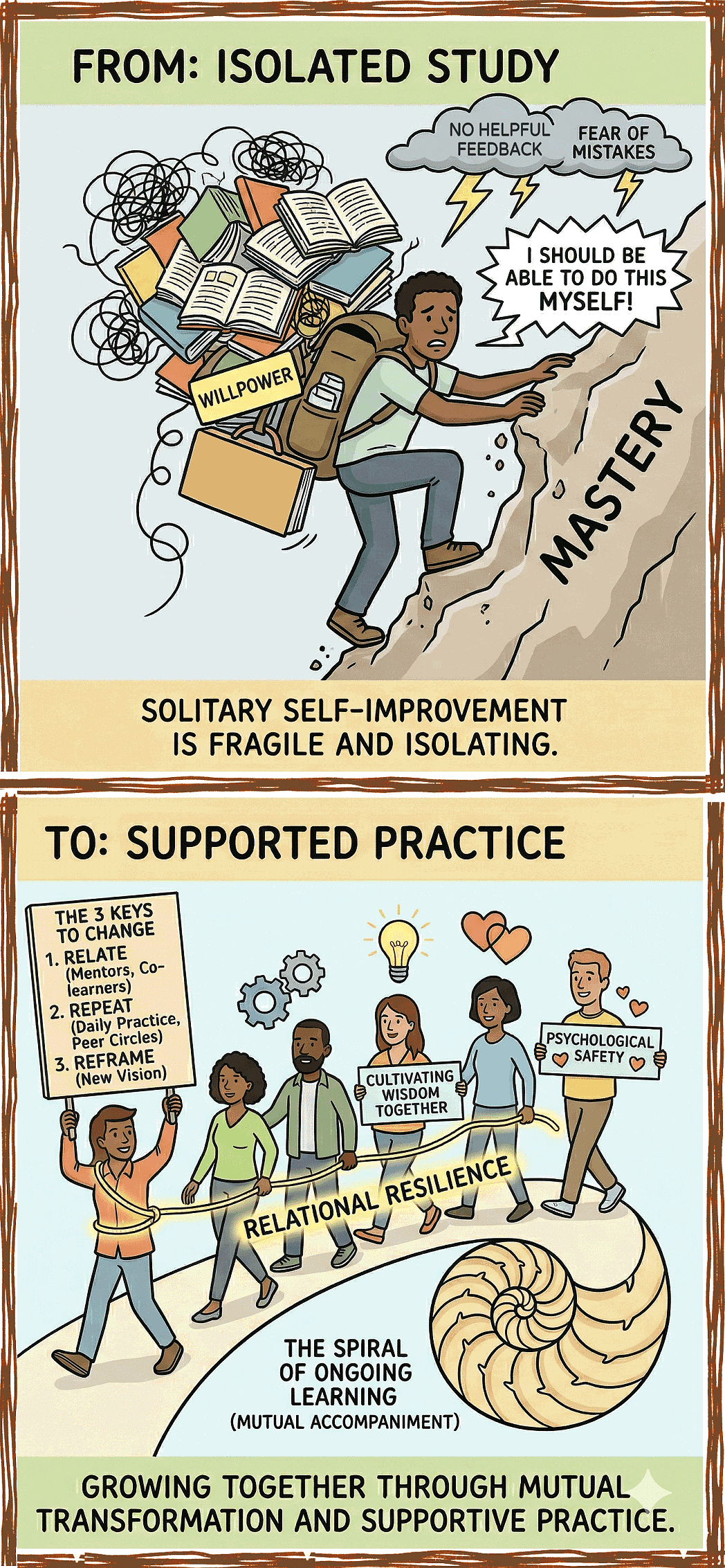
In Transformation One, I mentioned Alan Deutschman’s book Change or Die. Studying people and organizations facing changes so urgent that their lives or livelihoods depended on them, Deutschman found that lasting change follows a specific pattern, which he summarized in three words: relate, repeat, reframe. And here is the finding that should interest every well-meaning educator and organizer, because so many of us underestimated it for so long: successful change almost never came from a lone individual gritting their way through by willpower. It came through relationships — not one, but three different kinds of relationship, working side by side. Although I list them in order below, they really operate in parallel.
Relate (to an empowering mentor). Lasting change appears to begin most frequently in connection with someone who gives you permission to grow — a person who embodies, in their own conduct, the truth that a very different way of behaving is genuinely possible, made possible by a very different vision of what a person can do and what a human being can become. The most famous of these change exemplars, people like Gandhi and Martin Luther King, Jr., showed entire societies that an entirely different world was possible. (There is an honest difficulty buried in this first key, which I will return to shortly: what if no such permission-giving mentor appears in your neighborhood, or what if you cannot afford one? Hold that question; it has a good answer.)
Repeat (in a supportive practice group). We are deeply shaped by what the people around us do. If the people around us are smoking, drinking, or routinely yelling at each other, simple imitation makes us very likely to do the same. (When I was a young man in the Navy, I took up smoking little plastic-tipped cigars that were popular in my unit — something I had never done before and never did again afterward, largely, I think, because I was never again surrounded by people smoking little plastic-tipped cigars.) Practicing new behaviors inside a supportive group lets us build new habits and steer around the old influences. A new peer practice group becomes the place where the repetition happens.
Here I want to add something to Deutschman’s account of the repeat step, because it connects to a discovery memory researchers made on an entirely separate track — and it may be the most quietly liberating fact in this whole book. I have made reference to this in earlier chapters, but it is so important that it is worth reviewing.
It is the phenomenon called overlearning. Repeat something — a poem, say — just enough times to recite it perfectly right now, and you still will not hold onto it for long. In the moment it genuinely feels learned; but that feeling is, for most of us, unreliable. To remember the poem for many days, memory researchers have found, you have to practice it roughly one and a half to two times beyond the point where you could first recite it — and to make it a permanent possession, you need short renewal sessions spread across the months that follow.
Please sit with what this means. Your built-in sense of “I’ve got this” fires far too early. So, if you tried a new way of listening two or three times, felt that you understood it, and then watched it desert you during a stressful Tuesday afternoon — of course it did. It was never anchored as deeply as you imagined. There was nothing wrong with your effort and nothing wrong with you. You had simply cleared the lowest bar, recognition and single recall, and mistaken it for mastery, exactly as every human brain is vulnerable to doing. Oh — no wonder it didn’t stick.
This is a large part of the hidden power of ongoing practice groups. Groups like AA meetings work, in part, because they let participants renew and deepen their grip on ideas and practices that seem firmly stored but are not yet as firmly held as anyone would hope. The group meets again next week. There will be another round of practice. Your companions are expecting you. That social fabric carries you well past the stopping point that, on your own, you would almost certainly have accepted as “good enough” — and overlearning is where competence under pressure is actually built.
Reframe (exploring new attitudes and understandings in dialogue with others). Deep change is not only about new behaviors; it is about new vision and a new vocabulary. Our practice companions become our new-vision companions. A new way of acting has to be woven into a new story about who we are and where our lives are going — a new map of what is possible. We do that weaving in conversation with other people who are working toward similar changes in their lives. Alone, the new story stays thin; in company, actively expressed, it grows into an ongoing feeling of new possibilities we can actually live inside. Saying it out loud in the company of others allows us to hear our new story with new ears.
Now that you have started your lifelong journey with the Nine Transformations of this workbook, you are in a position to recognize Deutschman’s framework not as abstract theory but as a description of some of what you have already been experiencing. The moments when a new skill felt most real were probably moments when you were practicing with, or in the warm presence of, someone who supported the effort. The moments when you drifted back to autopilot were probably the isolated ones, with no one to reflect with, and no one with a commitment to learn these skills expecting you at next week’s practice session.
This chapter is about deliberately building the relational support that Deutschman’s research shows is essential — not as an add-on to the skills you have been learning, but as the very environment in which those skills can take root and flourish.
9.4 You Are Not the Only One
So the evidence is clear: companions matter. But there is something that can keep a person from ever stepping into that companionship in the first place — a quiet feeling that stops a great many people from seeking out a learning companion at all, and keeps others from taking part fully even once they have found one.
It is the corrosive suspicion that you should already know how to do this — how to communicate well, and that needing to practice is evidence that something is wrong with you. After all, you have been talking to people your entire life. Shouldn’t you be good at it by now? The very fact that you are reading a workbook about communication skills can come to feel like an admission of failure rather than an act of courage.
Researchers who study the emotions of learning have a name for this: competence shame — the belief that your difficulty with something other people seem to handle effortlessly is proof of a personal deficiency. And here is what the research consistently shows, in words I invite you to read slowly: almost everyone feels this way, and almost everyone believes they are the only one who does.
Irvin Yalom, who spent decades studying how groups heal and teach, gave a name to the moment this illusion breaks. He called it universality — the discovery that the struggle you thought was uniquely yours is in fact a common human experience. It happens when someone else in the room describes, out loud, the exact difficulty you have been silently carrying, and something in your chest loosens. Yalom found that universality was often the first healing force to operate in any group, because until it does, nothing else can take hold. A person who believes they are uniquely broken will not risk practicing, will not accept feedback, will not let themselves be seen learning something new.
This matters for a reason that goes well beyond comfort. Researchers studying shame and learning — from Helen Block Lewis and June Tangney onward — have shown that shame is one of the most powerful inhibitors of learning we know of. A person who feels ashamed of a difficulty hides it, from others and from themselves. They stop asking questions. They pretend to have mastered what they have not. They avoid the very situations where learning would happen. Dissolving the shame removes an obstacle that most people never even recognize as an obstacle — because they experience it not as a barrier but as a fact about themselves.
A practice group dissolves this isolation simply by existing. When you sit in a circle with several other people who are all working on the same skills, you see with your own eyes that intelligent, capable, good-hearted adults find this hard too. The inner monologue shifts. “What is wrong with me?” becomes “This is genuinely difficult, and we are in it together.” The shame does not merely shrink. It transforms into something warmer. It becomes solidarity.
So if you have been hesitating to seek out a learning companion because you feel embarrassed about needing one, please hear this: that very feeling is one of the strongest reasons to reach out. The companionship is precisely where the feeling finally loosens its grip.
9.5 Resilience Grows in Relationship
Letting go of that private shame does more than make you feel better. It points to something researchers have learned about resilience itself — something that overturns the whole solitary model of self-improvement.
We tend to think of resilience as an individual trait: a kind of inner toughness that some lucky people are simply born with, and that the rest of us either have or lack. The psychologist Linda Hartling has documented something quite different, and far more hopeful. Resilience is not a trait. It is a relational capacity. It grows — and it can only grow — through participation in what she calls growth-fostering relationships.
What this means for us is direct and important. The resilience you will need for this work — the steadiness to keep pursuing a more compassionate way of communicating in a culture that too often rewards dominance and contempt — is not something you can manufacture alone by sheer willpower. Left entirely to our own devices, most of us eventually become overwhelmed by the sheer volume of hostility around us, and quietly give up on the dream of a more cooperative way of relating. It is in the act of accompanying others, and being accompanied, that we find a way to sustain what would otherwise seem impossible: kindness in the face of cruelty, empathy in the face of contempt.
So the practice group is not a crutch for people who are too weak to change on their own. It is the place where the strength to keep going is made. You are not borrowing resilience from the group to cover a deficit in yourself. You are growing your own resilience in the only soil where it grows. We already understand this at the physical level: we understand that two people can carry an object that is too heavy or too awkward-shaped for one person to manage. As it says on the cardboard carton of a new washing machine: “TWO PERSON LIFT”. I invite you to extend that understanding to new areas: your resilience in trying out new communication skills in wider circles will be greatly helped by a set of encouraging relationships in one or more smaller circles.
Which raises an honest and somewhat deflating question — one that stands between many readers and the next widening circle — the one that stops a great many people before they take a single step.
9.6 But What If No One Is There?
Deutschman’s first key, relate, assumes you can find a permission-giving mentor and a willing group. But what if you can’t? His examples often feature a charismatic figure — a visionary doctor, an inspiring program director — who supplies that initial, empowering, you-can-do-it relationship. What if no such person appears in your neighborhood? What if you live somewhere that nobody seems interested in learning to communicate more cooperatively? What if you simply cannot find, or afford, a charismatic mentor at all?
I want to name this plainly, because it is a real problem and you deserve an honest answer rather than a cheerful evasion. But notice carefully what kind of problem it is. This is a problem about your circumstances — about who happens to live near you and what is available to you right now. It is not a problem about you. The obstacle here is the empty chair, not any emptiness in yourself.
And the answer begins with a quiet reversal of expectation. If no one is coming to organize our growth for us, then the people we have been waiting for turn out to be ourselves — and one another. There are, as it happens, companions you can begin to gather this very day, before you have found a single living partner.
9.7 Your Circle of Empowering Ancestors
In Transformation One, the shift to conscious conversations, I invited you to begin keeping a Learning Journal, and allow your learning journal to be your first companion of the journey.
Your Learning Journal can become the home base of your next group of companions, what I call your circle of empowering ancestors.
Throughout human history, certain individuals have demonstrated — through their lives, their struggles, and their integrity — that it is possible to live with extraordinary compassion and courage even in the face of overwhelming cruelty. They did not merely talk about a different way of living. They lived it, often at great personal cost, and in doing so they left the rest of us a gift: the evidence that such a life is actually possible.
Consider a few. Mahatma Gandhi showed that an entire empire could be confronted through disciplined nonviolence and moral courage. Harriet Tubman demonstrated that one person’s fierce compassion could lead hundreds out of bondage, risking her life again and again for people she had never met. Marie Curie modeled a life of relentless curiosity that broke through the gender barriers of her era. Martin Luther King, Jr. articulated a vision of the Beloved Community that insisted on including everyone — even his opponents — within the circle of human dignity. Nelson Mandela emerged from twenty-seven years of imprisonment and chose reconciliation over revenge, a quality of forgiveness that changed a nation. Rachel Carson, facing both terminal illness and the hostility of powerful industries, wrote the book that awakened a civilization to its responsibility toward the living world.
These individuals lived differently, in part, so that we could live differently. They are also, if you think about it, exactly the permission-giving mentors that Deutschman’s relate step calls for — and they are freely available to anyone, in any town, at any hour, regardless of who happens to live next door.
Here is the practice. Take some time, perhaps in your journal, perhaps in quiet reflection, to identify the people whose lives give you permission to be more compassionate, more courageous, more honest in your communication. They might be figures from history, from your own cultural or spiritual tradition, from your family, or from your own experience. They might be living people you admire. The tradition does not matter. What matters is that their example awakens something in you — a sense that a different way of relating to others is not merely desirable but genuinely possible.
Write their names down. Learn their stories. (You might be just one click away from a YouTube biography about them.) Devote a page to them in your Learning Journal. Let their struggles and their triumphs become part of your inner landscape. When the surrounding culture tells you that kindness is weakness, or that domination is the only road to success, let these ancestors remind you of a deeper truth: you are not alone in your aspiration to live a more successfully cooperative life and to build a more successfully cooperative world. You belong to a long lineage of people who chose compassion in the face of cruelty, and that lineage gives you permission to do the same. This inner circle can sustain you in the days before you find living companions — and it will deepen your practice long after you do. Human development is not about abstract principles alone. It is also about the human beings who radiantly lived those principles, giving us both permission and example.
9.8 Seeding What We Need
Your empowering ancestors can sustain you in the days before you find living companions — and they will deepen your practice long after you do. But ancestors, however beloved, cannot practice listening with you on a Tuesday evening. For that, you need a living companion. And the way you find one is by becoming one.
This insight has deep roots. It lives in the African American tradition as the saying we are the ones we have been waiting for. It appears in contemporary scholarship under the name radical accompaniment — the practice of walking alongside others as equals, each person at once giving and receiving support, rather than waiting for experts to descend from above. Mary Watkins, in Mutual Accompaniment and the Creation of the Commons, documents how this kind of accompaniment has powered some of the most durable change movements in the world.
So the answer to the empty chair is not to keep waiting for the right person to walk in and fill it. The answer is that you don’t find a group so much as you seed one — by reaching toward one other person as an equal, offering exactly the companionship you hope to receive. This is the heart of the whole matter, and the simplest place to begin is with a single other human being.
9.9 Purpose Partners: The Power of Two
Here, then, is your first widening circle — and there is something uniquely powerful about a committed partnership of two. The intimacy of a pair creates conditions that no larger group can replicate: deep mutual knowledge, the freedom to speak with complete honesty, rapid trust-building, and a degree of mutual accountability that is difficult to evade or dilute.
This is not a new discovery; paired learning runs deep across human cultures. In the Jewish tradition, havruta — studying sacred texts in pairs — has been central to learning for millennia; the two partners challenge each other’s interpretations and hold each other to genuine engagement. Buddhism speaks of the kalyana mitra, the noble companion or spiritual friend who can see what we cannot see in ourselves. Celtic Christian spirituality cherished the anam cara, the soul friend. And in Alcoholics Anonymous, the sponsor relationship — one person who has walked the path accompanying another who is just beginning — has proven to be one of the most effective structures for sustained behavior change ever devised. In Powers of Two, Joshua Wolf Shenk documents how a remarkable share of history’s creative breakthroughs came not from lone geniuses but from pairs — Lennon and McCartney, Marie and Pierre Curie, Wozniak and Jobs — partnerships whose power was often invisible precisely because our culture is so enchanted with the myth of the solitary hero.
What all these traditions share is the recognition that two people can do together what neither can do alone — not because either is deficient, but because of the generative power of genuine mutual engagement. Two people can hold a mirror for each other. Two people can notice each other’s blind spots. Two people can sustain each other’s courage when the surrounding culture pushes back.
The three-note chord of every partnership
One of the most helpful ways to understand a purpose partnership comes from a simple observation: with every person we meet, we actually have at least three parallel relationships at once, like a chord of three notes played together.
There are areas where your partner knows more than you, has lived more than you have lived. There, you are the student, and gratitude is the natural response. There are areas where the two of you know and have experienced roughly the same, where you are companions and co-explorers, and curiosity is the natural stance. And there are areas where you know more, have lived more — where life invites you to offer yourself as a gentle mentor, not a superior, but a servant of the other’s learning.
In a competitive culture, there are powerful rewards for attending only to the third note — the areas where we know more. But a real purpose partnership asks you to keep all three notes sounding: receiving as well as giving, learning as well as teaching, being vulnerable as well as being strong. That balance is itself one of the deepest communication practices there is — and it is the living form of the principle at the center of this whole chapter: as adults, we can only receive as much companionship as we are willing to give.
Finding and sustaining a purpose partner
Finding a partner. Look first among the people you already know — a friend, a colleague, a family member, a neighbor — for someone who shares your interest in communicating more skillfully. Your partner does not need to be at the same point on the journey as you; some difference in experience can enrich the partnership. What matters is mutual willingness: both people agreeing to show up, to practice, and to be honest. If no one in your immediate circle seems interested, reach out through community organizations, libraries, faith communities, or online. A simple invitation is usually enough: I’m working through a communication skills workbook and looking for a practice partner — would you like to explore it together?
Establishing a rhythm. The single most important factor in sustaining a partnership is consistency. Agree on a regular time — weekly is ideal, every two weeks at minimum — and protect it. Twenty minutes of focused, honest conversation can be worth more than an occasional two-hour marathon. In person, by phone, or by video — the medium matters far less than the regularity.
Structuring your time. A simple structure many pairs find useful: begin with a brief check-in, then each partner takes a turn sharing a recent communication experience — something that went well, something that was hard, something they are trying to change. While one shares, the other practices the listening skills from Transformation Two — reflecting back, acknowledging feelings, resisting the urge to fix or advise unless asked. Then trade roles. Close by each naming one thing to practice before the next meeting.
Navigating difficulty. Partnerships are not immune to the very challenges this workbook addresses. You may find your partner’s temperament quite different from your own — and that is valuable, even when it is uncomfortable, because it means you are practicing across difference, which is exactly what cooperative communication asks of us. When conflicts arise, treat them as practice: use the skills from Transformations Four and Five, expressing yourself clearly and translating complaints into requests. And if the partnership is not working despite good-faith effort, it is entirely all right to acknowledge that honestly, express gratitude for what you shared, and part with kindness.
Growing beyond the pair. Many of the most effective peer networks began as a single pair that gradually expanded. When your partnership feels established, please consider inviting others — to form additional pairs, or to seed a small circle. Your team of two can become the seed of something larger. Just as you are, from wherever you are starting, the world around you, full of intense conflict, deeply needs you to be the seed of something better.
9.10 Circles of Six: Small-Group Co-Learning
If the partnership is your first widening circle, the small group is the second — and its distinctive power lies in diversity. A circle of four to six people — what I will call a Circle of Six, though the exact number can vary — brings together enough different temperaments, histories, and communication styles that the group itself becomes a living laboratory for the very skills this workbook teaches.
In a circle, you will almost certainly meet someone whose way of communicating challenges you — someone who processes more slowly or more quickly than you do, who leads with feeling where you lead with analysis, whose cultural background shapes their expression in unfamiliar ways. This is not a problem to be solved. It is the point.
Recall the three-sided insight at the heart of this workbook, which we first explored in Transformation One: every human group, from a couple to a whole company, has to do three things at once. It has to accomplish its tasks together, it has to support its members emotionally, and it has to make room for different temperament types. Let any one of the three collapse, and the others soon follow. This is not a theory; it is one of the most consistently confirmed findings in the social sciences, from Robert Bales’s pioneering small-group research in the 1950s through Amy Edmondson’s contemporary work on teams. A Circle of Six is a microcosm of exactly this challenge — and learning to balance task, emotional support, and difference, in real time, with real people, gives you a felt experience of cooperative communication that goes far deeper than anything you could absorb from reading alone.
Why safety comes first
Amy Edmondson has spent decades studying what makes teams effective, and her central finding is this: the single most important factor is psychological safety — the shared belief that the group is a safe place for interpersonal risk-taking. In a psychologically safe group, members feel free to admit confusion, ask the naive-sounding question, acknowledge a mistake, and try a new behavior without fear of humiliation.
This matters enormously here, because the skills we are practicing all require a kind of nakedness. Sharing a feeling, making a request, offering honest feedback, listening to someone whose view is very different from yours — each of these involves real risk of being seen as awkward. And this is the gift a good circle gives that no book and no amount of private determination can: a safe, face-saving place to be clumsy. In a well-coordinated circle, stumbling is expected, looking foolish is normal, and getting something only half right is not failure — it is exactly what everyone came to do. The circle becomes a kind of greenhouse, where tender new ways of relating can take root in sheltered conditions before they have to survive in the open weather of your most important relationships.
Psychological safety does not arise by itself. It is built through explicit agreements, through every member modeling it, and through gentle honesty when the group drifts from its values. It helps to say so out loud from the very first meeting: We are going to try things that feel awkward. We are going to make mistakes. That is not failure — that is the work.
A quiet bonus: learning to see yourself
There is one more gift the circle gives, almost as a side effect. The earlier Transformations ask you to do something genuinely difficult — to participate in a conversation and observe yourself participating, at the same time. That doubled awareness is hard to develop alone, because when you are inside a charged exchange, the observing part of your mind keeps getting swept into the current. But when you take a turn as a listener or coach for someone else in the circle — noticing what they are doing well, gently offering what they might try — you get to practice that observing mind from the outside, with room to breathe, because you are not the one in the hot seat. Over time, that capacity migrates home. You begin to notice, in real time, how you are listening and expressing yourself. We learn to see ourselves, in part, by first learning to see others more clearly.
Starting and running a circle
Gather your people. Start with your purpose partner, if you have one, and invite two to four more. Four to six is the sweet spot — fewer than four and you lose the diversity that makes circles valuable; more than eight and it becomes hard for everyone to take part in a single meeting.
Hold a first meeting focused on connection. Before diving into workbook content, spend the first meeting simply getting to know one another. What brings each person here? What challenges are you facing? What do you hope for? End by confirming the next meeting time and reviewing your working agreement.
Establish a consistent rhythm. As with partnerships, consistency is the lifeblood of a circle. Meet at the same time each week or every two weeks, and put it on the calendar as a recurring commitment. Circles that meet only when someone gets around to organizing it rarely survive past the second month.
Rotate responsibilities. If one person does all the organizing and facilitating, they will burn out. Share the roles of facilitator, timekeeper, and coordinator. The rotation itself gives everyone practice in group leadership — a valuable communication skill in its own right.
A sample meeting (about 75–90 minutes).
- Opening check-in (10–15 min). Go around the circle; each person briefly shares how they are arriving. The others listen without comment. This simple ritual builds the habit of attentive listening.
- Skill focus (20–30 min). Work with one skill or passage from the workbook. Read it aloud, discuss what resonates and what feels hard, or work an exercise together, taking turns practicing while others observe and offer supportive feedback.
- Practice and sharing (20–30 min). Members share recent real-life experiences — moments they tried something new, moments old patterns reasserted themselves. The group practices its listening, asks open-ended questions (Transformation Six), and expresses appreciation for the courage it takes to be honest (Transformation Seven). This is where the learning comes alive.
- Closing (10–15 min). Each person names one thing they want to practice before next time and one thing they appreciated today. Confirm the next meeting and facilitator.
Online, in person, or hybrid. The earlier editions of this workbook have been used by people on every continent, and many readers have no local access to others interested in this work. The good news is that online circles can be highly effective. Cellphone video calls allow the face-to-face connection the practice requires, and time zones can be navigated. The key principles — consistency, psychological safety, structured meetings, shared responsibility — apply just as fully on a screen as in a living room.

9.11 A Working Agreement for Purpose Partners and Circles
Whether you are forming a pair or a circle, a few words of shared agreement do something quietly powerful: they turn good intentions into a commitment people can actually rely on, and they give everyone the same clear picture of what they are saying yes to. Here is a suggested starting place; adapt it freely to your own needs.
In order to deepen our communication skills and support one another’s growth, we agree to:
Meet regularly. We will meet every __________ for approximately ________ minutes, using this workbook as one of our primary learning resources.
Listen with care. We will practice the listening and self-expression skills described in this workbook with one another — not perfectly, but sincerely. We will treat each meeting as an opportunity to practice, not merely to discuss.
Hold confidence. We will keep in confidence whatever personal experiences people share in our meetings. The struggles and the successes shared here stay here, unless someone gives explicit permission to share their story.
Share responsibility. We will take turns with facilitation and coordination, so that the work of sustaining our group never falls on any one person’s shoulders.
Be honest and kind. We will speak honestly about our experiences, including our difficulties, and receive one another’s honesty with respect and compassion. When we disagree or feel uncomfortable, we will treat those moments as chances to practice the very skills we are learning.
Reassess periodically. We will check in every _______ months to ask whether our partnership or circle is meeting our needs, and we will adapt in good faith. If the group is no longer serving its purpose, we will say so honestly, and either change course or close with gratitude.

9.12 Next Steps for the Cooperative Journey
As you complete this first circle through the Nine Transformations Workbook and continue the adventure of building your support network and becoming a supportive learning companion to others, please take some time to reflect on and write down your responses to these questions as your next entries in your Learning Journal. These explorations can be an important part of your widening circles.
- Who are the empowering ancestors — living or historical — whose lives give you permission to pursue more compassionate communication? Write down at least three names, and briefly note what each one models for you.
- Think of one person in your life who might be willing to explore this workbook with you as a Purpose Partner. What would you say to invite them?
- What is your biggest concern about reaching out to someone? Where might that concern have come from — and what, in your life now, might help you move through it?
- Look back at your vision, early in this workbook, of communicating more skillfully six months from now. How has that vision changed or deepened as you have worked through the Transformations? What feels more possible now than it did at the beginning?
- Think about the double helix — development (inward growth) and cooperation (outward engagement). Where do you feel you have grown most? Where does the next widening circle call you?
- What is one concrete step you will take this week to begin building your learning companionship?
- If you are a teacher, psychotherapist or social worker, please feel free to introduce this material to your students/clients. Each chapter is available free of charge as a separate PDF file on the communication-skills.net website.
PERMISSIONS GRANTED: This workbook is yours to use, adapt, reproduce, give away and/or sell, in print, PDF and all other formats. It carries a Creative Commons shared copyright license (https://creativecommons.org/licenses/by-sa/4.0/) and thus belongs to everyone. For more information, please see the permissions details on the reverse side of the title page.
Dennis Rivers, August 2026, Eugene, Oregon, USA
9.13 References and Recommended Reading for this Chapter
Bales, Robert F. Interaction Process Analysis: A Method for the Study of Small Groups. Addison-Wesley, 1950.
Brown, Brené. Daring Greatly: How the Courage to Be Vulnerable Transforms the Way We Live, Love, Parent, and Lead. Gotham Books, 2012.
Deutschman, Alan. Change or Die: The Three Keys to Change at Work and in Life. Harper Business, 2007.
Edmondson, Amy C. The Fearless Organization: Creating Psychological Safety in the Workplace for Learning, Innovation, and Growth. Wiley, 2019.
Hartling, Linda M. “Strengthening Resilience in a Risky World: It’s All About Relationships.” Wellesley Centers for Women Research and Action Report, vol. 24, no. 1, 2003, pp. 4–7.
Holzer, Elie, with Orit Kent. A Philosophy of Havruta: Understanding and Teaching the Art of Text Study in Pairs. Academic Studies Press, 2013.
Kegan, Robert. The Evolving Self: Problem and Process in Human Development. Harvard University Press, 1982.
Lewis, Helen Block. Shame and Guilt in Neurosis. International Universities Press, 1971.
Rogers, Carl R. On Becoming a Person: A Therapist’s View of Psychotherapy. Houghton Mifflin, 1961.
Shenk, Joshua Wolf. Powers of Two: Finding the Essence of Innovation in Creative Pairs. Eamon Dolan / Houghton Mifflin Harcourt, 2014.
Sinek, Simon. Start with Why: How Great Leaders Inspire Everyone to Take Action. Portfolio/Penguin, 2009.
Tangney, June Price, and Ronda L. Dearing. Shame and Guilt. Guilford Press, 2002.
Watkins, Mary. Mutual Accompaniment and the Creation of the Commons. Yale University Press, 2019.
Yalom, Irvin D., with Molyn Leszcz. The Theory and Practice of Group Psychotherapy. 5th ed., Basic Books, 2005.
Your notes on this chapter