Conversational Transformation Eight — Shift Evolutionary Gears by Adopting the Continuous Learning Stance
by Adopting the Continuous Learning Stance
- From waiting for life to shove you in the right direction
to choosing your direction before the shove arrives - From the fixed mindset (“I’m just not good at this”) to the continuous learning stance (“I haven’t learned this yet — and I’m going to”)
- From hiding your mistakes
to embracing them as the raw material of learning - From thinking your capacity to form habits is the enemy
to realizing that habit formation can be pointed in positive dirctions - From hoping things will work out
to building the skills that make things work out - From isolated self-improvement
to the shared practice of growing — together - From the new-at-life person you have been
to the more deeply developing person you are becoming
8.1 The Inward Turn
If you have been working through the Transformations in this workbook, you have already done something remarkable. You have been trying new things in real conversations with real people, where real feelings are at stake. You have practiced listening without interrupting, experimented with translating a complaint into a request, asked a question that invited someone to think out loud. Some of those experiments probably went well. Some probably didn’t. And every one of them demonstrated something important about you: you can do this. You have the capacity to notice a pattern, try something different, and learn from what happens.
This chapter is about that capacity — where it comes from, why it is more powerful than you may realize, and what happens when you decide to use it on purpose. It is the inward turn of the workbook: a chapter about the learner rather than the skills. The next chapter — Transformation Nine — will take the outward turn, exploring how learning partnerships and practice companions make this inner shift sustainable over the long haul. For now, the question is an inward one: What opens up when you decide to become a conscious learner — someone who chooses their own direction before life demands it — and what kind of person are you becoming, one conversation at a time?
8.2 What Continuous Learning Actually Means
Here is something puzzling about human beings. We have an extraordinary capacity — perhaps unique among all living creatures — to learn new skills before a crisis forces us to. We can watch someone else’s marriage struggle and decide to learn to listen better before our own is in trouble. We can observe a colleague get fired for poor communication and choose to develop those skills while our job is still secure. And yet, most of the time, we don’t. We wait. The ancient default — wait for the crisis, then scramble — runs deep, and it persists like an old habit that hasn’t yet been replaced.
The fact that you are reading this workbook means you have already begun to override that default. You are already doing the extraordinary thing: choosing to develop before life demands it. That choice is what I am going to call the continuous learning stance.
Why “continuous”? Because people around the world have discovered, over many decades and even centuries, that if you want to get really good at a complex task — whether it’s flying an airplane, performing brain surgery, or playing the violin — you enter into a continuous learning relationship with that activity. Pilots don’t wait for a midair emergency to reflect on their skills. Surgeons don’t wait until a patient is in danger to study a new technique. They learn all the time, from everything — from the small corrections, the near-misses, the quiet moments when something went slightly better or slightly worse than expected.
The organizers and managers of what is called Continuing Professional Education (CPE) are applying, in very local ways, a much broader truth about human life. Some tasks are complex enough that they call for continuous learning — an always-open, never-finished process of getting better. And it happens that interpersonal communication is right up there, in terms of complexity, with brain surgery and playing the violin. Human beings are complex. Problem-solving conversations, conflict resolution negotiations, giving comfort to another person in the face of tragedy, even just coordinating the needs of three or four people of different ages living under a single roof — all of these are complex processes. And complex tasks go better with continuous learning. This workbook invites you to do for all the conversations of your life what the best professionals do for their work: keep learning, keep reflecting, keep growing — not because you are failing, but because so much more is possible, and because your family, your work, and your world need you at your very best.
And here is why continuous learning, practiced the way this chapter describes, is genuinely radical. First, it lowers the threshold of paying attention. Most of us learn only from the dramatic moments — the argument that went terribly wrong, the relationship that finally ended. But the many small moments of an ordinary day have just as much to teach us: a slight tension in a conversation, a question you answered too quickly, a moment when you started to say something appreciative and then didn’t. If we set our threshold so high that only a crisis counts as a learning opportunity, we miss all the valuable material woven into daily experience, and we will inadvertently help ourselves to an ongoing supply of crises.

Climbing the infinite stairway
of continuous learning
Second, continuous learning is anticipatory rather than reactive. We are not waiting to trip on a barrier in order to ask where the barriers are. We are not waiting to accidentally stumble into a great job or a great life. Instead, we are walking through the day with our learning eyes open, looking at the path that opens before us, and asking: What could this moment teach me? How could I bring more of my best self to this moment? Stephen Covey observed that some of the most important things in life will never become an emergency until it is too late to do anything about them. Taking a daily walk to keep your heart healthy will never feel like an emergency. Spending some listening time with your kids every day will never feel like an emergency, but research suggests that the degree of influence you have on your children’s behavior is directly proportional to the amount of time you spend with them. The list goes on. Communication skills are exactly like this. At home, it rarely seems like a crisis. Most of the time we can muddle through. But we sacrifice a great deal of fulfillment and success along the way. The continuous learning stance says: Don’t wait for the crisis. Build the skills now. More success is possible. How will you learn what you need to know in order to help that success happen?
8.3 The Mirror: Catching Your Fixed-Mindset Sentence
Stanford psychologist Carol Dweck has spent decades studying why some people keep developing throughout their lives while others plateau early and stay stuck. Her answer — the distinction between the fixed mindset and the growth mindset — has transformed how millions of people think about learning. Her book, Mindset: The New Psychology of Success, is a modern classic, and I warmly recommend it.
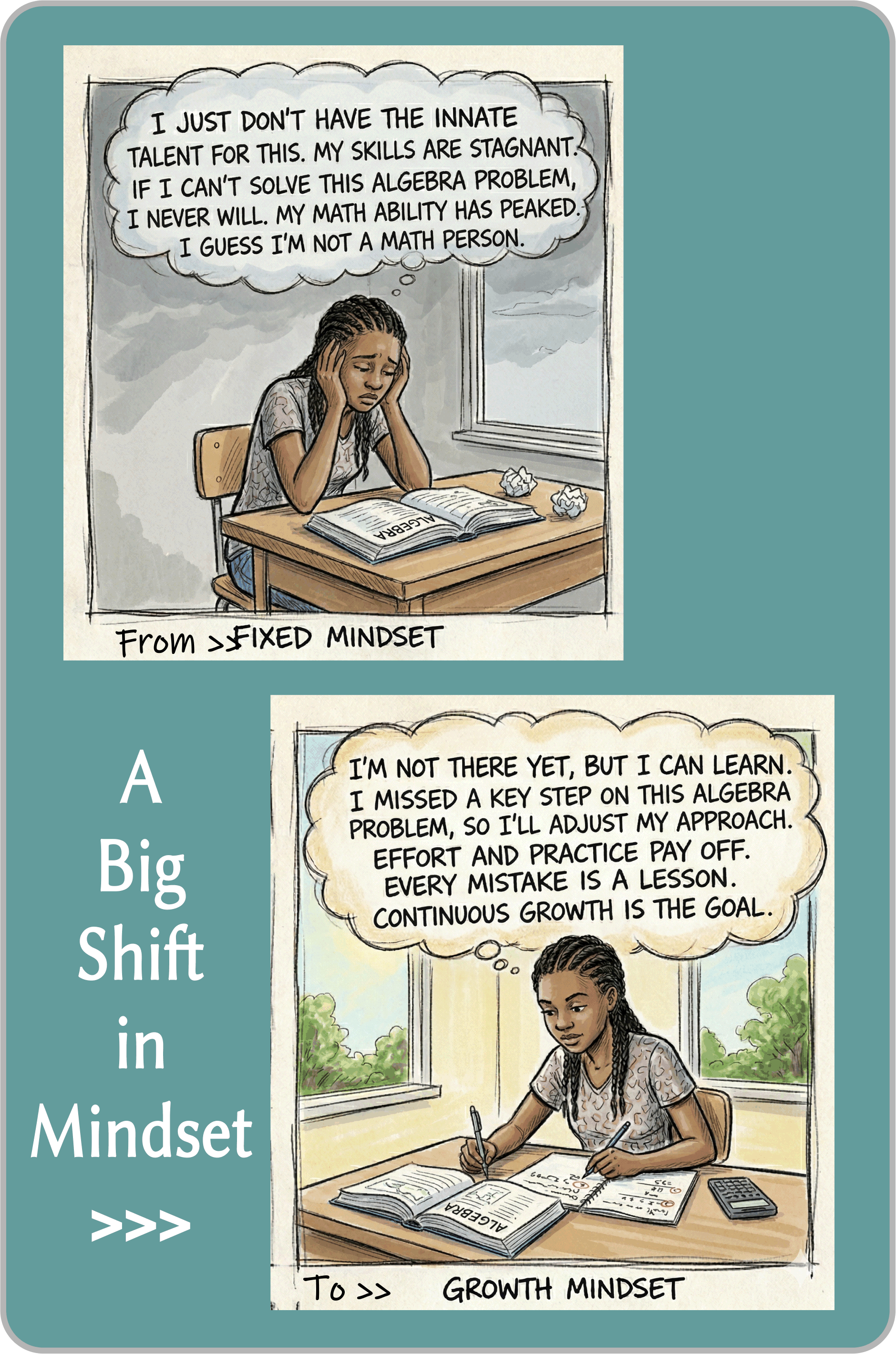
People with a fixed mindset believe that their qualities are carved in stone — that intelligence, personality, and character are things you either have or you don’t. People with a growth mindset believe that their qualities can be developed through dedication and effort. Mistakes are not verdicts; they are information. You were born with a brain magnificently wired for language but knowing zero words, wired for communication but knowing zero communication skills. Everything you know about talking and listening, you learned. And since you learned it, you can learn to do it differently.
But here is what makes the fixed mindset so hard to see: it almost never announces itself as a theory. It shows up as a quiet sentence — so familiar you barely notice you’re thinking it.
“I’m just not a people person.”
“I’m bad at confrontation — I always have been.”
“Some people are natural listeners. I’m not one of them.”
“That’s just how I am.”
Do you recognize your own version of that sentence? Most of us have one. It lives in the back of the mind, quiet as a closed door, and every time we bump against it we turn away without noticing that we’ve just decided something enormous about our own capacity. The growth mindset simply says: the door you thought was locked is actually just stuck. And the difference between “I can’t do this” and “I haven’t learned this yet” is the difference between a wall and a path.
Professor Dweck’s “growth mindset” names the inner attitude that makes continuous learning possible — the belief that your qualities can be developed. What I am calling the continuous learning stance is what happens when you put that attitude into sustained practice: I am changing — right now, in this conversation, and in the next one. But if communication patterns really are learnable rather than fixed, a practical question arises: What is the mechanism that turns a conscious choice into a lasting change? The answer turns out to be something you already own.
8.4 Your Habit System Wants to Help
Here is something that most books on personal change don’t tell you, and it changes everything. Your brain has an extraordinarily powerful system for forming habits. Walking, breathing, reading these words — you formed habits about all of these things a long time ago, and they work beautifully for you. Most books mention habits only to tell you they are the problem — that you need to break them, fight them, overcome them. I want to tell you something very different. Your brain’s habit-formation system is not the obstacle to change. It is the instrument of change. It learned to walk for you. It learned to talk for you. That system is not your enemy. It is your greatest ally.
The problem is not that you have a habit engine. The problem is that nobody ever told you that you could drive it.
Your habit system has two modes. In its default mode, it forms patterns from whatever you repeatedly do, without asking whether those patterns serve you well. If you repeatedly interrupt people, it builds an interrupting habit. If you repeatedly go silent during conflict, it builds a silence-during-conflict habit. It is not judging you. It is simply turning repeated actions into automatic patterns. But in a second mode — the mode that continuous learning activates — the same system can form patterns from what you choose to practice. Same machinery. Different operator.

Now for the honest part. Your habit system is your ally, but it is an ally with a complication: the default mode has had a head start of many years. The patterns it laid down — your ways of handling conflict, expressing affection, responding to criticism — were built through thousands of repetitions over a lifetime. Those patterns don’t step aside just because you’ve decided to learn something new. They persist, they compete, and they reassert themselves most forcefully under stress — exactly when you need your new skills the most.
So the old habits are not sabotaging you. They are simply better practiced than the new ones. When you practice a new communication skill, you are building a new automatic pattern strong enough to compete with the old one. The old pattern had thousands of repetitions behind it. The new one has to accumulate enough of its own to hold its ground when the pressure is on. Your brain wants to be your friend, but you have to meet it halfway — by showing up, consciously and repeatedly, to practice the response you want to become automatic. And practicing your new habit way past the point where you feel reasonably comfortable with it. Psychologists call this “overlearning”, and it has been exhaustively documented. If you are memorizing some new information, and you repeat it just enough to be able to close the book and recite it accurately, you will not actually remember it for very long. To move that information from short-term memory to long-term memory, you would need to keep on practicing three or four times longer than it took to first repeat it, and then arrange follow-up practice sessions over the coming days and weeks.
You can change deeply ingrained patterns, but not by “getting rid of them”. Your brain will remember your well-practiced old patterns forever. But, and this is really important, you can learn new patterns and practice doing them first. The need for overlearning to change our behavior is a fact of life. It is not a NO to new behavior, but it is a much slower YES than we were hoping for. Our brain is actually trying to help us, by not moving every new experience immediately into long-term memory, and not losing track of behaviors we have practiced a lot. Our brains appear to be concluding that if we have done it a lot, it must be worth keeping. Our brains need our conscious help about what to keep and what to replace.
Following in the footsteps of many teachers and trainers, I recommend that you focus on the new pattern you want to establish. Instead of saying to yourself, “I am going to interrupt less”, it would produce better results if you were to set a goal such as “I’m going to listen for a full two minutes without saying anything. I’ll hold a pen in my hand to remind me. And when I do speak up, the first thing I am going to offer is a brief summary of what the speaker just said.”
Even with all our good efforts, learning almost always involves trial and error, and that means we will make some mistakes. And in those moments you will need something from beyond the realm of practice: a deeper acceptance for trial and error as an essential part of the continuous learning life.
8.5 Self-Forgiveness: Learning’s Necessary Partner
Consider learning to shoot a basketball. You throw the ball toward the basket. Sometimes it goes in; much of the time it does not. If you concluded, the first time the ball missed, that you were a terrible player and deserved to be punished for your badness, I guarantee you would never learn to make it go in. Focusing on your badness means you are not watching the ball. It is only by observing your own performance — did it go left? right? what did your body feel like when you threw? — that you can learn to throw better.
Here is the continuous learner’s way to think about this: a creature that learns through trial and error cannot afford to punish itself for the errors. The errors are not the problem. They are the information. They are how the habit system knows what to adjust. Self-punishment doesn’t help this process. It interferes with it, because a mind consumed with shame cannot observe itself clearly and plan its next move.
When your carefully practiced new response vanishes and the old automatic one takes its place, that is not evidence that you are failing. It is evidence that your old habits have had a long head start and the new patterns haven’t been practiced enough to compete under pressure. It is a timing problem, not a character problem.
No one criticizes a baby for weighing five pounds. Why, then, would you criticize yourself for being at the beginning of a learning process that has no end? Learning complex skills means starting over a thousand times and getting used to it — enjoying the small steps rather than cursing yourself for not making giant leaps. Good things in nature happen slowly. So I suggest that you adopt an attitude of compassionate forgiveness toward yourself for all the mistakes you have made and will make, and commit deeply to learning what each mistake has to teach you. If we get in the habit of learning from our many small mistakes, we will probably make fewer big ones.
(A note of caution: the attitude of forgiveness I recommend here is central to the teaching of many great psychologists and spiritual teachers. However, if someone you are close to is violent or is abusing drugs or alcohol, please see a counselor right away to help you set appropriate boundaries. Forgiveness and healthy boundaries are not opposites — they are partners.)
8.6 The Open Horizon: What You Are Becoming
As you continue to practice — listening more carefully, expressing yourself more fully, asking better questions, offering more appreciation — you may notice that something is happening beyond skill development. The way you listen today is shaping the kind of listener you are becoming. The way you handle conflict this week is shaping the kind of person you will be next year. Over time, through thousands of conversations, the qualities you practice become the qualities you embody.
I want to leave you with this thought. In the short run, our conversations express who we are. But in the long run, our conversations create who we are, as we continually practice particular ways of relating to others. Each of us has it within our power to make each conversation an opportunity to become a more aware, more skillful, more compassionate person. Not a perfect person. A growing one. Direction, not perfection. And that is the most natural thing in the world. It is what we were born to do.
For a fuller exploration of the directions of personal growth that emerge through better conversations — drawing on the work of Carl Rogers, Abraham Maslow, and many other scholars and teachers — please see my companion article, Communication and Personhood: What Kind of Person Am I Becoming? What Kind of People Are We Becoming Together? at https://communication-skills.net/library/communication-and-personhood.pdf.
8.7 The Spiral: How This Transformation Connects to All the Others
If you’ve been reading this workbook in sequence, you may notice that the continuous learning stance has been quietly present in every chapter — not as a named idea, but as a lived posture. Every time you tried something new and noticed what happened, you were practicing it. Now that it has a name, you can see it at work everywhere: in the deliberate attention of responsive listening (Transformation Two), in the conscious pause before explaining your conversational intent (Transformation Three), in the courage required to express what is actually happening inside you (Transformation Four), in the moment you catch a complaint and redirect it into a request (Transformation Five), in the shift from closed questions to open, creative ones (Transformation Six), and in the rewired attention that lets you notice what is good and say so (Transformation Seven). Each of these skills is continuous learning in action — choosing a deliberate response over an automatic one, and letting the habit system build the new pattern through practice.
Everything in this chapter has been about the inner dimension of continuous learning — understanding your habit system, forgiving yourself, practicing deliberately. But decades of research on lasting personal change show that the inner shift is very difficult to sustain alone. The next chapter introduces the practice of building learning partnerships — the relationships and structures that keep the continuous learning stance alive over the long haul. The inner work of this chapter makes that outer work possible. The outer work of the next chapter makes this inner work sustainable. You don’t have to walk this road alone.
8.8 Transformation Eight Exercises: Your Continuous Learning Journal
Reading this chapter has been a kind of in-breath — taking in a new way of seeing your own capacity to grow. But understanding the continuous learning stance and living it are two different things, and the understanding comes alive only on the out-breath, in real practice. Breathe in the idea; breathe out the practice.
The practice for this chapter is to deepen your Learning Journal dialogue. Think of your journal as one of your first Nine Transformations learning companions: a patient listener available twenty-four hours a day, ready to help you observe your own communication experience with the curiosity and self-forgiveness this chapter has described. Your journal can be any format that works for you: a bound book, a digital document, an online notebook, even a series of messages to yourself. (I love 3-ring binders, because I can add new pages anywhere.) What matters is that it becomes a regular practice — a place where you slow down and pay attention to what you are doing and learning. Give each of the Nine Transformations its own section. When you notice something — a moment when you listened well, a time when you caught a complaint and turned it into a request, a conversation where an open-ended question opened up something unexpected — you have a place to record it. Your journal becomes a map of your own developing competence, visible to you in a way that your busy daily life cannot show you.
May you discover, one conversation at a time, the astonishing reach of what you can learn — and the person you are becoming along the way!
8.9 A Reading for Transformation Eight:
An overview of Prof. Carol Dweck’s
MINDSET: THE NEW PSYCHOLOGY OF SUCCESS
Content in this section copyright 2006-2010 by Carol Dweck. Excerpted, adapted and summarized by Dennis Rivers, MA, from publicly available paragraphs on Prof. Dweck’s website, www.mindsetonline.com. Distributed free of charge in PDF and web formats to communication skills learners under the “fair use” copyright doctrine for scholarly excerpts. We love this book! Please find it in your local library or buy yourself a copy.
Stanford psychology professor Carol Dweck’s book, Mindset, explains how our attitude toward our own skills and abilities, our developmental mindset, can influence the unfolding of those same skills and abilities.
Mindsets are beliefs — beliefs about yourself and your most basic qualities. Think about your intelligence, your talents, your personality. Are these qualities simply fixed traits, carved in stone and that’s that? Or are they things you can cultivate throughout your life?
People with a fixed mindset believe that their traits are just givens, given perhaps by genes, by God, by the stars, or by some other agency of fate. The fixed mindset views each of us as having a certain amount of brains and talent, and nothing can change that. If they have a lot, they’re all set, but if they don’t… So people in this mindset worry about their traits and how adequate they are. They have something to prove to themselves and others, and they are fragile in the face of setbacks.
People with a growth mindset, on the other hand, see their qualities as things that can be developed through their dedication and effort. Sure they’re happy if they’re brainy or talented, but that’s just the starting point. They understand that no one has ever accomplished great things—not Mozart, Darwin, or Michael Jordan—without years of passionate practice and learning.
Since the dawn of time, people have thought differently, acted differently, and fared differently from each other. It was guaranteed that someone would ask the question of why people differed why some people are smarter or more moral – and whether there was something that made them permanently different. Over the centuries experts have often claimed that there was a strong physical basis for these differences, making them unavoidable and unalterable.
But scientists today are learning that people have more capacity for life-long learning and brain development than they ever thought. Of course, each person has a unique genetic endowment. People may start with different temperaments and different aptitudes, but it is clear that experience, training, and personal effort take them the rest of the way. Robert Sternberg, the present-day guru of intelligence writes that the major factor in whether people achieve expertise “is not some fixed prior ability, but purposeful engagement.” Or, as his forerunner, Binet, recognized, it’s not always the people who start out the smartest who end up the smartest.
For more than twenty years, Prof. Dweck’s research has shown that the view you adopt for yourself profoundly affects the way you lead your life. It can determine whether you become the person you want to be and whether you commit to and accomplish the things you value. How does this happen? How can a simple belief have the power to transform your psychology and, as a result, your life?
Believing that your qualities are carved in stone—the fixed mindset—creates an urgency to prove yourself over and over. If you have only a certain amount of intelligence, a certain personality, and a certain moral character, well then you’d better prove that you have a healthy dose of them. It simply wouldn’t do to look or feel deficient in these most basic characteristics. Every situation calls for a confirmation of their intelligence, personality, or character. Every situation is evaluated with a life or death intensity.
Our mindsets shape the moment-to-moment stories we tell ourselves about our situation. They guide the whole interpretation process. The fixed mindset creates an internal monologue that is focused on judging: “This means I’m a total loser.” “This means I’m forever a better person than they are.” “This means I’m a bad husband.” “This means my partner is selfish.” Each success is interpreted to make you (or the person you are thinking about) a total success, each failure is interpreted to make you (or the person you are thinking about) a total failure. This all-or-nothing framing creates a mood of emotional crisis rather than a calm focus on skill improvement.
People with a growth mindset are also constantly monitoring what’s going on, but their internal monologue is not about judging themselves and others in this way. Certainly they’re sensitive to positive and negative information, but they’re attuned to its implications for learning and constructive action: What can I learn from this? How can I improve? How can I help my partner do this better?
Do people with the growth mindset believe that anyone can be anything, that anyone with proper motivation or education can become Einstein or Beethoven? No, but they believe that a person’s true potential is unknown (and unknowable), that it’s impossible to foresee what can be accomplished with years of passion, toil, and training.
Did you know that Darwin and Tolstoy were considered ordinary children? That Ben Hogan, one of the greatest golfers of all time, was completely uncoordinated and graceless as a child? That the photographer Cindy Sherman, who has been on virtually every list of the most important artists of the 20th century, failed her first photography course? That Geraldine Page, one of our greatest actresses, was advised to give it up for lack of talent? (She was nominated for an Academy Award eight times, and won for Best Actress in 1985.)
You can see how the belief that cherished qualities can be developed creates a passion for learning, and a story line suggesting that every setback can be overcome, thus mobilizing the effort to actually overcome them.
Therefore, Prof. Dweck challenges us like a determined sports coach: Why waste time proving over and over how great you are, when you could be getting better? Why hide deficiencies instead of overcoming them? Why look for friends or partners who will just shore up your self-esteem instead of ones who will also challenge you to grow? And why seek out the tried and true, instead of experiences that will stretch you? The passion for stretching yourself and sticking to it, even (or especially) when it’s not going well, is the hallmark of the growth mindset. This is the mindset that allows people to thrive during some of the most challenging times in their lives.
Comparison: Fixed Mindset vs. Growth Mindset
|
IN REGARD TO: |
Fixed Mindset: |
Growth Mindset: |
|
Challenges |
…avoid challenges |
…embrace challenges |
|
Obstacles |
…give up easily |
…persist in the face of setbacks |
|
Effort |
…see effort as fruitless or worse |
…see effort as the path to mastery |
|
Criticism |
…ignore useful negative feedback |
…learn from criticism |
|
Success of others |
…feel threatened by the success of others |
…find lessons and inspiration in the success of others |
|
Long-term consequences |
As a result, they may plateau early and achieve less than their full potential, confirming a deterministic view of the world and themselves. |
As a result, they reach ever-higher levels of achievement, confirming an open-ended view of the world and themselves |
Adapted from Dweck, C. (2008). Mindset: The new psychology of success : [how we can learn to fulfill our potential] (p. 245). New York: Ballantine Books.
8.10 Reflection Questions for Your Learning Journal
Please take some time to reflect on and write down your responses to these questions.
1. Look back at the six communication skills you’ve been practicing (Transformations Two through Seven). Which one has produced the most noticeable change in your conversations or relationships? What happened?
2. Think of a moment when you caught yourself falling back into an old communication pattern — and then chose differently. In the language of this chapter, you were taking the wheel from your autopilot. What did that feel like? What made it possible?
3. Can you identify a specific area of your communication life where you’ve been operating from a fixed mindset — telling yourself “I’m just not good at this”? What would it look like to shift toward the continuous learning stance: “I haven’t learned this yet — and I’m going to”?
4. Think about your habit system as an ally rather than an enemy. What is one communication habit you would like to build — not a bad habit to break, but a good habit to create? What would it take to practice it often enough that it starts to become automatic?
5. What does self-forgiveness look like for you, specifically? Can you think of a recent communication mistake that you could revisit — not to judge yourself, but to learn from? What information does the mistake contain?
6. Think about a communication challenge you can see coming — not one that has already arrived, but one that is on the horizon of your life. A conversation you know you’ll need to have. A relationship that is slowly drifting. A workplace situation that is gradually getting worse. What skill would help you meet that challenge before it becomes a crisis? That is your continuous learning agenda, and you can start working on it today.
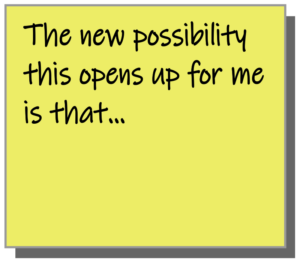
7. Complete this sentence: “The kind of communicator and person I am becoming, one conversation at a time, is someone who…”

8.11 References and Recommended Reading for this Chapter
Please note: Because the chapters of this Workbook are often
distributed as separate study documents, we reference a given book
or article in every chapter where a reference may be needed.
Bandura, Albert. Self-Efficacy: The Exercise of Control. W. H. Freeman, 1997.
Covey, Stephen R. First Things First. Free Press, 1994.
Dweck, Carol. Mindset: The New Psychology of Success. Random House, 2006.
Edmondson, Amy C. The Fearless Organization: Creating Psychological Safety in the Workplace for Learning, Innovation, and Growth. Wiley, 2019.
Maslow, Abraham H. Toward a Psychology of Being. 2nd ed., Van Nostrand Reinhold, 1968.
Rogers, Carl R. On Becoming a Person: A Therapist’s View of Psychotherapy. Houghton Mifflin, 1961.
Rogers, Carl R. A Way of Being. Houghton Mifflin, 1980.
Rivers, Dennis. “What Kind of Person Am I Becoming? What Kind of People Are We Becoming Together?” 1999. Available at communication-skills.net.
Schön, Donald A. The Reflective Practitioner: How Professionals Think in Action. Basic Books, 1983.
Your notes on this chapter