Conversational Transformation Six — Asking Questions More Open-endedly and Creatively
by Asking Questions More Open-endedly and Creatively
- From “Are you going to do it?” to “How are you feeling about it?”
- From asking questions to confirm what you already believe
to asking questions to find out what you don’t yet know - From yes-or-no to tell-me-more
- From asking in order to judge to asking in order to understand
- From helpless thrashing to the question that finds a foothold
- From problem-saturated questions that remind you of your failures
to questions that reclaim the sparkling moments you had forgotten - From asking what’s broken to asking what’s already working well
- From questions that close people down
to questions that open them up — one conversation at a time
6.1 Summary
What opens up when you begin asking questions that genuinely invite people to think and feel out loud? More than you might expect — and the practice itself is within reach of anyone willing to try.
Open-ended, creative questions invite your conversation partners to share more of what they actually think, feel, and know — which gives you a far richer picture than any yes-or-no question can provide. This matters in quiet conversations and in crises alike: people who feel free to voice their real concerns, doubts, and insights give you access to information and cooperation that closed questions will never reach.
This chapter explores what creative questioning looks like when it is done well, why so simple a shift in how you ask makes so large a difference, and how ten families of questions — drawn from psychotherapy, negotiation, philosophy, narrative practice, and the arts — can become part of your own conversational repertoire. And the inquiry arrives somewhere personal: by the end, the chapter will invite you to pick one question and live with it for a week — because questions are not tools you memorize. They are companions you travel with.
6.2 A Capacity You Already Possess
You already know what a good question feels like — from the receiving end. Think of a time when someone asked you something that made you stop and think, really think, before answering. Not a quiz question and not an interrogation. Something more like: “What matters most to you about this?” or “How did that feel from where you were standing?” or even just “Tell me more.” Maybe it was a friend who asked the right question at the right moment and something you hadn’t been able to say suddenly came into words. Maybe it was a teacher who asked a question that changed the direction of your thinking for years. Maybe it was a quiet moment with someone you trusted, when a single open question unlocked something you didn’t know you needed to say.
If you can remember a moment like that, you already know the most important thing this chapter has to teach: the right question, asked with genuine curiosity, is one of the most powerful gifts one human being can offer another. And you have already, in your own rough way, been offering it — every time you asked “What do you think?” instead of “Don’t you agree?”, every time you responded to someone’s struggle with curiosity rather than advice, every time you let a question sit in the air long enough for the other person to find their own answer.
In Transformation One, we explored the “born to learn” idea: you were born with a magnificent capacity for language, but zero words in your vocabulary. The same is true for the art of questioning. You were born with a deep, natural curiosity — every small child is proof of that — and that curiosity has been developing, unevenly and without much guidance, your whole life. This chapter is about recognizing what you already partly do, giving it a name, and learning to do it more deliberately and more often.
Here is the question at the heart of everything that follows: What opens up when you begin asking questions that invite people to think and feel out loud — and how far does that shift in how you ask reach into every conversation you have? The shift itself is almost embarrassingly simple: replacing questions that demand a verdict with questions that open a door. But its effects — on your relationships, on your capacity to navigate conflict, and on your own inner life — turn out to reach far beyond what a simple change in wording would seem to promise. To see why, it helps to begin with a scene you will probably recognize.
6.3 What Opens Up When You Ask Differently
Consider two versions of the same question between two people deciding something together:
“Honey, do you want to go ahead and rent that apartment we saw yesterday?”
versus:
“Honey, how do you feel about us renting that apartment we saw yesterday?”
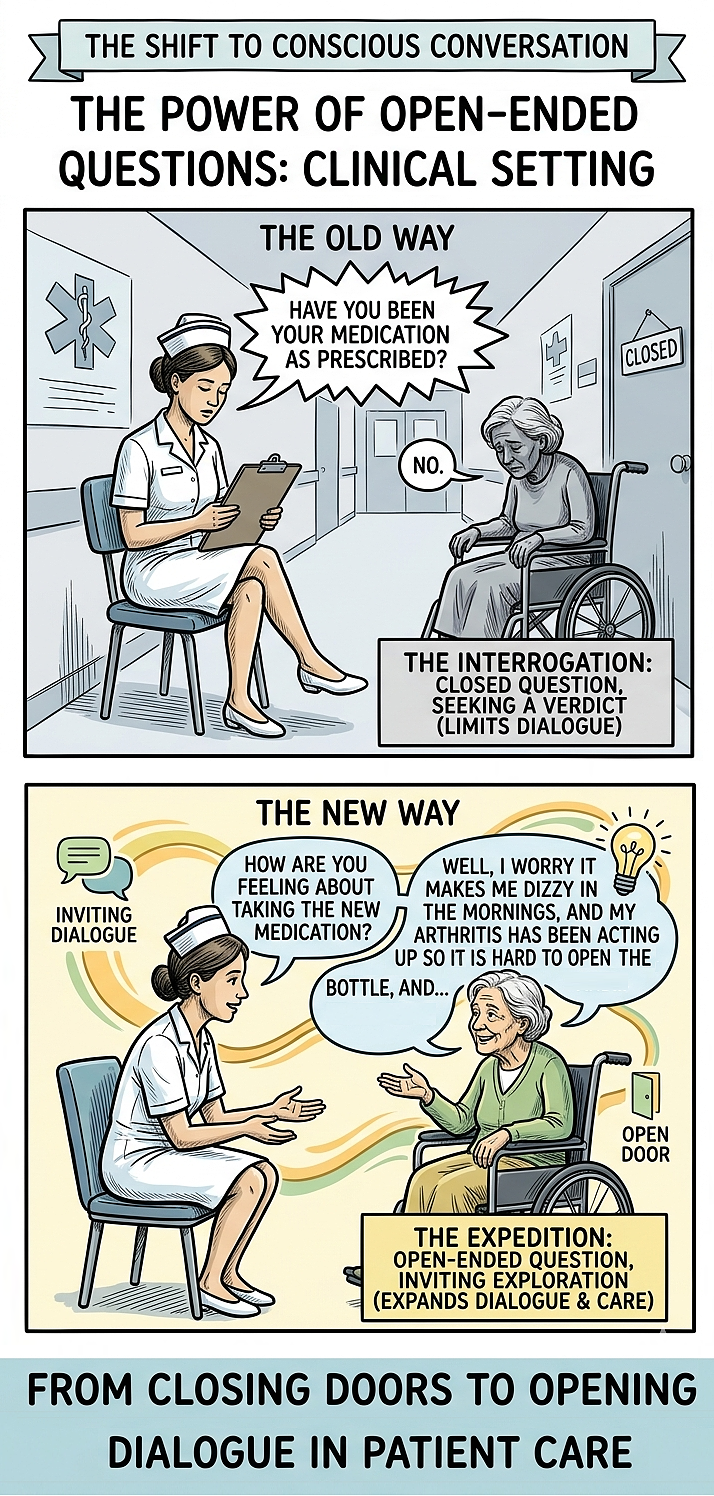
The first question suggests yes or no, leans toward yes, and does not invite discussion. The second opens a wide range of responses — including concerns you need to hear before you can make a good decision together. The content is identical. The shape of the question is entirely different. And that shape — open or closed — determines what your partner feels free to say.
Many good communicators already do this naturally. Listen for it and you will start noticing it everywhere: the doctor who asks “How has this been affecting your daily life?” instead of “Is it bothering you?”; the manager who asks “What would you need to make this project work?” instead of “Can you get it done by Friday?”; the parent who asks “What’s your plan for getting everything done tonight?” instead of “Don’t you think you should do your homework first?” In each case, the open question does something the closed one cannot: it invites the other person to think, to share what they actually know, and to become a genuine partner in the conversation rather than a witness being cross-examined.
Here are a few more translations, because seeing several at once makes the pattern easier to carry into your own life:
| Closed (Yes/No) | Open-Ended Alternative |
|---|---|
| “Do you like it?” | “How did that land for you?” |
| “Do you agree?” | “What do you think?” |
| “Do you really think that’s the right thing to do?” | “What were you hoping for?” |
| “Aren’t I right?” | “Help me understand your view.” |
| “Have you been taking your medication?” | “How’s the medication working for you these days?” |
| “Don’t you think you should do homework first?” | “What’s your plan for getting everything done tonight?” |
When you are under time pressure, it is tempting to push toward quick yes-or-no answers. But pressing forward without addressing people’s real concerns has played a key role in many on-the-job accidents and tragedies. People who couldn’t voice their reservations — or weren’t asked — have been present at some of the most costly mistakes in human history. (In Transformation Two, we explored one of the most vivid: the Air Florida flight that crashed because a captain’s closed, dismissive responses silenced a first officer who was trying to say something was wrong.) Open questions are not a luxury. In some settings, they are a matter of survival.

Open-ended questions open the door
to new possibilities and new problem resolutions
These translations may look almost too simple to qualify as a “skill.” But something this easy to demonstrate turns out to be remarkably powerful in practice. Which raises a natural question: if the skill of asking openly is this simple, and if most of us have already experienced it in rough form, what would happen if we went further — if we learned to ask not just openly, but creatively? That is where the deeper territory of this chapter begins.
6.4 The Courage to Be Curious
Open-ended questions are the first step. Creative questions are the next. And the difference between the two is a shift not just in wording but in posture — a movement from the need to be right toward the courage to be curious.
Consider:
| The Verdict Question | The Inviting Question |
|---|---|
| “Why are you always making such big messes?” | “How could we work together to solve this?” |
| “How could I have been so stupid?” | “What could I learn from this?” |
| “How am I going to nail that guy?” | “What would be best for me here?” |
| “How can I do this without anybody finding out?” | “If I do this, what kind of person will that make me?” |
Psychologists Carl Rogers and Abraham Maslow recognized this shift as one of the hallmarks of human growth: a movement from defending what you already believe toward genuinely wanting to find out what you don’t yet know. Carol Dweck’s research on the growth mindset shows the same pattern — people with a fixed mindset ask questions to confirm what they already believe; people with a growth mindset ask questions to discover what they haven’t yet seen. The questions on the left side of the table above are fixed-mindset questions. The ones on the right are growth-mindset questions. And the encouraging news is that the shift from left to right is not a matter of talent or temperament. It is a learnable practice.
Donald Schön, who studied creative professionals across many fields, described questions as something like a grappling hook thrown into the unknown — we throw the hook and pull ourselves toward the future. But we need to learn how and where to throw, so we pull ourselves toward a better future rather than a worse one. That is the art this chapter explores.
And there is something deeper still. The philosopher Sam Keen put it directly: your questions are the quest you’re on. No questions — no journey. Timid questions — timid trips. In many relationships and institutions, the freedom to ask certain questions is quietly restricted. We sense — from tone, from silence, from atmosphere — which questions are not welcome. Learning to ask creative questions is therefore not just a skill. It is an act of reclamation — a quiet returning to yourself of the curiosity you were born with.
If you’ve been working through this workbook, you may already sense why this capacity sits where it does. In Transformation Two, you learned to listen responsively — to give someone the experience of being genuinely heard. In Transformation Three, you learned to open conversations with an invitation rather than an eruption. In Transformations Four and Five, you learned to express your own experience more fully and to translate complaints into requests. Creative questioning is the natural next step: it is how you turn toward another person’s experience and say, in effect, I am genuinely curious about what you see, feel, and know. Listening is receiving. Questioning is reaching out. Together they form a single gesture of attention.
So the shift from closed questions to open ones is already valuable. But the shift from routine questions to creative ones opens a far wider territory — a territory we can map. What follows are ten families of questions, each drawn from a different tradition, each opening a different door. Think of them not as a list to memorize but as a toolkit you will carry — and choose from — for the rest of your life.
6.5 A Word Before You Begin
What follows are ten clusters of questions drawn from psychotherapy, negotiation, narrative practice, philosophy, and the arts. Each cluster serves a different purpose. Each opens a different door. And they are arranged in a sequence that builds: the first three are questions you ask yourself; the next two are questions you bring to difficult situations; the sixth asks about the person you are becoming; the seventh and eighth help you discover strengths you may have overlooked; and the last two deepen your connection with others. You can enter at any point, but walking through them in order lets each family prepare the ground for the next.
Don’t try to memorize them. Choose one. Live with it for a week. Write it on a card by your mirror or in the notes app on your phone. Let it accompany you through your days. At the end of the week, notice what you see that you might have missed. Then come back and choose another. Over a few months, you will have genuinely lived with most of these — not just read them.
6.6 Ten Families of Questions Worth Carrying
Family 1: Questions That Ground You in What You’re Actually Feeling
How does this feel to me? What am I experiencing right now?
These come from the Gestalt therapy tradition, and they shift your attention from analysis to lived experience. The next time you feel vaguely uneasy — before reaching for an explanation — try asking yourself: How does this actually feel in my body right now? You will be surprised how often the answer you get is more useful than any story you could have invented. This is where creative inquiry begins: with the honest acknowledgment of your own experience, the same self-awareness at the heart of Transformation Four’s Five I-Messages.
If you can learn to pause and ask this question of yourself, you are ready for a second one — the question you ask after the feeling has been noticed.
Family 2: Questions That Turn Stumbles into Stepping Stones
How could I have done that differently? What could I learn from this mistake or painful experience?
These questions replace self-blame with curiosity. The goal is not to let yourself off the hook — it is to extract the lesson without the shame. Every failure contains information. These questions help you get at it. They are the growth mindset in action: instead of “How could I have been so stupid?” (a verdict), you ask “What would I do differently next time?” (an inquiry). The first question closes the conversation with yourself. The second one opens it.
But what if the stumble is not a one-time event — what if it is a pattern, something that keeps happening? That calls for a different kind of question entirely.
Family 3: Questions That Interrupt the Helplessness Spiral
What kind of explanations do I give myself when bad things happen? How easy would it be for me to see this as temporary, specific to one area, and partly beyond my control?
Martin Seligman’s research on learned helplessness and explanatory style shows that over-generalizing — “this will always be this way, everywhere, and it’s all my fault” — is a key driver of depression and paralysis. These questions interrupt that spiral. They invite you to ask whether the catastrophic story you are telling yourself is the only story available. Often it is not. These questions are best practiced on yourself first, before trying them with others, because they require the kind of honest self-inquiry that only you can do.
The first three families are questions you direct inward — tools for your own clarity. The next two take that clarity outward, into situations where other people are involved and where the stakes may be high.
Family 4: Questions for When Conflict Is in the Room
What is the most important thing I want from this situation? What solutions might bring everyone more of what they want? What is my best alternative if we can’t agree? What kind of self-fulfilling prophecy do I want to set in motion here?
These are the heart of principled negotiation, drawn from the work of Fisher, Ury, and Patton. The last question is especially powerful: what you expect shapes your behavior, and your behavior shapes what you get. Hostile questions produce defensive answers. Curious questions invite thoughtful ones. This is directly related to what you learned in Transformation Five about the courage of making requests — the same vulnerability that turns a complaint into a request can turn a hostile interrogation into a genuine inquiry.
Conflict, though, is not the only arena where creative questions do their best work. Sometimes the most productive question is the one that leaves the literal and reaches for the imaginative.
Family 5: Questions That Unlock Creative Possibilities
What possibilities would open up if we looked at this situation as if it were a garden… a river… a jazz improvisation? What does this remind me of — and what does that suggest?
Donald Schön showed that metaphors unlock what literal description misses. When a group of engineers working on synthetic paintbrush bristles got stuck, they broke through by asking “What if the bristle were a kind of pump?” The analogy opened a design space that logical analysis had missed entirely. Try several metaphors for whatever you are facing. Notice which one opens the most doors. This is how architects, engineers, and artists think — and it is available to anyone willing to play. Creative questioning, at its best, is a form of disciplined play.
The first five families are questions about situations — about what you feel, what you can learn, what might resolve a conflict, what a metaphor might reveal. The sixth family shifts the lens to something larger: the person you are becoming through the questions you choose to ask.
Family 6: Questions About the Person You’re Becoming
If I do what I’m thinking about doing, what kind of person will that make me? What sort of person do I seem to be becoming? What sort of person do I want to become?
These may be the most quietly powerful questions in the entire set. They come from social constructionist theory: our sense of self is the ongoing story we tell to make sense of our actions. Every choice either supports or weakens the story we want to be living. These are the questions that transform practical decisions into questions about character — not through moralizing, but through genuine inquiry. Sit with them slowly. They don’t rush.
If these questions point you toward the person you are becoming, the next two families help you discover the person you already are — the strengths and successes you may have forgotten to notice.
Family 7: Questions That Recover Your Hidden Moments of Success
When did we get along well — when this problem wasn’t there? How did that work and what did it feel like? What were the turning points? Reviewing those moments, what kind of future might be possible?
These come from narrative therapy, which observes that our self-stories tend to leave out the moments that don’t fit our dominant — usually problem-saturated — narrative. We remember the fights and forget the repairs. We remember the failures and forget the times we got it right. These questions deliberately bring the “sparkling moments” back into view. When someone is stuck in a problem story, helping them find even one moment of success can shift the whole conversation. And that shift connects directly to the next family — the one that asks not just what went right, but how can we grow more of it?
Family 8: Questions That Grow What’s Already Working
What did you most appreciate about how this went? What has been working well, even in the midst of this difficulty? What strengths have you brought that you might not have fully recognized?
These come from David Cooperrider’s Appreciative Inquiry tradition, and they carry one of the most important insights in this entire workbook: what you consistently ask about tends to grow — for better or worse. A group that asks only “What’s broken?” gets more awareness of brokenness. A group that asks “What’s already working, and how do we do more of it?” gets more of whatever is already working. These questions are the natural bridge to Transformation Seven, on expressing appreciation. One sincere appreciative question can shift the emotional tone of an entire conversation, especially in a group that has been stuck in problem-focus.
The last two families bring the art of questioning into its most relational form — the questions you ask when you genuinely want to understand another person’s experience and help them find their way.
Family 9: Questions That Deepen Any Conversation
Would you be willing to tell me more about that? I’d love to understand your experience — how did this feel from where you were standing? What haven’t I asked you that you wish I would?
Carl Rogers found that feeling genuinely heard — not evaluated, not analyzed, but heard — was itself therapeutic. These are the open-ended questions from section 6.2 in their most relational form. The difference between an information-gathering question and an inviting question lives in tone and genuine curiosity, not wording alone. And the last one — “What haven’t I asked you that you wish I would?” — may be the most powerful question in any close relationship. It is an act of hospitality: a door you open that the other person did not know was there.
Family 10: Questions That Help Someone Find Their Foothold
Of everything you’re facing right now, what is the one thing that matters most? If you could only change one thing, what would it be? What do you most need from me right now — to listen, to help problem-solve, or something else?
These come from solution-focused therapy and crisis counseling. Sometimes the most compassionate move is not to open things up wider — it is to help someone find the one foothold they need when they are overwhelmed. The last question — asking explicitly what kind of support they want — is an act of care that most people have never experienced. And notice how naturally it connects back to Transformation Three: you are explaining the kind of conversation you are offering and inviting the other person’s consent to have it. The skills in this workbook are not isolated tools. They are a single repertoire, and they strengthen one another every time you practice any one of them.
6.7 Living with the Questions
Knowing about these ten families is one thing. Making them your own is another. Here are three approaches, each suited to a different pace of learning. You do not need to do all three. Choose the one that fits your life right now.
The Slow Read. Go through the ten families one at a time. Pause at each. Ask yourself: “Is there a situation in my life right now where this might be useful?” Jot it down. Don’t answer the question — just notice what it opens. This approach is for people who like to let ideas settle before they act on them.
The Weekly Practice. Pick one question. Just one. Write it on a card or in your notes app. Carry it with you for a week. At the end of the week, write down one or two things you noticed that you might not have seen without it. Next week, pick another. Over a few months, you will have genuinely lived with most of these — not just read them. This is the approach I most recommend, because questions are companions, not tools. They do their deepest work when you live with them long enough for them to surprise you.
The Practice Pair. If you are working with a partner or small group (see Transformation Nine), each person picks one question that speaks to something real in their life. In turns, share: which question, why it resonates, what it illuminates. Others listen without advice, then reflect back what they heard. You will find that other people’s questions often illuminate your own life in unexpected ways — and that the act of listening to someone else explore a question deepens your own capacity for inquiry.
6.8 The Spiral: How Creative Questions Reach into Everything
By now you may have noticed how many threads from earlier chapters weave through these ten families of questions. That is not a coincidence. Creative questioning is not an isolated skill — it is the connective tissue of the entire repertoire you are building. Before we close, let’s see those connections clearly, because seeing them is what helps a new practice take root.
The listening connection (Transformation Two). A creative question is a conversational invitation, inviting another person to express themselves. A sincerely asked creative question also carries with it an implied promise to listen. The question is only half the process; the other half is how carefully you listen and what you do with the answer. Every open question you ask creates a moment that calls for the responsive listening of Transformation Two — the kind of listening where you reflect back what you heard so the other person knows they have been received. Questioning and listening are not two separate skills. They are two moments in the evolution of a conversation.
The conversational intent connection (Transformation Three). The very act of asking a question is a way of framing a conversation — of telling your partner what kind of exchange you are inviting. “What do you think?” sets a very different stage than “Don’t you agree?” When you choose your questions consciously, you are practicing the meta-communication of Transformation Three: explaining, through the shape of your question, what kind of conversation you are hoping to have.
The self-expression connection (Transformation Four). Many of the ten families of questions explored in this chapter — especially Families 1, 2, 3, and 6 — are questions you can ask yourself, and they serve the same purpose as the Five I-Messages: they help you identify what you are actually feeling, what needs and interpretations are driving those feelings, and what you want to do about them. Creative self-questioning is the inward face of the self-expression you practiced in Transformation Four.
The request connection (Transformation Five). Family 4 and Family 10 are, in essence, the requesting skills of Transformation Five in question form. Instead of making a request outright, you ask the other person what would help, what they need, what solution might work for both of you. The request becomes an inquiry — and the inquiry often produces a better request than you could have formulated on your own.
The appreciation connection (Transformation Seven). Family 8 — the appreciative questions drawn from David Cooperrider’s work — is the natural on-ramp to Transformation Seven on expressing gratitude and appreciation. When you ask “What’s already working?” you are practicing the appreciative stance (focusing on what is working, rather than on what is broken) that the next chapter will develop into a full practice.
The “already a trainer” connection (Transformation One). Every time you model open, creative questioning, you teach everyone present that conversations can be curious rather than adversarial, exploratory rather than defensive. Your children learn that questions can be invitations. Your coworkers see that curiosity is strength, not weakness. You are already a communication skills trainer. The question is whether you will train people in interrogation or in inquiry.
The peer learning connection (Transformation Nine). The ten families of questions are superb material for Purpose Partners and Circles of Six. Sharing which question spoke to you, what you noticed during your week of living with it, and what surprised you — this kind of reflective practice deepens the learning enormously. And it reminds you that you are not doing this alone. You don’t have to be. That is the promise of Transformation Nine on creating mutual support circles.
One last thought before the exercises. Reading this chapter has been a kind of in-breath — taking in a new way of seeing what questions can do when they are asked with genuine curiosity. But no one ever learned all they need to know about questioning more creatively just by reading; the understanding comes fully alive only on the out-breath, in real conversations where you actually try the open, inviting questions described here. Breathe in the idea; breathe out the practice. That gentle rhythm will return in every chapter of this book. So think of the exercises that follow not as an appendix to the chapter but as its natural exhale — the moment where reading quietly becomes doing.
6.9 Radical Questions for Critical Times
A contribution from philosopher Sam Keen
By Sam Keen (1931–2025) — Our thanks go to Sam Keen for permission to include this.
This chapter began with questions that open up conversations. It closes with questions that open up a life. The philosopher Sam Keen spent decades exploring what happens when a person dares to ask the questions that most of us leave unasked. His reflection that follows is not a technique. It is a shift in perspective — a reminder that the art of questioning reaches far beyond communication skills, into the deepest territory of what it means to be a human being who is still growing. Here is Sam Keen’s vision of questions and questioning:
Your questions are the quest you’re on. No questions — no journey. Timid questions — timid trips. Radical questions — an expedition to the root of your being.
Cross-Examining the Self: What is happening to me? What comes next? What do I really desire? What have I not brought forth that is within me? What does my dream-self know that “I” don’t?
Questions for I and Thou: Whom do I love? By whom am I loved? How intimate are we? What clandestine emotions keep us from being authentic with each other? When is it time to say goodbye?
Probing the Commonwealth: Who is my neighbor? For whom, beyond my family, do I care? Can I be just, loving, merciful — and still be loyal to my profession, my country? If we measured success by Gross National Happiness, how would everything change?
Keen’s questions remind us that creative inquiry is not only a conversational tool. It is a way of being in the world — a stance toward life that keeps possibility alive. The questions you choose to carry are, in a very real sense, the life you choose to live.
6.10 Transformation Six Exercises
Exercise 6A: Translating Your Own Questions
Goal: To practice the fundamental shift from closed to open-ended questions in your own life.
Find three yes-or-no questions that you have recently asked someone — or wanted to ask. Write each one down. Then, next to it, write an open-ended alternative using the translations in section 6.2 as models. For each pair, ask yourself: what information might the open-ended version reveal that the yes-or-no version would miss? What problems does the yes-or-no version create that the open version avoids?
Exercise 6B: The Weekly Question Companion
Goal: To experience what it is like to live with a question rather than just read about one.
Choose one question from any of the ten families — whichever one speaks to something real in your life right now. Write it on a card, tape it to your bathroom mirror, or put it in your notes app. Carry it with you for a full week. At the end of the week, in your learning journal, write down: Which question did you choose? Why? What did you notice during the week that you might not have noticed without it? What surprised you?
Exercise 6C: The Appreciation Question Experiment
Goal: To test the power of appreciative questions in a real conversation.
In one conversation this week — with a partner, a friend, a coworker, or a family member — ask one question from Family 8: “What did you most appreciate about how this went?” or “What has been working well, even in the midst of this difficulty?” Notice what happens to the emotional tone of the conversation. In your learning journal, write down what you asked, what the other person said, and how the conversation shifted.
Exercise 6D: The “What Haven’t I Asked?” Experiment
Goal: To practice the most relational question in the toolkit.
In a conversation with someone you care about, find a natural moment to ask: “What haven’t I asked you that you wish I would?” Then listen — really listen, in the responsive way described in Transformation Two. In your learning journal, write down what happened. Was the question hard to ask? What did you learn?
Exercise 6E: Sharing Questions with a Practice Partner
Goal: To deepen your practice through reflection with another person.
If you are working with a practice partner or a Circle of Six (see Transformation Nine), each person picks one question from the ten families that speaks to something real in their life. In turns, share: which question you chose, why it resonated, and what it illuminated. Others listen without advice, then reflect back what they heard. Compare notes on which families of questions felt most natural and which felt most challenging. What does that tell you about the kind of questioner you are — and the kind you might become?
6.11 Suggested Additional Readings on Creative Questioning
Adams, Marilee G. Change Your Questions, Change Your Life: 12 Powerful Tools for Leadership, Coaching, and Results. 4th ed., Berrett-Koehler, 2022. Written as a fable, this book outlines the “Question Thinking” model with twelve questions for personal and professional change.
Finlayson, Andrew. Questions That Work: A Resource for Facilitators. OD Practitioner Press, 2001. A “questioning manifesto” for professional life — practical, sharp, and immediately usable.
Grace, Sean. The Art of the Question: A Guide to Short-Term Question-Centered Therapy. Routledge, 2015. A comprehensive exploration of how effective inquiry leads to better decisions and deeper relationships.
Leeds, Dorothy. The 7 Powers of Questions: Secrets to Successful Communication in Life and at Work. Perigee, 2000. Seven ways questions improve relationships, uncover opportunities, and get more from every encounter.
Rivers, Dennis. Twelve Thought Questions for Deeper Reading: A Guide for Independent Study. OneEarth.University Creative Commons Publications, 2025. A learning toolkit for independent students and study groups. Available as free PDF at:
https://oneearth.university/twelve-thought-questions/
6.12 References and Recommended Reading for this Chapter
Please note: Because the chapters of this Workbook are often
distributed as separate study documents, we reference a given
book or article in every chapter where a reference is needed.
Adams, Marilee G. Change Your Questions, Change Your Life. 4th ed., Berrett-Koehler, 2022.
Cooperrider, David L., and Diana Whitney. Appreciative Inquiry: A Positive Revolution in Change. Berrett-Koehler Publishers, 2005.
Dweck, Carol. Mindset: The New Psychology of Success. Random House, 2006.
Fisher, Roger, William Ury, and Bruce Patton. Getting to Yes: Negotiating Agreement Without Giving In. 2nd ed., Penguin Books, 1991.
Keen, Sam. Hymns to an Unknown God: Awakening the Spirit in Everyday Life. Bantam, 1994.
Maslow, Abraham. Toward a Psychology of Being. 2nd ed., Van Nostrand, 1968.
Rogers, Carl R. On Becoming a Person: A Therapist’s View of Psychotherapy. Houghton Mifflin, 1961.
Rosenberg, Marshall B. Nonviolent Communication: A Language of Life. 3rd ed., PuddleDancer Press, 2015.
Schön, Donald A. The Reflective Practitioner: How Professionals Think in Action. Basic Books, 1983.
Seligman, Martin E. P. Learned Optimism: How to Change Your Mind and Your Life. Vintage, 2006.
White, Michael, and David Epston. Narrative Means to Therapeutic Ends. Norton, 1990.
Your notes on this chapter