Conversational Transformation Three — Explaining Your Conversational Intent and Inviting Consent
Explaining Your Conversational Intent & Inviting Consent

- From launching into conversations
to inviting people into them - From assuming availability to asking for it
- From unclear purpose to shared understanding
- From forcing a role on someone to requesting the partnership you need
- From talking at people to beginning a dialogue with them
- From surprise attacks to respectful openings
- From “you need to hear this”
to “would you be willing to explore this with me?” - From the tension of surprise conversational beginnings
to the relaxation of respectful arranging
3.1 Summary
Why do so many important conversations go wrong before they have even really begun? And what is the one overlooked step that can turn a conversational ambush into a collaborative invitation?
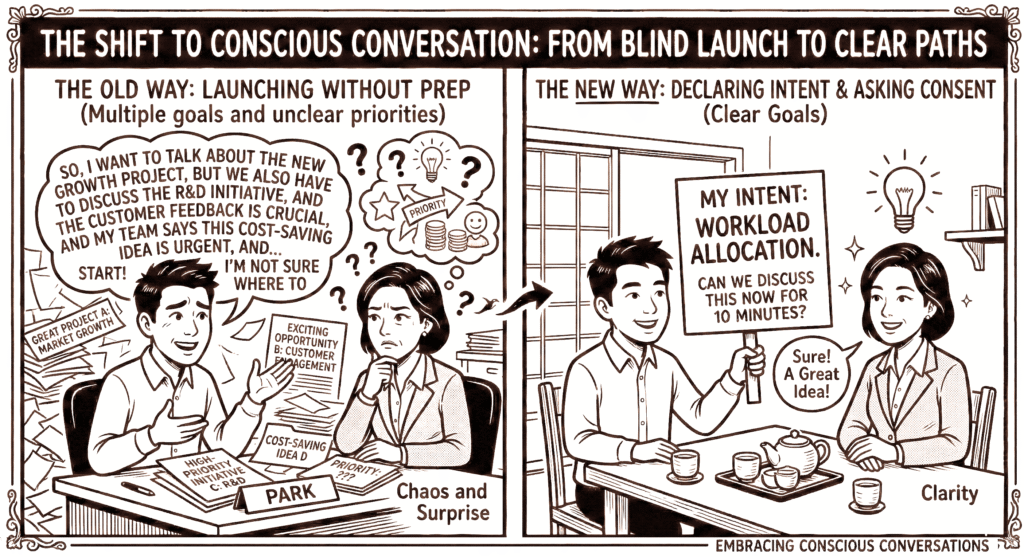
To help your conversation partner cooperate with you, and to head off needless misunderstanding, begin your important conversations by inviting the other person to join you in the particular kind of conversation you want to have. The more a conversation is going to mean to you, the more it matters that your partner can see the big picture. When you need to have a long, complex, or emotion-laden conversation with someone, it makes a remarkable difference if you briefly explain your intention first — and then invite the other person’s consent before you begin.
This chapter explores why this practice of declaring intent and inviting consent makes such a profound difference, what it sounds like when it is done well, what quietly keeps us from doing it — and how to begin practicing it in your own life, one conversation at a time.
3.2 The Mini-Conversation Before the Conversation
I have always been a go-along-to-get-along sort of person, which meant that making a complaint or starting a hard conversation was an especially difficult business for me. I worked out the ideas in this chapter by running a great many small experiments in how to begin a conversation — and I was continually surprised at how easy it became.
One episode sticks in my mind. I was in a large health-food market hunting for my favorite snack, broccoli, which I like to munch raw, dipped in salad dressing. You can imagine my disgust when I found the store’s broccoli crawling with tiny insects and dusted with some sort of thick white insect powder. Get me out of here! But instead of bolting, I walked over to the customer service counter and decided to put my new interpersonal navigation tools to work.
Stepping up to the person behind the counter, I said, in my most diplomatic voice, “I would like to make a complaint.” That one sentence let her get emotionally ready for the kind of conversation that was coming. “Yes,” she said, in a confident voice. “How can I help?” Then I said — with a little of my surprise and disgust showing in my tone — “There are bugs in the broccoli!” She was not knocked off balance by my feeling, because she already knew a complaint was on its way. She simply answered, again confidently, “We’ll take care of it right away.”
Many experiments like that one taught me something I now consider among the most practical skills in this entire workbook: the importance of the mini-conversation before the conversation. Before you launch into any important exchange — especially one involving strong feelings, a significant request, or the possibility of conflict — there is a brief, crucial step that can make the difference between connection and collision. You explain the kind of conversation you would like to have, and you invite the other person’s consent to have it. This is Transformation Three, and of all the skills in this workbook, it may be the one that produces the most immediate, visible results. How does it sound?
3.3 What This Skill Sounds Like in Practice
Many good communicators already do this by instinct. Listen for it and you will start noticing it everywhere:
“Hi, Steve. I need to ask for your help on my project. Got a minute to talk about it?”
“Maria, do you have a minute? I’d like to talk with you about the schedule change. Is that OK?”
“Sit down for a minute and let me tell you what happened…”
“Hello, Mr. Sanchez. I’m not completely comfortable about the safety conditions on this job. Can we talk about it for a few minutes?”
“Hi, Jerry, this is Mike. I want to talk to you about Fred. He’s in jail again. Is this a good time?”
Notice what each of these openings accomplishes. In a few seconds, the speaker does something that would otherwise take much longer to negotiate through body language, tone, and guesswork. They tell the other person, in effect: here is what I need to talk about, here is how much time and energy I think it will take, and I am asking your permission before I begin.

~~~ Where do I want to go on The Island of Many Possible Conversations? ~~~
.
This is what I mean by the mini-conversation before the conversation. It is brief. It is respectful. And it changes everything that follows. The underlying principle is simple: the bigger the request that is on its way, the clearer the invitation needs to be. The more we are going to ask of another person, the more important it is to let them get ready.
These examples may sound almost too simple to qualify as a “skill.” But something this easy to demonstrate turns out to be remarkably powerful in practice. Which raises the obvious question: why does so small a step make so large a difference?
3.4 Six Reasons This Makes Such a Difference
When we combine an explanation of intent with an invitation to consent, we help a conversation along in six distinct ways — and each one connects to something deeper about how human relationships and groups actually work.
The first element is related to the theme of Transformation One: shifting from cultural autopilot to conscious conversations. It is completely human and OK to have several needs at the same time. But human language can only handle one topic at a time, and most human listeners can only process one topic at a time. So, in order to have our most important need addressed by others, it is important for us each to take a moment before important conversations and sort out what is most important to us. The more clearly we know where we want to go, the more easily other people will be able to help us get there.
Second, cultural bridge-building. Here we bump into something close to a universal truth about conversational intentions: although now and then we may stumble into getting what we want, most of the time getting what we really want depends on first being clear, with ourselves, about what we really want, and then being clear with others. How do we do that? Isolated cultural groups work out their own unique ways of signaling conversational starts and stops: body language, throat-clearing, shouting “Hey!“, facial expressions, all learned in childhood by simple imitation. The world we live in today, however, often mixes together people from many different cultures. In this more varied world we can’t rely on our listeners to understand our particular informal gestures. Hence, to get the cooperation of other people in meeting our needs and goals, we need respectful, specific and consciously voiced ways of making contact. The explanation of intent and invitation to consent explored here is a creative effort in that direction.
Third, we give our listeners a real chance to consent — or to decline. A person who has agreed to take part will take part more fully. This is no small thing. It connects directly to the three-sided insight at the heart of this workbook (Transformation One): every human group needs to accomplish tasks together, support one another emotionally, and accommodate its members’ different temperaments. Some people need a moment to shift gears before an emotional conversation. Some take in difficult news better when they know it is coming. When you invite consent, you are honoring those differences rather than steamrolling over them.
Fourth, we help our listeners see the big picture. Decades of research in linguistics and communication studies confirm that grasping a person’s overall conversational intention is crucial to understanding their specific words (Grice 1975; Cohen et al. 1990). If I know you are about to ask for my help, I hear your words very differently than if I fear you are about to criticize me. The big picture frames everything that follows inside it. This practice works in both directions. As we clarify the big picture in our own minds in order to explain it to another person, we also clarify it for ourselves.
Fifth, we help our listeners understand the role we are asking them to play. Do we need a fellow problem-solver? A giver of emotional support? A sounding board? An advice-giver? A decision-maker? These are very different roles, and conversations go far better when we ask someone to play just one major role at a time. This connects back to the balance of task and emotional support we explored in Transformation One: if your partner thinks you want practical advice when what you really need is to be heard, you will both leave the conversation frustrated — not from any bad intention, but from a simple mismatch of expectations. This is another process that works both ways. In coming to clarity about my most important reason to have a conversation, I am clarifying the role I am going to play: a story sharer, a help requester, an instruction giver or receiver, etc. As I express my intent by saying, “Hey! Lemme tell ya about this great restaurant I went to last week!”, my listener will usually understand the corresponding conversational role.
Sixth, to be invited into a conversation is an act of respect. A person who has consciously agreed to talk is far more likely to pay attention and cooperate than someone who feels pushed into an undefined conversation by the sheer momentum of another person’s talking.
Consider it from the receiving end. When someone erupts at you — pouring out a complaint or an emotional disclosure with no warning — how does your body respond? If you are like most people, you tense. Your guard goes up. You are in no position to listen well, because you are too busy working out whether you are under attack. Now imagine the very same conversation beginning instead with: “I have something important I’d like to talk about. It’s about what happened yesterday, and I think it might take about fifteen minutes. Is now a good time, or would later be better?” The content is identical. The experience is entirely different. The second version treats you as a partner rather than a target. It generates goodwill — the quiet trust that your needs and your availability will be taken into account — and that goodwill is exactly the currency we need for creative problem-solving, genuine empathy, and agreements that actually hold.
3.5 Specifics on Clarifying Your Intentions for Yourself
Before you can explain your intentions to others, you will need to clarify them for yourself. This is worth a quiet moment or two before any important conversation.
Ask yourself: What do I actually need from this conversation? To share information? Solve a problem? Express a feeling? Make a request? Repair a relationship? Sometimes our surface intentions hide deeper ones. I might believe I want to argue about the dishes when what I really need is reassurance that my partner still values the life we share.
Consider the context, too. What is the other person likely to be feeling right now? How much time and emotional energy will this conversation ask of them? Am I requesting something small, or something that will take real effort on their part?
And here is a question worth borrowing from Carol Dweck’s work on the growth mindset, which we explore in depth in Transformation Eight: What would a successful version of this conversation look like? Not a fantasy in which you win and they lose — but a genuine exchange in which both people feel heard, feel respected, and end up closer to a workable outcome. Holding that picture in mind, even briefly, can change the way you open.
Once you have reflected on these questions, you can shape a clear intention, drawing on the list of fulfilling intentions in the next section:
“I’d like to share my experiences and feelings about what happened at work this week.”
“I’d like to explore some possibilities for our summer plans — I don’t need a decision, just your thoughts.”
“My intention is to resolve the conflict we’ve been having about the budget. I think it will take about half an hour.”
“I’d like to express my appreciation for something you did that meant a lot to me.”
A good intention is specific, positive, and expresses the feeling of “I want to do my part here” rather than “You should do more of your part here.” With your own intention clear, a natural question arises: just how many kinds of conversations are there? You may be surprised how wide a range of doors you can learn to open.
What follows is a tour of this new territory, expressed in words that will feel familiar to speakers of English and other European languages. The aim here is not to build rigid categories but to suggest many of the “flavors” of intention we can distinguish in everyday talking and listening.
The idea from linguistics that in order to understand someone’s utterances, we need to know what kind of conversation they are trying to have with us, is probably a universal truth. Just exactly how this duet of intent and consent gets worked out (or doesn’t) will vary widely from one culture to the next. What follows therefore is not a list of rules, it is a list of possibilities.
3.6 An Exploratory List of Fulfilling Conversational Intentions
As you explore this practice and grow familiar with the many kinds of conversational intention, you will find it easier to invite someone into one of a wide range of conversations, to accept someone else’s invitation, to say “no” or renegotiate an invitation, to gently ask a person to clarify what kind of conversation they are trying to have with you, and to steer clear of conversations that are negative, self-defeating, or self-destructive.
Here is a list of roughly thirty fulfilling conversational intentions. Don’t try to memorize it; it is a reference, not a test. Browse it the way you would browse a restaurant menu — not to order everything, but to discover possibilities you did not know were on offer. Some will feel natural and familiar. Others may feel surprising or even uncomfortable. The uncomfortable ones are often the most valuable to explore, because they mark the edges of your conversational comfort zone.
Although few conversations are exactly alike, for the sake of exploration we can group most English and European language conversations into roughly forty overlapping types of intention. I count about thirty of these as fulfilling (and about twelve as unfulfilling). As you read, feel free to add your own, and add the positive conversational intentions specific to your culture or ethnic group.
Imagine each sentence beginning with: “Right now I’d like to take about [number] minutes and…”
- …tell you about my experiences and feelings — with no implied requests or complaints toward you, or so that you will understand the request, offer, or concern I want to raise.
- …hear what’s happening with you.
(More specific: hear how you are doing with a particular topic.) - …entertain you with a story.
- …explore some possibilities concerning a particular topic — requiring your empathy but not your advice or permission.
- …plan a course of action for myself — with your help, advice, and/or permission, or with you as listener and witness only.
- …coordinate and plan our actions together concerning…
- …express my affection for you, or my appreciation of you concerning…
- …express support for you as you cope with a difficult situation.
- …make a request about something you have done or said. (For better resolution of conflicts, translate complaints into requests — see Transformation Five.)
- …confirm my understanding of the experience or position you just shared. (This usually continues with “I hear that you…,” “Sounds like you…,” “So you’re feeling kind of…,” or “Let me see if I understand you…”)
- …resolve a conflict that I have with you about…
- …negotiate or bargain with you about…
- …work with you to reach a decision about…
- …give you permission or consent to… / get your permission or consent to…
- …give you some information about… / get some information from you about…
- …give you some advice about… / get some advice from you about…
- …give you directions, orders, or work assignments / get directions or orders from you.
- …make a request of you — for action, time, information, an object, money, a promise, etc.
- …consent to or decline a request you have made to me.
- …make an offer to you — for action, information, an object, a promise, etc.
- …accept or decline an offer you have made to me.
- …persuade or motivate you to adopt a particular point of view.
- …persuade or motivate you to choose a particular course of action.
- …forgive you for… / ask for your forgiveness concerning…
- …make an apology to you about… / request an apology from you about…
- …offer an interpretation of what something means to me / ask for your interpretation.
- …offer an evaluation of how good or bad I think something is / ask for your evaluation.
- …change the subject of the conversation and talk about…
- …have some time to think things over.
- …leave or end this conversation so that I can…
3.7 First Exercise: Practicing the Conversation Before the Conversation
With a practice partner (or on your own, in your journal), try starting each of the conversations on the list in section 3.6. Begin with: “Right now I’d like to take about [number] minutes and…” Notice which conversations feel easy to start and which feel more challenging. The challenging ones are often the most valuable to explore.
In your Learning Journal, or in the space below, record your thoughts and feelings about this exploration of positive conversational intentions:
3.8 When People Say No — and Why That’s Not the End
If this practice produces such good results, and is so simple to perform, why don’t people start their conversations this way? Here is the explanation I find most convincing.
When we explain our intent and invite consent, we give up something: the familiar elements of conversational coercion and surprise that quietly do our work for us whenever we just launch into whatever we want to say. In asking plainly for what we need, we make ourselves more vulnerable — because the person can now say no. That, it seems to me, is the real reason a step this simple is so often skipped. It is not that we never thought of it, or can’t imagine it. It is that simply erupting spares us a risk that inviting forces us to take: the risk of hearing “no.” To begin our important conversations differently, we have to make a quiet peace with that possibility.
At first glance, the risk of being turned down feels like a very legitimate worry to a person with something important to talk about. But here is what I have learned: a “no” to an invitation is almost never a permanent refusal. It is often a “not now,” or a “not like this.” And knowing how to respond in those moments can turn what felt like a dead end into a stronger connection.
When someone says “I’m too busy right now,” acknowledge their situation and offer an alternative. “I understand. Would later this week work? Or I could send you a note with my thoughts, and we could talk once you’ve had a chance to consider them.” You have respected their time and kept the door open.
When someone responds with emotional resistance — “I don’t want to talk about it,” or “You always twist my words” — validate the feeling first. “I hear that you’re frustrated, and I understand that. Would it help if we each wrote down our thoughts separately first? Or would you feel more comfortable talking with someone else present?” You are not forcing the conversation. You are offering a gentler path into it.
When someone makes a counterproposal — “I don’t have an hour, but I could do fifteen minutes” — be flexible and prioritize. Focus on the most important points, and schedule a follow-up if you need more time. The very willingness to adapt demonstrates the cooperative spirit this whole workbook is about.
When someone says “Maybe tomorrow,” agree to postpone, but pin down a specific time. “Of course. How about after dinner tomorrow, around seven?” Without a real commitment, “tomorrow” has a way of becoming “never.”
In each of these situations, the act of negotiating when and how to have a conversation is itself a form of communication. How you handle it sets the tone for the conversation to come and can even deepen the relationship before the real exchange begins. You are practicing patience, flexibility, and respect — the very qualities you are cultivating throughout this workbook. So the fear, it turns out, was pointing at a door, not a wall. But there is one more thing to settle before you extend an invitation to anyone else.
3.9 Intentions Worth Avoiding
Browsing the above list of fulfilling intentions can expand your sense of what is possible. But to see the whole picture — and to understand what you are growing away from as well as what you are growing toward — it helps to look honestly at the conversational intentions that create suffering rather than connection.
To be realistic about how people actually behave, I have included a second, shorter list — what I call conversational intentions that create problems for both participants.
- To lie, deceive, or mislead (on extremely rare occasions partly redeemed by good overall intentions, but usually not)
- To threaten with physical harm
- To hurt or abuse
- To punish (creates resentment, avoidance, and a desire for revenge)
- To blame (focuses on the past instead of the present and future)
- To control or coerce — to force or influence someone against their will and consent
- To manipulate — to influence someone without their knowledge and consent
- To demean, humiliate, or shame — to try to make someone look bad in the eyes of others, or to make people doubt themselves or feel bad about themselves
- “Stonewalling”: to deny the existence of a problem in the face of strong evidence and sincere appeals from others
- To hide what is important to me from you, if you are an important person in my life
- To suppress or invalidate someone’s emotional response to an event or situation — as in “Don’t cry!”, or the even more coercive “You stop crying or I’ll really give you something to cry about!”
- To withdraw from interaction in order to avoid the consequences of something I have done
These intentions and the actions that flow from them are unfulfilling because, at the very least, we would not want anyone to do these things to us. And when we begin conversations with intentions like these, we teach and encourage others to do the same — or we teach them to avoid contact with us altogether.
In our time, television, movies, popular music, and books offer us a steady supply of ready-made examples of every item on that list, along with displays of extraordinary sarcasm, cruelty, and violence. So in developing our own positive personal style of interaction, we may have to mindfully out-maneuver what amounts to a kind of cultural conditioning in favor of cruelty and coercion and against cooperation, respect, and kindness.
There are many moral arguments to be had about these matters, and I leave the deep questions of morality to you. I would, however, point out three of the most serious practical liabilities of these coercive and demeaning intentions.
It comes back to you. The first liability is that whatever we do to others, we teach others to do back to us — in conversation and in life generally. I watched this play out chillingly over a period of years as a stressed-out, single-mother friend of mine used sarcasm to discipline her bright ten-year-old son. The ten-year-old soon became a teenager who spoke to his mother with the same withering sarcasm she had used on him. He spent the rest of his teen years living with another family, because their relationship had become unsustainable. (Notice the “already a trainer” insight from Transformation One at work here: she was training him in sarcasm, though it was the last thing she intended. Every interaction is a lesson, whether we mean it to be or not.)
People leave. The intentions on that list can offer a little short-term satisfaction as ways of venting anger or frustration. But the second drawback is that anyone who can avoid being the target of such behavior probably will not stick around to be coerced or demeaned. And if someone truly cannot leave, no one in the relationship will be happy.
Very bad things can happen. Recent history offers tragedies that show how catastrophe can grow out of coercive conversation. An engineer warned managers at the Challenger rocket launch site that cold weather would cause flexible parts of the rocket to harden and fail; the managers stonewalled, the rocket was launched, and the astronauts aboard died when it exploded. A similar story about the tragic consequences of not listening comes to us in the record of an Air Florida airliner that crashed on takeoff from a snowy Washington, D.C., airport. Nearly everyone aboard was killed. The captain had adamantly ignored the first officer’s stated concerns about taking off with too much ice on the wings. (See the reading in Chapter Two for more on this disaster.) And it has become a recurring American sorrow that teenagers relentlessly humiliated at school have returned to murder their classmates and teachers.
3.10 Second Exercise: Conversational Intentions to Grow Away From
In your Learning Journal please explore the following questions. To what degree do you find yourself relying on these kinds of conversations to influence the people in your life? What possibilities for change do you see? To what degree are you — or were you — an unwilling participant in such conversations? And what new possibilities open up as you become more aware of conversational intentions, both your own and other people’s?
If you find yourself leaning heavily on these negative behaviors to navigate life with others, or repeatedly running into them in the people around you, please consider three actions:
- begin practicing the positive conversation openers described in section 3.6 above, to expand your conversational navigation skills;
- start keeping a private journal about when and how your conversations become painful;
- seek professional help from a therapist, counselor, or communication-skills coach.
Having explored both what we are growing toward and what we are growing away from, we can take stock of what this one small practice actually opens up in your life.
3.11 Summing Up: The New Possibilities That Open When You Invite
As you become more consciously familiar with the range of positive conversational intentions available to you, you may find yourself empowered in ways that surprise you. You will find it easier to:
- Invite someone into one of a wide range of conversations, depending on your own wants and needs or the needs of the situation.
- Accept someone’s conversational invitation with greater clarity and a fuller willingness to take part.
- Say “no” — declining or renegotiating someone’s invitation — without guilt.
- Gently prompt another person to clarify what kind of conversation they are trying to have with you, and how much time and attention they need.
These new abilities are real, and they tend to arrive faster than people expect. But none of them stands alone. Each one reaches back to skills you have already begun to build and forward to others still ahead — and seeing those connections is the last thing that helps a new practice take root.
3.12 Looking Forward — The Spiral of How This Transformation Connects to All the Others
Think back, for a moment, to how you learned to talk at all. First came single words, and then, slowly, a feel for how words combine into something larger. Learning to communicate well as an adult has a similar shape — except that now the building blocks are not words but whole conversational moves: inviting, declining, appreciating, requesting, repairing, asking for time to think. You are assembling a repertoire. And one of the surest ways to make a new move feel like your own is to notice how it connects to the others you are gathering. So before we close, let’s see how this one move — explaining your intent and inviting consent — reaches back to everything we have explored and forward to everything still to come.
The “born to learn” connection (Transformation One). Most of us were never taught to name our conversational intentions; our cultural autopilot simply left the step out. Recognizing that gap — without shame — is the first step toward filling it. You didn’t fail to learn this because something is wrong with you. You didn’t learn it because it wasn’t in your environment. Now it is.
The listening connection (Transformation Two). When you explain your intent, you make it easier for the other person to listen, because you have handed them the big picture that lets them hear your specific words in context. And when they respond — even if the answer is “not now” — you have a fresh chance to practice the responsive listening of Transformation Two. These two skills are natural partners.
The three-sided triangle (Transformation One). When you explain your intent and invite consent, you address all three sides of the triangle that every human group needs. You clarify the task (“here’s what I’m hoping to accomplish”), you offer emotional respect (“I care enough about you to ask”), and you make room for different temperaments (“I know you may need a moment to get ready for this”). One small practice, serving all three needs at once.
The “already a trainer” insight (Transformation One). Every time you model the habit of explaining your intent and inviting consent, you teach everyone who witnesses it that conversations can begin this way. Your children absorb a new template. Your coworkers glimpse a different possibility. Your friends notice that you have treated them with a kind of respect they may rarely have met. You are training the people around you — this time consciously — in a better way to begin the conversations that matter.
The peer-learning connection (Transformation Nine). Explaining intent and inviting consent is itself a skill worth practicing with a Purpose Partner or a Circle of Six. It feels awkward at first — most new skills do. Having someone to practice with, to role-play difficult openings, and to reflect with afterward makes the learning faster, deeper, and more lasting. If you are working through this workbook with a companion, this is a wonderful skill to grow together.
Seen all at once, this is the spiral: a single small move that draws on nearly everything before it and quietly strengthens nearly everything that follows. Practice it, and you are not only opening better conversations — you are becoming someone who knows, in your bones, how many kinds of conversation are possible, and how to begin the one you need.
May all your conversations be lighter and clearer!
3.13 References and Recommended Readings for this Chapter
Please note: Because the chapters of this Workbook are often
distributed as separate study documents, we reference a given
book or article in every chapter where a reference is needed.
Austin, J. L. How to Do Things with Words. Clarendon Press, 1962.
Bales, Robert F. Interaction Process Analysis: A Method for the Study of Small Groups. Addison-Wesley, 1950.
Cohen, Philip R., et al., editors. Intentions in Communication. MIT Press, 1990.
Deutschman, Alan. Change or Die: The Three Keys to Change at Work and in Life. Harper Business, 2007.
Dweck, Carol. Mindset: The New Psychology of Success. Random House, 2006.
Edmondson, Amy C. The Fearless Organization: Creating Psychological Safety in the Workplace for Learning, Innovation, and Growth. Wiley, 2019.
Grice, H. P. “Logic and Conversation.” Syntax and Semantics, Vol. 3: Speech Acts, edited by P. Cole and J. Morgan, Academic Press, 1975, pp. 41–58.
Hamilton, Diane Musho, et al. Compassionate Conversations: How to Speak and Listen from the Heart. Shambhala, 2020.
Rogers, Carl R. On Becoming a Person: A Therapist’s View of Psychotherapy. Houghton Mifflin, 1961.
Rosenberg, Marshall B. Nonviolent Communication: A Language of Life. 3rd ed., PuddleDancer Press, 2015.
Your notes on this chapter

Your notes on this chapter