Conversational Transformation Two — Listening More Carefully and Responsively
by Listening More Carefully and Responsively
- From waiting for your turn to talk, to genuinely wanting to understand
- From half-listening to full presence
- From the debate stage to the dialogue
- From “I hear you, but—” to “Tell me more”
- From confusing acknowledgment with agreement
to the freedom of separating the two - From listening only to respond…
to listening in order to receive - From the silence that merely waits…
to the silence that genuinely attends - From defeating people in conversation…
to engaging the person whose cooperation you may need tomorrow
2.1 Summary
Listen first and acknowledge what you hear, even if you don’t agree with it, before expressing your own experience or point of view.
Doing so accomplishes two things at once: you take in more of the “big picture” of the conversation, and you earn more of your partner’s attention in return. So listen first, and offer a brief restatement of what you have heard — especially the feelings in it — before you express your own needs or position.
The kind of listening recommended here mentally separates acknowledging from approving or agreeing. Acknowledging another person’s thoughts and feelings does not have to mean that you approve of or agree with that person’s actions or way of experiencing, or that you will do whatever someone asks.
2.2 The First Skill — and a Capacity You Already Possess
You already know what good listening feels like — from the receiving end. Think of a time when someone gave you their full, unhurried attention while you talked about something that mattered to you. Not advice. Not a quick fix. Just the experience of being heard — of watching another person’s face and realizing, They’re actually with me right now. If you can remember a moment like that, you already know the most important thing this chapter has to teach: that kind of listening is one of the most powerful gifts one human being can offer another. And you have already, in your own rough way, begun to offer it yourself — every time you set aside what you were about to say and genuinely tried to understand someone else’s experience first.
In Transformation One, we explored the “born to learn” idea: you were born with a magnificent capacity for language, but zero words in your vocabulary. The same is true for communication skills. You were born with the capacity for skillful, responsive listening — and that capacity has been developing, unevenly and without much guidance, your whole life. This chapter is about recognizing what you already partly do, giving it a name, and learning to do it more deliberately and more often.
Of all the skills in this workbook, listening may be the most transformative — and the most underestimated. It is the skill that most quickly changes the emotional temperature of a difficult conversation. It is the skill that most directly addresses the “emotional support” side of the relationship triangle we explored in Transformation One. And it is the skill that, with practice, begins to reshape not just your conversations but also your ability to bring your own thoughts and feelings into focus — more on that later in this chapter.
Here is the question at the heart of everything that follows, and it is worth naming out loud before we go any further: What would it be like to become someone others genuinely trust with their experience — and how far does that one capacity reach? That question may sound large, but the practice at its center is surprisingly small — a brief, spoken reflection that lets a speaker know you have truly followed the story of their experience, something a murmured “yeah” or “uh-huh” can never quite convey. The chapter ahead will show you where this capacity already lives in your life, what sometimes gets in its way, and how a single, learnable distinction can free it to do more than you might expect.
Responsive listening is unusual in that it serves two very different needs at once. In the quiet, everyday life of a relationship, it is the thread that weaves connection — the way we let the people around us know, moment by moment, that they are seen and received. And in the hardest moments — during conflict, misunderstanding, or high-stakes disagreement — it is the practice that most reliably keeps a conversation from spiraling into a deadlock or an explosion. This chapter explores both dimensions, beginning with the quieter one, because it turns out that’s where the deeper power lives.
What follows is both a practical guide and an invitation to see listening in a new light — not as a passive activity, a matter of waiting politely while the other person finishes, but as one of the most active and rewarding things a human being can do. The great twentieth-century psychologist Carl Rogers placed this kind of listening at the very heart of his approach to psychotherapy and called it “active listening.” He was convinced that anyone could learn it, and that it carried a quiet current of emotional support into every conversation where it was practiced. I have re-labeled it “responsive listening,” because so many people picture good listening as completely silent. In truth, the magic lies in small spoken responses — the brief reflections described above. To see how a practice this small can carry so much weight, we begin with what every relationship needs in order to survive.
2.3 Listening and the Three Things Every Relationship Needs
In Transformation One, we explored the insight that every human group — from a couple to an entire organization — needs to do three things at once: accomplish tasks together, support one another emotionally, and accommodate the differences in temperament and experience that its members bring. This team-building triangle analogy has some important messages to bring us. To support our discussion, here is another of our series of posters on this theme.
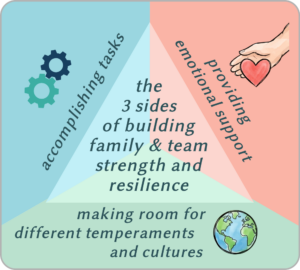
The Team-Building Triangle
If a team’s strength is the area of the triangle, notice what happens when even one side grows short: the whole central area shrinks, no matter how long the other two sides remain. And, let any one of the three needs be met more deeply and the strength of the whole relationship improves. We will revisit this theme in every chapter as a way of paying more attention to how they interweave in every conversation we have.
Responsive listening plays a central role in meeting all three of the needs described in the triangle graphic. It is the most direct way we give one another emotional support. It is the essential tool for navigating across difference — for genuinely understanding someone whose way of experiencing the world is quite different from our own. And without it, the task side of the triangle quickly suffers. too. First, because responsive listening is the way that team members confirm to one another that they understand and agree on a plan of action. And second, because people who feel unheard will struggle to cooperate with team plans, and will tend to repeat themselves more loudly trying to make people hear their unacknowledged concerns, or simply withdraw and shut down. Definitely not a recipe for excellence!
In every relationship, at home, at work, or in your community, by listening and then repeating back in your own words the essence and feeling of what you have just heard — how things look and feel from the speaker’s point of view — you allow the speaker to feel the satisfaction of being understood, one of the deepest of all human needs. The listening ear is the star of the conversation.

the listening ear is the star of the conversation
Our conversation partners do not automatically know how well we have understood them, and they may not be very good at asking for confirmation from us. When a conversation is tense or difficult it is even more important to listen first and acknowledge what you hear. Otherwise, your chances of being heard by the other person go way down.
Consider a hospital nurse speaking with a frustrated patient:
“I hear that you are very uncomfortable right now, Susan, and you would really like to get out of that bed and move around. But your doctor says your bones won’t heal unless you stay put for another week.”
Susan is much more likely to listen to the statement above than if the nurse had simply said:
“I’m really sorry, Susan, but you have to stay in bed. Your doctor says your bones won’t heal unless you stay put for another week.”
What is missing in this second version is an acknowledgment of Susan’s present experience of frustration. And the nurse in the first version is not just doing her job more skillfully. She is doing all three things simultaneously: attending to Susan’s medical situation (task), acknowledging Susan’s frustration (emotional support), and bridging the difference between Susan’s perspective and the medical reality she cannot yet feel the importance of (navigating difference). All three, in one short exchange. That is the leverage point of skillful listening.
Notice how natural the nurse’s response sounds — how little effort it seems to require. That naturalness is worth pausing over, because it tells us something encouraging: responsive listening is not an exotic technique imported from a laboratory. It is a refinement of something many good communicators already do by instinct. Listen for it in the people around you and you will start noticing it everywhere — a colleague who paraphrases what you just said before offering her own view, a friend who names your feeling before changing the subject, a parent who says “I can see how much that hurt” before saying anything else. These small acts of acknowledgment are the skill this chapter teaches, already alive in the world, waiting to be recognized and practiced more deliberately. Two true stories, as different in scale as two stories could be, show just how far this capacity can reach.
2.4 The Reach of Responsive Listening: Two True Stories
A small miracle of empathy. Psychologist John Gottman describes a moment with his two-year-old daughter, Moriah, on an airplane. She wanted Zebra, her favorite stuffed animal, which was packed in the checked luggage far below. Gottman tried explaining that he couldn’t get it. He tried reasoning with her. He tried distracting her. Nothing worked. She grew more and more upset.
Then he tried something different. He simply acknowledged what she was feeling.
“You wish you had Zebra now.”
“Yeah,” she said sadly.
“And you’re angry because we can’t get him for you.”
“Yeah.”
“You’re tired now, and smelling Zebra and cuddling with him would feel real good. I wish we had Zebra here so you could hold him.”
“Yeah,” she said with a sigh.
Within a few minutes, she was asleep. She wasn’t interested in his excuses, his arguments, or his diversions. But finding out that he understood how she felt made her feel better. Gottman calls it a “memorable testament to the power of empathy.” (The full story appears as Reading 2-1 at the end of this chapter.)
No technique was needed. No special training. Just the willingness to stop trying to fix the situation and start trying to understand the person in it. That willingness — that shift from solving to receiving — is the seed of everything this chapter teaches.
A life-and-death failure to listen. But the same capacity, when it goes unexercised, can have devastating consequences. On a snowy afternoon in Washington, D.C., on January 13, 1982, Air Florida Flight 90 crashed into the 14th Street Bridge and plunged into the icy Potomac River, killing 78 people. The cockpit voice recorder tells a chilling story of communication failure. As the Boeing 737 prepared for takeoff in icy conditions, the first officer noticed that the instrument readings looked wrong:
First Officer (at this moment, assigned to be in charge of takeoff): “God, look at that thing. That don’t seem right, does it? Ah, that’s not right.”
Captain (at this moment, assigned to play supportive role) : “Yes it is, there’s eighty.”
First Officer: “Naw, I don’t think that’s right. Ah, maybe it is.”
Captain: “Hundred and twenty.”
First Officer: “I don’t know.”
The first officer expressed his doubts repeatedly, but the captain dismissed them without genuinely exploring what his colleague was seeing. There was no moment of “I hear you — what’s our next step?” No acknowledgment, no curiosity, no responsive pause. Critical information was ignored. The opportunity to abort the takeoff was missed. And 78 people died.
This tragedy galvanized the aviation industry into rethinking how flight crews communicate. The resulting reforms — known as Crew Resource Management — placed empathic, responsive listening at the center of cockpit procedure. The lesson extends far beyond aviation: in any high-stakes situation, the failure to genuinely hear what someone is telling you can have catastrophic consequences. (The full account of Flight 90 and its lessons appears as Reading 2-2 at the end of this chapter.)
Two stories, vastly different in scale. But both reveal the same truth: when people feel genuinely heard, something shifts — a child calms, a crisis is averted, a relationship deepens. And when they don’t, things go wrong — sometimes a little, sometimes catastrophically. The capacity is the same in both cases. What makes the difference is whether someone exercises it. Which raises the most useful question this chapter can ask: if the capacity for responsive listening is this natural — if a father on an airplane can stumble into it in a single moment — what keeps it from showing up more often? The answer has two layers, one visible and one hidden, and they are worth looking at in turn.
2.5 What Sometimes Gets in the Way
The first layer is the one we can see: the competition for our attention. Smartphones, notifications, the ambient pull of social media — all of these have made sustained, present-tense attention to another person significantly harder than it used to be. Many of us have developed the habit of half-listening while simultaneously scanning a screen, composing a reply in our minds, or monitoring what’s happening across the room.
Our conversation partners notice this, even when they don’t say so. The experience of being half-listened to is, for most people, only marginally better than the experience of being ignored. It communicates, beneath the surface:
“You are not quite important enough to have my full attention.”
That is rarely the message we intend to send.
One practical response is simply to slow down and make a deliberate choice at the beginning of a conversation:
“I am going to be here, fully, for the next few minutes.”
Put the phone face-down. Turn away from the screen. Make eye contact. These small acts of physical commitment have a surprisingly large effect on the quality of the listening that follows — and on how the other person feels about the conversation. You have almost certainly done this already, more than once — chosen to set a distraction aside and give someone your full presence. Every time you made that choice, you were already practicing the first move of responsive listening. I make a practice of turning my cellphone ringer off, and telling the person I am with “I am turning my phone off. You have my undivided attention.”
But distraction, however real, is only the outer layer. The deeper friction — the one that explains why even an undistracted, well-meaning person can struggle to listen — is not out in the world at all. It is inside us. When someone tells us something we disagree with — a complaint about us, a view we think is wrong, a feeling we believe they shouldn’t be having — a quiet instinct warns us that to acknowledge what they are saying is to concede it: to agree, to approve, to give ground we may not want to give. So we clamp down. We withhold even the smallest sign that we have heard, for fear that hearing will be mistaken for agreeing.
If you have felt that bracing — that flicker of resistance when you are asked to really hear someone you disagree with — you are not a poor listener. You are an ordinary human being meeting an ordinary human obstacle. And the encouraging news is that this obstacle very nearly dissolves the moment we see one distinction clearly. That distinction — the heart of everything in this chapter — is waiting in the next section.
2.6 The Power of Simple Acknowledging
The practice of responsive listening described here separates acknowledging the thoughts and feelings a person expresses from approving, agreeing, advising, or persuading.
For many people, this distinction is genuinely surprising — because in everyday conversation, acknowledging and agreeing are fused together in our minds like a two-for-one package deal at the supermarket. The effect is that if John feels that any acknowledgment of Fred’s experience implies agreement and approval, John will not acknowledge any of Fred’s experience. Fred tries harder and harder to be heard, and John tries harder and harder not to hear. This, of course, is a recipe for a stalemated argument.
But acknowledging another person’s thoughts and feelings still leaves you with all of your options:
- You still have the option of agreeing or disagreeing with that person’s point of view, actions, or way of experiencing.
- You still have the option of saying yes or no to a request.
- You still have the option of saying more about the matter being discussed.
Most of the people we are talking with in the course of our daily lives want both: to be understood and acknowledged on the one hand, and to be approved and agreed with on the other. With practice, you can learn to respond first with a simple acknowledgment. As you do this, you may find that you can give your conversation partners half of what they want, even if you can’t give them all of what they want. In many conflict situations, that will be a giant step forward. Your conversation partners will also be more likely to acknowledge your position and experience, even if they don’t sympathize with you. This mutual acknowledgment can create an emotional atmosphere in which it is easier to work toward agreement or more gracefully accommodate disagreements.
Here are three examples of acknowledgments that do not imply agreement:
Counselor to a drug abuse client: “I hear that you are feeling terrible right now and that you really want some drugs to get you through the day. And I want you to know that I’m still concerned this stuff you’re taking is going to kill you.”
Mother to seven-year-old: “I know that you want some more cake and ice cream, Jimmy, because it tastes so good, but you’ve already had three pieces and I’m really worried that you’ll get an upset tummy. That’s why I don’t want you to have any more.”
Union representative to company owner’s representative: “I understand from your presentation that you see XYZ Company as short of cash, threatened by foreign competition, and not in a position to agree to any wage increases. Now I would like us to explore contract arrangements that would allow my union members to get a wage increase and XYZ Company to advance its organizational goals.”
In each case, the listener’s acknowledgment of his or her conversation partner’s experience or position increases the chance that the conversation partner will be willing to listen in turn.
As Marshall Rosenberg reports in his book, Nonviolent Communication: studies in labor-management negotiations demonstrate that the time required to reach conflict resolution is cut in half when each negotiator agrees, before responding, to repeat what the previous speaker had said.
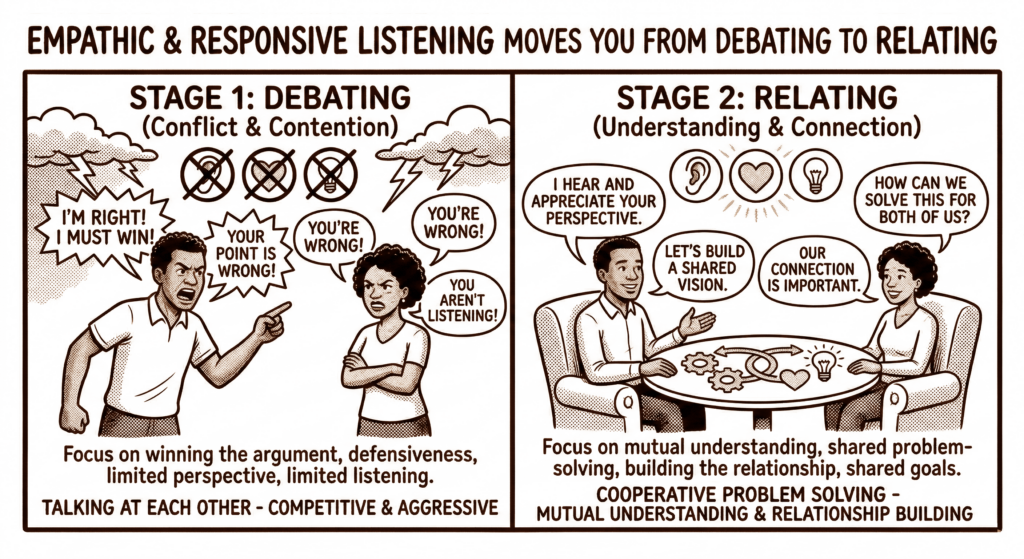
Because so much of communication is about coordinating our life activities with the life activities of others, we would do well to resist two very popular (but terrible) models of communicating: arguing a case in court and participating in a public debate. In courts and debates, each side tries to make its own points and listens to the other side only to tear down the other side’s arguments (and perhaps make them look thoughtless). Since the debaters rarely have to reach agreement or get anything done together outside of the courtroom or debate stage, it doesn’t seem to matter how much ill will their hostile conversational style generates. Don’t try this at home!
Most of us are in a very different situation. We spend most of our lives trying to arrange agreement and cooperative, coordinated action. So we need to be concerned with engaging people, not defeating them. In business — and in family life, too — the person we defeat today will often be the person whose cooperation we need tomorrow.
Responsive listening offers us a different path. Once people feel that their messages and feelings have been heard and understood, they start to relax and they themselves have more attention available for listening. That is the quiet miracle at the center of responsive listening: by acknowledging first, you create the conditions in which you yourself can finally be heard. Look at how far this single distinction has carried us. The capacity that Gottman stumbled into on an airplane — the willingness to receive before responding — turns out to be a practice anyone can learn, and its reach extends from a two-year-old’s tantrum to a union negotiation table. Something this simple, practiced more often and more deliberately, can change the emotional atmosphere of an entire relationship.
If that sounds straightforward, it is — in principle. But the experience of actually doing it, especially when emotions are running high, requires more than understanding. It requires practice. The following suggestions can help you develop that practice.
2.7 Suggestions for Practicing Responsive Listening
The simplest acknowledgment is to reassure your conversation partner with a word or two that you have heard and understood whatever they are experiencing. For example, saying, “You sound really happy — or sad — about that,” is often enough to make someone feel genuinely met.
As you listen to the important people in your life, give very brief summaries of the experiences they are talking about, and name the want or feeling that appears to be at the heart of the experience:
“So, you were really happy about that…”
“So, you drove all the way over there and they didn’t have the part they promised you on the phone. What a let-down.”
“Sounds like you wanted a big change in that situation…”
“Oh, no! Your dog got run over. You must be feeling really terrible…”
The point here is to empathize, not to give advice. If you added to that last statement, “That total SLOB of a driver!!! You should sue them! People REALLY need to pay for their mistakes —” you would be taking over the conversation and leading the person away from their own feelings and toward your reactions. The ear that listens without hijacking the conversation is a rare and precious gift.
As a general rule, do not just repeat another person’s exact words. Summarize their experience in your own words. But in cases where people actually scream or shout something, sometimes you may want to repeat a few of their exact words in a quiet tone of voice to let them know that you have heard it just as they said it.
If the emotion is unclear, make a tentative guess: “So it sounds like maybe you were a little unhappy about all that…” The speaker will usually correct your guess if it needs correcting — and that correction is itself a step forward in the conversation.
Listening is an improvisational art. The purpose of learning and practicing basic patterns is to become so familiar with them that you can improvise easily to meet the needs of the current conversation. Pay attention to whether the person speaking accepts your summaries by saying things such as “yeah!”, “you got it,” “that’s right,” and similar responses. These small signals tell you whether your listening is being received as accurate.
Think of your voice like a tuning fork: when you summarize, try to gently match the emotional frequency the other person is broadcasting. If they are devastated, a quiet, softer tone shows you understand. If they are thrilled, a brighter tone shares their energy. But this resonance only works if it’s authentic. If you cannot relate to their feelings at all, simply aim for a tone of steady, supportive respect. Whatever you do, avoid an emotionally flat, monotone delivery. Responding like an automated machine reading back a list of facts is jarring and unsupportive. And if you find that you cannot muster even basic, respectful attention, it is completely okay to admit you are tapped out and ask to pause the conversation. You are a companion on life’s journey, with both personal strengths and limits. That puts you in a different relationship to your conversation partner than being a psychotherapist or social worker with formal responsibilities.
Such compassionate listening is a powerful resource for navigating through life, and it also makes significant demands on us as listeners. We may need to learn how to hold our own ground while we restate someone else’s position — that takes practice. We also have to be able to listen to people’s criticisms or complaints without becoming disoriented or totally losing our sense of self-worth. That requires cultivating a deeper sense of self-worth, which is no small project. In spite of these difficulties, the results of compassionate, responsive listening have been so rewarding in my life that I have found it to be worth all the effort required. And there is one more reward, quieter than the rest and easy to overlook: with enough practice, this skill stops being something you do and slowly becomes part of who you are.
2.8 How Listening Becomes Character
We have been calling listening a “skill,” and it is one. But the word can mislead us, because a skill sounds like a tool — something you pick up when you need it and put away when you’re done. Responsive listening turns out to be more than that. Each time you practice it, you are not only doing something. You are quietly becoming someone.
When you pause, reflect back, and genuinely try to understand, you are — in that very moment — being an attentive person. When you stay present with someone in distress instead of rushing in to fix or redirect, you are being a compassionate person. And the way we are, moment after moment, is the raw material from which a character is slowly made. Practice this often enough and you will not merely become a more skilled listener; you will become someone other people seek out — because in your company they feel a little less alone, a little more understood. Seen this way, every small act of listening is also a small step on a long and worthy journey: the slow growth, across a lifetime, into a more patient and generous human being.
But there is something more immediate going on as well — something the long view of character can make easy to miss. As you practice paying careful attention to another person’s thoughts and feelings, you are simultaneously building the awareness you need to recognize your own. The psychiatrist and neuroscientist Daniel Siegel calls this capacity mindsight — the ability to perceive the internal world of your own mind and the minds of others — and his research points to a finding that may surprise you: these are not two separate abilities. They are two aspects of a single capacity, developed through the same kinds of interpersonal experience and grounded in the same neural circuitry. When you listen empathically to a friend describing a frustration she can barely articulate, you are exercising the very same awareness you will need when you sit down to ask yourself, What am I actually feeling right now?
The developmental psychologist Lev Vygotsky proposed a principle that illuminates why this is so: every higher psychological function — including the ability to observe and name your own inner states — appears first as something that happens between people, and only later becomes an internal capacity. A child who is asked, with genuine curiosity, What are you feeling? eventually learns to ask herself that same question. And this process does not stop in childhood. Each time you reflect back what someone is experiencing — each time you name a feeling they hadn’t yet put into words — you are not only offering them a mirror. You are deepening, in yourself, the very awareness you will need in your own most important moments. So the practice of responsive listening gives the listener three gifts at once: improved chances for a successful conversation right now, the gradually increasing capacity for self-awareness which grows out of paying deep attention to others, and the slow formation of a more compassionate way of being a companion on the road of life.
This is also the most reassuring thing I know to say about the awkwardness of your first attempts. That awkwardness is not a sign that you are “naturally a bad listener.” It is simply the feeling of a beginner — the normal feel of a capacity stretching beyond its familiar range — and every listener you have ever admired began exactly where you are now. Untrained is a condition that responds to practice. The difficulty of listening well is not a flaw in the practice or a flaw in you. In a real sense, it is the practice — and meeting it, one conversation at a time, is exactly how an ordinary person becomes an extraordinary listener.
2.9 Listening Inward: A Preview
If listening to others builds the capacity for self-observation — and the research strongly suggests it does — then a practical question follows: is there a way to make that connection deliberate? The answer is yes, and the framework is already waiting for you in Transformation Four.
Many of us are far better listeners to our friends than to ourselves. We can sense when a colleague is frustrated or a child is afraid, yet we go for days without pausing to ask: What am I feeling right now? What do I need? What am I hoping for? When we skip that question, we arrive in important conversations not yet knowing what we want to say — because we haven’t yet “checked in” with what is going on inside us. In Transformation Four you’ll explore a simple framework, the Five I-Messages, that maps this inner landscape: what you observe, what you feel, why you feel it, what you want, and what good outcome you are hoping for. It was designed to help you speak more clearly to others, but it turns out to be just as valuable for helping you listen to yourself.
And here is a surprise that many learners discover: it is often easier to begin by coaching someone else through the five dimensions — listening for what they are observing, what they are feeling, what needs are driving those feelings, what they want, and what positive outcome they are hoping for — than to do the internal inventory required to express your own. The outward practice is the training ground for the inward one. As you gently help another person unfold the full picture of their experience, you are learning the landscape of the five dimensions at a level that no amount of reading about them can provide. And when it comes time to ask yourself those same five questions, they will feel familiar — because you have already been living inside them while listening to someone else.
This is one of the reasons Transformation Nine, on building a mutual support network, matters so deeply to the kind of learning this workbook asks of you. When you find a practice partner or a small circle of co-learners and take turns coaching each other through the Five I-Messages, you are not just gaining motivational support for a solitary project. You are entering the developmental pathway itself. Each conversation of mutual listening — where you coach a partner through their five messages and they coach you through yours — deepens both partners’ capacity for self-awareness. Transformation Nine names the principle at the heart of this: in this particular kind of learning, we can only receive as much help as we are willing to give. That is not a moral exhortation. It is a developmental fact. The giving is the learning.
So the listening ear you are developing in this chapter is not only a gift you offer to others. It is the very practice through which you build the awareness to know your own mind — and when you offer that practice to a fellow learner, you deepen it for both of you. Outward listening and inward listening are not two separate skills. They are one capacity, aimed in two directions, growing from a single root. We will return to this theme when we reach the Five I-Messages in Transformation Four and the mutual support structures of Transformation Nine.
2.10 What Lies Ahead: Listening as the Foundation
The transformational journeys that continue from here — new ways of self-expression, explaining conversational intent, translating complaints into requests, asking open-ended questions, expressing appreciation, and embracing continuous learning — all depend on the foundation you’re building here. You cannot express yourself well to someone who has never been listened to. A sincere question carries with it a silent promise to listen to the answer. The other skills grow more naturally the more deeply the listening skill takes root. Think back, too, to the triangle of team survival from the start of this chapter — task, emotional support, and the bridging of difference. Responsive listening is the one practice that strengthens all three sides at once, which is why it sits beneath everything else in this book.
As you practice listening more carefully, you will probably find that your conversation partners begin to listen more carefully in return. This is one of those rare cases where the more you give, the more you receive — not because people are keeping score, but because being genuinely heard tends to lower people’s defensiveness and open their attention. The quality of both sides of the conversation rises together.
You are already, in a deeply important sense, a listening teacher to the people around you. Every time you put the phone down and turn toward someone who is speaking, you are demonstrating to everyone present that full presence is possible — and, as we explored in the previous section, you are also deepening your own capacity for self-awareness in the very act of offering it. That is a lesson worth teaching, and a gift worth receiving. And it begins with this: listen first.
One last thought before the exercises. Reading this chapter has been a kind of in-breath — taking in a new way of seeing and letting it settle. But listening is never learned by only reading about it; the understanding comes fully alive on the out-breath, in real conversations where you actually try the small responses described here. Breathe in the idea; breathe out the practice. That gentle in-and-out is the rhythm of every transformation in this book, and you will feel it return again and again. So think of the two exercises that follow not as an appendix to the chapter but as its natural exhale — the moment where reading quietly becomes doing.
2.11 Listening Exercises
Exercise 1: Active Listening Practice….Find a practice partner. Bring your Learning Journal. With your partner, take turns telling events from your lives. As you listen to one another, sum up their overall experience and feelings in brief responses during the telling. After each exchange, ask your partner: “Did I get that right? Is there anything important I missed?” After you have finished this exercise session, make a quiet time to reflect on both the successes and the snags. Make notes in your Learning Journal about both.
Exercise 2. Learning from the Past with the Tools of the Present….Think of one or more conversations in your life that went badly. Imagine how those conversations might have gone better with more responsive listening. in your Learning Journal, write down your alternative version of the conversation. In class or group exercise settings, explore these possibilities with your exercise partner(s).
Exercise 3: Your Notes on the Listening Chapter Readings….Please read the two short articles on the following pages, Zebra! and Lessons from an Airline Accident. In your Learning Journal, explore how you could apply these ideas and lessons in your own life.

2.12 First Reading on the Topic of Listening — Zebra!
Psychologist John Gottman describes his discovery that empathic listening really works:
I remember the day I first discovered how Emotion Coaching — my approach to empathic listening — might work with my own daughter, Moriah. She was two at the time and we were on a cross-country flight home after visiting with relatives. Bored, tired, and cranky, Moriah asked me for Zebra, her favorite stuffed animal. Unfortunately, we had absentmindedly packed the well-worn critter in a suitcase that was checked at the baggage counter.
“I’m sorry, honey, but we can’t get Zebra right now. He’s in the big suitcase in another part of the airplane,” I explained.
“I want Zebra,” she whined pitifully.
“I know, sweetheart. But Zebra isn’t here. He’s in the baggage compartment underneath the plane and Daddy can’t get him until we get off the plane. I’m sorry.”
“I want Zebra! I want Zebra!” she moaned again. Then she started to cry.
By now I was getting “do something” looks from the passengers, from the flight attendants, from my wife seated across the aisle. I looked at Moriah’s face, red with anger, and imagined how frustrated she must feel. Then it dawned on me: I couldn’t get Zebra, but I could offer her the next best thing — a father’s comfort.
“You wish you had Zebra now,” I said to her.
“Yeah,” she said sadly.
“And you’re angry because we can’t get him for you.”
“Yeah.”
“You’re tired now, and smelling Zebra and cuddling with him would feel real good. I wish we had Zebra here so you could hold him.”
“Yeah,” she said with a sigh.
“I’m so sorry,” I said, watching the tension leave her face.
She rested her head against the back of her safety seat. She continued to complain softly a few more times, but she was growing calmer. Within a few minutes, she was asleep.
Although Moriah was just two years old, she clearly knew what she wanted — her Zebra. Once she began to realize that getting it wasn’t possible, she wasn’t interested in my excuses, my arguments, or my diversions. My validation, however, was another matter. Finding out that I understood how she felt seemed to make her feel better. For me, it was a memorable testament to the power of empathy.
From The Heart of Parenting: How to Raise an Emotionally Intelligent Child, by John M. Gottman with Joan DeClaire. New York: Simon & Schuster, 1997, pp. 69–70.
2.13 Second Reading on the Topic of Listening— Empathic Listening: Lessons from
an Airline Accident
(March 2026 revision)
On a snowy afternoon in Washington, D.C., on January 13, 1982, Air Florida Flight 90 crashed into the 14th Street Bridge, plunging into the icy Potomac River. This tragic accident, which claimed the lives of 78 people, serves as a stark reminder of the critical importance of effective communication and empathic listening, especially in high-stakes situations.
The Fatal Flight
As the Boeing 737 prepared for takeoff from Washington National Airport, the weather conditions were far from ideal. A snowstorm had closed the airport earlier that day, and even after reopening, a moderate snowfall continued with temperatures hovering around 24°F (-4°C). These challenging conditions set the stage for a series of communication failures that would ultimately lead to disaster.
The cockpit voice recorder reveals a chilling conversation between Captain Larry Wheaton and First Officer Roger Pettit. As they went through their pre-flight checklist, a critical error occurred:
First Officer: “Engine anti-ice?”
Captain: “Off.”
This brief exchange highlights a fundamental breakdown in communication. The first officer, following procedure, asked about the engine anti-ice system. The captain’s response, while clear, was fatally incorrect. In icy conditions, this system should have been activated to prevent ice buildup on crucial engine components. The first officer, perhaps out of excessive deference to his superior officer, does not stop to question the captain’s wrong answer. Each of them made a serious mistake at that moment. We will never know all the factors at play in this situation, but the size of the tragedy that followed galvanized an effort to create communication procedures that would prevent this kind of mistake.
Ignored Warnings
As the plane began its takeoff roll, the first officer noticed several anomalies in the instrument readings. The transcript of the cockpit voice recorder paints a picture of growing concern:
First Officer (at this moment, assigned to be in charge of takeoff): “God, look at that thing. That don’t seem right, does it? Ah, that’s not right.”
Captain (at this moment, assigned to play supportive role) : “Yes it is, there’s eighty.”
First Officer: “Naw, I don’t think that’s right. Ah, maybe it is.”
Captain: “Hundred and twenty.”
First Officer: “I don’t know.”
This exchange reveals a critical failure in empathic listening. The first officer, who at this moment was assigned the responsibility for piloting the takeoff, repeatedly expressed his doubts about the instrument readings, but the captain, who at this moment was assigned a supportive co-pilot role, dismissed these concerns without truly acknowledging or exploring them. This lack of responsive listening meant that vital information was ignored, and an opportunity to abort the takeoff was missed.
The Consequences of Poor Communication
The result of these communication failures, in combination with the failure to follow regulation de-icing procedures, was catastrophic. The plane, struggling with ice-laden wings and insufficient engine power, barely became airborne before crashing into the 14th Street Bridge and plunging into the Potomac River. The NTSB (National Transportation Safety Board) investigation concluded that the probable cause of the accident included “the flight crew’s failure to use engine anti-ice during ground operation and takeoff, their decision to take off with snow/ice on the airfoil surfaces of the aircraft, and the captain’s failure to reject the takeoff during the early stage when his attention was called to anomalous engine instrument readings.”
The Importance of Empathic Listening
This tragedy underscores the vital importance of empathic and responsive listening, especially in high-pressure situations. Empathic listening goes beyond merely hearing words; it involves actively seeking to understand the speaker’s perspective, acknowledging their concerns, and responding in a way that shows true comprehension.
In the case of Flight 90, if the captain had practiced empathic listening, he might have responded differently to the first officer’s concerns. Instead of dismissing them, he could have acknowledged the observations and explored them further. For example:
First Officer: “God, look at that thing. That don’t seem right, does it?”
Captain: “I hear you see a bad reading. What’s our next step?”
This type of response would have opened up a dialogue, potentially leading to a more thorough examination of the instruments and possibly a decision to abort the takeoff. The practice of empathic listening could have created a cockpit environment where both pilots felt empowered to express and explore their concerns fully.
Five Lessons from a Tragedy
The Air Florida Flight 90 disaster led to significant changes in pilot training, with a greater emphasis on crew resource management and improved communication within the cockpit. But the lessons from this tragedy extend far beyond the aviation industry. They teach us about the power of empathic listening in all aspects of our lives.
Acknowledge and validate concerns: When someone expresses worry or doubt, take the time to acknowledge their feelings and explore their perspective. This doesn’t mean you have to agree, but it shows respect and opens the door for deeper understanding.
Create an environment of open communication: Foster a culture where all team members feel comfortable expressing their thoughts and concerns without fear of dismissal or ridicule.
Practice active listening: Pay full attention to the speaker, ask clarifying questions, and summarize what you’ve heard to ensure understanding.
Set aside hierarchy when safety is at stake: In critical situations, valuable input can come from anyone, regardless of their position or rank.
Encourage questioning of assumptions: Create an environment where it’s not only acceptable but also encouraged to question procedures and challenge assumptions when something doesn’t seem right.
A Difficult but Life-Saving Lesson
The 78 lives lost in the crash of Air Florida Flight 90 offer us a difficult but profoundly important lesson. Every challenging human encounter, whether in a cockpit, a boardroom, or a family dinner table, carries with it the potential for misunderstanding and conflict. But it also presents an opportunity for connection, understanding, and potentially life-changing (or life-saving) communication.
In our daily lives, when faced with disagreements or conflicts, we can pause and ask ourselves: “Am I truly listening? Am I seeking to understand, not just to respond?” By doing so, we not only improve our relationships and decision-making but also potentially prevent disasters both large and small.
References for this reading
This article was researched and written with the assistance of multiple AI systems.
“Air Florida Flight 90.” Wikipedia, Wikimedia Foundation, https://en.wikipedia.org/wiki/Air_Florida_Flight_90.
National Transportation Safety Board. “Aircraft Accident Report: Air Florida, Inc., Boeing 737-222, N62AF, Collision with 14th Street Bridge Near Washington National Airport, Washington, D.C., January 13, 1982.” NTSB-AAR-82-8, 1982.
2.14 Suggestions for More Reading and Research on the Topic of Listening
Tell Me More, an essay by Brenda Ueland, explores the transformative power of listening to friends and family members.
Compassionate Listening: An Exploratory Sourcebook About Conflict Transformation, by Gene Knudsen Hoffman (1919–2010). Hoffman was both a Quaker peace activist and a pastoral counselor. In the course of her lifetime she took the practice of compassionate listening out of the quiet environs of the Quaker meeting house, out from behind the closed doors of counseling sessions, and on to the stage of the world’s greatest conflicts. Her many peacemaking journeys during her lifetime made her a legend in the peacemaking community.
The Empathic Circle: How Listening to Others Teaches Us to Listen to Ourselves. By Dennis Rivers with Claude.AI Explores the well-researched but still provocative idea that we do not first know ourselves and then learn to understand others; in the course of human development, we learn to understand others first, and self-knowledge grows out of that soil. The empathic listening conversation nurtures each participant in different ways.
2.15 References and Recommended Reading for this Chapter
Please note: Because the chapters of this workbook are often distributed as separate study documents,
a reference to a given book or article will appear in every chapter where it is needed.
Edmondson, Amy C. The Fearless Organization: Creating Psychological Safety in the Workplace for Learning, Innovation, and Growth. Wiley, 2019.
Gottman, John M., with Joan DeClaire. The Heart of Parenting: How to Raise an Emotionally Intelligent Child. Simon & Schuster, 1997.
Hoffman, Gene Knudsen, Cynthia Monroe, and Leah Green. Compassionate Listening: An Exploratory Sourcebook. New Conversations Initiative, n.d. https://communication-skills.net/pdf/compassionate_listening.pdf.
Rivers, Dennis, with Claude.AI. “The Empathic Circle: How Listening to Others Teaches Us to Listen to Ourselves.” Communication Skills.net, 2026,
https://communication-skills.net/library/the-empathic-circle.pdf.
Rogers, Carl R. Client-Centered Therapy: Its Current Practice, Implications, and Theory. Houghton Mifflin, 1951.
Rogers, Carl R. On Becoming a Person: A Therapist’s View of Psychotherapy. Houghton Mifflin, 1961.
Rosenberg, Marshall B. Nonviolent Communication: A Language of Life. 3rd ed., PuddleDancer Press, 2015.
Siegel, Daniel J. Mindsight: The New Science of Personal Transformation. Bantam Books, 2010.
Tannen, Deborah. The Argument Culture: Moving from Debate to Dialogue. Random House, 1998.
Ueland, Brenda. “Tell Me More.” Ladies’ Home Journal, Nov. 1941. Reprinted at http://communication-skills.net/library/Tell_Me_More.pdf.
Vygotsky, Lev S. Mind in Society: The Development of Higher Psychological Processes. Edited by Michael Cole et al., Harvard University Press, 1978.
Your notes on this chapter