Transformation One — Awakening to and Embracing Conscious Conversations
Awakening to and Embracing Conscious Conversations
- From communicating on autopilot to communicating on purpose
- From invisible habits absorbed in childhood
to visible choices made as an adult - From “this is just how I am” to “this is where I’m starting”
- From blaming yourself for not being better at this
to forgivingly realizing you were born not knowing but ready to learn - From trying to change alone with a book
to finding companions for the journey - From every interaction being an accident
to every interaction being an instruction and an invitation - From clunky autopilot to skillful flying — one conversation at a time
1.0 Overview: Your Entire Life Has Been a Journey of Expanding Awareness — This Workbook Will Help You Continue It
You came into this world with two vast territories to explore. One stretches outward — the world of people and places, trees and houses, food and weather, schools and workplaces. The other stretches inward — the world of your own thoughts and feelings, hopes and fears, habits and dreams. Both are real, both are complex, and you have been exploring both your entire life — though much of the inner exploration has happened so quietly you may not have noticed how far you have already come.
Here is what I mean. A three-year-old has feelings — powerful ones — but cannot step back and observe them. When a small child is angry, the child is anger. There is no gap between the feeling and the self. But somewhere around age five or six, something remarkable happens. A kindergartner might say, “I’m mad at you!” — which is not the same thing as simply hitting. The ability to notice a feeling, name it, and report on it has appeared. What was invisible — because the child was completely inside it — has become, at least partly, visible.
That shift — from being inside an experience to being able to step back and look at it — is one of the great recurring patterns of human development, and it does not stop in kindergarten. The developmental psychologist Robert Kegan, in his landmark book The Evolving Self, traced this pattern across the whole arc of a human life, and what he found is both simple and profound: growing up is a lifelong journey of expanding awareness — a gradual process of making visible what was previously invisible, so that we can make genuine choices about things that used to just happen to us.
The journey continues in the most ordinary ways. A teenager begins to notice their own emotional patterns — I always get defensive when someone criticizes my work. Why do I do that? A parent watches their child’s tantrum and recognizes, with a start, the echo of their own frustration style — That’s what I do when I’m overwhelmed. I just do it with words instead of on the floor. Each time, something that felt like “just who I am” moves into the foreground where it can be seen, examined, and gradually changed. You do not become a different person. You become a person with a wider view.
Now here is where this lifelong journey connects to the book you are holding. In every conversation, your inner and outer worlds are at work simultaneously — and so are the other person’s. Their feelings, their hopes, their interpretation of what you just said are all dancing with their outer world just as busily as yours. So every conversation is a weaving together of many strands: what you want, what they want, what the words mean to you, what they might mean to them, and what is happening emotionally on both sides. That is a lot to manage at once. No wonder some conversations go sideways.

Communication is not difficult because you are bad at it. Communication is difficult because it is genuinely complex. And yet you already know how to master something this complex. By the time you were three, you could walk across a room without a second thought — but you got there through months of extraordinarily focused attention, pulling yourself up, wobbling, falling, trying again. You do not remember that effort. You only remember the ease that came after. But the attention came first. Every complex skill follows that same path: conscious effort, then growing fluency. Communication skills are just like that.
Most of us have been communicating on what you might call autopilot — running patterns we absorbed long before we were old enough to examine them. That autopilot is not a failure. It is simply unexamined. What this workbook invites you to do — gently, one step at a time — is to bring the same kind of focused attention you once brought to learning to walk to one more territory: how you actually talk and listen. Not to judge your conversations. To see them. Because once you can see a pattern, you have a choice you did not have before. To learn to do something in a new way, we have to slow down and pay attention to it with a new level of focus.
One of the most important discoveries of my own life was that how I talked and listened was not a fixed personality trait but a set of learnable skills I had absorbed without examination. I did not make that discovery early enough to save my first two marriages. But once I enrolled in my first communication class, something surprising happened: I was not starting from zero. The class gave me a lens for seeing what was already working in my best moments, and a name for what was going wrong in my worst. Whatever mix of good moments and frustrating ones brought you to this workbook, I want you to know: the difficulties are real, they are nearly universal, and the situation is genuinely improvable.
What this book asks is your attention, a little at a time, and practice: small experiments in real conversations. Before long it will invite you to find a companion to practice with. If that sounds like a lot, here is the promise that runs through every chapter: each request will arrive in pieces small enough to actually do.
The five starting points that follow each widen your view of why moments of connection happen, why they do not happen more often, and how you can learn to create them deliberately. If you are eager to get to the practical skills, they are coming — Transformation Two puts specific tools in your hands. But these starting points are the ground those skills grow from, and most readers find they make everything that follows land more deeply. By the end of this chapter, I will invite you to take two small first steps: starting a Learning Journal and beginning to keep an eye out for a practice partner.
1.1 Starting Point 1:
Good communication is more than a nice extra — our success in life depends on coordinating with others through talking and listening. Where do we start? With two capacities you already possess and a practice pattern we can adopt.
Every day you are in dozens of conversations — with your partner, your kids, your coworkers, your friends, your neighbors, sometimes with strangers whose cooperation you need. And here is the thing that is easy to miss: some of those conversations are going better than you realize. Every time you pause before reacting, every time you ask a genuine question instead of assuming, every time you listen in a way that helps someone feel heard — you are already practicing, in rough form, the skills this workbook will help you refine.
As we explored in the Overview, much of this everyday communicating runs on autopilot — patterns absorbed before we were old enough to examine them. But autopilot is not the only option available to you.


To discover the areas of new possibilities in both conversations and life,
turn on the twin headlamps of conscious attention and intention
I think of those two beams in the picture above — conscious attention and conscious intention — as the twin headlamps of this entire journey, and you will meet them again in every chapter. Turning them on does not require talent, luck, or a new personality. It only requires remembering that they are there and choosing to use them again and again, in the course of each day, the third element in the A-I-M infographic below. This workbook offers a clear set of practices to do exactly that.
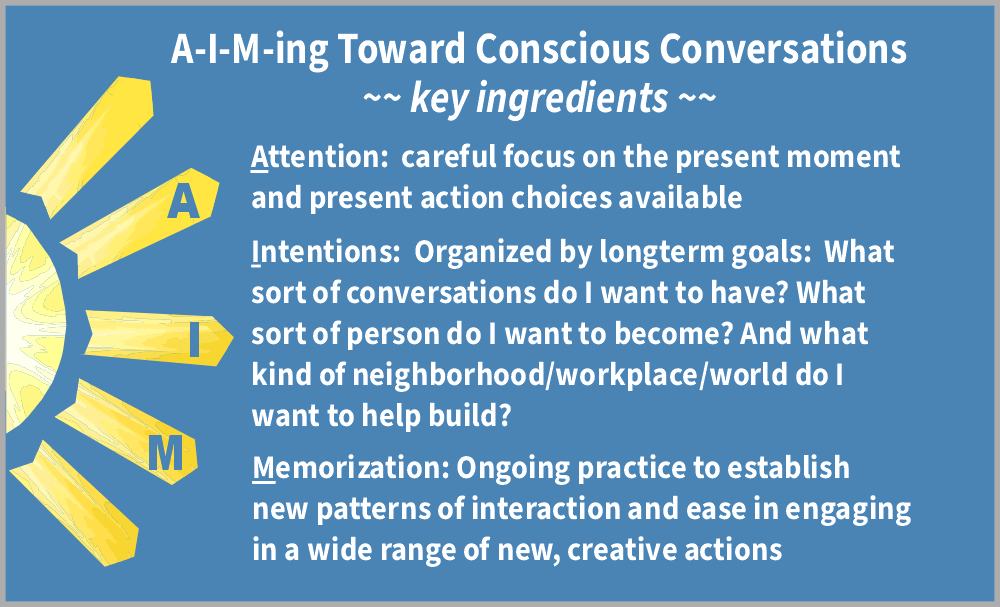
Those choices raise a natural question. If the three key ingredients are available to anyone, then what shaped the patterns we have been running on all this time? And why do those patterns sometimes serve us so poorly, even with the people we love most?
1.2 Starting Point 2:
For complex biological reasons we are born ready to learn, rather than fully equipped with the life skills we will need to flourish where we were born
Here is the biology, and it is encouraging at its core. You were born with a brain magnificently wired for language learning and connection development. But as the Overview traced, every complex skill begins at zero. You arrived knowing nothing about how to communicate — you could cry and nurse, and that was it. (In order to get born, a human being’s brain has to be small enough to allow passage through the birth canal.) Everything you know about talking, listening, and taking turns, you learned — by absorbing the patterns of your family, your community, your culture, and increasingly, your screens.
Your communication habits work the way language acquisition works: a baby born in a house full of Portuguese speakers learns Portuguese — not because Portuguese is better or worse than any other language, but because that is what was there. Your conversational patterns are inherited the same way: not through your genes, but through your environment, copied from the people around you when you were too little to know what was going on. If what you absorbed was skillful, you got lucky. If what you absorbed was sarcasm, avoidance, yelling, or silence, you learned that instead.
I think of this as the “born to learn” predicament. We humans are astonishingly adaptable, AND… none of us arrives pre-equipped for the particular communication challenges we will face. Our very adaptability — born with an empty tool box waiting to be filled with local tools — means we are also vulnerable to uneven development, where we miss out on skills that could help us. There is no shame if you find yourself missing some conversational tools. We were not born knowing all of it — we were born to learn it.
it is also true that many cultures teach their children how to assert themselves and how to fight, but not necessarily how to nurture and how to negotiate win-win solutions. I am convinced that as adults, we need to develop more of the last two in order to keep from being stuck within the limits of the first two.
And here is the genuinely hopeful fact: the same learning channel that installed your old patterns — observation, imitation, repetition — is still wide open. The awareness journey we traced in the Overview — from being embedded in our patterns to being able to see and examine them — does not have to stop. As we travel through life, we can examine what we inherited, keep what works, and learn new skills to replace what does not, one conversation at a time.
The psychologist Carol Dweck has documented something that matters enormously here. People who believe their abilities are fixed (“I’m just not good at talking about feelings”) tend to avoid challenges, because every difficulty feels like proof of a permanent limitation. People who believe their abilities can grow (“I haven’t learned how to talk about feelings yet“) tend to welcome challenges, because every difficulty is simply the next step in learning. If you have spent years believing that your communication difficulties are just “who you are,” this reframe may be the most important thing in the entire workbook. You are not a bad communicator. You are a developing one — someone whose communication patterns are ready to grow. In Transformation Eight, we will return to Dweck’s work in much greater depth.
So the capacity to learn is still open, and the invitation is real. But what exactly are we asking that capacity to do? Communication sounds like one thing — just talking and listening — but it turns out to involve a balancing act far more many-leveled than most of us ever imagined.
1.3 Starting Point 3:
Communication skills need practice because family and team coordination is a complex balancing act of three needs that pull in different directions.
Decades of research on human groups — families, work teams, organizations, neighborhoods — have found the same pattern everywhere. Every human group, from a couple to an entire company, needs to do three things at once:
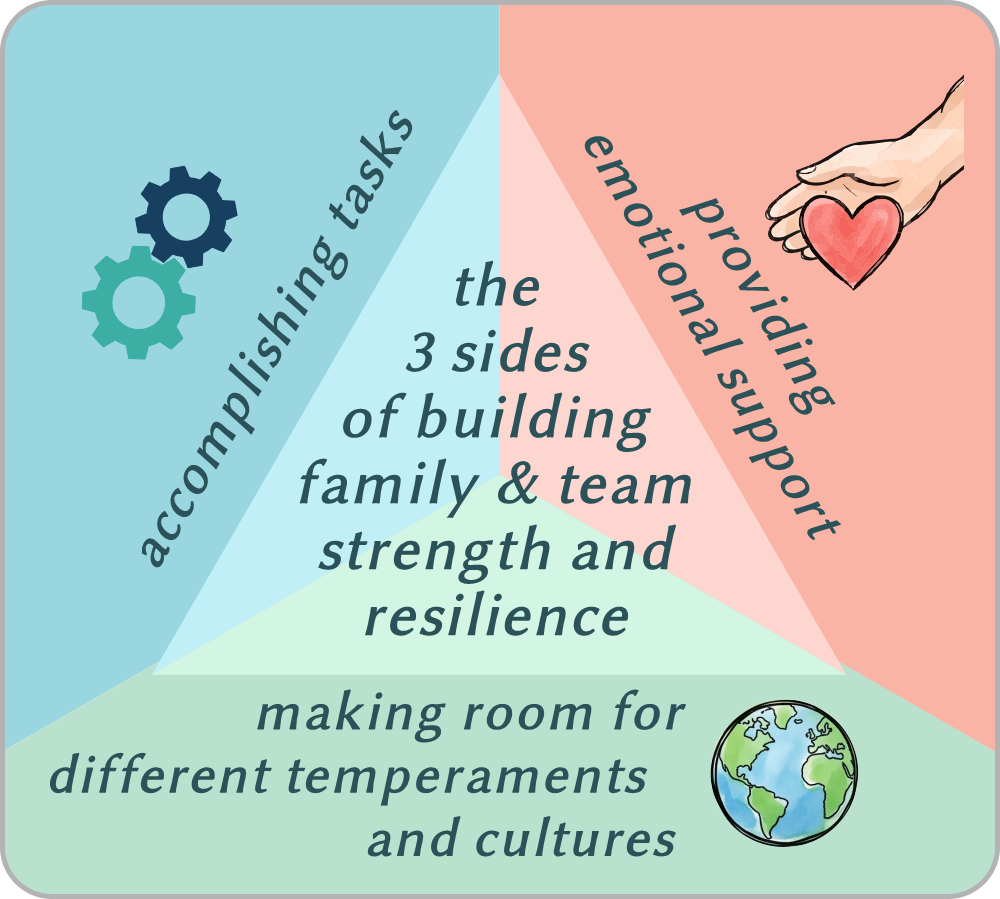
- accomplish tasks together (including sorting out conflicting needs that arise),
- support one another emotionally, through listening, empathizing, and creating times and places for people to express both their frustrations and gratitude, and
- accommodate different temperament types (and in most modern societies, make room for cultural differences).
Let one fall apart, and the others follow. Improve one, and the other two will be more easily improved. I call this three-sided pattern the team-building triangle, and it lies at the heart of everything in this workbook.
Think about your own life for a moment — not the failures, but the successes. The team at work that functions well probably does all three: the tasks get done, people feel appreciated, and different styles are accommodated. The friendship that has lasted for decades probably does all three, even if no one ever named it. Now think about the places where things are harder — the partner who handles logistics brilliantly but never feels appreciated, the work team that is all warmth but cannot meet a deadline. These are not separate problems. They are challenges to weave together the three strands more skillfully.
The third element — navigating genuine differences in temperament, culture, and style — deserves special attention. This variety is a tremendous asset, but it does not manage itself. Remember the many strands we traced in the Overview — your inner world, the other person’s inner world, both outer worlds, all dancing at once. Add the dimension of genuine difference to that dance, and you can see why this takes real practice.
The skills in this workbook address all three sides of the triangle, and the encouraging news is that you do not have to strengthen all three at once. Each of the Nine Transformations works on one strand at a time, and small gains in one corner quietly improve the other two.
So you are already doing this complex three-sided work, often better than you realize. The skills in this book are refinements, not replacements. But an honest question remains: if the skills are genuinely learnable and the growth mindset is available to anyone, why do so many earnest people read communication books, feel inspired for a few weeks, and then drift back to their old patterns? The answer has very little to do with willpower — and everything to do with an ingredient that changes the whole picture.
1.4 Starting Point 4:
Some skills don’t require learning companions, others do. Communication skills definitely fall in the learning-buddies-required group.
In high school I ran track. Most of the time it was just me and the dirt, and it felt great. But I gradually realized it was not a good model for every learning challenge I faced. One thing I have learned in thirty years of working in the communication skills field is this: reading a book on the topic, by itself, does not produce lasting change — not because the information is bad, but because information alone is not how human beings actually change.
Journalist Alan Deutschman spent years studying what it actually takes for people to make lasting changes in their lives. His conclusion, drawn from fields ranging from cardiac rehabilitation to criminal justice, is captured in three words: “Relate, Repeat, Reframe.” Change begins within a web of new relationships — an engaging teacher who believes in your capacity to grow and walks beside you (relates). Within a circle of supportive co-learners, you repeat new behaviors until they begin to feel natural. And in dialogue and practice sessions with those co-learners, you gradually reframe your understanding of yourself and what is possible.
This explains why so many people read books like this one, feel inspired, try new approaches for a few weeks, and gradually drift back. That drift is not a character flaw. It is the predictable result of trying to change without relational support. Remember the many strands we explored in the Overview — your inner world, the other person’s inner world, both outer worlds weaving together. A skill that complex needs the kind of repeated, supported practice that happens most naturally between people who are learning together.
If you have tried to improve your communication before and felt like you failed, Deutschman’s research offers a different interpretation: you did not lack willpower or intelligence. You lacked the support structure. The missing ingredient was not inside you — it was around you. And that is genuinely good news, because support structures can be built — by ordinary people, starting small. This is why Transformation Nine is entirely devoted to helping you find practice partners and develop a circle of people to learn with. I encourage you to read that chapter soon, perhaps even before you dive into the skills themselves.
For now, just hold this thought: as you read through this workbook, keep one eye open for someone you could invite to explore it with you. Even one person makes an enormous difference.
So the capacity is real, the growth mindset is available, and companionship is the ingredient that makes practice stick. But there is one more realization — one that took me decades to fully grasp — and it widens the whole picture in a way you may not expect.
1.5 Starting Point 5:
We are, each of us, already communication skills trainers-by-example. Our big choice is what we will teach others about communicating.
Usually we think of teachers at the front of the room and students in rows of chairs. But that picture is deeply misleading when applied to communication skills. You are not only an ongoing communication skills learner. You are also, right this minute, already a communication skills trainer. And you have been one every day of your life.
This is not motivational rhetoric. From the moment you wake up until you fall asleep, you are demonstrating to everyone around you one particular way that conversations can unfold. When you interrupt, you are teaching that interrupting is normal. When you listen carefully, you are teaching that careful listening is possible. When you express frustration as an attack, you are modeling one path. When you translate that frustration into a clear request, you are modeling another. Every interaction is, at some level, an instruction and invitation to the people witnessing it. Some part of what is coming toward us from other people is a reflection of what we ourselves are sending out.
One of the most empowering lessons I learned from communication coach Marshall Rosenberg was this: In order to have new conversations, we do not need to wait for the other person to change. We have half the lines in every conversation, and with mindful attention, we can start talking and listening more skillfully no matter what the other person is doing. If someone throws a mudball at you, you do not have to pick it up and throw it back. We have choices. We can choose how we respond. We can choose how we reach out. This workbook is a map of some of the most powerful choices.
Marshall had translated Gandhi’s idealistic-sounding vision of “be the change you want to see” into the very practical vision of modeling with your own behavior the behavior you want to evoke from the other person — turning the spiral of escalation into a spiral of cooperation.
Hold that picture: every conversation you have is already shaping the communication culture around you — family, work team, community — whether you mean it to or not. The only real question is whether you will shape it on autopilot or by conscious and compassionate choice. Which brings us, at last, to the practical question this whole chapter has been building toward: where, exactly, does a person begin?
1.6 Conclusion: What’s Ahead on This Journey
The chapters ahead each address a specific dimension of the awareness journey we began in the Overview. Some teach practical skills — listening, self-expression, translating complaints into requests. Some address the perspectives and attitudes that make those skills sustainable — the growth mindset, self-forgiveness, the courage to keep learning when it is uncomfortable.
Together, the Nine Transformations form not a rigid sequence but an interconnected set of practices you can return to again and again. You can work through them in order, or start with whichever transformation speaks most directly to your life right now.
In Transformation Eight, we will return to many of the ideas introduced here — the growth mindset, the “born to learn” predicament, the relationship between practice and development — but you will encounter them differently after having practiced Transformations Two through Seven. What feels conceptual now will feel experiential then. That is the spiral this workbook is built on — and it mirrors, at the scale of a single book, the spiral of expanding awareness that Robert Kegan traced across the whole arc of a human life.
Each chapter follows a rhythm you will come to recognize: breathe in the idea — let it connect to your own experience, feel the recognition of something you may have already partly known — and then breathe out the practice, trying something small in a real conversation and noticing what happens.
And now, the two small first steps I promised — one to take today, and one to begin watching for.

The step for today: start a Learning Journal. It can be any kind: a bound book, a digital document, an online notebook, a three-ring binder — even a daily email to yourself. Your Learning Journal is your first learning companion — a private, patient place where writing down your experiences allows you to see them from a different angle. That shift in perspective is where conscious learning begins. As your first entry, complete the brief reflection exercise below.
The step to begin watching for: a practice partner. No action is required yet — just keep one eye open, as you read, for a person you might eventually invite to explore this workbook with you. Any time you are ready, Transformation Nine will walk you through the invitation, step by step.
1.7 Transformation One Exercise:
Taking Stock of My Journey Toward Conscious Communication
Before you continue reading, please launch your Learning Journal. Take some time to reflect on and write down your responses to any of these questions.
1.—Think of a communication moment that went well recently — a time when you felt genuinely connected with someone, or when a difficult conversation resolved better than expected. What made it work? What were you doing, and what was the other person doing?
2.—Now think of a communication moment that went poorly — a conversation that left you frustrated, hurt, or disconnected. Without blaming anyone (including yourself), what do you wish had gone differently?
3.—What brings you to this workbook? What situation or relationship do you most want to improve?
4.—Alan Deutschman’s research suggests that change begins with new relationships, not just new information. Who in your life might you invite to explore this workbook with you? Even one practice partner can make an enormous difference.
1.8 Transformation One: References and Recommended Reading
Bales, Robert F. Interaction Process Analysis: A Method for the Study of Small Groups. Addison-Wesley, 1950.
Deutschman, Alan. Change or Die: The Three Keys to Change at Work and in Life. Harper Business, 2007.
Dweck, Carol. Mindset: The New Psychology of Success. Random House, 2006.
Edmondson, Amy C. The Fearless Organization: Creating Psychological Safety in the Workplace for Learning, Innovation, and Growth. Wiley, 2019.
Kegan, Robert. The Evolving Self: Problem and Process in Human Development. Harvard University Press, 1982.
Pearce, W. Barnett. Communication and the Human Condition. Southern Illinois University Press, 1989.
Putnam, Robert D. Bowling Alone: The Collapse and Revival of American Community. Simon & Schuster, 2000.
Richerson, Peter J., and Robert Boyd. Not by Genes Alone: How Culture Transformed Human Evolution. University of Chicago Press, 2005.
Rogers, Carl R. On Becoming a Person: A Therapist’s View of Psychotherapy. Houghton Mifflin, 1961.
Rosenberg, Marshall B. Nonviolent Communication: A Language of Life. 3rd ed., PuddleDancer Press, 2015.
Your notes on this chapter
Your notes on this chapter