Overview Edition R3
Getting Started with Transformation 1 — Seeing with New Eyes: Awakening to and Embracing Conscious Conversations — Page 4
Getting Started with Transformation 2 — Connect Better with Your Conversation Partners by Listening More Carefully and Responsively — Page 8
Getting Started with Transformation 3 — Start New Conversations by Explaining Your Conversational Intent and Inviting Consent — Page 12
Getting Started with Transformation 4 — Understand and Express Yourself More Clearly and Completely with the Five I-Messages — Page 16
Getting Started with Transformation 5 — Resolve Everyday Conflicts by Translating Criticisms and Complaints into Specific, Success-Focused
Requests — Page 20
Getting Started with Transformation 6 — Move Your Conversations Forward by Asking Questions More Open-Endedly and Creatively — Page 24
Getting Started with Transformation 7 — Deepen All Your Relationships by Expressing More Gratitude, Appreciation, Encouragement, and Delight
— Page 28
Getting Started with Transformation 8 — Shift Evolutionary Gears by Adopting the Continuous Learning Stance — page 32
Getting Started with Transformation 9 — Grow Wider Circles of Mutual Support with Practice Partners, Circles of Six, and Cooperative Networks — Page 36
Getting Started with Chapter 10 — The Right to Inspire and Invite: Reaching Out to Advocate and Mend in a Troubled World — Page 40
Dedicated to Marshall Rosenberg, Barnett Pearce, Ramon Panikkar, and Joanna Macy, four of
my teachers, and to the creative team-builders and peacemakers in every culture and faith.
Where there is a clash of wills, may we bring the light of new understanding and a meeting of hearts.
In the spirit of the teachers mentioned above, this workbook carries a Creative Commons copyright license. Anyone may republish it or make as many copies of all or parts of it as they wish. For more information about the details of this Creative Commons license, please see the reverse side of the title page.

The Loom of Emergence
We weave together words to make sentences.
We weave together sentences, and listening, and turns, to make conversations.
We weave together conversations and actions to make relationships.
We weave together relationships to make families and communities.
We weave together communities to make a shared world.
Transformation One
Getting Started with Transformation 1 —
Seeing with New Eyes: Awakening to and Embracing Conscious Conversations
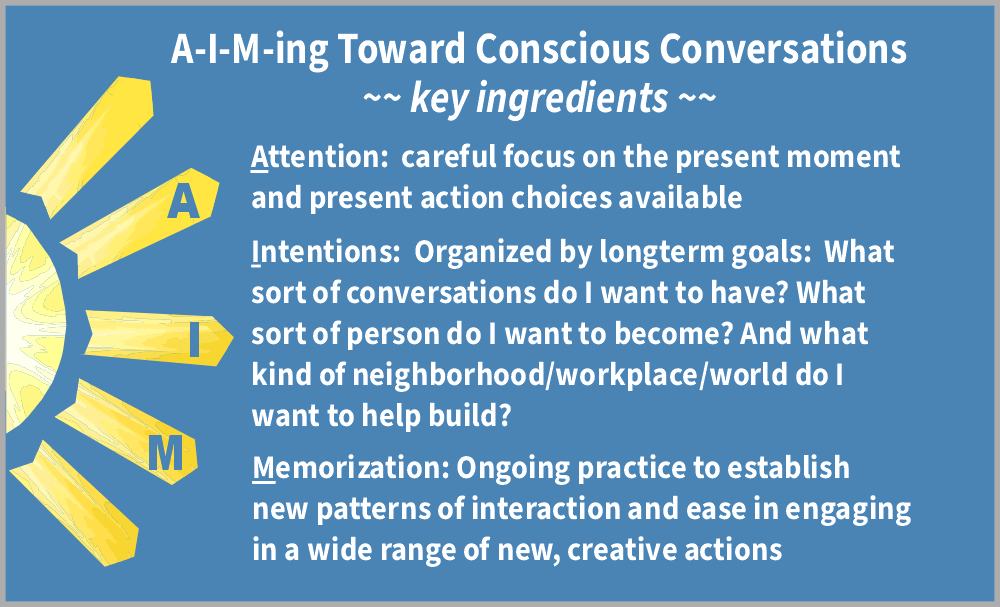
Think about how you learned to walk. You pulled yourself up, wobbled, fell down, tried again — and you did this thousands of times with fierce, unselfconscious attention. You don’t remember any of that effort now. You only remember the ease that came after. But the attention came first. Every complex skill follows that same path: conscious effort, then growing fluency. That is the path this workbook opens for your conversations — and the encouraging news is that you are not starting from zero. Every time you have paused before reacting, asked a genuine question instead of assuming, or listened in a way that helped someone feel truly heard, you were already practicing, in rough form, the skills this workbook will help you refine.
Here are the three most empowering ideas from this chapter to carry with you as you begin.
You were born not knowing — but magnificently ready to learn. You came into the world with a brain wired for connection and language, but with zero communication skills in your toolkit. Everything you know about talking and listening, you learned — by absorbing the patterns of your family, your community, and your culture, mostly before you were old enough to examine any of it. If what you absorbed was skillful, you got lucky. If what you absorbed included sarcasm, avoidance, yelling, or silence, you learned that instead. There is no shame in any of it. You weren’t born knowing — you were born to learn. And the same learning channel that installed your old patterns is still wide open. What the psychologist Carol Dweck calls the “growth mindset” puts this beautifully: the difference between “I’m just not good at talking about feelings” and “I haven’t learned how to talk about feelings yet” is the difference between a locked door and a path. You are not a bad communicator. You are a developing one — and this workbook is a map for the next stretch of that development.
You are already a communication skills trainer — every day, whether you know it or not. From the moment you wake up until you fall asleep, you are demonstrating to everyone around you one particular way that conversations can unfold. When you interrupt, you teach that interrupting is normal. When you listen carefully, you teach that careful listening is possible. When you express frustration as an attack, you model one path; when you translate that frustration into a clear request, you model another. Every interaction is, at some level, an instruction and an invitation to the people witnessing it. Marshall Rosenberg, the communication coach who developed Nonviolent Communication, crystallized this insight: in order to have new conversations, we do not need to wait for the other person to change. We have half the lines in every conversation, and with mindful attention, we can start talking and listening more skillfully no matter what the other person is doing. The only real question is whether you will shape the communication culture around you on autopilot — or by conscious and compassionate choice.
Lasting change requires companions, not just information. Journalist Alan Deutschman spent years studying what it actually takes for people to make lasting changes in their lives, and his conclusion applies directly to everything in this workbook. Change does not come from reading a book, feeling inspired for a few weeks, and then drifting back to old patterns. That drift is not a character flaw — it is the predictable result of trying to change without relational support. Deutschman’s research, drawn from fields ranging from cardiac rehabilitation to criminal justice, shows that lasting change follows three keys: Relate (find an encouraging companion who believes in your capacity to grow), Repeat (practice new behaviors in the company of supportive co-learners until they begin to feel natural), and Reframe (in dialogue with others, gradually build a new story about who you are and what is possible). If you have tried to improve your communication before and felt like you failed, this research offers a different interpretation: you did not lack willpower. You lacked the support structure. The missing ingredient was not inside you — it was around you. That is why this workbook will keep inviting you to find a practice partner and eventually a small circle of co-learners. Even one companion makes an enormous difference.
Together, the Nine Transformations form not a rigid sequence but an interconnected set of practices you can return to again and again. Some teach practical skills — listening, self-expression, translating complaints into requests, creative questioning. Some address the perspectives and attitudes that make those skills sustainable — the growth mindset, self-forgiveness, the courage to keep learning when it is uncomfortable. You can work through them in order, or start with whichever transformation speaks most directly to your life right now.
Two small first steps: start a Learning Journal — any format works — and begin keeping an eye out for someone you might invite to explore this workbook with you. The skills ahead will give you practical tools for each of these dimensions, and the relationships you build along the way will be where all of it takes root.
Going deeper: The full chapter explores all five starting points of the conscious conversation journey, including the team-building triangle, developmental psychology, and the first journaling exercises. We invite you to read the full chapter as a free PDF file by clicking here:
https://communication-skills.net/pdf/9transformations-chap1.pdf
Your notes on this chapter

Getting Started with Transformation 2 —
Connect Better with Your Conversation Partners by Listening More Carefully and Responsively
You already know what good listening feels like — from the receiving end. Think of a time when someone gave you their full, unhurried attention while you talked about something that mattered to you. Not advice. Not a quick fix. Just the experience of being heard — of watching another person’s face and realizing, “They’re actually with me right now.” If you can remember a moment like that, you already know the most important thing this chapter has to teach: that kind of listening is one of the most powerful gifts one human being can offer another. And you have already begun offering it yourself — every time you set aside what you were about to say and genuinely tried to understand someone else’s experience first.
Here are the three most empowering ideas from this chapter.
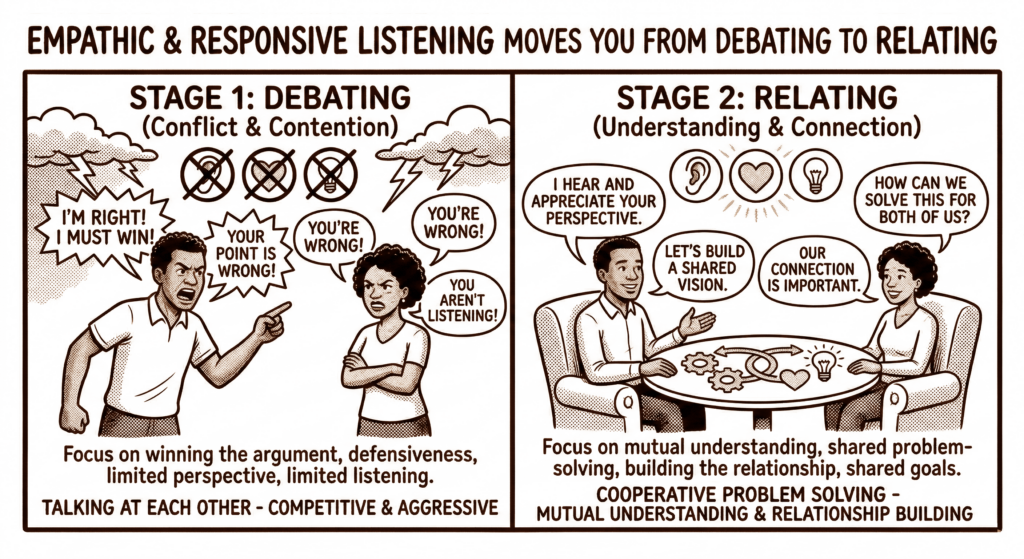
Acknowledging what someone says is not the same as agreeing with it — and separating the two changes everything. For many people, this distinction is genuinely surprising. In everyday conversation, acknowledging and agreeing are fused together like a two-for-one deal at the supermarket. The effect is that if John feels any acknowledgment of Fred’s experience implies agreement, John will refuse to acknowledge any of it. Fred tries harder and harder to be heard; John tries harder and harder not to hear. This is a recipe for a stalemated argument. But here is the liberating truth: you can acknowledge what someone is experiencing and still retain every one of your options. You can still disagree. You can still say no to a request. You can still share your own point of view. What responsive listening gives you is a way to say, in effect, “I hear you” — and mean it — without surrendering anything. A hospital nurse who says to a frustrated patient, “I hear that you’re uncomfortable and you want to get out of that bed,” is not agreeing that the patient should get up. She is acknowledging the patient’s experience — and that acknowledgment makes the patient far more willing to listen to what comes next. Research in labor-management negotiations shows that the time required to reach conflict resolution is cut in half when each side agrees to restate the other’s position before responding.
Responsive listening transforms both sides of the conversation at the same time. When you listen well, two things happen that are easy to miss. First, the speaker feels the satisfaction of being understood — one of the deepest of all human needs — and begins to relax. Their defensiveness lowers, their attention opens, and they become far more willing to hear you in return. Second, and less obviously, you begin to understand the situation more fully than you did before, because you are taking in information your own reactions would otherwise have blocked. This is the quiet miracle at the center of responsive listening: by acknowledging first, you create the conditions in which you yourself can finally be heard. In John Gottman’s famous story of his two-year-old daughter on an airplane, desperately wanting her stuffed animal Zebra, no amount of reasoning or distraction worked — but the moment he simply named what she was feeling (“You wish you had Zebra now… and you’re angry because we can’t get him for you”), the child calmed down and fell asleep. She was not interested in his excuses. But knowing that he understood how she felt made her feel better. That same principle holds in conversations between adults, in workplaces, and even in the cockpit of an airplane — where the failure to listen to a co-pilot’s concerns contributed to the crash of Air Florida Flight 90 in 1982, killing 78 people. Responsive listening is not a luxury. In some settings, it is a matter of survival.
Listening to others builds the very capacity you need to understand yourself. The psychiatrist Daniel Siegel calls this “mindsight” — the ability to perceive the internal world of your own mind and the minds of others. His research points to a finding that may surprise you: these are not two separate abilities. They are two aspects of a single capacity, grounded in the same neural circuitry. When you listen empathically to a friend describing a frustration she can barely articulate, you are exercising the very same awareness you will need when you sit down to ask yourself, “What am I actually feeling right now?” The developmental psychologist Lev Vygotsky proposed a principle that explains why this is so: every higher psychological function — including the ability to observe and name your own inner states — appears first as something that happens between people, and only later becomes an internal capacity. So each time you reflect back what someone is experiencing, you are not only offering them a mirror. You are deepening, in yourself, the self-awareness you will need in your own most important moments. Outward listening and inward listening are one capacity, aimed in two directions, growing from a single root.
A practice to begin today: in one conversation, set your phone aside, give your full attention, and after the other person finishes speaking, briefly summarize what you heard — especially the feelings in it — before you respond with your own point of view.
Going deeper: The full chapter includes detailed listening practice exercises, the complete Zebra story, the Air Florida Flight 90 case study, and guidance on how listening becomes character over time. We invite you to read the full chapter as a free PDF file by clicking here:
https://communication-skills.net/pdf/9transformations-chap2.pdf
Your notes on this chapter

Getting Started with Transformation 3 —
Start New Conversations by Explaining Your Conversational Intent and Inviting Consent
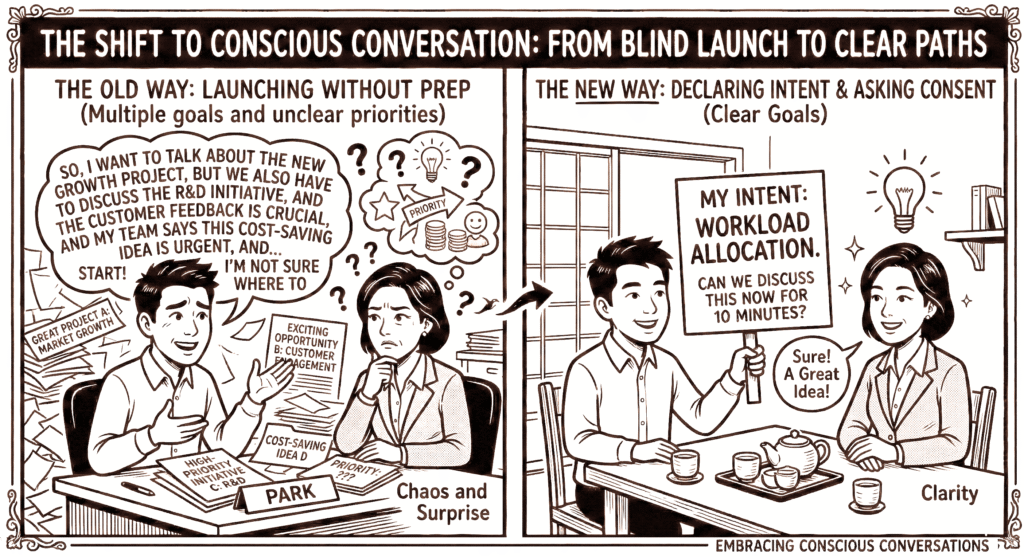
Why do so many important conversations go wrong before they have even really begun? And what is the one overlooked step that can turn a conversational ambush into a collaborative invitation? If you have ever watched someone’s face go blank — or tight — the moment you launched into something important, you have already felt the answer in your body. The missing step is so simple it can feel almost too obvious: before you begin an important conversation, briefly explain what kind of conversation you’d like to have, and invite the other person’s consent to have it.
Here are the three most empowering ideas from this chapter.
The mini-conversation before the conversation changes everything that follows. “Hi, Steve — I need to ask for your help on my project. Got a minute?” “Maria, I’d like to talk about the schedule change — is now a good time?” These openings do something that would otherwise take much longer to negotiate through body language, tone, and guesswork. In a few seconds, the speaker tells the listener: here is what I need to talk about, here is roughly how much time and energy it will take, and I am asking your permission before I begin. Consider what happens when someone erupts at you instead — pouring out a complaint or an emotional disclosure with no warning. Your guard goes up. You tense. You are in no position to listen well, because you are too busy figuring out whether you are under attack. The very same conversation, beginning with a brief explanation of intent and an invitation to consent, treats you as a partner rather than a target. The content is identical. The experience is entirely different. And that difference generates the goodwill and trust that creative problem-solving, genuine empathy, and agreements that actually hold all depend on.
Inviting consent serves all three things every relationship needs — at the same time. In Transformation One, we explored how every human group, from a couple to an entire organization, needs to accomplish tasks together, support one another emotionally, and make room for different temperaments and styles. When you explain your intent and invite consent, you address all three at once. You clarify the task (“here’s what I’m hoping to accomplish”). You offer emotional respect (“I care enough about you to ask”). And you make room for different temperaments (“I know you may need a moment to get ready for this”). A person who has consciously agreed to take part will take part more fully — and that fuller participation matters enormously. Some people process slowly and need warning before an emotional conversation. Some take in difficult news better when they know it is coming. When you invite consent, you are honoring those differences rather than steamrolling over them. And as you become more consciously familiar with the range of conversational intentions available to you — from sharing experiences to making requests, from coordinating plans to expressing appreciation — you will find it easier to invite someone into precisely the conversation you need, to say yes or no to someone else’s invitation, and to gently ask people to clarify what kind of conversation they are trying to have with you.
The fear of “no” points at a door, not a wall. If this practice produces such good results and is so simple to perform, why don’t more people start their conversations this way? When we explain our intent and invite consent, we give up something: the familiar elements of conversational coercion and surprise that quietly do our work for us whenever we just launch into whatever we want to say. In asking plainly for what we need, we become more vulnerable — because the other person can now say no. That, it seems to me, is the real reason a step this simple is so often skipped. But here is what experience teaches: a “no” to a conversational invitation is almost never a permanent refusal. It is often “not now,” or “not like this.” When someone says “I’m too busy right now,” you can acknowledge their situation and offer an alternative. When someone responds with emotional resistance, you can validate the feeling and suggest a gentler path in. The very willingness to adapt demonstrates the cooperative spirit this whole workbook is about. Every time you model the habit of explaining your intent and inviting consent, you teach everyone who witnesses it that conversations can begin this way. Your children absorb a new template. Your coworkers glimpse a different possibility. You are training the people around you — this time consciously — in a better way to begin the conversations that matter.
A practice to begin today: before your next important conversation, pause and say one sentence about what kind of conversation you’d like to have, and ask if now is a good time.
Going deeper: The full chapter includes a list of thirty fulfilling conversational intentions, twelve intentions worth growing away from, and exercises for practicing conversational openings with a partner. We invite you to read the full chapter as a free PDF file by clicking here:
https://communication-skills.net/pdf/9transformations-chap3.pdf
Your notes on this chapter
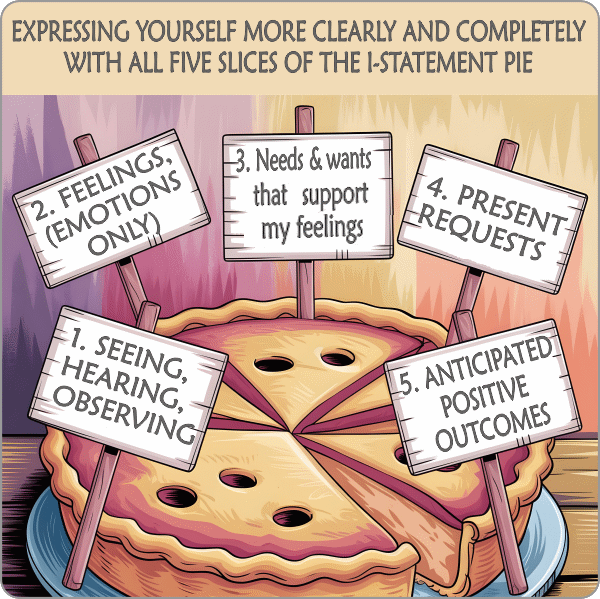
Transformation Four: Using the 5 I-Messages as a cognitive tool for both
deeper self-understanding and clearer self-expression
Getting Started with Transformation 4 —
Understand and Express Yourself More Clearly and Completely with the Five I-Messages
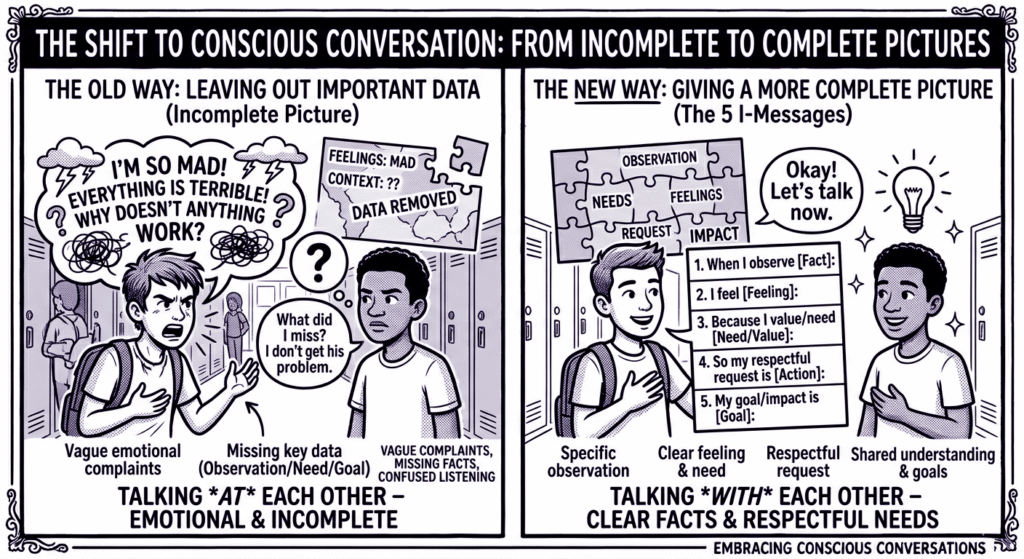
Think of a time when you were upset and, instead of reacting immediately, you paused. Maybe you stepped out of the room, or took a slow breath, or simply waited — and in that pause, something came into focus. You noticed that underneath the anger was something else: fear, or sadness, or a need you hadn’t named. And when you finally spoke, you spoke from that deeper place. Maybe you said something like, “I’m not angry about the dishes — I’m feeling overwhelmed because I had a terrible day and I was hoping we could make dinner together tonight.” And your partner’s face changed, because for the first time they actually understood what was going on inside you. If you can remember a moment like that, you already know the foundation of everything this chapter teaches: the pause to look inward is what makes speaking outward meaningful.
Here are the three most empowering ideas from this chapter.
Self-observation comes before self-expression — and the Five I-Messages are what you do on the balcony. The conflict resolution expert William Ury recommends “going to the balcony” — stepping back briefly from a tense situation to sort out your own thoughts and feelings before re-engaging. The Five I-Messages are the questions you ask yourself while you are up there. Five dimensions of experience are always happening inside you, whether or not you are aware of them: (1) What are you seeing or hearing? (2) What emotions are you feeling? (3) What needs, wants, or interpretations are driving those feelings? (4) What do you want to ask for right now? (5) What positive outcome are you hoping for? In many situations — especially the intense ones where self-expression matters most — we genuinely don’t know the answers to these questions until we have paused long enough to ask. A nurse who feels the urge to shout “Stop that racing!” at a young patient in a wheelchair can, with a moment’s pause, discover that what she is actually feeling is concern, not anger — and can express the full picture: “John, when I see you rolling down the hall really fast, I feel worried, because I need everybody to be safe, so I want to ask you to slow down, so you can get out of here in one piece.” The self-observation came first. The expression followed from it. The listener hears not a command but a whole person.
The same map works for understanding other people, not just yourself. The Five I-Messages were designed for self-expression, but they turn out to be equally powerful as a listening tool. When someone is telling you about a difficult experience, you can listen for the same five dimensions: What are they observing? What are they feeling? What need is driving the feeling? What do they want? What outcome are they hoping for? This is “listening with five ears,” and it makes you a profoundly better listener because you know what to listen for. You may be surprised how much more understood your conversation partner feels — and how much more clearly you understand them — when you listen for all five. Coaching a friend or practice partner through their five messages often turns out to be easier than doing your own internal inventory, and it is superb training for the inward version. The outward practice is the training ground for the inward one.
From scales to jazz: skill development has three stages, and the awkward middle is where the learning lives. People who try structured communication formulas sometimes complain that using them sounds robotic. Their partners roll their eyes. So they abandon the whole thing. But what’s happening is a confusion between a training protocol and a way of life. Learning the Five I-Messages is like learning to play the piano. Stage One is unconscious abbreviation — you express yourself in shorthand without realizing what you’re leaving out, and when misunderstandings arise, you blame the other person. Stage Two is conscious expansion — the scales. You deliberately pause to notice all five dimensions and practice expressing them, even when it feels excessive. Stage Three is informed brevity — you return to something that looks like ordinary conversation, brief and natural and fluid, but it is fundamentally different from Stage One, because now your brevity is chosen rather than automatic. You can feel when something important is missing — and you supply just that piece. The awkwardness of Stage Two is not a sign that the skills don’t work. It is the normal feel of a capacity stretching beyond its familiar range — and every person you have ever admired for their communication skill began exactly where you are now.
A practice to begin today: choose one moment from your day and write a five-message self-inventory in your journal. Don’t worry about whether you will ever say these words to anyone. The practice is in the noticing.
Going deeper: The full chapter includes detailed examples, a printable Five I-Messages worksheet, a Five-Part Listening Inventory for coaching others, and exercises for paired practice. We invite you to read the full chapter as a free PDF file by clicking here:
https://communication-skills.net/pdf/9transformations-chap4.pdf
Your notes on this chapter
Getting Started with Transformation 5 — Resolve Everyday Conflicts by Translating Criticisms and Complaints into Specific, Success-Focused Requests
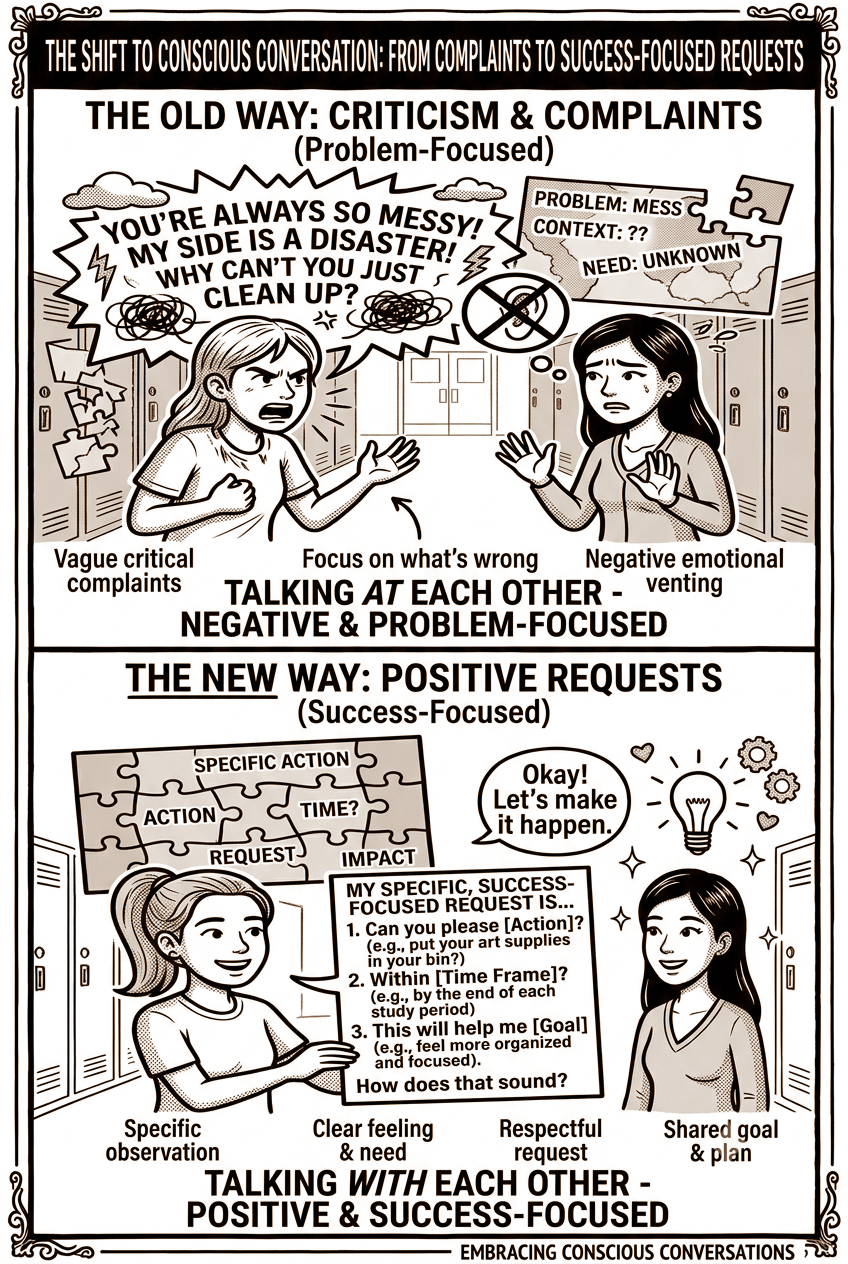
If your coworker keeps scheduling meetings over your lunch break, you probably don’t need to explore all five dimensions of your inner experience in order to address it. You need a quick, clear request. But here is the peculiar thing: most of us will complain about that meeting schedule to three other colleagues before we ever say a word to the person who could actually change it. We find it significantly easier to criticize someone for not meeting our needs than to simply ask. Why? Because in the economy of emotional risk, complaints feel cheap and requests feel expensive.
Here are the three most empowering ideas from this chapter.
Complaining protects your ego but costs you your relationships. When we complain, we position ourselves as the judge — elevated, protected, righteous. The logic of the complaint lets us maintain an illusion of self-sufficiency: “I don’t really need anything from you; I’m simply pointing out that you’re doing it wrong.” But this safety comes at a terrible price. We deny others the opportunity to actually help us. We create spirals of mutual accusation — because a criticism from one partner, no matter how justified it feels, tends to evoke a counter-criticism from the other. And the deeper tragedy is that the relationship remains shallow. By refusing to ask, we choose the guaranteed resentment of silence over the possibility of satisfaction. Think about this in terms of the three things every relationship needs: a complaint attacks all three sides of the triangle at once. It frames the task as someone else’s failure, it withdraws emotional support by adopting the posture of a judge, and it refuses to bridge the gap between perspectives. A clear request, by contrast, serves all three sides — it names a specific action that would help, it reveals your need (which is an act of trust), and it invites the other person into your perspective without demanding they abandon their own.
The quick tool turns everyday friction into everyday cooperation: a specific action plus a “so that” explanation. This chapter introduces a complement to the full Five I-Messages — a quick tool for the small, specific, fixable frustrations that make up most of daily life. The formula has two parts: “Would you be willing to [specific action]… so that [positive result]?” That is it. “Would you be willing to call me when you’re going to be more than ten minutes late, so I don’t worry?” Notice the mechanics: the request uses verbs (actions a person can do) rather than adjectives (character labels). It focuses on the future rather than the past. And the explanatory clause transforms a rigid demand into a flexible collaboration — if they can’t do exactly what you asked, understanding the “why” lets them propose an alternative that serves the same goal. This skill also works in the other direction. When someone is complaining to you, and you can hear the unspoken request buried in their frustration, you can say: “It sounds like you’re asking me to… Is that right?” This single move can redirect a conversation from mutual accusation toward problem-solving — and it is one of the most generous things you can do in a difficult moment.
Our fear of “no” is dramatically out of proportion to reality. Even knowing everything in this chapter, the fear remains: what if they say no? Research by social psychologist Vanessa Bohns at Cornell has consistently found that we dramatically underestimate other people’s willingness to say yes. In study after study, people predicted that only about 30% of those asked would agree to help; the actual compliance rate was typically above 50%. We are so focused on the possibility of rejection that we fail to recognize how often people are genuinely glad to help when simply asked. And learning to hear “no” simply as “no” — as information about the other person’s current capacity rather than a judgment of your worth — is one of the most liberating skills a person can develop. A “no” to a request is not a “no” to the relationship. It is often just a “no” to this specific strategy at this specific time. And every time you model a clear request instead of a complaint, you teach everyone within earshot — your children, your coworkers, your friends — that there is an alternative to the guaranteed resentment of silence.
This chapter also introduces an important distinction. Not every frustration calls for the quick tool. When the situation involves deep feelings, tangled history, or a relationship that feels fragile, you need the full Five I-Messages from Transformation Four. The quick tool is for the small, specific, fixable frictions of daily life — the everyday moments where a fire truck would be overkill but a pair of pruning shears would be just right. Knowing when to use which tool is itself a skill that develops with practice.
A practice to begin today: catch yourself grumbling — internally or aloud — and translate the complaint into a specific action request plus a “so that” explanation. Write both versions in your journal and notice what shifts.
Going deeper: The full chapter includes a complaint-to-request translation table, a guide for choosing between the quick tool and the full Five I-Messages, exercises for building your “asking muscle” with a practice partner, and more on the courage of vulnerability. We invite you to read the full chapter as a free PDF file by clicking here:
https://communication-skills.net/pdf/9transformations-chap5.pdf
Your notes on this chapter
Getting Started with Transformation 6 — Move Your Conversations Forward by Asking Questions More Open-Endedly and Creatively
Think of a time when someone asked you something that made you stop and really think before answering. Not a quiz question, not an interrogation — something more like: “What matters most to you about this?” or “How did that feel from where you were standing?” Maybe a friend asked the right question at the right moment and something you hadn’t been able to say suddenly came into words. If you can remember a moment like that, you already know the most important thing this chapter teaches: the right question, asked with genuine curiosity, is one of the most powerful gifts one human being can offer another.
Here are the three most empowering ideas from this chapter.
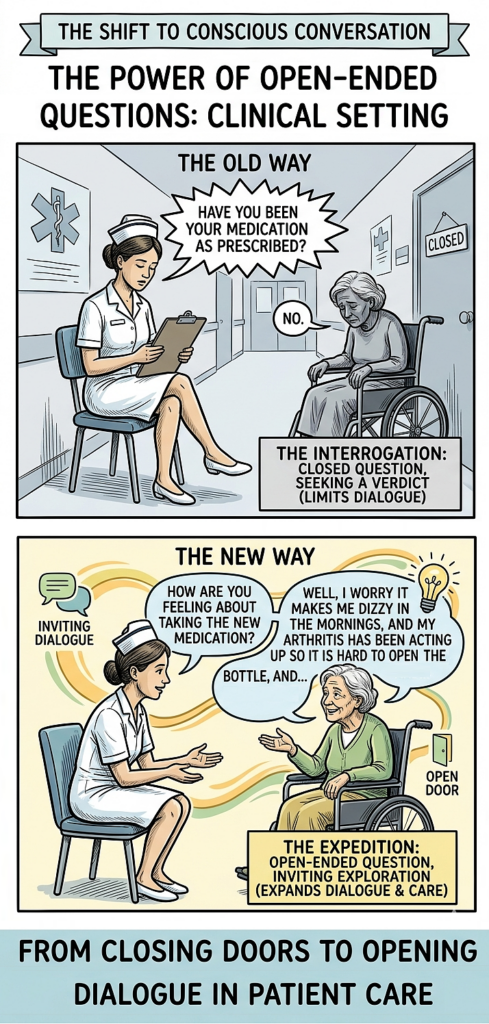
The shape of your question determines what the other person feels free to say. “Honey, do you want to go ahead and rent that apartment we saw yesterday?” leans toward yes and invites a one-word answer. “Honey, how do you feel about us renting that apartment?” opens a wide range of responses — including concerns you need to hear before you can make a good decision together. The content is identical. The shape of the question is entirely different. Open-ended questions — the ones that begin with “how,” “what,” “in what ways” — invite your conversation partners to share more of what they actually think, feel, and know. This matters in quiet conversations and in crises alike. People who feel free to voice their real concerns give you access to information that closed questions will never reach. In high-stakes settings, this can be the difference between disaster and safety. Open questions are not a luxury; they are how you give the people around you permission to tell you the truth.
Ten families of creative questions, each drawn from a different tradition, each opening a different door. Beyond the basic shift from closed to open questions lies a wider territory of creative inquiry. This chapter maps ten families of questions, arranged in a sequence that builds. The first three are questions you ask yourself: questions from the Gestalt tradition that ground you in what you are actually feeling right now; questions that replace self-blame with curiosity (“What could I learn from this?” instead of “How could I have been so stupid?”); and questions from Martin Seligman’s research that interrupt the helplessness spiral of “this will always be this way, everywhere, and it’s all my fault.” The next families address outward situations: questions from principled negotiation for when conflict is in the room, and questions that use metaphor to unlock creative possibilities. From social constructionist theory come questions about the person you are becoming: “If I do what I’m thinking about doing, what kind of person will that make me?” From narrative therapy come questions that recover your hidden moments of success — the times when the problem wasn’t there, which your dominant story may have edited out. From David Cooperrider’s Appreciative Inquiry come questions that grow what is already working: “What did you most appreciate about how this went?” And perhaps the most powerful relational question of all: “What haven’t I asked you that you wish I would?” — a door you open that the other person didn’t know was there.
Questions are companions, not tools — live with one for a week and let it surprise you. Don’t try to memorize all ten families. Choose one question — whichever one speaks to something real in your life right now. Write it on a card by your mirror or in the notes app on your phone. Carry it with you for a full week. At the end of the week, write down one or two things you noticed that you might not have seen without it. Then come back and choose another. Over a few months, you will have genuinely lived with most of these — not just read them. The philosopher Sam Keen put it directly: “Your questions are the quest you’re on. No questions — no journey. Timid questions — timid trips.” Questions do their deepest work not when you apply them like a technique but when you live with them long enough for them to change how you see. And if you are working with a practice partner or a Circle of Six, questions are superb material for shared reflection — comparing notes on which question spoke to you, what you noticed, and what surprised you. One particular family of questions — the appreciative ones — points directly toward the next transformation: the practice of noticing and expressing what is good.
A practice to begin today: find one yes-or-no question you have recently asked someone, and write an open-ended alternative beside it. Notice what information the open version might reveal that the closed version would have missed. Then choose one question from any of the ten families and carry it with you this week.
Going deeper: The full chapter explores all ten families of questions in detail, includes the Sam Keen reading on radical questioning, and offers paired exercises for sharing your questions with a practice partner. We invite you to read the full chapter as a free PDF file by clicking here: https://communication-skills.net/pdf/9transformations-chap6.pdf
Your notes on this chapter
Getting Started with Transformation 7 — Deepen All Your Relationships by Expressing More Gratitude, Appreciation, Encouragement, and Delight
The last time you walked into your home, did you notice the roof keeping rain off your head? The floor holding you up? The light switch that worked when you flipped it? Almost certainly not. And that is not because you are ungrateful. It is because human consciousness is built to notice what is broken, what is threatening, what needs fixing. The philosopher Martin Heidegger observed that our tools and our world disappear from awareness when they are working smoothly — we notice the hammer only when it breaks. This structural bias means that, without deliberate practice, we may sleepwalk through the very gifts that make our lives possible — including the people who make them possible.
Here are the three most empowering ideas from this chapter.
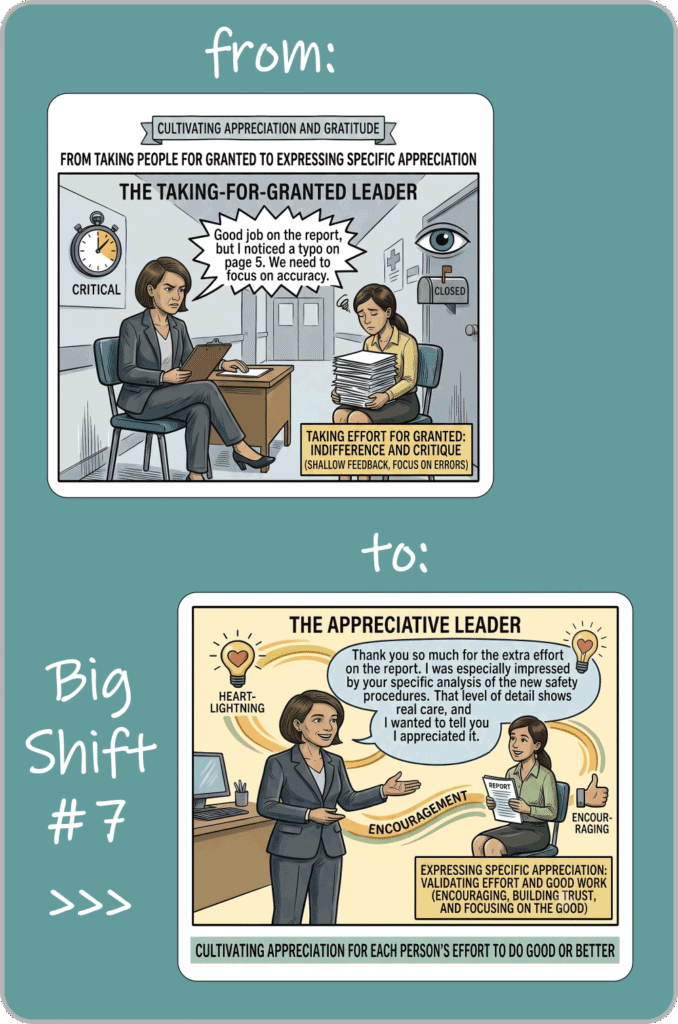
Appreciation is not a luxury — it is a corrective to a profound structural bias in human attention. The research on what happens when positive recognition is present — and when it isn’t — is among the most dramatic in the social sciences. John Gottman found that the determining factor in the long-term success of love relationships is the ratio of positive to negative interactions: roughly five appreciations for every one criticism. Couples who fell below this ratio were significantly more likely to divorce. Betty Hart and Todd Risley found a parallel pattern in child development: the most curious and self-starting children come from homes where expressions of interest exceed corrections by about three to one. Appreciation is the sunshine of human development. When it is present in sufficient measure, people flourish. When it is absent, they wither — slowly, invisibly, and often without understanding why. But the obstacles go deeper than forgetfulness. Researcher Brené Brown describes “foreboding joy” — the experience of feeling happiness and immediately bracing for disaster, as though letting yourself feel too much joy makes you vulnerable to a greater fall. Brown found that the most resilient people were not those who suppressed their joy but those who had learned to pause in moments of happiness and deliberately feel thankful. The practice of gratitude doesn’t make you more vulnerable. It makes you more able to bear what comes.
Four distinct forms of positive attention — the Four Heart Beams — each with its own gift to give. Gratitude is the warm recognition that someone has met your need — and the impulse to let them know you felt it. It is personal, specific, and relational. Appreciation is wider — an act of witness on behalf of the community when you see goodness that doesn’t involve you directly. When you watch a stranger help an elderly person across a busy street, no need of yours has been met, yet something in you responds. Appreciation says: “I saw what you did. It mattered. Not just to me — to us.” Delight is the spontaneous overflow of joy in the presence of something beautiful or alive. It asks nothing and explains nothing. It simply says: I am moved, and I want to share this aliveness with you. Encouragement is forward-looking. It says: “I see you struggling toward something good, and I want to strengthen your resolve.” Real encouragement requires that you actually see the person — where they are, what they’re reaching for, and what it’s costing them. Together, these four heart beams form a practice of attention that can gradually shift the balance of your inner life from one dominated by what’s wrong to one that also — regularly, deliberately, joyfully — notices what’s right.
Three-Part Appreciations give your gratitude the specificity that makes it land. “You’re wonderful!” is a positive judgment, but it puts the speaker in the role of judge and disappears the speaker’s own experience from the message. The Three-Part Appreciation, built directly on the Five I-Messages from Transformation Four, is far more powerful: name the action (“When you stayed late to help me finish the report…”), name the feeling it evoked (“…I felt so relieved and supported…”), and name the need it met (“…because I really needed to know I wasn’t alone with that deadline”). This specificity is what makes the difference between an appreciation that produces a brief, pleasant glow and one that the recipient remembers for years. Think of appreciation as the emotional savings account of any relationship. When the account is full — when both parties feel regularly seen, thanked, and celebrated — the relationship can absorb the withdrawals that disagreements inevitably make.
Each of the four heart beams is a different corrective to the breakdown bias. Gratitude corrects the tendency to take personal gifts for granted. Appreciation corrects the cultural blindness to acts of goodness that don’t involve us directly. Delight corrects the habit of rushing past beauty on the way to the next problem. And encouragement corrects the isolation of someone who is trying to grow but can’t yet see their own progress. Together they fill the emotional savings account that makes a relationship strong enough to hold the tensions of disagreement and problem-solving.
A practice to begin today: compose one Three-Part Appreciation for someone in your life — name the specific action, the feeling it evoked in you, and the need of yours it met — and consider delivering it.
Going deeper: The full chapter explores the research in depth, the ecological vision of gratitude as reciprocity, the stories we tell ourselves that block our capacity for joy, and a week of appreciation exercises. We invite you to read the full chapter as a free PDF file by clicking here: https://communication-skills.net/pdf/9transformations-chap7.pdf
Your notes on this chapter
Getting Started with Transformation 8 — Shift Evolutionary Gears by Adopting the Continuous Learning Stance
If you have tried any of the skills in this workbook in a real conversation, you have almost certainly felt the awkwardness. The paraphrase that sounded stilted. The five-message self-inventory that felt like filling out a form. The open-ended question that landed clumsily. That awkwardness is not a sign that the skills don’t work or that you aren’t cut out for them. It is the normal feel of a capacity stretching beyond its familiar range — and every person you have ever admired for their communication skill began exactly where you are now.
Here are the three most empowering ideas from this chapter.
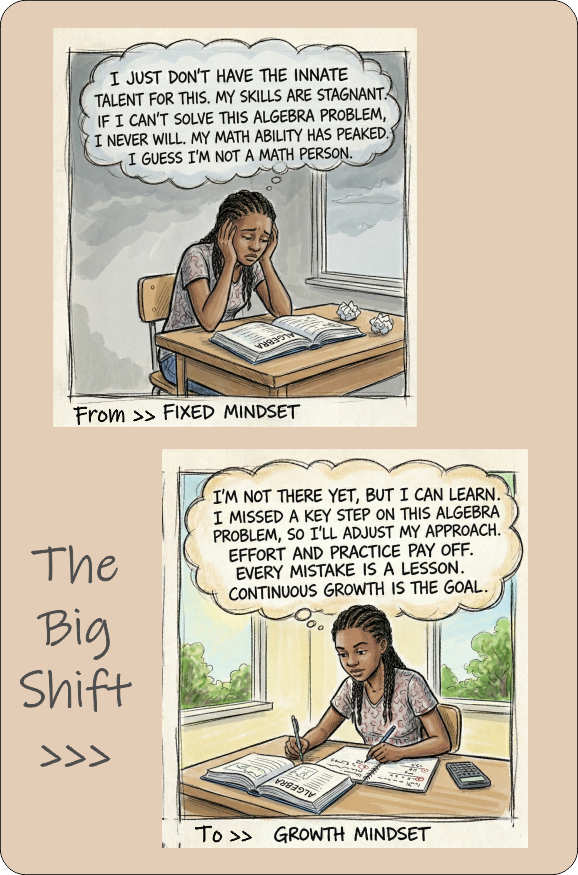
The growth mindset: the difference between “I’m just not good at this” and “I haven’t learned this yet” is the difference between a wall and a path. Stanford psychologist Carol Dweck has spent decades studying why some people keep developing throughout their lives while others plateau early and stay stuck. People with a fixed mindset believe their qualities are carved in stone — that intelligence, personality, and communication ability are things you either have or you don’t. Every difficulty becomes proof of a permanent limitation. People with a growth mindset see their qualities as things that can be developed through dedication and effort. Every difficulty becomes the next step in learning. The fixed mindset almost never announces itself as a theory. It shows up as a quiet sentence in the back of your mind: “I’m just not a people person.” “I’m bad at confrontation — I always have been.” “That’s just how I am.” The growth mindset replies: the door you thought was locked is actually just stuck. If you have spent years believing that your communication difficulties are just “who you are,” this reframe may be the most important thing in the entire workbook. You are not a bad communicator. You are a developing one — someone whose communication patterns are ready to grow.
Your habit system is not the enemy — it is the instrument of change. Most books about personal change mention habits only to tell you they are the problem. This chapter tells you something very different. Your brain has an extraordinarily powerful system for forming habits. It learned to walk for you. It learned to talk for you. That system is your greatest ally — the problem is that nobody ever told you that you could drive it. In its default mode, your habit system forms patterns from whatever you repeatedly do, without asking whether those patterns serve you well. If you repeatedly interrupt, it builds an interrupting habit. But in its second mode — the mode that continuous learning activates — the same system can form patterns from what you choose to practice. Same machinery, different operator. The honest part: your old habits have had a head start of many years, and they reassert themselves most forcefully under stress. So building a new habit means practicing it well past the point where you feel comfortable — a process psychologists call “overlearning.” The new pattern has to accumulate enough repetitions to hold its ground when the pressure is on. You can change deeply ingrained patterns, but not by getting rid of them. You learn new patterns and practice doing them first.
Self-forgiveness is learning’s necessary partner. Consider learning to shoot a basketball. You throw the ball toward the basket. Much of the time it does not go in. If you concluded, the first time the ball missed, that you were a terrible player and deserved to be punished for your badness, you would never learn to make it go in. Focusing on your badness means you are not watching the ball. A creature that learns through trial and error cannot afford to punish itself for the errors. The errors are not the problem — they are the information. Self-punishment interferes with this process, because a mind consumed with shame cannot observe itself clearly and plan its next move. When your carefully practiced new response vanishes under pressure and the old automatic one takes its place, that is not evidence that you are failing. It is evidence that the old habits have had a long head start and the new patterns haven’t been practiced enough to compete under pressure. It is a timing problem, not a character problem. Direction, not perfection. And that is the most natural thing in the world — it is what we were born to do.
In the short run, our conversations express who we are. But in the long run, our conversations create who we are, as we continually practice particular ways of relating to others. The qualities you practice become the qualities you embody. Each of us has it within our power to make each conversation an opportunity to become a more aware, more skillful, more compassionate person. Not a perfect person. A growing one. Direction, not perfection.
A practice to begin today: identify the quiet fixed-mindset sentence in the back of your own mind about communication — the one that says “I’m just not good at this” — and rewrite it as a growth-mindset sentence. Note both versions in your journal.
Going deeper: The full chapter includes a detailed summary of Carol Dweck’s research, the relationship between continuous learning and character formation, and journaling exercises for each transformation. We invite you to read the full chapter as a free PDF file by clicking here: https://communication-skills.net/pdf/9transformations-chap8.pdf
Your notes on this chapter
Getting Started with Transformation 9 — Grow Wider Circles of Mutual Support with Practice Partners, Circles of Six, and Cooperative Networks
If you have been reading this workbook in sequence, you have noticed a recurring invitation: “Find a practice partner.” “Try this with a co-learner.” That invitation has been growing more insistent with each chapter — and now, at last, this transformation devotes itself entirely to showing you how. This is not an afterthought. It is a developmental necessity. The skills in this workbook are relational skills, and they grow through relational practice — in the same way that you cannot learn to dance by reading about it in a room by yourself.
Here are the three most empowering ideas from this chapter.
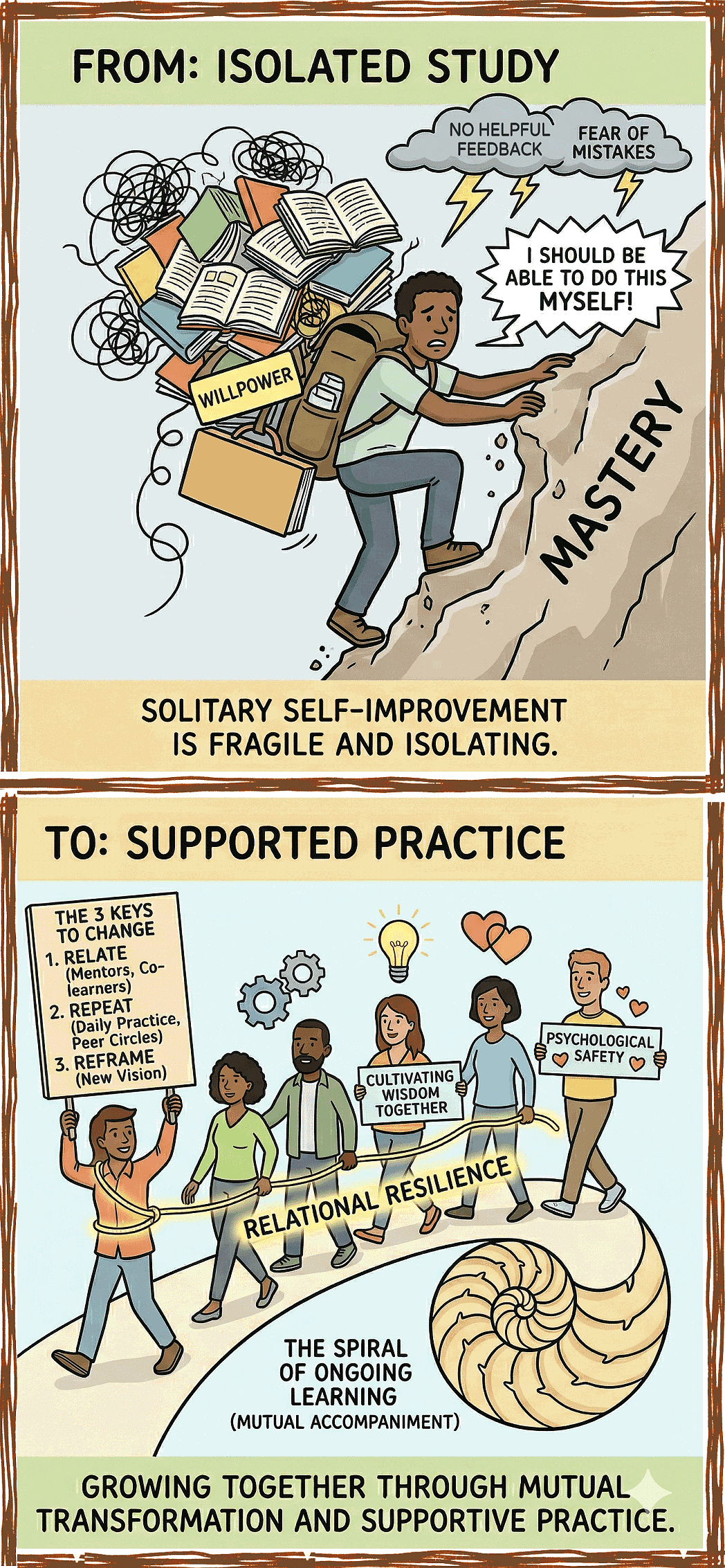
Relate, repeat, reframe: the three keys to lasting change all require companions. Alan Deutschman’s research shows that lasting personal change follows a specific pattern. It begins with a relationship to someone who embodies a different way of being — an empowering mentor, a practice companion, even a historical figure whose life gives you permission to grow. It deepens through repetition inside a supportive group, where new behaviors can be practiced past the point of initial comfort into genuine, pressure-tested competence. And it matures through reframing — building, in dialogue with others, a new story about who you are and what is possible. If you have tried to improve your communication before and felt like you failed, this research offers a different interpretation: you were attempting, largely on your own, something that by its very nature almost no one sustains on their own. You did not lack willpower. You lacked the relational environment where the change could take root. Almost everyone who struggles with communication skills feels a quiet shame about needing to practice them — a corrosive suspicion that you should already know how to do this. Psychologist Irvin Yalom called the moment this illusion breaks “universality”: the discovery that the struggle you thought was uniquely yours is in fact nearly universal. A practice group dissolves this isolation simply by existing.
Purpose Partners and Circles of Six give you concrete structures for mutual learning. The Practice Partnership is the first widening circle — two people who commit to meeting regularly, taking turns coaching each other through the Five I-Messages, practicing responsive listening, role-playing difficult conversation openings, and reflecting on what they are learning. The intimacy of a pair creates conditions no larger group can replicate: deep mutual knowledge, complete honesty, and a degree of accountability that is difficult to evade. In every partnership, there is a three-note chord: areas where your partner knows more than you (where you are the student and gratitude is natural), areas where you are roughly equal (where you are co-explorers and curiosity is the stance), and areas where you know more (where you gently offer yourself as a mentor). Keeping all three notes sounding is itself one of the deepest communication practices there is. The Circle of Six is the second widening circle — a small group of four to six people that meets regularly to practice together. Its distinctive power lies in diversity: different temperaments, different communication styles, different life experiences — the very differences that make cooperative communication necessary in the first place. The circle becomes a living laboratory for the skills this workbook teaches, and a greenhouse where tender new ways of relating can take root before they have to survive in the open weather of your most important relationships.
Your circle of empowering ancestors can sustain you before you find living companions — and deepen your practice long after you do. If no permission-giving mentor appears in your neighborhood, you are not without companions. Throughout human history, certain individuals have demonstrated — through their lives, their struggles, and their integrity — that it is possible to live with extraordinary compassion and courage. Gandhi, Harriet Tubman, Marie Curie, Martin Luther King Jr., Nelson Mandela, Rachel Carson — these individuals lived differently, in part, so that we could live differently. They are freely available to anyone, in any town, at any hour. Take time to identify the people whose lives give you permission to pursue more compassionate communication. Write their names in your Learning Journal. Learn their stories. When the surrounding culture tells you that kindness is weakness, let these ancestors remind you that you belong to a long lineage of people who chose compassion in the face of cruelty.
Here is the core developmental principle at the heart of this transformation: in this particular kind of learning, the giving is the learning. You cannot receive as much help as you are unwilling to give — not because of a moral rule, but because of how the capacity actually develops. Each time you coach a partner through their five messages, you deepen your own capacity for self-awareness. Each time you listen responsively to someone else’s struggle, you strengthen the very circuitry you need for your own moments of self-observation.
A step to begin today: think of one person you might invite to explore this workbook with you. A simple invitation is usually enough: “I’m working through a communication skills workbook and looking for a practice partner — would you like to explore it together?” Even one companion makes an enormous difference.
Going deeper: The full chapter includes detailed guidance on finding and sustaining a purpose partner, running a Circle of Six, a sample working agreement, and the research on how resilience grows in relationship. We invite you to read the full chapter as a free PDF file by clicking here:
https://communication-skills.net/pdf/9transformations-chap9.pdf
Your notes on this chapter

Seeds in the Morning Sky of a New Day
Image: Dennis Rivers + AI — Public Domain — May be reproduced.
Getting Started with Chapter 10 — The Right to Inspire and Invite:
Reaching Out to Advocate and Mend in a Troubled World
The previous chapters have described the cooperative life as though it unfolds in a friendly world. It does not always. This short closing chapter acknowledges the world as it actually is — and invites you to recognize that the skills you have been developing are not just personal improvements. They are seeds you carry into a world that desperately needs them.
Here are the three most empowering ideas from this chapter.
Every conversation you have is already shaping the communication culture around you — the only question is whether you will shape it on autopilot or by conscious choice. Everything you practice inside a partnership or a circle travels with you into the rest of your life. The listening you refine with your practice partner becomes the listening you bring to a tense meeting at work. The ability to translate a complaint into a request, first practiced in the safety of your circle, becomes the move that saves a conversation with your teenager. These skills do not stop at the edge of the practice group. They belong to you as a member of widening circles — your family, your workplace, your neighborhood, your community — and they travel into every conversation you will ever have.
The right to inspire and invite: offering seeds, not demands. There is a right that every human being possesses, though it has never been written into any constitution. It is the right to inspire and invite — not the right to coerce, to diagnose, or to fix. It is the right to say, openly: I have found something that has made my life better — a set of skills, a way of listening, a practice of translating frustration into honest requests — and I want to offer it to you, freely, with no strings attached. You may say no. You may say not now. But the offer itself is an act of care. Think of this as Johnny Appleseed work. He did not force anyone to plant orchards. He walked the frontier, scattered seeds, tended what he could, and moved on. Some seeds took root and fed communities for generations. Some did not. He kept planting. He understood that you do not have to see the harvest to justify the planting.
You are the agent of transformation you have been waiting for — and the next circle is ready to open. This is the arc of the entire workbook, seen from above: from the autopilot of Transformation One to the conscious choice of this closing chapter. From the discovery that you were born to learn, to the recognition that you are already teaching. From the first awkward paraphrase to the slow formation of a more compassionate way of being in the world. The Nine Transformations are not a rigid sequence to complete and set aside. They are a repertoire to return to — each time with more experience and more companions for the journey. You will be met with eye-rolls. But remember your empowering ancestors — the people who chose compassion in the face of cruelty. You are in their lineage. And remember the children. Every seed of cooperative skill you plant in one family, one workplace, one neighborhood is one small push against the culture of violence. The seeds travel further than the planter.
We invite you to learn this material deeply and become a peer volunteer learning companion for others traveling the path of the Nine Transformations. We invite you to read the full chapter as a free PDF file by clicking here: https://communication-skills.net/pdf/9transformations-chap10.pdf
Your notes on this chapter
CREATIVE COMMONS COPYRIGHTS AND PERMISSIONS:
(the gist) YOU HAVE PERMISSION TO MAKE COPIES
AND TRANSLATIONS OF ALL OR PARTS OF THIS DOCUMENT
For non-profit distribution: You have non-exclusive permission to make an unlimited number of copies and/or translations of this entire workbook (or parts thereof written by Dennis Rivers) for use in your family, school, college or university, business, public agency, church, synagogue, mosque, temple, and/or community service organization, provided that such copies include this permissions page (or in the case of sections or pages, include one of the short Creative Commons copyright notices described below)
For general distribution (including course readers in schools and colleges): The pages and documents appearing in Nine Transformations for New Conversations are copyright 1997 through 2026 by Dennis Rivers, except where otherwise noted or where excerpts from already copyrighted scholarly works have been cited in accordance the “Fair Use” doctrine of copyright law. The parts of this workbook written by Dennis Rivers may be copied, adapted, translated, distributed and/or sold in book or sheet format, under the terms of the “CC BY-SA 4.0 Attribution-ShareAlike 4.0 International Deed” which you can read at https://creativecommons.org/licenses/by-sa/4.0/deed.en . This License provides that any such copies, editions, translations, and/or adaptations bear the license shown below, allowing others to reproduce and further develop the work adapted. The parts of this workbook written by authors other than Dennis Rivers retain their original copyright and cannot be sold to the general public or incorporated into new works for sale without the permission of their respective authors.
Please include the following at the end of any multiple-page copies of material written by Dennis Rivers:
In all countries allowing Creative Commons free-to-copy licenses:
“Copyright 1997-2026 by Dennis Rivers. Reproduced with author’s permission from the original at Communication-Skills.NET under the CC BY-SA 4.0 Attribution-ShareAlike 4.0 International Deed” which you can read at https://creativecommons.org/licenses/by-sa/4.0/deed.en”
Please note individually reproduced pages that are written by Dennis Rivers as “Copyright 1997-2026 by Dennis Rivers. Reproduced with author’s permission under Creative Commons license CC BY-SA 4.0.”
In all countries not recognizing Creative Commons free-to-copy licenses:
“Copyright 1997-2026 by Dennis Rivers. Non-exclusive permission to reproduce for educational, community, organizational and commercial use granted by author.”