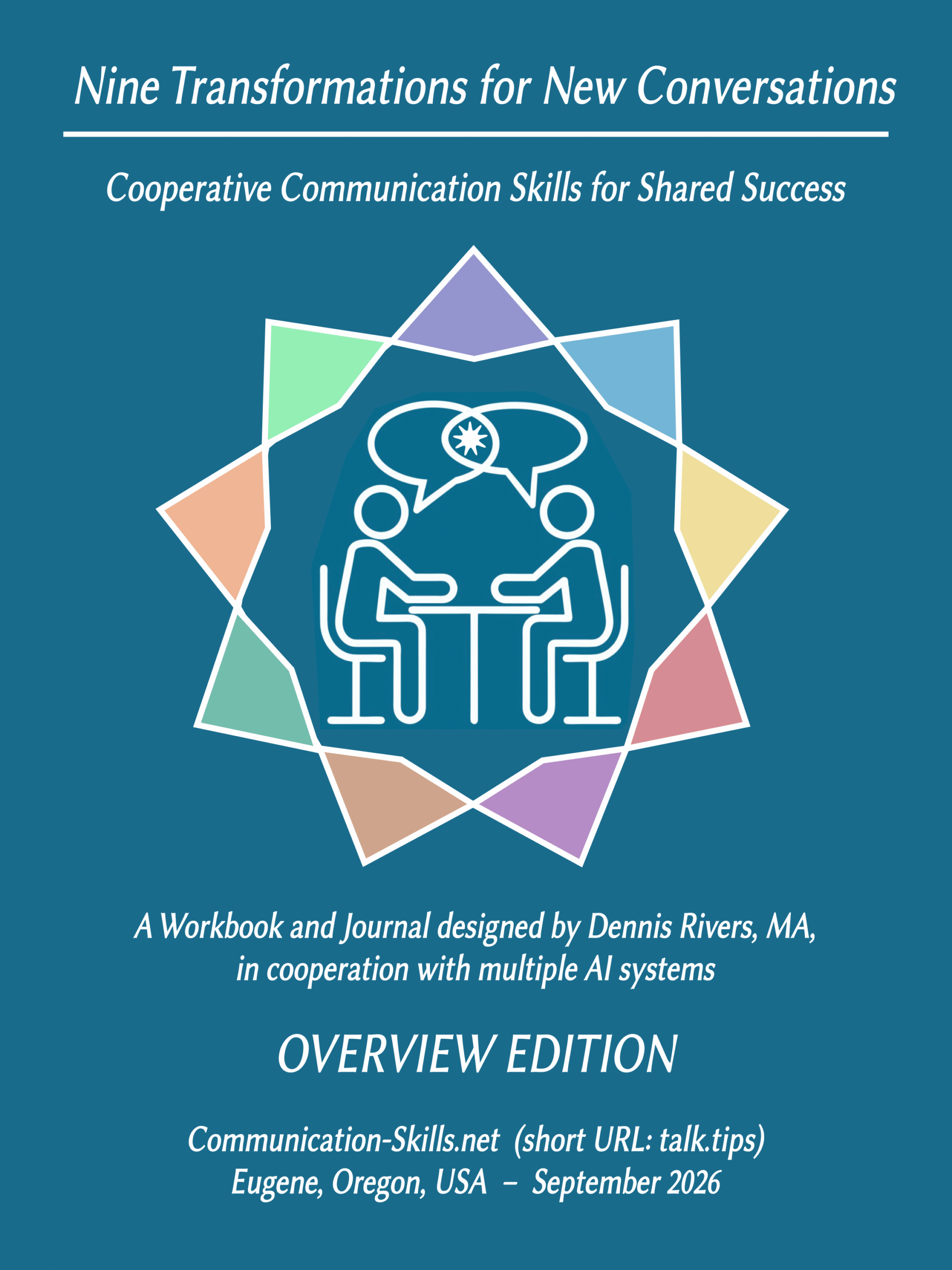
OVERVIEW EDITION — Nine Transformations for New Conversations — Cooperative Communication Skills for Shared Success
Transformation 1 —
Seeing with New Eyes: Awakening to and Embracing Conscious Conversations
Transformation 2 —
Connect Better with Your Conversation Partners by Listening More Carefully and Responsively
Transformation 3 —
Start New Conversations by Explaining Your Conversational Intent and Inviting Consent
Transformation 5 — Resolving Everyday Conflicts by Translating Criticisms and Complaints into Specific, Success-Focused Requests
Transformation 4 —
Understanding and Expressing Yourself More Clearly and Completely with the Five I-Messages
Transformation 6 — Move Your Conversations Forward by Asking Questions More Open-Endedly and Creatively
Transformation 7 — Deepen All Your Relationships by Expressing More Gratitude, Appreciation, Encouragement, and Delight
Transformation 8 — Shift Evolutionary Gears by Adopting the Continuous Learning Stance
Transformation 9 — Grow Wider Circles of Mutual Support with Practice Partners, Circles of Six, and Cooperative Networks
Chapter 10 — The Right to Inspire and Invite: Reaching Out to Advocate and Mend in a Troubled World
Dedicated to Marshall Rosenberg, Barnett Pearce, Ramon Panikkar, and Joanna Macy, four of
my teachers, and to the creative team-builders and peacemakers in every culture and faith.
Where there is a clash of wills, may we bring the light of new understanding and a meeting of hearts.
In the spirit of the teachers mentioned above, this workbook carries a Creative Commons copyright license. Anyone may republish it or make as many copies of all or parts of it as they wish. For more information about the details of this Creative Commons license, please see the reverse side of the title page.

The Loom of Emergence
We weave together words to make sentences.
We weave together sentences, and listening, and turns, to make conversations.
We weave together conversations and actions to make relationships.
We weave together relationships to make families and communities.
We weave together communities to make a shared world.
Transformation One
Transformation 1 —
Seeing with New Eyes: Awakening to and Embracing Conscious Conversations
By the time you were three, you could walk across a room without a second thought — but you got there through months of extraordinarily focused attention: pulling yourself up, wobbling, falling, trying again. You do not remember that effort. You only remember the ease that came after. But the attention came first. Every complex skill follows that same path: conscious effort, then growing fluency. Communication skills are just like that — and something in your own experience already confirms this, if you pause long enough to notice it.
Think of a conversation that went well recently — a time when you felt genuinely connected with someone, or when a difficult exchange resolved better than expected. What made it work? Whatever you did in that moment — pausing before reacting, asking a genuine question, listening in a way that helped someone feel heard — you were already practicing, in rough form, the skills this workbook will help you refine.
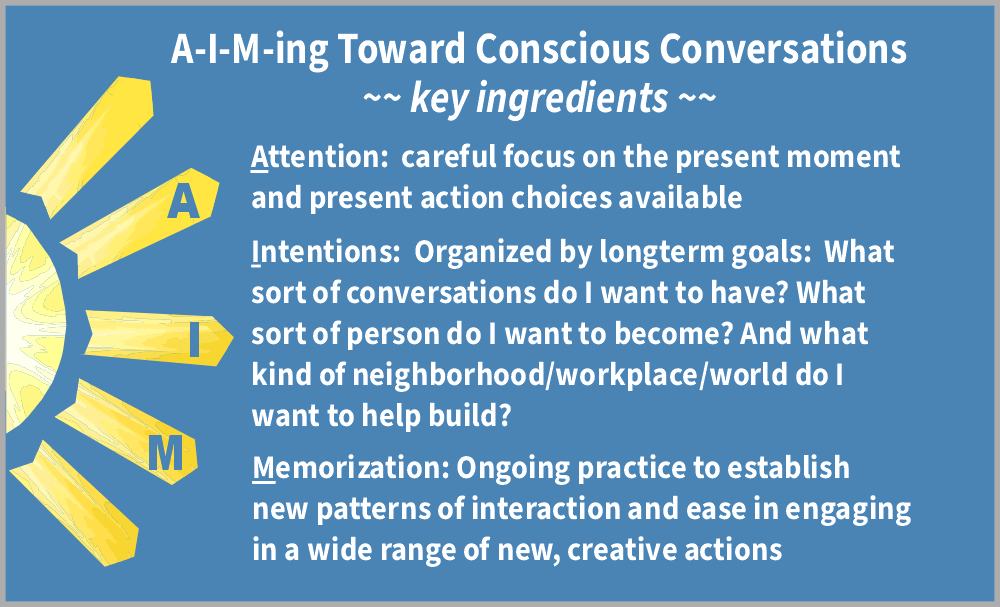
Most of us have been communicating on autopilot — running patterns absorbed before we were old enough to examine them. Your conversational habits are inherited not through your genes but through your environment, copied from the people around you when you were too little to know what was going on. The developmental psychologist Robert Kegan traced a recurring pattern across the arc of a human life: growing up is a lifelong journey of expanding awareness — making visible what was previously invisible so we can make genuine choices about things that used to just happen to us. That shift, from being inside an experience to being able to step back and see it, is what this workbook invites.
Communication is not difficult because you are bad at it. Communication is difficult because it is genuinely complex. Research on human groups has found the same pattern everywhere: every group, from a couple to an entire company, needs to do three things at once — accomplish tasks together, support one another emotionally, and accommodate different temperaments and styles. This “team-building triangle” lies at the heart of the workbook.
But information alone does not produce lasting change. Journalist Alan Deutschman’s research found that change begins within a web of new relationships: relate, repeat, reframe. If you have tried to improve your communication before and felt like you failed, Deutschman’s research offers a different interpretation: you did not lack willpower — you lacked the support structure. This is why the workbook will eventually invite you to find a practice partner. And here is one more realization that widens the whole picture: you are not only a communication skills learner. You are already, right this minute, a communication skills trainer-by-example. Every interaction you have demonstrates to the people witnessing it one particular way that conversations can unfold. The only real question is whether you will shape that culture on autopilot or by conscious and compassionate choice — which brings us to the most practical question: where does a person begin? With listening.
Transformation 2 — Connect Better with Your Conversation Partners by Listening More Carefully and Responsively
You already know what good listening feels like — from the receiving end. Think of a time when someone gave you their full, unhurried attention while you talked about something that mattered to you. Not advice. Not a quick fix. Just the experience of being heard — of watching another person’s face and realizing, They’re actually with me right now. If you can remember a moment like that, you already know the most important thing this chapter has to teach: that kind of listening is one of the most powerful gifts one human being can offer another. And you have already, in your own way, been offering it.
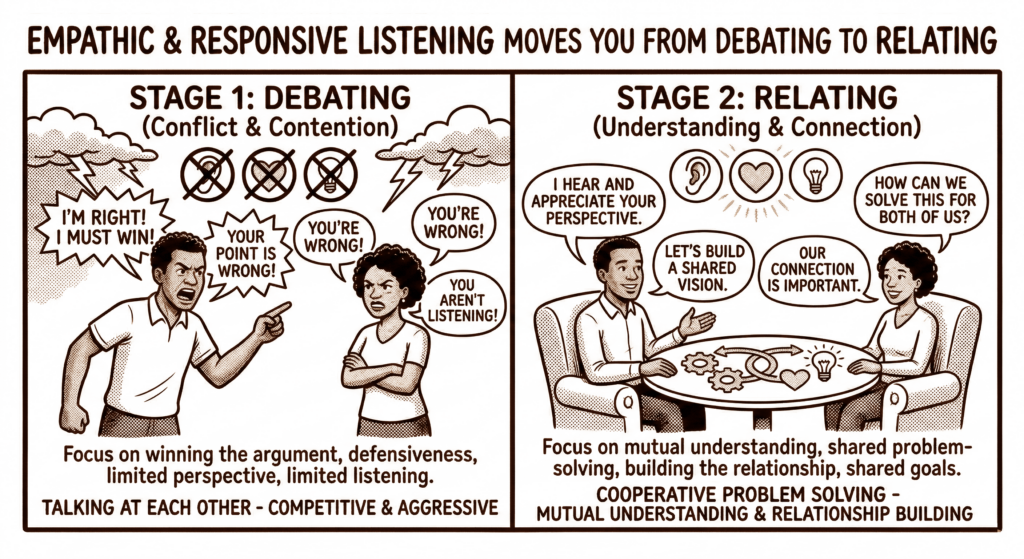
The practice at its heart is deceptively simple: listen first and acknowledge what you hear, even if you don’t agree with it, before expressing your own view. This practice separates acknowledging from approving — a distinction that many people find genuinely surprising, because in everyday conversation the two are fused together. The effect of that fusion is deadlock: if John feels that any acknowledgment of Fred’s experience implies agreement, John will refuse to acknowledge anything, and Fred will try harder and harder to be heard. But once the distinction is clear, something opens. You can say, “I hear that you’re frustrated and that you want this to change,” and still hold every one of your own options — agreeing, disagreeing, saying yes, saying no.
Two true stories show the reach of this single capacity. Psychologist John Gottman describes calming his two-year-old daughter on an airplane by simply naming what she was feeling instead of explaining, reasoning, or distracting. Within minutes, she was asleep. At the opposite extreme, the crash of Air Florida Flight 90 in 1982, which killed 78 people, was partly caused by a captain who dismissed his first officer’s repeated concerns about ice on the wings without ever genuinely exploring them. One moment of “I hear you — what’s our next step?” might have changed everything.
What keeps responsive listening from showing up more often is not just distraction — it is the quiet fear that hearing will be mistaken for agreeing. That fear nearly dissolves the moment you see that acknowledgment and agreement are separate acts. And as the psychiatrist Daniel Siegel’s research on “mindsight” reveals, the capacity to perceive another person’s inner world and the capacity to perceive your own are not two separate abilities — they develop together, through the same interpersonal experiences. Each time you listen deeply to someone else, you are strengthening the very awareness you need for your own most important moments.
With practice, responsive listening does more than improve conversations. It quietly reshapes who you are. Each time you pause, reflect back, and genuinely try to understand, you are not only doing something — you are becoming someone other people seek out, because in your company they feel a little less alone. But the question naturally arises: once you can listen well, how do you begin a conversation so that the listening has its best chance?
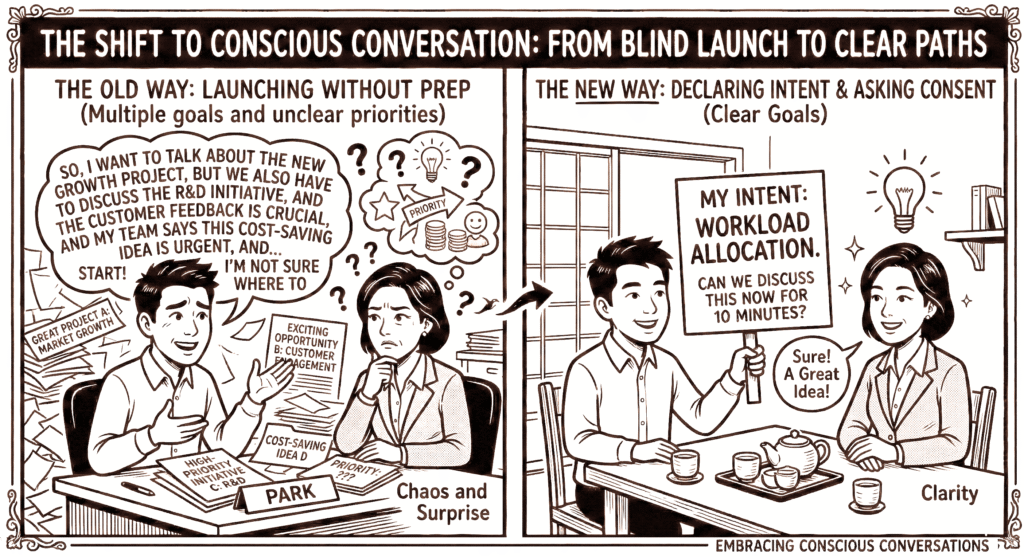
Transformation 3 — Start New Conversations by Explaining Your Conversational Intent and Inviting Consent
Consider a moment you may recognize. Someone launches into a complaint — or an emotional disclosure, or a difficult request — with no warning. How does your body respond? If you are like most people, you tense. Your guard goes up. You are in no position to listen well, because you are too busy figuring out whether you are under attack. Now imagine the same conversation beginning with: “I have something important I’d like to talk about. It’s about what happened yesterday. Is now a good time?” The content is identical. The experience is entirely different.
This is what the chapter calls the “mini-conversation before the conversation.” Before launching into any important exchange, briefly explain the kind of conversation you want to have and invite the other person’s consent. Of all the skills in the workbook, this may be the one that produces the most immediate, visible results.
The practice grew out of the author’s own experiments. At a health-food market, disgusted by insect-covered broccoli, he walked up to the customer service counter and said, “I would like to make a complaint.” That one sentence let the clerk get ready. When the complaint arrived, she was not knocked off balance — she simply answered, confidently, “We’ll take care of it right away.”
This small step makes a large difference for six reasons that connect to everything explored so far. It clarifies the speaker’s own purpose. It bridges cultural differences in conversational signals. It gives the listener a genuine chance to consent — and a person who has agreed to participate will participate more fully. It helps the listener see the big picture that frames everything that follows. It names the role you are asking them to play — fellow problem-solver, sounding board, emotional support — so expectations match. And it treats the other person as a partner rather than a target, generating the goodwill needed for creative problem-solving.
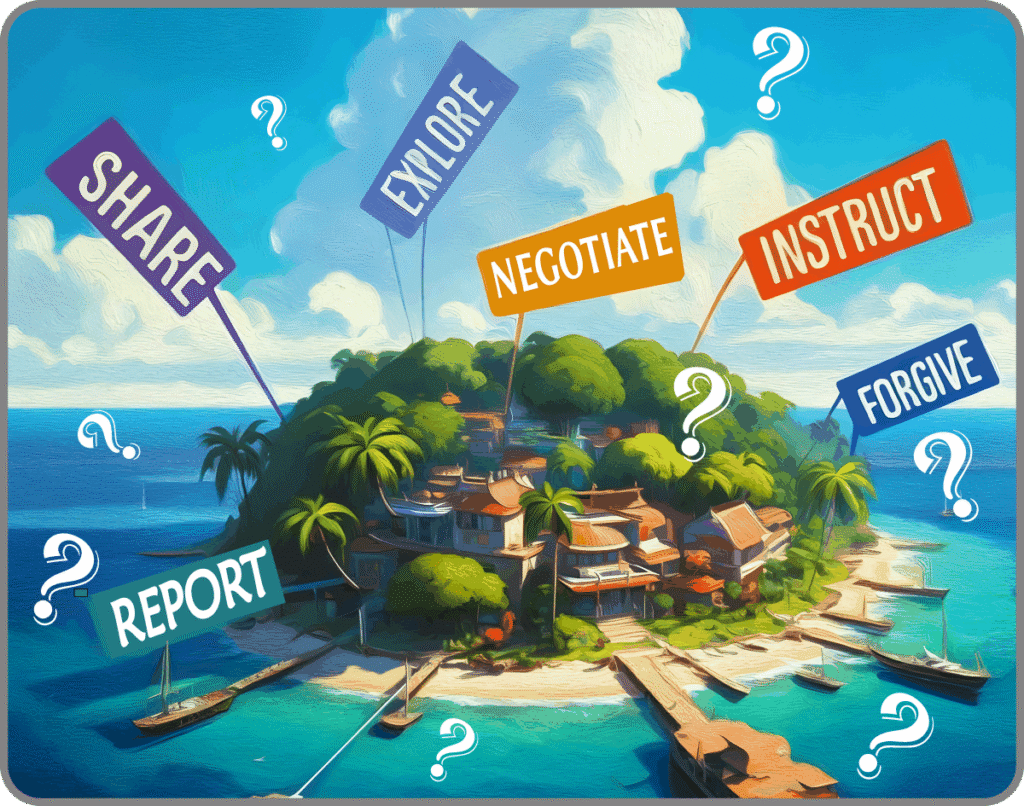
The chapter explores roughly thirty types of fulfilling conversational intention — from “I’d like to hear what’s happening with you” to “I’d like to resolve a conflict” — and a dozen worth growing away from, including deception, manipulation, and stonewalling.
If the practice produces such good results and is so simple, why don’t people start conversations this way? Because inviting consent means giving up the familiar elements of conversational surprise that quietly do our work for us. When we ask plainly, the person can say “no.” But a “no” to an invitation is almost never a permanent refusal — it is often a “not now” or a “not like this,” and knowing how to respond can turn a dead end into a stronger connection. You have now learned to listen and to open. The next question is natural: once you are inside the conversation, what do you actually say?
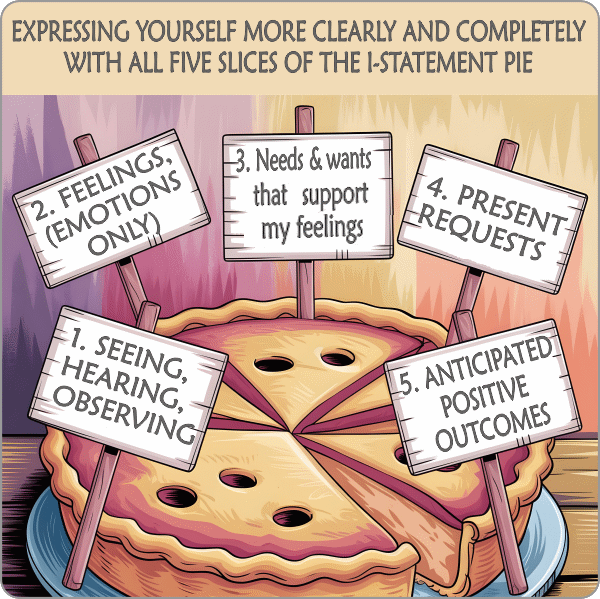
Transformation Four: Using the 5 I-Messages as a cognitive tool for both
deeper self-understanding and clearer self-expression
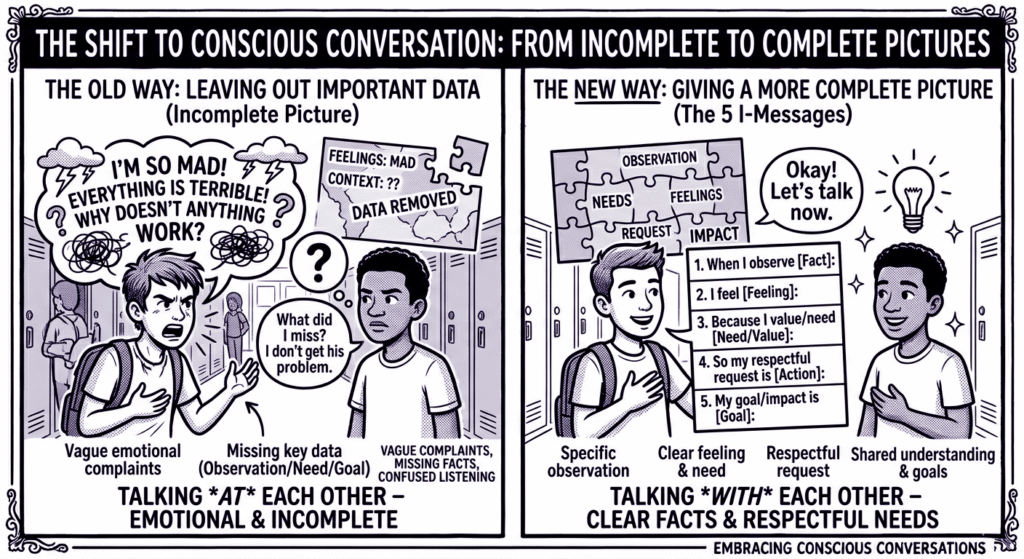
Transformation 4 — Understanding and Expressing Yourself More Clearly and Completely with the Five I-Messages
Here is a scene you may recognize. You are upset about something — really upset — and you open your mouth and what comes out is a burst of shorthand: “Stop that!” or “You always do this!” or “I can’t believe you.” And the other person hears a verdict, not a person. They get defensive. The conversation spirals. Afterward, you realize that what you meant was something far more layered: you saw something that startled you, you felt worried, you needed reassurance, you wanted something specific, and you were hoping for a particular good outcome. But none of that made it into the sentence. You compressed five dimensions of experience into a single burst — and the compression lost exactly the information your listener most needed.
The Five I-Messages map those five dimensions: (1) what you are seeing or hearing — facts, without evaluation; (2) what emotions you are feeling; (3) what needs, wants, or interpretations are driving those feelings — the “because” that connects the situation to your response; (4) what you are ready to ask for right now; and (5) what positive results you envision. The conflict resolution expert William Ury recommends “going to the balcony” in tense situations — stepping back to sort out your thoughts before re-engaging. The Five I-Messages are what you do while you’re on the balcony.
Before they are a communication tool, they are a self-inventory. In many situations — especially the intense ones — we genuinely do not know what we are feeling, or what we want, until we have paused long enough to ask. The psychologist Carl Rogers spent his career demonstrating that many of us learned early in life that it wasn’t safe to say what we really felt, and we became experts at not noticing our own feelings. As adults, we have new cognitive resources. We can close the missing-information gap — and the closing begins not with better expression but with better self-observation.
The chapter describes a developmental journey from “scales to jazz.” Stage One is unconscious abbreviation — compressing without realizing it. Stage Two is deliberate practice, noticing and expressing all five dimensions even when it feels excessive. Stage Three is informed brevity — returning to natural conversation, but now your brevity is chosen, and you can feel when something important is missing.
The Five I-Messages also serve as a powerful listening framework. When someone is upset, you can listen for what they are observing, feeling, needing, wanting, and hoping for — “listening with five ears.” Over time, this practice transforms not just your conversations but the kind of person you become: someone whose words make others feel safe enough to listen, whose honesty invites honesty in return. But the full Five I-Messages are a rich instrument — and as any musician will tell you, not every moment calls for the full orchestra. What about the small, daily frustrations that make up most of the friction in a life?
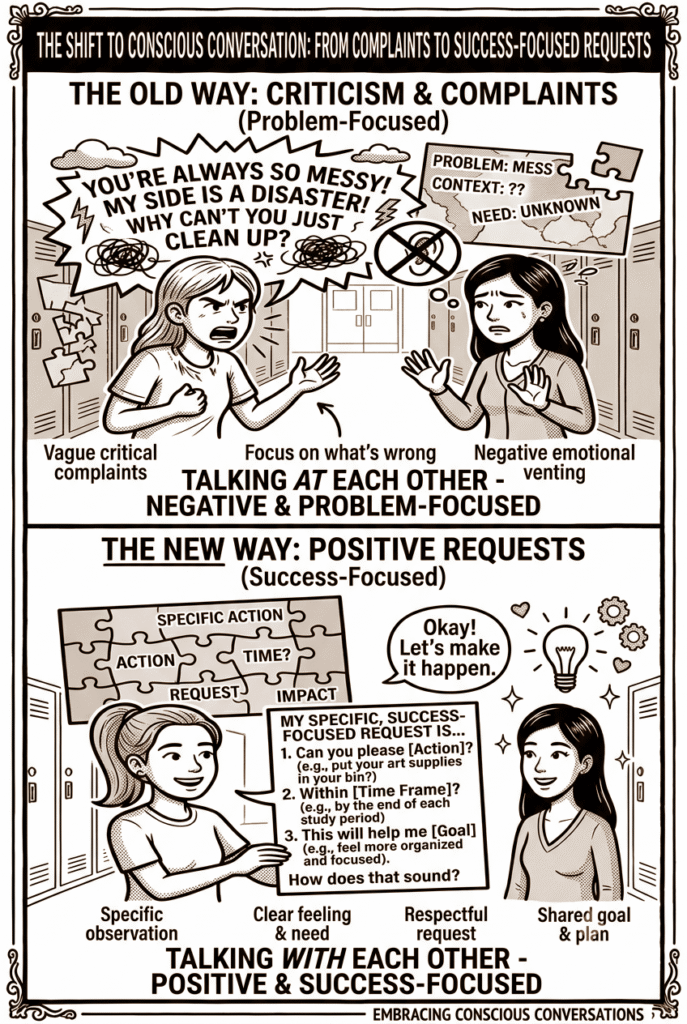
Transformation 5 — Resolving Everyday Conflicts by Translating Criticisms and Complaints into Specific, Success-Focused Requests
If your coworker keeps scheduling meetings over your lunch break, you probably do not need to explore all five dimensions of your inner experience in order to address it. You need a quick, clear request. But here is the peculiar thing: most of us will complain about the meeting schedule to three other colleagues before we ever say a word to the person who could actually change it. We find it significantly easier to criticize someone for not meeting our needs than to simply ask.
Why? Because in the economy of emotional risk, complaints feel cheap and requests feel expensive. When we complain, we position ourselves as the judge — elevated, protected, righteous. When we ask, we admit three truths our egos find dangerous: I have a need, I cannot meet it alone, and your response matters to me. The courage to ask requires us to stand in our need without armor.
This chapter introduces a “quick tool” for everyday friction — a complement to the full Five I-Messages for deeper conversations. The formula has two parts: a specific action request plus a “so that” explanation pointing toward a positive result. “Would you be willing to call me when you’re going to be more than ten minutes late, so I don’t worry?” Notice the mechanics: the request uses verbs (actions a person can do) rather than adjectives (character labels). It focuses on the future rather than the past. And the explanatory clause transforms a rigid demand into a flexible collaboration — if they can’t do exactly what you asked, understanding the “why” lets them propose an alternative that serves the same goal.
The chapter also teaches the underappreciated skill of translating other people’s complaints. When someone is criticizing you and you can hear the unspoken request buried in their frustration, you can say: “It sounds like you’re asking me to… Is that right?” This single move can redirect a conversation from mutual accusation toward problem-solving — and it is one of the most generous things you can do in a difficult moment.
Research by social psychologist Vanessa Bohns has consistently found that we dramatically underestimate other people’s willingness to say yes. Our fear of “no” is statistically unfounded — people are wired for cooperation and are often glad to help when simply asked. And every time you model a clear request instead of a complaint, you teach everyone present that there is an alternative to the guaranteed resentment of silence.
You can now listen, open a conversation well, express your full experience, and translate complaints into requests. These are powerful tools for situations where you know what you need. But what about the moments when you are trying to understand someone else — when you need to draw out what another person thinks, feels, or knows? That calls for a different kind of skill entirely: the art of the question.
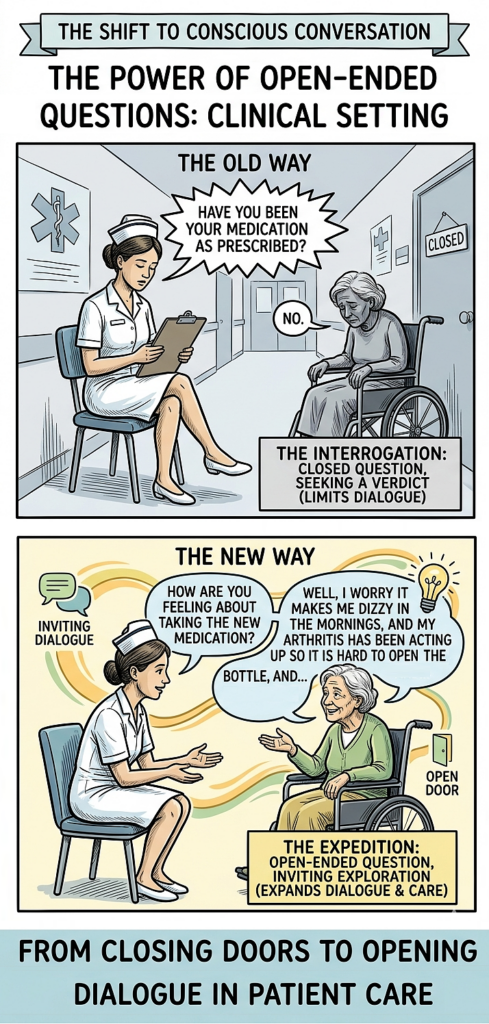
Transformation 6 — Move Your Conversations Forward by Asking Questions More Open-Endedly and Creatively
“Honey, do you want to go ahead and rent that apartment we saw yesterday?” That question leans toward yes and invites a one-word answer. “Honey, how do you feel about us renting that apartment?” opens a wide range of responses — including concerns you need to hear before you can make a good decision together. The content is identical. The shape of the question is entirely different. And that shape determines what the other person feels free to say.
The shift from closed to open questions is the entry point, but the chapter goes further — into ten families of creative questions, each drawn from a different intellectual tradition, each opening a different door. The first three are directed inward: questions from the Gestalt tradition that ground you in what you’re actually feeling right now; questions that replace self-blame with curiosity (“What could I learn from this?” instead of “How could I have been so stupid?”); and questions from Martin Seligman’s research that interrupt the helplessness spiral of “this will always be this way, everywhere, and it’s all my fault.”
The next two families address outward situations: questions from principled negotiation for when conflict is in the room, and questions that use metaphor to unlock creative possibilities — the way a group of stuck engineers broke through by asking “What if the bristle were a kind of pump?” The sixth family shifts to the person you are becoming: “If I do what I’m thinking about doing, what kind of person will that make me?” — questions from social constructionist theory that transform practical decisions into questions about character.
The seventh and eighth families carry one of the most important insights in the entire workbook. From narrative therapy come questions that recover your hidden moments of success — the times when the problem wasn’t there, which your dominant story may have edited out. From David Cooperrider’s Appreciative Inquiry come questions that grow what’s already working: “What did you most appreciate about how this went?” What you consistently ask about tends to grow — for better or worse. A group that asks only “What’s broken?” gets more awareness of brokenness.
The ninth family deepens any conversation: “What haven’t I asked you that you wish I would?” may be the most powerful question in any close relationship — a door you open that the other person didn’t know was there. The tenth helps someone find their foothold when overwhelmed.
The philosopher Sam Keen wrote: “Your questions are the quest you’re on. No questions — no journey. Timid questions — timid trips.” The chapter recommends choosing one question and living with it for a week, because questions do their deepest work when they have time to surprise you. And one particular family of questions — the appreciative ones — points directly toward the next transformation: the practice of noticing and expressing what is good.
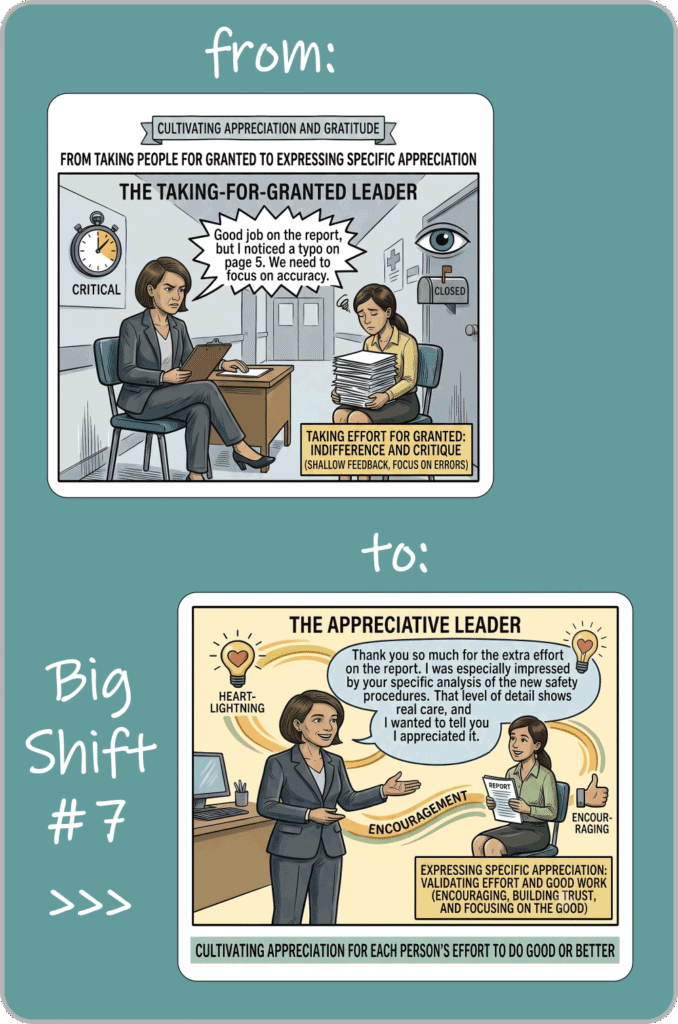
Transformation 7 — Deepen All Your Relationships by Expressing More Gratitude, Appreciation, Encouragement, and Delight
The last time you walked into your home, did you notice the roof keeping rain off your head? The floor holding you up? The light switch that worked when you flipped it? Almost certainly not. And that is not because you are ungrateful. It is because human consciousness is built to notice what is broken, what is threatening, what needs fixing. The philosopher Martin Heidegger observed that our tools and our world disappear from awareness when they are working smoothly — we notice the hammer only when it breaks. This structural bias in attention means that, without deliberate practice, we may sleepwalk through the very gifts that make our lives possible.
The research on what happens when appreciation is present — and when it isn’t — is among the most dramatic in the social sciences. John Gottman found that the determining factor in the long-term success of love relationships is the ratio of positive to negative interactions: roughly five appreciations for every criticism. Betty Hart and Todd Risley found a parallel pattern in child development: the most curious and self-starting children come from homes where expressions of interest exceed corrections by about three to one. Appreciation is the sunshine of human development. When it is present in sufficient measure, people flourish. When it is absent, they wither — slowly, invisibly, and often without understanding why.
But the obstacles to gratitude go deeper than forgetfulness. Researcher Brené Brown describes “foreboding joy” — the experience of feeling happiness and immediately bracing for disaster, as though letting yourself feel too much joy makes you vulnerable to a greater fall. Brown found that the most resilient people were not those who suppressed their joy but those who had learned to pause in moments of happiness and deliberately feel thankful. And Martin Seligman’s research on learned helplessness shows how the stories we tell ourselves about suffering — “this will always be this way, everywhere, and it’s all my fault” — can filter out the evidence of grace entirely.
The chapter introduces the Four Heart Beams as four distinct forms of positive attention. Gratitude is the recognition that someone has met your need. Appreciation is wider — an act of witness on behalf of the community when you see goodness that doesn’t involve you directly. Delight is the spontaneous overflow of joy in the presence of something beautiful or alive. And encouragement is forward-looking: “I see you struggling toward something good, and I want to strengthen your resolve.”
Appreciation is the emotional savings account that makes relationships strong enough to hold the tensions of problem-solving. But how do you keep growing in all of these skills when the initial enthusiasm fades and the old habits pull you back?
For practical expression, the chapter offers Three-Part Appreciations — built directly on the Five I-Messages framework from Transformation Four, adapted to express a need fulfilled.
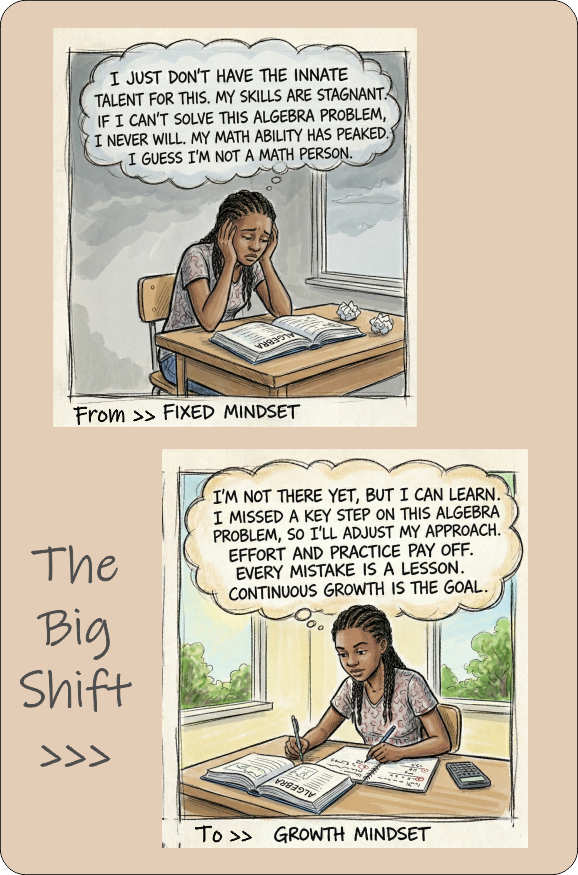
Transformation 8 — Shift Evolutionary Gears by Adopting the Continuous Learning Stance
Every chapter in this workbook has asked you to try something new — and if you have actually tried any of it, you have almost certainly felt the awkwardness. The paraphrase that sounded stilted. The five-message self-inventory that felt like filling out a form. The open-ended question that landed clumsily. That awkwardness is not a sign that the skills don’t work or that you aren’t cut out for them. It is the normal feel of a capacity stretching beyond its familiar range — and every person you have ever admired for their communication skill began exactly where you are now.
Stanford psychologist Carol Dweck’s landmark research illuminates what is happening in those awkward moments. People with a fixed mindset believe their traits are carved in stone: a given amount of intelligence, talent, and personality that cannot change. Every difficulty becomes proof of a permanent limitation. People with a growth mindset see their qualities as things that can be developed through dedication and effort. Every difficulty becomes the next step in learning. The difference is not talent. It is the story you tell yourself about what the difficulty means.
The fixed mindset creates an internal monologue of perpetual judgment: “This means I’m a total failure.” “This means my partner is selfish.” Each setback triggers an all-or-nothing verdict rather than a calm focus on improvement. The growth mindset monologue is different: “What can I learn from this? How can I improve? How can I help my partner do this better?” If you have spent years believing that your communication difficulties are just “who you are,” Dweck’s reframe may be the most important thing in the entire workbook: you are not a bad communicator. You are a developing one — someone whose communication patterns are ready to grow.
This chapter translates Dweck’s research into a practical stance — the continuous learning stance — and connects it back to every transformation that came before. The chapter’s practical tool is the Learning Journal — a regular practice where you slow down and pay attention to what you are doing and learning. Give each transformation its own section. When you notice something — a moment when you listened well, a time you caught a complaint and turned it into a request — record it. Your journal becomes a map of your developing competence, visible to you in a way that your busy daily life cannot show you.
But the continuous learning stance has a limit when practiced alone. You can sustain new habits for weeks, sometimes months, on willpower and fresh enthusiasm. What keeps them alive past that point — what turns a temporary experiment into a permanent shift in how you move through the world — is other people. Which raises a question the workbook has been quietly building toward since the very first chapter: where do you find the companions?
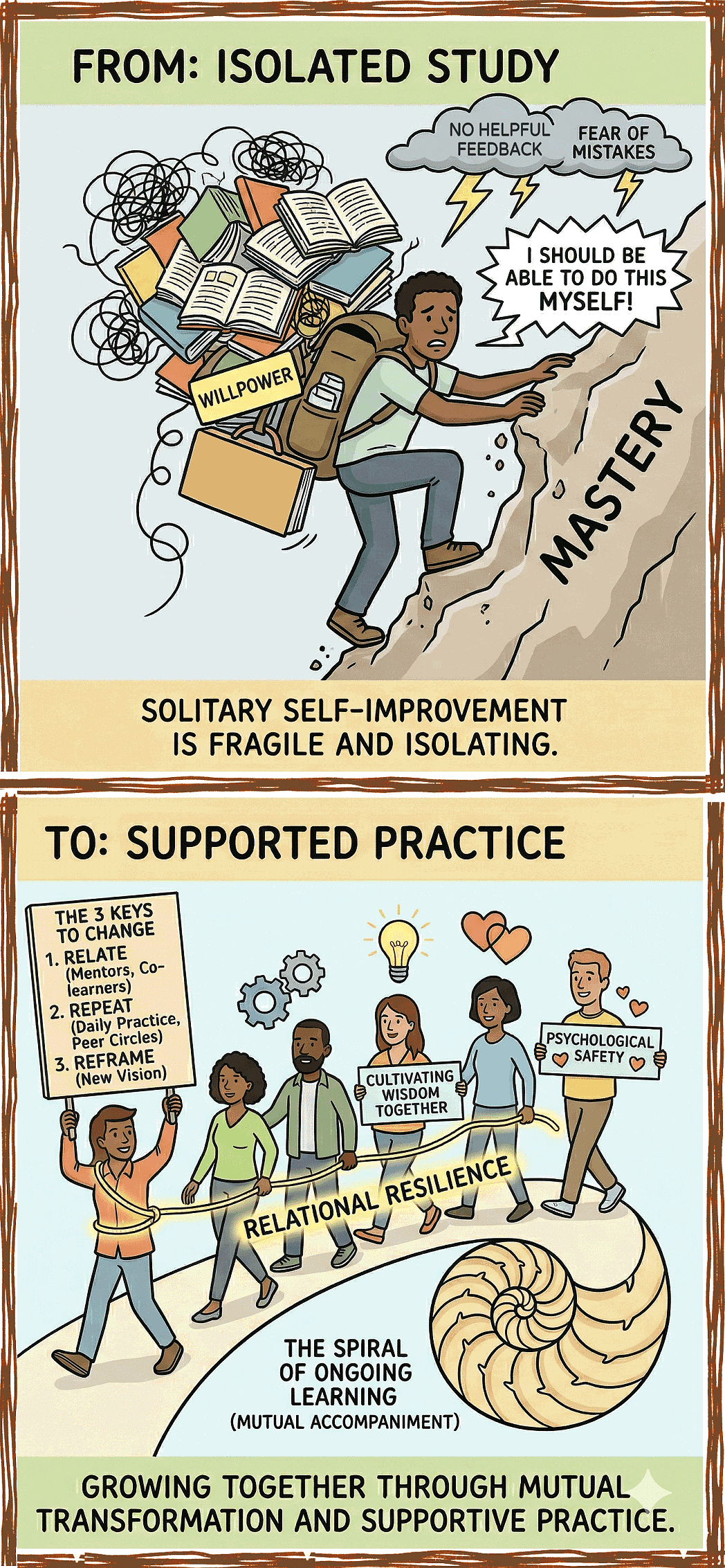
Transformation 9 — Grow Wider Circles of Mutual Support with Practice Partners, Circles of Six, and Cooperative Networks
If you have been reading this workbook in sequence, you have noticed a recurring invitation: “Find a practice partner.” “Try this with a co-learner.” “Share this with a Circle of Six.” That invitation has been growing more insistent with each chapter — and now, at last, the workbook devotes an entire transformation to showing you how.
This is not an afterthought or a motivational appendix. It is a developmental necessity. Alan Deutschman’s research, introduced in Transformation One, showed that lasting change begins within a web of new relationships — relate, repeat, reframe. Responsive listening is an interpersonal capacity; it cannot be strengthened only by reading about it. Self-expression requires a real person to express yourself to. Translating complaints into requests is an act that happens between people. Even the Learning Journal works better when you have someone to share your reflections with. The skills in this workbook are relational skills, and they grow through relational practice.
The chapter provides two concrete structures. The first is the Practice Partnership — two people who commit to meeting regularly, taking turns coaching each other through the Five I-Messages, practicing responsive listening, role-playing difficult conversation openings, and reflecting on what they are learning. The second is the Circle of Six — a small group that meets regularly to practice together, providing what a single partnership cannot: multiple perspectives, a wider safety net, and the experience of building a small community around shared learning.
Running through both structures is a double helix: one strand pointing inward toward personal development, the other pointing outward toward cooperation. Each time you coach a partner through their five messages, you deepen your own capacity for self-awareness. Each time you listen responsively to someone else’s struggle, you strengthen the very neural circuitry you need for your own moments of self-observation. This is the developmental principle at the heart of the transformation: in this particular kind of learning, the giving is the learning. You cannot receive as much help as you are unwilling to give — not because of a moral rule, but because of how the capacity actually develops.
The chapter introduces the idea of a “circle of empowering ancestors” — historical figures whose courageous lives demonstrate that compassionate, cooperative living is actually possible. Gandhi, Harriet Tubman, Marie Curie, Martin Luther King Jr., Nelson Mandela, Rachel Carson — these individuals lived differently, in part, so that we could live differently. Keeping their examples close is a way of sustaining your own resolve during the inevitable stretches when the learning feels hard and the old habits pull.
Everything you practice inside a partnership or circle travels with you into the rest of your life. These skills do not stop at the edge of the practice group. They belong to you as a member of widening circles — and that widening is where the final chapter begins.

Seeds in the Morning Sky of a New Day
Image: Dennis Rivers + AI — Public Domain — May be reproduced.
Chapter 10 — The Right to Inspire and Invite:
Reaching Out to Advocate and Mend in a Troubled World
The previous chapters have described the cooperative life as though it unfolds in a friendly world. It does not always. This short closing chapter acknowledges the world as it actually is — and argues that the skills you have been developing are not just personal improvements but seeds you carry into a world that desperately needs them.
Every conversation you have, with anyone, becomes a place where the cooperative life is either reinforced or weakened. This is not a burden you are being asked to take on. It is something that is already happening. You are already shaping the communication culture around you — family, work team, community — in every interaction, whether you mean to or not. The listening you offer or withhold, the complaint you translate or don’t, the question you open or close — all of it teaches the people around you what is normal, what is possible, what a conversation can be.
The chapter argues that in a densely interwoven world, the right of self-defense must necessarily include the right to advocate peaceful conflict resolution and everyday compassionate communication. You are, in effect, already a conscious or unconscious “Johnny Appleseed” of communication habits. The question has never been whether you will influence the communication culture around you — the question is whether you will do so by conscious and compassionate choice.
Think back to the double helix from Transformation Nine: development pointing inward, cooperation pointing outward. Your partnerships and circles have been strengthening both strands simultaneously. You have been growing more skillful — more aware, more articulate, more able to listen past your own reactions. And you have been growing more cooperative — more able to hold complexity, to navigate difference, to build something with another person that neither of you could build alone. Those two capacities travel with you everywhere. Into your family, your workplace, your neighborhood, your community, and into every conversation you will ever have.
This is the arc of the entire workbook, seen from above: from the autopilot of Transformation One to the conscious choice of Transformation Ten. From the discovery that you were born to learn, to the recognition that you are already teaching. From the first awkward paraphrase to the slow formation of a more compassionate way of being in the world. The Nine Transformations are not a rigid sequence to complete and set aside. They are a repertoire to return to — a set of practices you will revisit again and again, each time with more experience, more depth, and more companions for the journey.
In a world convulsed with violence, and building even more powerful weapons, we invite you to both live and offer an alternative way of connecting with others and resolving conflicts. We invite you learn this material deeply and become a peer volunteer learning companion for others traveling the the path of the Nine Transformations.
CREATIVE COMMONS COPYRIGHTS AND PERMISSIONS:
(the gist) YOU HAVE PERMISSION TO MAKE COPIES
AND TRANSLATIONS OF ALL OR PARTS OF THIS DOCUMENT
For non-profit distribution: You have non-exclusive permission to make an unlimited number of copies and/or translations of this entire workbook (or parts thereof written by Dennis Rivers) for use in your family, school, college or university, business, public agency, church, synagogue, mosque, temple, and/or community service organization, provided that such copies include this permissions page (or in the case of sections or pages, include one of the short Creative Commons copyright notices described below)
For general distribution (including course readers in schools and colleges): The pages and documents appearing in Nine Transformations for New Conversations are copyright 1997 through 2026 by Dennis Rivers, except where otherwise noted or where excerpts from already copyrighted scholarly works have been cited in accordance the “Fair Use” doctrine of copyright law. The parts of this workbook written by Dennis Rivers may be copied, adapted, translated, distributed and/or sold in book or sheet format, under the terms of the “CC BY-SA 4.0 Attribution-ShareAlike 4.0 International Deed” which you can read at https://creativecommons.org/licenses/by-sa/4.0/deed.en . This License provides that any such copies, editions, translations, and/or adaptations bear the license shown below, allowing others to reproduce and further develop the work adapted. The parts of this workbook written by authors other than Dennis Rivers retain their original copyright and cannot be sold to the general public or incorporated into new works for sale without the permission of their respective authors.
Please include the following at the end of any multiple-page copies of material written by Dennis Rivers:
In all countries allowing Creative Commons free-to-copy licenses:
“Copyright 1997-2026 by Dennis Rivers. Reproduced with author’s permission from the original at Communication-Skills.NET under the CC BY-SA 4.0 Attribution-ShareAlike 4.0 International Deed” which you can read at https://creativecommons.org/licenses/by-sa/4.0/deed.en”
Please note individually reproduced pages that are written by Dennis Rivers as “Copyright 1997-2026 by Dennis Rivers. Reproduced with author’s permission under Creative Commons license CC BY-SA 4.0.”
In all countries not recognizing Creative Commons free-to-copy licenses:
“Copyright 1997-2028 by Dennis Rivers. Non-exclusive permission to reproduce for educational, community, organizational and commercial use granted by author.”