Challenge Three — rev 17
Challenge Three: Expressing Yourself More Clearly and Completely
Using the Five I-Messages to Navigate Through the Four Biggest Snags
in Interpersonal Communication
Here is the simplest version of what this chapter is about: when conversations go wrong, they usually go wrong for one of four reasons. We leave out too much. We point our frustration outward instead of looking inward. We hide what we actually feel. Or — most painfully — we have lost track of what we feel in the first place. These four snags catch us throughout our lives, in conversations large and small. The Five I-Messages are a beginner’s doorway into a lifetime of working with all four. They are one practice among many possible practices. But for most people, they are the easiest place to start.
A From-To / Many-View Prologue
- From shorthand that leaves your listener guessing to clarity that lets them understand
- From “you, you, you” to “I am seeing… I am feeling… I am needing…”
- From hiding what you feel to letting it be safely seen
- From not knowing what you feel to gently retrieving yourself
- From accusations about the past to requests about the future
- From demands people can only refuse to invitations people can freely accept
- From vague frustration to specific observations
- From “you always” and “you never” to “when I saw… I felt…”
- From compression that isolates you, to expression that connects you
- From a single conversation gone wrong
to a lifelong practice of showing up honestly
3.1 An Ordinary Conversation, Going Wrong
Imagine an evening that may feel familiar. Two people who have been together for many years are in the kitchen. One of them has just come home from work, later than expected, for the third time this week. The other has been waiting — and stewing. The waiting partner finally speaks:
“You’re always doing this. Why can’t you just be considerate for once?”
The late partner sighs, sets down a bag, and answers wearily:
“What do you want from me? I’m doing the best I can.”
The conversation goes nowhere good from there. By bedtime they are both miserable, and neither of them is quite sure what the fight was actually about.
If you slow that exchange down and look at it carefully, you will notice that at least four different things have gone wrong — four distinct snags in the fabric of communication. Each one is doing real damage. Each one is invisible to the people in the kitchen. And each one shows up not just in this scene but in millions of conversations every day, between partners, between parents and children, between coworkers, between friends.
The first snag is compression. “You’re always doing this” leaves the listener with no idea what “this” is. Working late? Forgetting to call? The accumulated weight of every late evening for the past two years? The shorthand is transparent to the speaker, who knows exactly what she means. It is opaque to the listener, who has to guess.
The second snag is direction of attention. Look at the sentence again: “You’re always doing this. Why can’t you just be considerate for once?” The speaker is in pain, but the speaker has vanished from the sentence. Every word is pointed outward at the partner’s alleged failings. There is no “I” in the speech — only “you, you, you.” The speaker has translated her own feelings into an accusation about someone else’s behavior, which is something humans do reflexively when we are hurt.
The third snag is concealment. Underneath the accusation, the speaker is probably feeling lonely. Maybe scared. Maybe sad about how distant the marriage has become. But none of that gets said. Vulnerability has felt unsafe in this relationship for a long time — perhaps for many relationships before this one — so the genuine feeling stays hidden behind the louder, safer feeling of anger.
The fourth snag is the deepest and the hardest to see. The speaker may not actually know what she is feeling. Years of pushing her real emotions out of sight may have left her without easy access to them. If you asked her in the middle of this fight, “What do you actually need right now?”, she might honestly say she has no idea. She knows what is wrong with her partner. She does not know what is true for herself.
These four snags — compression, accusation, concealment, and self-loss — are the territory this chapter explores. They live in every human conversation, surfacing whenever the stakes get high enough to matter. And the Five I-Messages, which I want to introduce you to in this chapter, are a beginner’s practice for working with all four. Not the only practice. Not the final practice. But a remarkably good place to start.
Before we meet the practice, we need to spend a little more time with the snags themselves. Each one has its own character, its own developmental story, and its own grip on us. The more clearly you can see them, the more sense the rest of this chapter will make.
3.2 The Four Snags: A Map of What Keeps Going Wrong
The four snags are not separate problems located in four different parts of a person. They are four expressions of a single underlying difficulty: the difficulty of being present in your own life and showing up honestly in your relationships. They are arranged here from the most surface to the deepest. Most of the time you will be working at the first two. But the deeper layers are always present, and even a beginner’s practice with the Five I-Messages will touch them sooner than you might expect.
Snag One: We compress too much. Human language naturally abbreviates. We compress, we imply, we lean on shared context. When a receptionist tells a counselor, “Your two o’clock is here,” neither of them needs a longer sentence — they share enough context that the shorthand works perfectly. Most of our daily speech operates this way, and most of the time it is a miracle of efficiency.
But the same compression instinct that lets us order coffee in a few words can sabotage us in the conversations that matter most. When the topic is loaded, the stakes are high, or the feelings are tangled, our usual shorthand leaves out exactly the information our listener most needs. And here is the painful twist: we usually do not realize we are abbreviating. The shorthand feels so familiar that it feels like the whole message. We think we said what we meant. We didn’t. We just can’t see what we left out.
This is not a personal failing. You did not miss a class on communication in middle school. You are abbreviating because that is how human language uses bandwidth efficiently. The skill is not to stop abbreviating — that would be exhausting and impossible. The skill is to notice when the stakes are high enough that the abbreviating needs to be steered, and to know what to put back in.
Snag Two: We point outward when we are hurt. When something distresses us, our reflex is to translate the distress immediately into a complaint about whoever or whatever caused it. “You never listen.” “You always do this.” “Why can’t you be reasonable?” Notice what happens in these sentences: the speaker is in pain, but the speaker is missing from the sentence. All the attention is aimed outward, at the other person’s alleged failings.
This pattern is so human and so universal that we barely notice it. But it has a serious cost. When you frame your pain as an accusation, you give your listener almost nothing they can work with. They cannot feel your loneliness or your fear, because you didn’t mention them. What they can feel is the attack, and most people respond to an attack by defending themselves rather than by trying to understand you. Marshall Rosenberg, the founder of Nonviolent Communication, devoted as much of his workshop time to this snag as to compression itself — because he saw, again and again, that learning to speak from “I” rather than “you” was one of the most transformative shifts a person could make.
For some people, the habit of pointing outward goes deeper than reflex. A person who has been chronically criticized, bullied, or controlled may develop what we might call an other-oriented stance: their attention is so habitually fixed on what other people are doing, demanding, or threatening that they have lost the ability to speak from their own center. Their inner life becomes organized around the people who hurt them and how to manage or avoid them. The “I” that should be the subject of their sentences has been pushed off the page.
Snag Three: We hide what we actually feel. There is a difference between abbreviating because language compresses and concealing because you learned the truth wasn’t safe. Many people arrive in adult life with a deeply practiced habit of misrepresenting their real feelings in order to keep the peace, maintain approval, or avoid conflict. This is sometimes called people-pleasing, but the term can trivialize what was often, in its origins, a survival strategy.
If the important people in your early life responded to your honest feelings with anger, withdrawal, ridicule, or punishment, you did the rational thing: you learned to show them what they wanted to see and to keep the rest hidden. The strategy worked. It kept you safe. And like most survival strategies, it long outlasted the conditions that made it necessary, becoming a habit that follows you into adult relationships where it is no longer required and no longer helpful.
At this snag, the issue is not that you cannot express your feelings clearly. The issue is that you have practiced for years not expressing them at all — or expressing them only in heavily disguised form. Honesty feels risky. Vulnerability feels exposing. The structured form of the Five I-Messages, with its clear scaffolding and its non-attacking grammar, often turns out to be exactly what makes honesty feel possible for the first time, because it gives you guardrails.
Snag Four: We lose track of what we feel. This is the deepest snag and an intensification of the third. In Snag Three, you know what you feel but conceal it from others. In Snag Four, the concealment has gone on so long and started so early that you have lost access to the feelings themselves. You no longer check in with yourself to find out what you think or want, because your thoughts and wants have been too inconvenient, too dangerous, or too painful for too long. Not knowing has become easier than knowing.
This can produce a quiet condition of being absent in your own life. You move through your days without much awareness of your own hopes, desires, or pain — and, more troublingly, without much wish to be aware, because self-knowledge might disturb the fragile coping arrangements that keep your world intact. People at this snag often describe themselves as “fine” and mean it as far as they can tell. The deeper register of feeling has gone underground.
At this snag, the Five I-Messages become something more than a communication technique. The simple act of sitting with the question “What am I actually feeling right now?” — and refusing to settle for “I don’t know” — can begin to reverse years of self-abandonment. Many people who take up the practice discover, often to their own surprise, that filling in the five dimensions doesn’t just help them communicate with a listener. It introduces them to themselves.
The four snags are not separate compartments. They are concentric rings of the same underlying challenge, and the practice we are about to explore touches all of them — sometimes one at a time, sometimes several at once. A person who sits down to write a five-message statement about a frustration at work may begin at Snag One (decompressing the abbreviation) and discover, by the time they reach the third message, that they have entered Snag Three or Snag Four — face to face with something they have been concealing from themselves for years.
This is why the Five I-Messages matter more than their simple appearance suggests. They look like a communication formula. They function as a doorway. Now let’s walk through it.
3.3 The Five I-Messages: A Beginner’s Doorway
Over the past half-century, a number of educational movements have developed structured approaches to more complete self-expression. Thomas Gordon’s Parent Effectiveness Training appeared in the 1960s. Marshall Rosenberg developed Nonviolent Communication through decades of workshops and writing. The Minnesota Couples Communication Program brought similar insights into relationship education. The Awareness Wheel, the Bowers’ work on assertive expression, and others have all contributed pieces of the same emerging picture.
What all these approaches share is a recognition that the four snags described above are real, that they keep tripping people up across cultures and contexts, and that there are learnable practices that begin to address them. The Five I-Messages presented here are one such practice. They are not the only way to address the four snags, and they make no claim to being the deepest or most comprehensive way. But they have a particular virtue: they are simple enough to start using on the first day of practice, and rich enough to repay decades of refinement.
The framework rests on a single observation: at any moment when you are speaking, there are five distinct dimensions of your experience that could potentially be shared with your listener. When the conversation is flowing well, you tend to share many of them naturally. When the conversation is tense, you tend to compress — leaving your listener with a fragment of the whole picture and forcing them to guess at the rest. The Five I-Messages are simply a name for those five dimensions, so that you can learn to recognize when one or more of them has gone missing.
The five dimensions are called I-Messages for two reasons. First, each one explicitly includes you as the experiencing “I” — they keep the speaker present in the speech, which directly counters Snag Two. Second, each one is a statement about your own experience rather than a judgment about someone else’s character, motives, or behavior. Both features matter. Both are part of what makes the practice work.
Here are the five dimensions:
(1) What you are seeing or hearing — a straightforward description of what actually happened, without evaluation.
(2) What emotions you are feeling — glad, sad, angry, scared, delighted, frustrated, concerned, hopeful.
(3) What needs, wants, or interpretations are shaping those feelings — the “because” that connects the situation to your emotional response.
(4) What you are ready to ask for right now — a specific, doable request for action, information, or commitment.
(5) What positive results you envision — the good outcome that would follow if your request were met.
These five dimensions are always present in your experience, whether or not you give voice to them. The question is never whether they exist. The question is how many of them you share with your listener, and how many you leave compressed inside your own head, forcing your listener to guess — or worse, leaving them with only an accusation to work with.
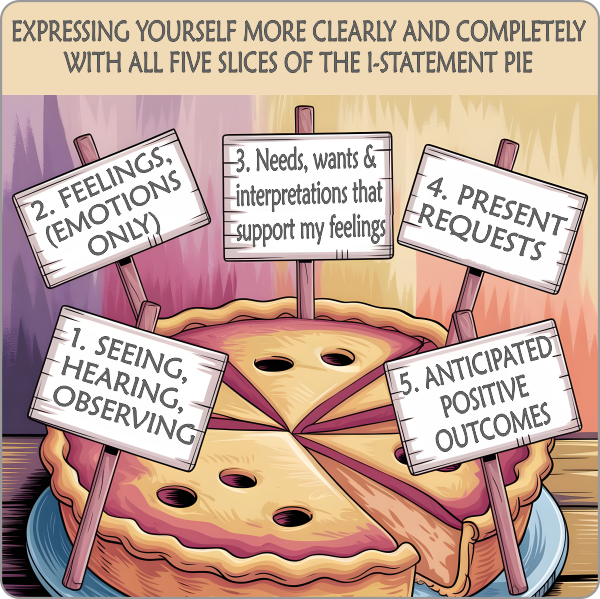
Let us return to the kitchen scene that opened this chapter and see what changes if the waiting partner uses all five dimensions instead of the compressed accusation.
The compressed version was: “You’re always doing this. Why can’t you just be considerate for once?”
An expanded version, using all five I-Messages, might sound like this:
“When I noticed it was almost eight o’clock and you still hadn’t come home, and I realized that’s three times this week (Message One), I started feeling really sad and a little scared (Message Two), because I’ve been missing you a lot lately and I worry that work is becoming more important to you than we are (Message Three). I’d like to ask if we could set aside some time this weekend to talk about it — maybe Saturday morning over coffee (Message Four), so we can both feel like we’re actually in this marriage together again (Message Five).”
Notice what just happened. The accusation is gone. The speaker has appeared in the sentence — there is an “I” doing the seeing, the feeling, the needing, and the asking. The vulnerability that was hidden underneath the accusation has surfaced. And there is now a concrete next step that the listener can actually respond to. The partner who was sighing wearily and saying “I’m doing the best I can” has been given something far more workable than blame.
This is the basic move that the Five I-Messages are designed to teach. It looks deceptively simple. It is, in fact, the work of a lifetime.
Table 3.1: Five “I-Messages”
| The Five I-Messages | express: | Example (nurse to young patient): |
|---|---|---|
| seeing, hearing… | 1. What are you seeing, hearing or otherwise sensing? (facts only) | “John, when I see you rolling down the hall in your wheelchair really fast… |
| and feeling… | 2. What emotions are you feeling? | …I feel REALLY concerned. |
| because I… | 3. What interpretations, wants, needs, memories or anticipations of yours support those feelings? | I am imagining you might hurt yourself and maybe someone else, too, or knock something over… |
| and now I want… | 4. What action, information or commitment do you want now? | …so what I need right now is for you to promise me that you will slow down… |
| so that… | 5. What positive results will that action lead to? (no threats) | …so that you can get out of here in one piece and I can stop worrying about a collision.” |
The nurse’s expanded message shows the framework with a single situation. But one of the most revealing things about the Five I-Messages is what happens when you hold Message One constant — the same outer observation — and watch how completely different feelings, interpretations, requests, and outcomes can flow from the same starting point. The following table demonstrates this with four pairs of examples. Read across the rows, and notice especially how the same scene can generate opposite responses depending on what the speaker brings to it in Messages Two through Five.
Table 3.2: Five “I-Message” Examples (Please read across the rows.)
| 1. When I saw/heard… | 2. I felt… | 3. because I… | 4. and now I want… | 5. so that… |
|---|---|---|---|---|
| When I saw the bear in the woods with her three cubs… | …I felt overjoyed!… | …because I needed a picture of bears for my wildlife class… | …and I wanted the bear to stand perfectly still… | so I could focus my camera. |
| When I saw the bear in the woods with her three cubs… | …I felt terrified!… | …because I remembered that bears with cubs are very aggressive… | …and I wanted to get out of there fast… | so that the bear would not pick up my scent. |
| When I saw the dishes in the sink… | …I felt happy… | …because I guessed that you had come back from your trip to Mexico… | …and I want you to tell me all about the Aztec ruins you saw… | …so that I can liven up some scenes in the short story I’m writing. |
| When I saw the dishes in the sink… | …I felt irritated… | …because I want to start cooking dinner right away… | …and I want to ask you to help me do the dishes right now… | …so that dinner will be ready by the time our guests arrive. |
| When I saw the flying saucer on your roof… | …I felt more excited than I have ever been in my life… | …because I imagined the saucer people would give you the anti-gravity formula… | …and I wanted you to promise that you would share it with me… | …so that we would both get rich and famous. |
| When I saw the flying saucer on your roof… | …I felt more afraid than I have ever been in my life… | …because I imagined the saucer people were going to kidnap you… | …and I wanted you to run for your life… | …so that you would not get abducted and maybe turned into a zombie. |
| When I saw the grant application in the office mail… | …I felt delighted… | …because I think our program is good enough to win a large grant… | …and I want to ask you to help me with the budget pages… | …so that we can get the application in before the deadline. |
| When I saw the grant application in the office mail… | …I felt depressed… | …because I can’t see clients when I’m filling out forms… | …and I want you to help me with the budget pages… | …so that I can keep up my case work over the next three weeks. |
Look at the bear examples. The same three cubs in the same woods produce either joy or terror — because the speaker’s needs and interpretations in Message Three are entirely different. Look at the dishes. Same sink, opposite feelings, different requests, different hoped-for outcomes. If either speaker had compressed away Messages Two through Five and simply said “I see the dishes in the sink,” the listener would have no way to know whether the next move should be talking about Mexico or grabbing a sponge.
This is the practical payoff of practicing all five dimensions: they give your listener enough information to actually understand you. Without all five, your listener is guessing — and the guess is often wrong. With all five, they can see your experience from the inside and respond to what you actually need, rather than what they imagine you need.
The Five I-Messages, then, are a structured doorway into the four snags we mapped at the beginning of the chapter. To see how they work as a practice — and why their effect runs so much deeper than a communication technique — let’s revisit the four snags one more time, this time with the framework in hand.
3.4 How the Five I-Messages Work on Each of the Four Snags
For Snag One (compression), the practice is decompression. When you deliberately fill in all five messages, you cannot leave out the parts your listener most needs. The framework will not let you. Message One forces you to say what actually happened, not your judgment about it. Message Two forces you to name the feeling, not assume your listener already senses it. Message Three forces you to share the inner context — the “because” — that explains why this situation produced this feeling. Messages Four and Five force you to say what you are actually asking for and what good would come of it. The five-part structure makes compression visible to you, because every blank spot in the framework is a missing piece in the message. You begin to feel where your shorthand has been hiding the meaning, even from yourself.
For Snag Two (pointing outward), the practice is reanchoring in “I.” Every one of the five messages is a first-person statement. There is no slot for “you never,” “you always,” or “why can’t you just.” If you try to deliver an accusation through the framework, the framework breaks down — there is nowhere for the accusation to go. The exercise of filling in the five dimensions pulls your attention back from the other person’s alleged behavior to your own experience, which is the only place from which honest communication is actually possible. This is exactly the move Marshall Rosenberg spent decades teaching: when you find yourself building a case against another person, translate the case back into a statement of your own observation, feeling, need, and request. The Five I-Messages provide a memorable scaffold for that translation.
For Snag Three (concealment), the practice is structured vulnerability. If you have spent your life hiding what you actually feel, the prospect of suddenly being honest can feel terrifying. The Five I-Messages help by giving honesty a container. You are not pouring out raw emotion in the hope that your listener will somehow handle it well. You are organizing your experience into a clear, non-attacking form — observation, feeling, reason, request, hoped-for outcome — that your listener can actually receive. Many people who have been concealing their feelings for years find that the framework makes honesty feel possible for the first time, because it removes the fear that being honest means losing control. The structure gives you a way to be vulnerable on purpose, in a form that does not blow up the relationship.
For Snag Four (self-loss), the practice is self-retrieval. This is where the Five I-Messages become more than a communication tool. When you sit down to fill in the five dimensions about a difficult situation, you may find that one or more of them is genuinely blank — you do not know what you feel, or you do not know what you need, or you cannot imagine a positive outcome. That blankness is information. It is telling you that part of yourself has gone underground. The practice of sitting patiently with the question “What am I actually feeling here? What do I actually want?” and refusing to settle for “I don’t know” is the beginning of self-retrieval. People who keep at it often discover, over months and years, that the inner territory they had given up on is still there, waiting to be visited again. Carl Rogers spent his career documenting exactly this kind of slow return.
None of this happens in a single conversation. The Five I-Messages are not magic; they are a practice. But they are a practice that touches all four snags whether you intend it or not. Even a beginner using the framework for the first time, working on a relatively low-stakes situation, will feel some of these effects. With sustained practice over months and years, the effects deepen into something that begins to reshape how you live.
The third and fourth snags — concealment and self-loss — were the lifelong study of the psychologist Carl Rogers. His work is worth pausing on, because it gives the deeper layers of this chapter their emotional weight.
3.5 What Carl Rogers Saw
Carl Rogers spent decades listening to people, and what he observed in that listening reaches well beyond the therapy office. He noticed that many people arrive in adult life carrying a vast gap between what they actually feel and what they believe they are supposed to feel. The gap opens early. Most children discover, sooner or later, that expressing what they really feel and want provokes displeasure from the big, important people in their lives. Because children depend on those people for survival and love, they make a rational adaptation: they begin expressing whatever will keep the affection coming, and they tuck the rest away.
If you are lucky, your parents and teachers help you learn to identify your real feelings and express them in ways that are both honest and kind. But this is intricate developmental work, and many parents and teachers never received that kind of guidance themselves. The result is that millions of adults walk through their lives with no reliable practice for closing the gap between what they feel and what they express — or, in the more painful cases Rogers documented, between what they feel and what they allow themselves to know they feel.
This is the developmental story behind Snags Three and Four. The concealment Rogers studied is not a character flaw. It is the predictable result of growing up in a world where honest feelings were often unwelcome. And the self-loss he saw in his most wounded clients was not a permanent condition. It was the long shadow of decades of necessary concealment, finally beginning to dissolve when the person encountered relationships in which the truth was actually safe to tell.
Here is the empowering truth Rogers spent his career demonstrating: as adults, you possess cognitive and emotional capacities that were simply not available to you as a child. You can learn to negotiate your conflicts. You can learn to confront difficult truths. You can learn to be honest about what you feel without being cruel about how you express it. The adaptations of childhood are not permanent sentences. They are habits — deeply grooved, emotionally charged habits — and habits can be reworked with patience, practice, and support.
The Five I-Messages do not produce this kind of transformation by themselves. Nothing produces it by itself. But they offer one of the most accessible doorways into the work. The practice gives concealment a safer form. It gives self-loss a structured way back. And it does so in language simple enough that you can begin tomorrow morning.
By now you may be raising an objection: “Are you really suggesting that I deliver all five of these messages every time I open my mouth? That would sound robotic. My partner would roll their eyes.” That is a fair concern — and the answer involves understanding something about how skills develop that most communication programs never discuss.
3.6 The Developmental Journey: From Scales to Jazz
I want to be honest with you about something that structured communication approaches rarely address, even though it may be the most practical insight in this chapter.
People who learn the four-step or five-step formulas from various communication programs sometimes complain that using them feels stilted and artificial. Their partners roll their eyes. Their friends say “please just talk to me like a normal person.” And so they abandon the whole approach, concluding that structured self-expression doesn’t work in real life.
The frustration is understandable. But what is happening is not a failure of the method. It is a confusion between a training exercise and a way of life.
Think about learning to play the piano. When you are a beginner, you practice scales. You play every note deliberately, one at a time. It sounds mechanical because it is mechanical — that is the point. You are learning where all the keys are. You are building muscle memory. Nobody expects you to play like that at a dinner party.
But you will not become a capable pianist without doing those scales. And once you have done them hundreds of times, something remarkable happens: you no longer need to think about where the keys are. Your hands know. You can improvise. You can play a jazz standard and leave out notes, add notes, bend the rhythm — because you have internalized the whole keyboard. The scales were never the performance. They were the foundation that makes performance possible.
The Five I-Messages follow exactly this developmental arc. There are three stages, and recognizing them will save you a great deal of unnecessary frustration.
Stage One: Unconscious compression. This is where almost everyone begins. You speak in shorthand without realizing it. You leave out your feelings, your reasons, your requests, your hoped-for outcomes — and you do not know you are doing it. When misunderstandings arise, you blame the other person for not getting it. After all, you said what you meant, didn’t you? In fact, you didn’t. You just can’t see what you left out.
Stage Two: Conscious expansion. This is the training stage — the scales. You deliberately practice expressing all five messages, even when it feels like overkill. It should feel somewhat mechanical. That is how you know you are building something new. I strongly encourage doing hundreds of practice exercises in which you express all five messages. Write one five-message statement a day in a journal. Practice with a partner. Work through the exercises at the end of this chapter. This stage is about training your awareness — learning to feel all five dimensions of your experience so that you know where every key on the keyboard is.
Stage Three: Informed brevity. Having internalized all five dimensions through sustained practice, you return to something that looks like ordinary conversation — brief, natural, fluid. But it is fundamentally different from Stage One, because now your brevity is chosen rather than automatic. You can feel when something important is missing. You have developed a kind of inner ear — the way a seasoned musician can hear a missing note in a chord without consciously thinking through the theory. When a conversation begins to go sideways, you can ask yourself: “Which of the five am I leaving out? Which one does my listener need right now?” And you supply just that piece — not all five in a ritual formula, but the one or two the moment requires.
This is the improvisational skill that makes communication artful rather than mechanical. You do not need to recite your multiplication tables for the rest of your life. But you need to have learned them well enough that the arithmetic is there when you need it. Similarly, you do not need to deliver all five I-Messages in every conversation for the rest of your life. But you need to have practiced them thoroughly enough that when a conversation falters, you can sense which missing piece — the unexpressed feeling, the unstated need, the request you haven’t made, the positive outcome you haven’t named — would bring things back into focus.
Paying close enough attention to a conversation to sense what is missing and what needs to be added is a far more subtle skill than reciting all five messages by formula. It is the difference between reading a navigation chart and steering by the feel of the wind. Both are valuable. Both have their place on the developmental path. If you are in Stage Two right now, doing your scales, please do not rush to skip ahead. The scales are what make the jazz possible.
Now that you can see the developmental arc, you are ready for more detailed guidance on how to express each of the five messages with greater skill. Think of the next section as your practice manual for the scales.
3.7 Expressing Each Message More Skillfully
Each of the five messages has its own subtleties and its own characteristic pitfalls. Here are suggestions for working with each one more effectively.
Message One: What you are seeing, hearing, or sensing. Begin with what you actually observed rather than how you feel about it or what you think it means. Be specific about what happened — time, place, actions — and describe rather than diagnose. Steer clear of words that label or judge (“slimy,” “lousy,” “neurotic”). Avoid generalizations like “you always” or “you never,” which are almost never literally true and which put your listener on the defensive immediately. And watch for descriptions that smuggle emotions in without naming them: phrases like “totally disgusting” or “horrible” are feelings masquerading as observations. Let your feelings come through in Message Two, where they belong.
For example: “When I saw the big coffee stain on the rug…” is far easier to hear and respond to than “When you ruined my day, as always, with your slimy, stinking, totally disgusting, rotten antics…”
Message Two: What emotions you are feeling. Use specific emotion words: glad, angry, delighted, sad, afraid, resentful, embarrassed, frustrated, hopeful, concerned. Be cautious with feeling words that actually imply someone else’s action: “I feel ignored, manipulated, mistreated, neglected, rejected, dominated, abandoned.” Notice how every one of these words quietly attributes your emotional state to something your listener supposedly did wrong. They are interpretations disguised as feelings. Translate them: “I feel ignored” probably means “I feel sad because I want more of your attention.” The real emotion is the sadness. The unmet want is the attention. Separating them makes you far easier to hear — and helps you understand your own experience more clearly.
Message Three: What needs, wants, or interpretations are shaping your feelings. This is the message that people compress away most often, and it is the one your listener most needs. A large part of your emotional response to any situation is generated by your own wants, memories, and interpretations, not solely by what the other person did. Expressing this dimension is an act of emotional maturity: you are taking responsibility for your inner world rather than asking your listener to guess at it. Use sentence starters like “…because I imagine that…” “…because I remember how…” “…because I was hoping that…” “…because I need…” rather than “…because YOU…”
Message Four: What you are ready to ask for right now. Ask for specific, doable actions rather than emotional states. Since most people cannot produce feelings on command, it is generally unproductive to ask someone to “cheer up” or “be more supportive.” Translate those desires into concrete verbs: “please listen,” “please sit with me,” “please tell me what you’re thinking.” Frame your request in positive terms (“Please arrive at eight” rather than “Don’t be late”). And include when, where, and how — the practical details that prevent misunderstandings later.
Message Five: What positive results you envision. When you describe the specific good things that would come from your request being met, you give the other person something to be motivated by. They can feel capable of contributing something worthwhile, rather than feeling burdened by guilt, duty, or the fear of making another mistake. The positive outcome also serves as a reality check for you: if you cannot articulate what good would come from getting what you’re asking for, you may not yet understand your own needs clearly enough.
With practice, these five messages accomplish something larger than preventing misunderstandings. They reach into something that connects this skill to the deepest needs of every human relationship. To see how, we need to step back and look at the bigger picture of what relationships actually require.
3.8 The Three Things Every Relationship Needs — and How Self-Expression Serves All Three
In the Introduction, we explored the insight that every human group — from a couple to a family to an entire organization — needs to do three things at once: accomplish tasks together, support one another emotionally, and accommodate the differences in temperament and experience that each member brings. When any one side of this triangle weakens, the other two suffer.
The Five I-Messages serve all three sides of the triangle in a single act of expression. When you describe what you are observing and make a specific request (Messages One and Four), you are addressing the task side: here is what is happening and here is what needs to be done. When you share what you are feeling (Message Two), you are addressing the emotional support side: here is what is happening inside me, and I trust you enough to let you see it. And when you explain the needs and interpretations that are driving your feelings (Message Three), you are addressing the differences side: here is how I am making sense of this situation, which may be quite different from how you are making sense of it.
This is why the Five I-Messages are so much more effective than either complaints or demands. A complaint (“You never help around here!”) collapses all five dimensions into a single burst of blame, and it leaves your partner with no information about what you feel, why you feel it, what you want, or what good would come of getting it. A demand (“Do the dishes!”) compresses away the feelings, the reasons, and the envisioned positive outcome. Both sacrifice two sides of the relationship triangle in exchange for a lopsided version of the third.
The Five I-Messages, by contrast, weave all three sides together. That is their hidden structural strength.
The Five I-Messages are a practical tool, a developmental path, a doorway into all four communication snags, and a way of honoring all three dimensions of every relationship at once. But there is one more thing to say about what happens when people actually begin to practice this kind of honest, caring self-expression. The effects go beyond technique, beyond even skill. They reach into the deepest currents of human connection.
3.9 What Happens When We Start Saying More
Carl Rogers and other researchers who studied empathic communication noticed that honest, caring, attentive conversations — just by themselves — set in motion a kind of deep learning that no lecture or instruction can produce. Here are five of the things that happen when people begin to express themselves more fully and listen to each other more carefully:
1. When you pay attention to someone in a calm, accepting way, you teach that person to pay attention to themselves in just that way.
2. When you care for others genuinely, you teach them to care for themselves and help them feel more capable of caring about others.
3. The more you have faced and accepted your own feelings, the more you can be a calm and steady witness for someone else who is struggling to face theirs.
4. When you forgive people for being human and making mistakes, you teach them to begin forgiving themselves and starting over.
5. And by having conversations that include the honest sharing of feelings and the exploration of alternatives, you help people discover that they can begin to have more honest and fruitful conversations with the important people in their own lives.
These experiences are not the exclusive property of therapists or trained professionals. They belong to everyone. They are part of being human. They are ours to learn, and through the depth of our caring, honesty, and empathy, ours to give. Self-expression, done with care, is not just a skill. It is an act of courage — and an invitation to deeper connection.•
3.10 The Spiral: How This Step Connects to All the Others
The “born to learn” connection (the Introduction). Most of us were never taught to express all five dimensions of our experience, and most of us were never taught to recognize the four snags either. Our cultural autopilot defaults to compression, accusation, concealment, and — for those most deeply affected — self-loss. Recognizing that pattern without shame is the first step toward changing it. You did not fail to learn these skills because something is wrong with you. You did not learn them because they were not in your environment. Now they are.
The listening connection (Challenge One). The Five I-Messages give your listener a richer picture to reflect back, and they give you a framework for listening to others. When someone is upset and you are not sure what is going on, you can listen for the five dimensions: What are they observing? What are they feeling? What need or interpretation is driving the feeling? What do they want? What outcome are they hoping for? This is what I call “listening with five ears” — and it makes you a profoundly better listener, because you know what to listen for.
The conversational intent connection (Challenge Two). In Challenge Two, you learned to set the stage for important conversations by explaining your intent and inviting consent. The Five I-Messages are what you bring to that stage. You have opened the door respectfully; now you fill the room with substance.
The adverbs-to-adjectives connection (Challenge Seven). When you consistently express yourself honestly, clearly, and completely (adverbs), over time you become a more honest, clear, and complete person (adjectives). Self-expression is not merely a technique. It is a practice of integrity that gradually becomes part of who you are.
The “already a trainer” connection (the Introduction). Every time you model five-dimensional self-expression, you teach everyone present that there is an alternative to blame, shorthand, and silence. Your children absorb a new template for how feelings can be expressed. Your coworkers see that it is possible to raise a difficult issue without attacking anyone. You are already a communication skills trainer. The question is whether you will train people in compression or in fullness.
The peer learning connection (Chapter Eight: Widening Circles). The Five I-Messages are excellent practice material for Purpose Partners and Circles of Six. Writing a five-message statement a day in your journal, or practicing with a partner who can give you supportive feedback, is among the most direct paths from Stage Two (Conscious Expansion) to Stage Three (Informed Brevity). You do not have to make this journey alone.
3.11 Challenge Three Exercises: Telling More of the Story With the Five I-Messages
Exercise 3.1
Re-tell the story of some of your recent conflicts, frustrations, and delights using the five-message format. Write one five-message statement a day in a journal or notebook. Use the worksheet on the following page, or download printable copies at communication-skills.net.
Exercise 3.2
With a practice partner, take turns describing a recent experience using all five messages. After each person speaks, the listener reflects back what they heard, using the listening skills from Challenge One. Then ask: “Did I get that right? Is there anything important I missed?”
Exercise 3.3
The Four Snags Inventory. Take a few quiet minutes to reflect on the four snags introduced in section 3.2:
- Compression. Think of a recent conversation where you compressed too much. What were you leaving out that your listener needed to know?
- Pointing outward. Notice the next time you find yourself building a case against someone in your head. What would the same complaint sound like translated into an “I am feeling…” statement?
- Concealment. Which feelings do you most often hide from the people closest to you? What did you learn early in life about whether those feelings were safe to express?
- Self-loss. When was the last time you genuinely asked yourself “What am I actually feeling right now?” — and waited for an answer? What did you discover, or what stopped you from waiting?
Exercise 3.4
Taking Stock. Please take some time to reflect on and write down your responses to these questions.
- Which of the five messages comes most naturally to you? Which one do you tend to leave out? (Many people find that Message Three — the needs and interpretations behind their feelings — is the one they compress away most often.)
- Where are you in the three-stage developmental journey (section 3.6)? Are you in Stage One, just beginning to notice what you leave out? Stage Two, deliberately practicing the full five-message format? Or Stage Three, starting to sense intuitively which piece is missing in a given conversation?
- Dweck’s growth mindset (Challenge Seven) reminds us that awkwardness is not a sign that we are doing it wrong — it is a sign that we are learning. Where do you notice a “fixed mindset” voice telling you that five-message self-expression will sound forced or unnatural? What would the growth mindset say instead?
- Who in your life might you invite to practice this skill with you? Even one practice partner can make an enormous difference — see Chapter Eight: Widening Circles.
A Five I-Messages Worksheet: Helping my conversation partner understand what I am experiencing
Use this form to practice expressing your experience more completely. Photocopy this page, print from PDF, or download printable copies at communication-skills.net.
| 5 Elements of my experiencing: | Helping people understand me better by expressing the various elements of my experience — past or present — using five different “I-messages” |
|---|---|
| 1. What actions, events and/or sensations am I seeing, hearing, doing, remembering or otherwise sensing? (Start with facts only, continue with feelings and evaluations) | As I (or when I) see (hear, remember, take action about)… |
| 2. What basic emotions am I feeling (glad, sad, mad, delighted, frustrated, proud, sorry, ashamed, grateful, etc.) about those actions/events? | … I feel (or felt)… |
| 3. What interpretations, evaluations, wants, hopes, needs and/or dreams of mine help to evoke and support my feelings? | … because I… |
| 4. What action, information, discussion, help or commitment would I want to receive, or would I like to ask for, now? | … and now I want (want to request)… |
| 5. What positive results or personal fulfillment do I envision that action, discussion, information or commitment leading to? | …so that I can… so that we can… in order for me/us to… |
References for this Chapter
A note on inspirations: Many scholars and psychotherapists have been developing frameworks for more complete interpersonal communication since Dr. Thomas Gordon first published Parent Effectiveness Training in 1962. My deep appreciation goes to him for being one of the first great popularizers of communication skills training in the United States.
The work of Marshall Rosenberg (Nonviolent Communication) helped me understand Messages One through Four, and his sustained workshop emphasis on translating accusations back into observations and feelings shaped my understanding of Snag Two.
The work of Sharon and Gordon Bower (Asserting Yourself) helped me understand Message Five, and the importance of describing hoped-for positive outcomes.
The work of scholars John Grinder and Richard Bandler helped me understand how people “delete” various aspects of their experience from their expressed communication — a process closely related to what I have called Snag One.
The “Awareness Wheel” of the Minnesota Couples Communication Program shows how scholars and researchers have been working to overcome the messages-left-out problem.
The work of Carl Rogers, particularly his observations of the gap between what people feel and what they allow themselves to express, shaped my understanding of Snags Three and Four.
My small contribution to this long effort of many hands has been to frame the Five “I-Messages” as a beginner’s doorway into four distinct communication snags — compression, accusation, concealment, and self-loss — that I believe underlie much of what goes wrong in human conversation.
Bandler, Richard, and John Grinder. The Structure of Magic, Vol. 1. Science and Behavior Books, 1975.
Bower, Sharon Anthony, and Gordon H. Bower. Asserting Yourself: A Practical Guide for Positive Change. Addison-Wesley, 1976.
Deutschman, Alan. Change or Die: The Three Keys to Change at Work and in Life. Harper Business, 2007.
Dweck, Carol. Mindset: The New Psychology of Success. Random House, 2006.
Edmondson, Amy C. The Fearless Organization: Creating Psychological Safety in the Workplace for Learning, Innovation, and Growth. Wiley, 2019.
Gordon, Thomas. Parent Effectiveness Training: The Proven Program for Raising Responsible Children. Harmony Books, 2000.
Miller, Sherod, et al. Connecting with Self and Others. Interpersonal Communication Programs, 1988.
Paul, Margaret, and Jordan Paul. Do I Have To Give Up Me To Be Loved By You? CompCare Publishers, 1983.
Rogers, Carl R. On Becoming a Person: A Therapist’s View of Psychotherapy. Houghton Mifflin, 1961.
Rosenberg, Marshall B. Nonviolent Communication: A Language of Life. 3rd ed., PuddleDancer Press, 2015.