Introduction: Awakening to & Embracing Conscious Conversations
Awakening to and Embracing Conscious Conversations
- From communicating on autopilot to communicating on purpose
- From “this is just how I am” to “this is where I’m starting”
- From invisible habits absorbed in childhood
to visible choices made as an adult - From sleepwalking through conversations to waking up inside them
- From not knowing what you don’t know to becoming a curious beginner
- From assuming communication is as easy as breathing
to discovering it’s as challenging as music - From blaming yourself for not being better at this
to forgivingly realizing you were never taught - From trying to change alone with a book
to finding companions for the journey - From every interaction being an accident
to every interaction being an instruction and an invitation - From thinking your difficult conversations are personal failings
to seeing them as universal human puzzles with learnable solutions - From the fixed mindset — “I’m just not good at this”
to the growth mindset — “I haven’t learned this yet” - From clunky autopilot to skillful flying — one conversation at a time
Introduction Overview: You Already Know What Connection Feels Like — This Book Is About Making It Happen on Purpose
Think of a conversation that went well. Not a perfect one — just a moment when something opened up between you and someone else. Maybe you said the right thing at the right time, and the other person’s face changed. Maybe someone really listened to you — not just waited for their turn to talk, but actually heard you — and you felt something shift. Maybe a tense conversation that could have gone badly somehow didn’t, and you walked away thinking, How did that happen?
You know that feeling. Everyone does. And it tells you something important: you already have the raw materials for what this workbook teaches. The skills in these pages are not foreign objects to be installed. They are refinements of something you have already experienced — something real that happens between people when the conditions are right.
This workbook is about those conditions. What makes them possible, what keeps them from showing up more often, and how you can learn to create them on purpose — even in the conversations that matter most and feel the hardest.
One of the most important discoveries of my life was that communication is a learnable skill — a set of learnable skills, actually — and that I could get much better at it. I didn’t make that discovery early enough to save my second marriage. It took two divorces and a long overdue enrollment in my first communication class to get me there. But once I arrived, something surprising happened. I wasn’t starting from zero. I had decades of real conversations behind me — many of them painful, yes, but also many where I had connected with someone without knowing how I’d done it. The class didn’t hand me a toolkit from outer space. It gave me a lens for seeing what was already happening in my best moments — and a name for what was going wrong in my worst.
If you’re reading this, you probably know something of that territory — not my divorces specifically, but the mix. The moments when something worked and you didn’t quite know why, alongside the moments that didn’t work at all: the argument that keeps recycling, the important thing that never gets said, the conversation where someone you care about is slipping away and you can feel it happening but can’t seem to stop it.

Whatever brought you here, I want you to know two things at the outset. First: the difficulties are real, and they are nearly universal. You are not alone in them, and they have identifiable causes that we will explore in this Introduction. Second: the situation is genuinely improvable. Not because I am going to hand you magic words, but because those moments of real connection you have already experienced are not accidents. They are early versions of something you can learn to do more often and more deliberately.
Let me paint a small picture of where this road leads, because you deserve to know what you are being invited into. Imagine the argument that has looped for years finally losing its grip — not because the other person suddenly changed, but because you responded in a new way that stopped feeding the loop. Imagine being able to say the important thing, kindly and clearly, instead of carrying it around unsaid for another decade. Imagine a tense conversation at work that ends with both people feeling heard — and maybe even a little more connected than before. These are not fantasies. They are the ordinary, repeatable experiences of people who practice the skills in this book, and I have watched such changes unfold in my students’ lives, and in my own, across more than thirty years.
And… to learn to do something in a new way, we have to slow down and pay attention to it with a new level of focus. That is a key ingredient in every chapter of this book — and, as you will see, in the entire shift from autopilot to conscious choice.
I also want to be honest with you, right from the start, about what this book asks of you — because it asks more than reading. It asks for your attention, a little at a time. It asks for practice: small experiments in real conversations. And before long it will invite you to find at least one companion to practice with. If that sounds like a lot, here is the promise that runs through every chapter: each request will arrive in pieces small enough to actually do. Big changes in this workbook are always broken down into small, doable steps.
To help get you started, what follows in this Introduction is a learner’s bird’s-eye view of communication skills — six perspectives that build on one another, each one widening your view of why those moments of connection happen, why they don’t happen more often, and how you can learn to create them deliberately. And the inquiry arrives somewhere practical: by the end of this Introduction, I will invite you to take two small first steps — starting a Learning Journal, and beginning to keep an eye out for a possible practice partner. An open horizon of development calls to each of us, no matter how many struggles we may have had in the past. Each perspective that follows explores another part of that horizon.
Introduction Perspective 1:
You’re Already Doing the Most Consequential Thing in the World
Every day you are in dozens of conversations — with your partner, your kids, your coworkers, your friends, your neighbors, sometimes with strangers whose cooperation you need. You are already communicating constantly. And here is the thing that is easy to miss: some of those conversations are going better than you realize. Every time you pause before reacting, every time you ask a genuine question instead of assuming, every time you make someone feel heard even for a moment — you are already practicing, in rough form, the skills this workbook will help you refine.
The question is not whether you can communicate. You have been doing it your whole life. The question is whether your communication is consistently producing what matters to you — connection, respect, understanding, cooperation — or whether it keeps producing frustrations alongside the good moments: the argument that loops forever, the important thing left unsaid, the conversation that leaves someone feeling unheard.
Most of us communicate on what you might call cultural autopilot. We react instead of responding. We continue to imitate whatever patterns surrounded us growing up. We handle conflict the way our parents handled conflict — or, if their way was painful enough, we swing to the opposite extreme, which brings its own problems. The autopilot is not a character flaw. It is simply what happens when a complex skill still runs on patterns we absorbed before we were old enough to examine them. And the encouraging news is that autopilot is not the only option available to you.

Turn on the twin headlamps of conscious attention and intention
I think of those two beams in the picture above — conscious attention and conscious intention — as the twin headlamps of this entire journey, and you will meet them again in every chapter of this book. Here is the encouraging part: turning them on does not require talent, luck, or a new personality. It only requires remembering that they are there. This workbook offers a clear set of practices to do exactly that — and to discover that you have far more choices in your conversations than you may have realized.
Those choices raise a natural question. If the twin headlamps are available to anyone — if conscious attention and conscious intention are things we could turn on — then what shaped the patterns we have been running on all this time? And why do those patterns sometimes serve us so poorly, even with the people we love most?
Introduction Perspective 2:
Born to Learn — Where Your Communication Patterns Came From, and Why They Can Change
Here is the biology, and it is encouraging at its core. You were born with a brain magnificently wired for language and connection. That wiring is one of the most remarkable things about being human. But you were born knowing exactly zero communication skills. You could cry. You could nurse. That was it.
Just as you were born with the capacity for language but no particular vocabulary, you were also born with the capacity for communication but no particular communication skills. Everything you know about talking, listening and taking turns, you learned — by absorbing the patterns of your family, your community, your culture, and increasingly, your screens.
If what you absorbed was skillful, you got lucky. If what you absorbed was sarcasm, avoidance, yelling, guilt-tripping, or silence, you learned that instead. Your communication habits work the way language acquisition works: a baby born in a house full of Portuguese speakers learns Portuguese — not because Portuguese is better or worse than any other language, but because that is what was there. Your conversational patterns are inherited in the same way: not through your genes, but through your environment, copied from the people around you when you were too little to know what was going on.
I think of this as the “born to learn” predicament. We humans are astonishingly adaptable — we can thrive in Arctic tundra and tropical rainforests, in fishing villages and megacities — but that very adaptability means none of us arrives pre-equipped for the particular communication challenges we will face. In contrast with newborn horses, who can gallop within twenty-four hours of birth, we arrive in life as beginners with an enormous amount of essential stuff to learn. There is no shame in not knowing this stuff.
We were not born knowing it — we were born to learn it.
What we may have missed in our early communication learning is not a personal failing. Cultures often teach their children how to (A) assert themselves and (B) how to fight, but not necessarily (C) how to nurture and (D) how to negotiate win-win solutions. Now, as adults capable of choosing our own learning paths, I am convinced that we need to develop the last two in order to keep from being unhappily stuck forever with inside limits of the first two.
And here is the genuinely hopeful fact hidden inside the biology: the same learning channel that installed your old patterns — observation, imitation, repetition — is still wide open, and it works just as well for installing new ones. The great twentieth-century psychologist Carl Rogers recognized this deeply: whatever we absorbed in childhood is not our final destination. As adults, we can examine what we inherited, keep what works, and learn new skills to replace what does not. You will not be asked to become a different person. You will be invited to make small additions to your repertoire, one skill at a time.
So the capacity to learn is still open, and the invitation is real. But what exactly are we asking that capacity to do? Communication sounds like one thing — just talking and listening — but it turns out to involve a balancing act far more many-leveled than most of us ever imagined. Understanding those levels is what makes the practice this workbook offers land so much more deeply.
Introduction Perspective 3:
The Three Things Every Family and Team Needs (and How the Skills in This Workbook Address All of Three)
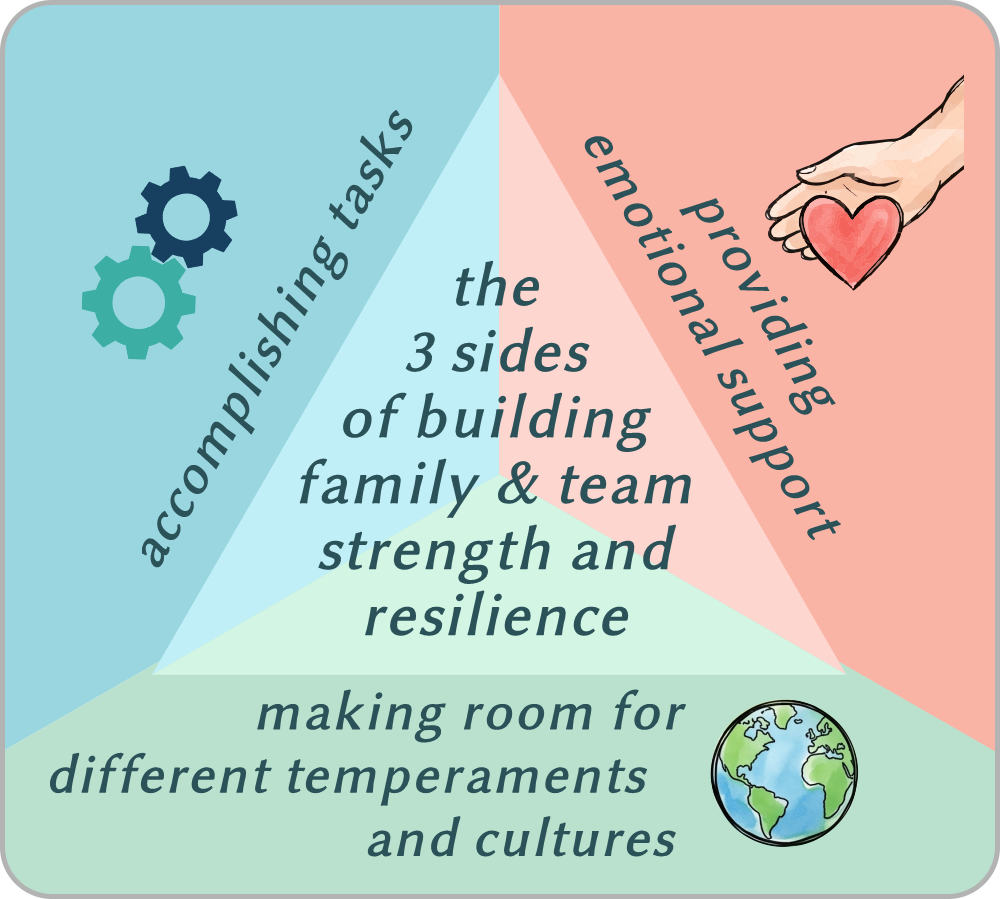
Decades of research on human groups — families, work teams, organizations, neighborhoods — have found the same pattern everywhere. Every human group, from a couple to an entire company, needs to do three things at once:
- accomplish tasks together (including sorting out conflicting needs that arise),
- support one another emotionally, and
- accommodate different temperament types (and in most modern societies, make room for cultural differences).
Let one fall apart, and the others follow. Improve one, and the other two will be more easily improved.
I call this three-sided pattern of interwovenness the team-building triangle, and it lies at the heart of everything in this workbook. You will see it again in the chapters ahead.
Think about your own life for a moment — not the failures, but the successes. The team at work that functions well probably does all three: the tasks get done, people feel appreciated, and different styles are accommodated rather than steamrolled. The friendship that has lasted for decades probably does all three, even if no one ever named it. You might already know what this balance feels like from your own personal experience. What you may not have had until now is a set of distinct names for the three processes you were already weaving together in those successful relationships.
Now think about the places where things are harder. The partner who handles the household logistics brilliantly and efficiently but never receives any expressions of recognition or gratitude will eventually burn out. The work team that is all warmth and camaraderie but cannot meet a deadline will fall apart under pressure. The family that is great at organizing holidays but terrible at talking about feelings will gradually stop gathering at all, or sit frozen at the dinner table. These are not separate problems. They can be understood as challenges to to a better job of weaving together the three strands.
Therapists and management coaches have done a lot of thinking about the balancing act of task accomplishment and emotional support. Now the third element is starting to receive more attention: building a successful team that includes all sorts of people who have different cultures, talents, temperaments, lifetime experiences, and styles of expression. This variety is a tremendous asset — diverse groups come up with better solutions, avoid more blind spots, and adapt more effectively. This variety is also both our fate in a highly interconnected world, and a fact of family life. (Parents give birth to children with temperaments different from either parent.) This kind of variety does not manage itself. It requires communication across difference, and communication across difference is genuinely challenging. It takes skill, patience, and practice. It would be nice if communicating well with people who are very different from us were like sneezing, which we can all do without any practice at all. But in my experience, it is much more like learning to play the piano. It takes conscious attention and sustained effort.
The skills in this workbook address all three sides of the triangle — the task side, the emotional-support side, and the navigating-variety side — because in real life they are inseparable. The encouraging news is that you do not have to strengthen all three sides at once. Each of the Seven Challenges works on one strand at a time, and the strands reinforce one another: a little more skill at listening makes emotional support come easier; a little more skill at turning complaints into requests makes shared tasks go better. Small gains in one corner of the triangle quietly improve the other two.
So you are already doing this complex three-sided work, often better than you realize. The skills in this book are refinements, not replacements. But a natural question arises: if these skills refine what we are already doing, can we really get better at them — especially if some of our patterns have been running for decades? The answer turns out to be more encouraging than most people expect.
Introduction Perspective 4:
You Have Already Proven You Can Learn — and Communication Is a Learnable Skill
Life is full of very challenging tasks. That is simply true. But life is also full of examples of people who get better and better at those tasks — and you yourself are one of those examples. You have mastered many skills in the course of your life journey up to now: standing up, walking, running, learning a vocabulary of thousands of words. It just happened so long ago that you have forgotten both how difficult it was and how successful you were. I am here to remind you of both.
If communication ability were a fixed personality trait — something you are born with or without — you would be stuck. But because it is a learned skill, you can develop it, at any age. The awkwardness you feel when you try something new — really listening instead of planning your reply, asking for what you need instead of hinting or withdrawing — is the same awkwardness a beginning guitarist feels. It is not a sign that you are doing it wrong. It is a sign that you are learning.
The psychologist Carol Dweck has documented something that matters enormously here. People who believe their abilities are fixed (“I’m just not good at talking about feelings”) tend to avoid challenges, because every difficulty feels like proof of a permanent limitation. People who believe their abilities can grow (“I haven’t learned how to talk about feelings yet“) tend to welcome challenges, because every difficulty is simply the next step in learning.
If you have spent years — maybe decades — believing that your communication difficulties are just “who you are,” this reframe may be the most important thing in the entire workbook. You are not a bad communicator. You are an untrained one. And “untrained” is a condition that responds beautifully to practice.
In the Challenge Seven chapter, we will return to Dweck’s work in much greater depth. By that point, you will have had the experience of actually practicing new skills — and discovering for yourself what the growth mindset feels like from the inside, not just as a concept but as a lived experience.
So communication is learnable, and you have the growth mindset available to you. These are genuinely hopeful facts. But an honest question remains, and I would rather show it to you now than let you discover it the hard way: most people who read communication books — even very good ones — feel inspired for a while and then drift back to their old patterns within a few weeks. If the skills are truly learnable, what makes the difference between people who read about them and people who actually change? The answer, it turns out, has very little to do with willpower — and everything to do with an ingredient that, once you see it, changes the whole picture.
Introduction Perspective 5:
The Power of Practicing Together
Here is perhaps the most important thing I have learned in thirty years of working in this field: reading a book about communication skills, by itself, does not produce lasting change. Not because the information is bad, but because information alone is not the largest factor in how human beings actually change.
Journalist Alan Deutschman spent years studying what it actually takes for people to make lasting changes in their lives — not what we wish it took, but what the evidence shows.
His inquiry was galvanized by a heartbreaking puzzle. Doctors know that much illness is the result of patients’ own behavior. But even when given the most medically accurate advice — change your habits or you will not survive — many patients do not change. They die instead. That puzzle moved Deutschman to title his book Change or Die, and it sent him on a quest: were there any personal behavior-change programs anywhere that actually worked? And when they worked, why? His findings provide us with significant pointers as we embark on our own quest to become kinder, wiser, and more effective listeners and talkers.
His conclusion, drawn from fields ranging from cardiac rehabilitation to criminal justice, is captured in three words: “Relate, Repeat, Reframe” — each one weaving us into a new web of relationships. Change does not get very far on new information or new willpower alone. It begins to take hold within a web of new relationships — often including an engaging teacher who believes in your capacity to grow and who walks beside you (relates) while you are learning. Then, within a circle of supportive co-learners, you repeat new behaviors until they begin to feel natural. And in dialogue and practice sessions with those supportive co-learners, you gradually reframe your understanding of yourself and what is possible.
This sequence — “Relate, Repeat, Reframe” — is the hidden architecture of every successful behavior change, from quitting smoking to learning a new language to transforming how you handle conflict. And it explains why so many earnest people read books like this one, feel inspired, try some new approaches for a few weeks, encounter resistance or awkwardness, and gradually drift back to their old patterns. That drift is not a character flaw. It is the predictable result of trying to change without the relational support that makes change sustainable, and without enough repeated practice to move new skills from short-term memory into long-term memory. (Our brain is trying to be helpful and not waste effort. It will not move anything into long-term memory unless it receives a signal, such as intense sensation, strong emotion, or repetition. The one signal we can send at will is repetitive practice, and group settings give emotional support for that repetitive practice.)
If you have tried to improve your communication before and felt like you failed, Deutschman’s research offers a very different interpretation: you did not lack willpower or intelligence. You lacked the support structure that makes deep change possible. The missing ingredient was not inside you — it was around you.
And that is genuinely good news, because support structures can be built — by ordinary people, starting small. This is why Chapter Eight of this workbook, Building Your Mutual Support Network Through Practice Partners and Circles of Six, is entirely devoted to helping you find empowering exemplars, nurture co-learning partners, and develop a circle of people to practice with. I encourage you to read that chapter soon — perhaps even before you dive into the skills themselves. You do not need to master anything first. All the communication skills explored here are deeply interwoven, and we develop these capacities together. It is an accident of language and book writing that we have to present them in a list, one at a time.
For now, just hold this thought: as you read through this workbook, keep one eye open for someone you could invite to explore it with you. A spouse, a friend, a coworker, a neighbor. Even one person makes an enormous difference. Two people committed to practicing together can sustain each other through the awkward early stages in ways that no book, however good, can do alone.
So the capacity is real, the growth mindset is available, and companionship is the ingredient that makes practice stick. But there is one more realization — one that took me decades to fully grasp — and it widens the whole picture in a way you may not expect.
Introduction Perspective 6:
You Are Already a Communication Skills Trainer
Usually we think of the teacher at the front of the room, and the students sitting quietly in rows of chairs. That may be true for a lot of topics, but it is a deeply misleading picture when applied to communication skills. You are not only a communication skills learner. You are also, right this minute, already a communication skills trainer. And you have been one every day of your life.
This is not motivational rhetoric. It is a simple observation about how human beings work. We are learning from each other all the time. From the moment you wake up until you fall asleep, you are demonstrating to everyone around you one particular way that conversations can unfold. When you interrupt someone, you are teaching the people present that interrupting is normal. When you listen carefully and reflect back what you have heard, you are teaching that careful listening is possible. When you express frustration as an attack, you are modeling one path. When you translate that frustration into a clear request, you are modeling another.
Every interaction you have is, at some level, an instruction and invitation to the people witnessing it — your children, your coworkers, your friends, your partner. Human beings are deeply social, and learn by observation and imitation. So with every interaction, we are also teaching other people how to treat us. Put plainly, some part of what is coming toward us from other people is a reflection of what we ourselves are sending out! While this might seem embarrassing at first, it actually opens an amazing new doorway to relationship change.
One of the most empowering lessons I learned from communication coach Marshall Rosenberg was this: In order to have new conversations, we do not need to wait for the other person to change. We have half the lines in every conversation, and with mindful attention, we can start talking and listening more skillfully and more compassionately no matter what the other person is doing. If someone throws a mudball at you, you do not have to pick it up and throw it back at them, getting yourself even more covered in mud in the process, and voting with your behavior for mudball throwing. We have choices. We can choose how we respond. We can choose how we reach out. This workbook is a map of some of the most powerful choices
In my experience, Marshall (as all his students called him) had translated Gandhi’s very idealistic sounding vision of “be the change you want to see” into the very practical “model with your own behavior the behavior you want to evoke from the other person”.
Hold that picture for a moment: every conversation you have is already shaping the communication culture around you — family, work team, community — whether you mean it to or not. The only real question is whether you will shape it on autopilot or by conscious choice. Which brings us, at last, to the practical question this whole Introduction has been building toward: where, exactly, does a person begin?
Introduction Conclusion:
What’s Ahead on This Journey
The chapters ahead — the Seven Challenges, plus Chapter Eight on building your learning support network — each address a specific communication challenge. Some teach practical skills, like listening, self-expression, and translating complaints into requests. Some address the perspectives, attitudes, and orientations that make those skills sustainable, like the growth mindset, the practice of self-forgiveness, and the courage to keep learning even when it is uncomfortable.
Together, the Seven Challenges form a powerful journey — not a rigid sequence, but an interconnected set of practices and attitudes you can return to again and again as your life presents new situations and new relationships to navigate. You can work through them in the order presented. (We have tried to arrange them so that each one prepares you for the next.) But you can also start with whichever challenge speaks most directly to your life right now, and weave the others in as you go along. We each learn differently, and we each have had a different set of needs, frustrations, and successes. That makes following your spontaneous interest an important part of your learning process: you are making your own connections to the material.
In Challenge Seven, we will return to many of the ideas introduced here — the growth mindset, the “born to learn” predicament, the relationship between practice and development — but you will encounter them differently after having worked on Challenges One through Six. What feels conceptual now will feel experiential then. That is the spiral this workbook is built on: each pass through the core ideas deepens your understanding, because you bring more lived experience to the encounter.
Each chapter follows a rhythm you will come to recognize: breathe in the idea — take in what the chapter has to show you, let it connect to your own experience, feel the recognition of something you may have already partly known — and then breathe out the practice, trying something small in a real conversation and noticing what happens. That rhythm of taking in and trying out is the heartbeat of the learning process, and it will carry you from chapter to chapter.
And now, the two small first steps I promised at the beginning — one to take today, and one to begin watching for.

The step for today: start a Learning Journal. It can be any kind that meets your needs: a bound book, a digital document, an online notebook, a three-ring binder — even sending yourself an email message each day with that day’s new experiences and understandings. Your Learning Journal is your first learning companion — a private, patient place where writing down your experiences allows you to see them from a different angle. That shift in perspective is where conscious learning begins: as mentioned earlier in this chapter, “to learn to do something in a new way, we have to slow down and pay attention to it with a new level of focus.” As your first entry, complete the brief reflection exercise below. It takes about ten minutes, and it will help you connect what you have just read to your own actual life — which is where all the real learning happens.
The step to begin watching for: a practice partner. No action is required yet — just keep one eye open, as you read, for a person you might eventually invite to explore this workbook with you. When you are ready, Chapter Eight will walk you through the invitation, step by step.
Introduction Exercise:
Taking Stock of My Communication Journey
Before you continue reading, please launch your Learning Journal. Take some time to reflect on and write down your responses to any of these questions.
1.—Think of a communication moment that went well recently — a time when you felt genuinely connected with someone, or when a difficult conversation resolved better than expected. What made it work? What were you doing, and what was the other person doing?
2.—Now think of a communication moment that went poorly — a conversation that left you frustrated, hurt, or disconnected. Without blaming anyone (including yourself), what do you wish had gone differently?
3.—What brings you to this workbook? What situation or relationship do you most want to improve?
4.—Alan Deutschman’s research suggests that change begins with new relationships, not just new information. Who in your life might you invite to explore this workbook with you? Even one practice partner can make an enormous difference.

Introduction:
References and Recommended Reading
Bales, Robert F. Interaction Process Analysis: A Method for the Study of Small Groups. Addison-Wesley, 1950.
Deutschman, Alan. Change or Die: The Three Keys to Change at Work and in Life. Harper Business, 2007.
Dweck, Carol. Mindset: The New Psychology of Success. Random House, 2006.
Edmondson, Amy C. The Fearless Organization: Creating Psychological Safety in the Workplace for Learning, Innovation, and Growth. Wiley, 2019.
Kegan, Robert. The Evolving Self: Problem and Process in Human Development. Harvard University Press, 1982.
Pearce, W. Barnett. Communication and the Human Condition. Southern Illinois University Press, 1989.
Putnam, Robert D. Bowling Alone: The Collapse and Revival of American Community. Simon & Schuster, 2000.
Richerson, Peter J., and Robert Boyd. Not by Genes Alone: How Culture Transformed Human Evolution. University of Chicago Press, 2005.
Rogers, Carl R. On Becoming a Person: A Therapist’s View of Psychotherapy. Houghton Mifflin, 1961.
Rosenberg, Marshall B. Nonviolent Communication: A Language of Life. 3rd ed., PuddleDancer Press, 2015.
Your notes on the Introduction