Chapter Ten — Exploring The Right to Invite and the Need to Nurture
Reaching Out to Advocate and Mend in a Troubled World
We Are the Agents of Transformation We Have Been Waiting For
Practicing your new communication skills with a practice partner can be your first step into a larger world of practice. A Circle of Six can be an even larger step. They are widening circles — and the circles keep widening. But I have been describing the cooperative life as though it unfolds in a friendly world. As we complete our first circle through the Nine Transformations, I feel the need to acknowledge the world as it actually is in many places. So I am going to use this short final chapter to explore the struggles and boundaries facing a person trying to grow a cooperative, creative and grateful life in a world that is often violent and fearful. In this exploration I will argue that the right of self-defense in a densely interwoven world must necessarily include the right to advocate peaceful conflict resolution and everyday compassionate communication. And I will invite you to become a conscious Joanna or Johnny Appleseed of the cooperative communication skills described in this workbook.
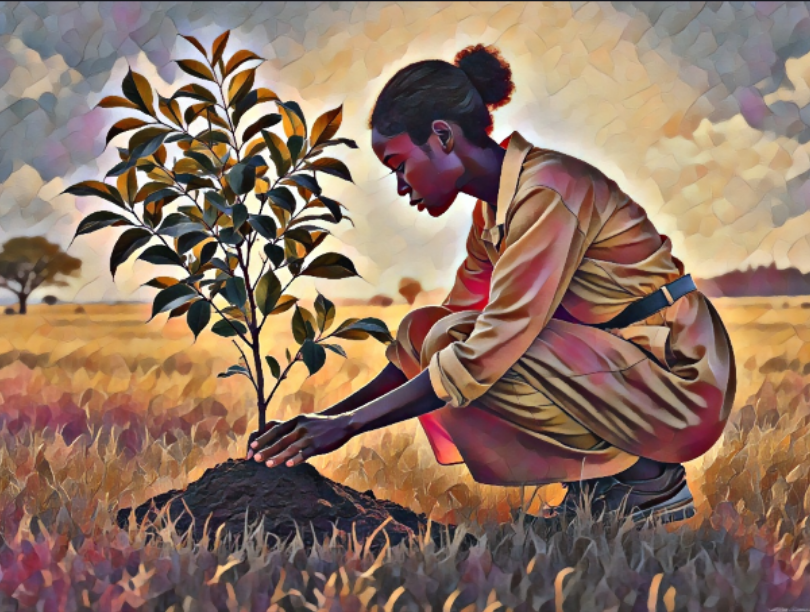
African Tree Planter — In memory of Wangari Maathai (1940-2011) — Public Domain Image
You already are a Joanna or Johnny Appleseed of communication skills in relation to the people you meet in everyday life. And everything you practice inside a partnership or a circle travels with you into the rest of your life. The listening you refine with your practice partner becomes the listening you bring to a tense meeting at work. The ability to translate a complaint into a request, first practiced in the safety of your circle, becomes the move that saves a conversation with your teenager. The capacity to hold your own needs and another person’s needs at the same time — the very heart of cooperation — grows stronger with every exchange, and it does not stop at the edge of the practice group.
Please think back to the double helix named at the beginning of Chapter 9: development pointing inward, cooperation pointing outward. Your partnerships and circles have been strengthening both strands simultaneously. You have been growing more skillful — more aware, more articulate, more able to listen past your own reactions. And you have been growing more cooperative — more able to hold complexity, to navigate difference, to build something with another person that neither of you could build alone.
Those two capacities do not belong only in the world of your practice group. They belong to you as a member of a widening-circles world. They travel into your family, your workplace, your neighborhood, your community and the culture you reinforce in every interaction you have with other people. Every conversation you have, with anyone, becomes a place where the cooperative life is either reinforced or eroded — and you now carry the skills and the lived experience to choose reinforcement, deliberately, even when the surrounding culture is pulling in the other direction. And, unfortunately, it is.
I do not need to catalog for you the violence and the failures of communication that surround us. You already know. School shootings, wars that grind on for years, communities torn apart by conflicts that no one knows how to resolve — all you need to do to know about them is turn on the news. I have lived through six major wars in my long lifetime, and each one has deepened the urgency behind this workbook. I am not going to use these pages to advocate for or against any particular policy about guns, or war, or kickboxing, or brain injuries in football players. That is not what this workbook is for. But I am going to name something that I believe with my whole heart, after many decades of living and more than thirty years of teaching communication: life is calling to us to do better than this.
And here is the strange twist that anyone who advocates for cooperative communication will eventually encounter. There is an asymmetry of social permission in American life — and in many cultures around the world — that is so pervasive most of us have stopped noticing it. It is perfectly acceptable — normal, even admirable — to prepare for violence. You can purchase weapons, train to use them, carry them in public, and consume a steady diet of entertainment built on people harming each other, and none of this is considered intrusive or anyone else’s business. It is your right. But if you stand up in your community and say, I think we should all learn to resolve our conflicts more cooperatively — if you offer, with an open hand, an invitation to practice the skills of listening, honest self-expression, and creative problem-solving — you are likely to be received as naive, preachy, or meddlesome. You are interfering with people’s right to be left alone.
I have felt the weight of this asymmetry in my own life, and I suspect you will feel it too, if you haven’t already. The moment you begin to share what you are learning in this workbook — the moment you invite a neighbor, a coworker, a family member to explore a different way of handling conflict — you will discover that some people experience the invitation itself as a kind of criticism. Are you saying there’s something wrong with how I communicate? The unspoken rule is: you may arm yourself against others, but you may not invite others to disarm. You may prepare for the worst in people, but you may not actively cultivate the best.
Please sit with that for a moment. Preparing for violence is protected space. Inviting cooperation is treated as an intrusion. What is wrong with this picture?
In 1963, Dr. Martin Luther King, Jr., wrote from his jail cell in Birmingham, Alabama, that “injustice anywhere is a threat to justice everywhere.” To me, the history of the world since then suggests a friendly amendment to Dr. King’s statement: in a hyper-networked world, the culture of coercion and cruelty is contagious. What happens in one place does not stay in one place. The patterns of domination travel — through media, through policy, through the stories we tell our children about what strength looks like.
But so do the patterns of cooperation. And that is the ground on which I want to stand.
The need to nurture. There is a teaching that goes back to the ancient Greeks, that we each have a duty to bring out the best in ourselves, arete. I want to propose a corollary to that teaching. In a world thoroughly, mind-bogglingly, interwoven and made smaller by technology, trade, and the climate crisis, we now have a need that only some have recognized in the past: a need to bring out the best in all the people around us, to be concerned about the well-being of everyone, as far as each of us can possibly reach. If we fail to care about others, to be concerned about their fate, and work to bring out the best in them, then it seems to me that we will condemn ourselves to live with the worst of which others are capable. This seems to hold true at every scale: in families, companies, countries, and now a world continuously at war, between countries, and with nature itself. How do we guide our world in new directions? After all, we ourselves are passengers in this boat of life. Whatever happens to it, happens to US!
The right to invite. Thinking about this, I want to name a right that I believe every human being possesses, though I have never seen it written down in any constitution. This right takes place in the world of social custom and biological survival rather than in the world of law. So it emerges through more people practicing it, not by some legislative body passing a law about it. I call it the right to invite. We already invite through embodiment, through our behavior. Gandhi once remarked, “My life is my sermon.” But in a world of voices shouting for more hatred and violence, and media showing vivid examples of that twenty-four hours a day, I am convinced that there is a place for us, a calling for us, to speak out loud about the beautiful possibilities of human cooperation and kindness.
The right to invite is not the right to coerce, to diagnose, or to shame. These activities all fail with alarming regularity. It is not the right to tell other people what is wrong with them. It is the practice of remembering and calling forth what is best in others, even when they may have forgotten it. It is the right to live and discuss more life-supporting ways of building agreement and resolving conflict. It is both the right to live quietly AND the right to say, openly: I have found something that has made my life better — a set of skills, a way of listening, a practice of translating frustration into honest requests — and I would be happy to share it with you, freely, with no strings attached. You may say no. You may say not now. You may never be interested. But I claim the right to make the offer.
This is entirely consistent with everything this workbook teaches. Transformation Three taught us that genuine communication begins with intent and consent — we never force an invitation on anyone. Transformation Four taught us to express ourselves clearly and kindly, without demanding agreement. Transformation Five taught us to translate complaints into requests — and an invitation is the purest form of a request: would you like to explore this with me? The right to invite is not a departure from the principles of cooperative communication. It is their fullest expression, turned outward toward the world.
I think of this as a kind of Joanna and Johnny Appleseed work. Johnny Appleseed — the real person behind the legend — did not force anyone to plant orchards. He walked the frontier, scattered seeds, tended what he could, and moved on. Some seeds took root and became trees that fed communities for generations. Some did not. He kept walking. He kept planting. He understood something that I want you to carry with you: you do not have to see the harvest to justify the planting.
I am asking you to become a Joanna or Johnny Appleseed of cooperative communication. Not a missionary who arrives with a diagnosis of what is wrong with the people around you — that has already failed many times. The appreciative stance we have practiced throughout this workbook asks of us something more in tune with the human heart and brain than that. Not an activist who arrives with a demand — though I honor the activists and their demands. Something quieter and, I believe, more durable: a person who has glimpsed a better way of being together, who practices it imperfectly but sincerely, and who offers it to others with an open hand. A seed-planter. An inviter.
You will often be met with eye-rolls. You will be dismissed as soft, or naive, or interfering. You may lose some arguments you never intended to start. But remember your empowering ancestors — the people who chose compassion in the face of cruelty, who kept going when the surrounding culture told them they were foolish. You are in their lineage. And remember the children — all the children, everywhere, who deserve to grow up in a world where cooperation is taught as seriously as competition. Remember that every seed of cooperative skill you plant in one family, one workplace, one neighborhood is one small push beyond the patterns of violence that put those children at risk. You may never see the connection between the listening skill you shared with a neighbor and the argument that did not escalate three years later in a household you will never visit. But the connection is real. The seeds travel further than the planter.
In the opening pages of this workbook there is a poem called “The Loom of Emergence.” It bears revisiting now, because it names the weaving that every seed-planter is part of:
We weave together words to make sentences.
We weave together sentences, and listening, and turns, to make conversations.
We weave together conversations and actions to make relationships.
We weave together relationships to make families and communities.
We weave together communities to make a shared world.
Your practice partnership is one thread in that loom. Your circle is another. Every invitation you extend — every time you offer a neighbor, a colleague, a stranger the chance to explore a more cooperative way of relating — is another thread. The loom keeps weaving. And the cooperative life you are building does not end at the edge of any single group. It extends into every relationship you have, and through those relationships, into the world.
This is the journey that Robert Kegan’s work describes: from the narrow focus on what I want, to the widening circles of cooperative engagement where everybody can get more of what they want and need. You are on that journey. You have been on it since the first day of your life and the first page of this workbook. And now, with companions beside you, with seeds in your pocket, and with a lineage of courageous ancestors at your back, the next circle is ready to open.
In a world living in the shadow of violence, we are the agents of transformation we have been waiting for.

Make a new beginning. (Public Domain Image)
Your notes on this chapter