9T-All-Chaps
Table of Contents
Communication Skills for Building a Shared Life
Nine Transformations for New Conversations
| Section | Focus | Page |
|---|---|---|
| TRANSFORMATION ONE | SEEING NEW POSSIBILITIES, WAKING UP TO CONSCIOUS CONVERSATIONS | 1 – 1 |
| TRANSFORMATION TWO | LISTENING MORE CAREFULLY & RESPONSIVELY, UNDERSTANDING MORE DEEPLY | 2-1 |
| TRANSFORMATION THREE | EXPLAINING OUR CONVERSATIONAL INTENT AND INVITING CONSENT | 3-1 |
| TRANSFORMATION FOUR | EXPRESSING OURSELVES MORE CLEARLY, CREATIVELY, AND COMPLETELY WITH THE FIVE “I-MESSAGES” | 4-1 |
| TRANSFORMATION FIVE | TRANSLATIGN CRITICISMS AND COMPLAINTS INTO SUCCESS-FOCUSED REQUESTS (HELPING YOUR CONVERSATION PARTNER MEET YOUR NEEDS) | 5-1 |
| TRANSFORMATION SIX | ASKING QUESTIONS MORE CONSCIOUSLY, “OPEN-ENDED-LY” AND CREATIVELY | 6-1 |
| TRANSFORMATION SEVEN | STRENGTHEN ALL OUR RELATIONSHIPS BY EXPRESSING MORE GRATITUDE, APPRECIATION, ENCOURAGEMENT, AND DELIGHT | 7-1 |
| TRANSFORMATION EIGHT | SHIFTING TO “CONTINUOUS-LEARNING” MODE: MAKING MORE CONSCIOUS / MORE CREATIVE COMMUNICATION A CENTRAL PART OF OUR LIVES | 8-1 |
| TRANSFORMATION NINE | DEVELOPING YOUR LEARNING SUPPORT NETWORK WITH TEAMS OF TWO AND CIRCLES OF SIX | 9-1 |
Dedicated to Marshall Rosenberg, Barnett Pearce and Ramon Panikkar, three of my teachers, and to the creative team-builders and peacemakers in every culture and faith. Where there is a clash of wills, may we bring the light of new understanding and a meeting of hearts.
In the spirit of the teachers mentioned above, this workbook carries a Creative Commons copyright license. Anyone may republish it or make as many copies of all or parts of it as they wish. For more information about the details of this Creative Commons license, please see the inside of the back cover.

The Loom of Emergence
We weave together words to make sentences.
We weave together sentences, and listening, and turns, to make conversations.
We weave together conversations and actions to make relationships.
We weave together relationships to make families and communities.
We weave together communities to make a shared world.
Awakening to and Embracing Conscious Conversations
- From communicating on autopilot to communicating on purpose
- From “this is just how I am” to “this is where I’m starting”
- From invisible habits absorbed in childhood
to visible choices made as an adult - From sleepwalking through conversations to waking up inside them
- From not knowing what you don’t know to becoming a curious beginner
- From assuming communication is as easy as breathing
to discovering it’s as challenging as music - From blaming yourself for not being better at this
to forgivingly realizing you were never taught - From trying to change alone with a book
to finding companions for the journey - From every interaction being an accident
to every interaction being an instruction and an invitation - From thinking your difficult conversations are personal failings
to seeing them as universal human puzzles with learnable solutions - From the fixed mindset — “I’m just not good at this”
to the growth mindset — “I haven’t learned this yet” - From clunky autopilot to skillful flying — one conversation at a time
1.0 Overview: You Already Know What Connection Feels Like — This Book Is About Making It Happen on Purpose
Think of a conversation that went well. Not a perfect one — just a moment when something opened up between you and someone else. Maybe you said the right thing at the right time, and the other person’s face changed. Maybe someone really listened to you — not just waited for their turn to talk, but actually heard you — and you felt something shift. Maybe a tense conversation that could have gone badly somehow didn’t, and you walked away thinking, How did that happen?
You know that feeling. Everyone does. And it tells you something important: you already have the raw materials for what this workbook teaches. The skills in these pages are not foreign objects to be installed. They are refinements of something you have already experienced — something real that happens between people when the conditions are right.
This workbook is about those conditions. What makes them possible, what keeps them from showing up more often, and how you can learn to create them on purpose — even in the conversations that matter most and feel the hardest.
One of the most important discoveries of my life was that communication is a learnable skill — a set of learnable skills, actually — and that I could get much better at it. I didn’t make that discovery early enough to save my second marriage. It took two divorces and a long overdue enrollment in my first communication class to get me there. But once I arrived, something surprising happened. I wasn’t starting from zero. I had decades of real conversations behind me — many of them painful, yes, but also many where I had connected with someone without knowing how I’d done it. The class didn’t hand me a toolkit from outer space. It gave me a lens for seeing what was already happening in my best moments — and a name for what was going wrong in my worst.
If you’re reading this, you probably know something of that territory — not my divorces specifically, but the mix. The moments when something worked and you didn’t quite know why, alongside the moments that didn’t work at all: the argument that keeps recycling, the important thing that never gets said, the conversation where someone you care about is slipping away and you can feel it happening but can’t seem to stop it.

Whatever brought you here, I want you to know two things at the outset. First: the difficulties are real, and they are nearly universal. You are not alone in them, and they have identifiable causes that we will explore in Transformation One. Second: the situation is genuinely improvable. Not because I am going to hand you magic words, but because those moments of real connection you have already experienced are not accidents. They are early versions of something you can learn to do more often and more deliberately.
Let me paint a small picture of where this road leads, because you deserve to know what you are being invited into. Imagine the argument that has looped for years finally losing its grip — not because the other person suddenly changed, but because you responded in a new way that stopped feeding the loop. Imagine being able to say the important thing, kindly and clearly, instead of carrying it around unsaid for another decade. Imagine a tense conversation at work that ends with both people feeling heard — and maybe even a little more connected than before. These are not fantasies. They are the ordinary, repeatable experiences of people who practice the skills in this book, and I have watched such changes unfold in my students’ lives, and in my own, across more than thirty years.
And… to learn to do something in a new way, we have to slow down and pay attention to it with a new level of focus. That is a key ingredient in every chapter of this book — and, as you will see, in the entire shift from autopilot to conscious choice.
I also want to be honest with you, right from the start, about what this book asks of you — because it asks more than reading. It asks for your attention, a little at a time. It asks for practice: small experiments in real conversations. And before long it will invite you to find at least one companion to practice with. If that sounds like a lot, here is the promise that runs through every chapter: each request will arrive in pieces small enough to actually do. Big changes in this workbook are always broken down into small, doable steps.
To help get you started, what follows in Transformation One is a learner’s bird’s-eye view of communication skills — six perspectives that build on one another, each one widening your view of why those moments of connection happen, why they don’t happen more often, and how you can learn to create them deliberately. And the inquiry arrives somewhere practical: by the end of Transformation One, I will invite you to take two small first steps — starting a Learning Journal, and beginning to keep an eye out for a possible practice partner. An open horizon of development calls to each of us, no matter how many struggles we may have had in the past. Each perspective that follows explores another part of that horizon.
1.1 Conscious Conversations Perspective 1:
You’re Already Doing the Most Consequential Thing in the World
Every day you are in dozens of conversations — with your partner, your kids, your coworkers, your friends, your neighbors, sometimes with strangers whose cooperation you need. You are already communicating constantly. And here is the thing that is easy to miss: some of those conversations are going better than you realize. Every time you pause before reacting, every time you ask a genuine question instead of assuming, every time you make someone feel heard even for a moment — you are already practicing, in rough form, the skills this workbook will help you refine.
The question is not whether you can communicate. You have been doing it your whole life. The question is whether your communication is consistently producing what matters to you — connection, respect, understanding, cooperation — or whether it keeps producing frustrations alongside the good moments: the argument that loops forever, the important thing left unsaid, the conversation that leaves someone feeling unheard.
Most of us communicate on what you might call cultural autopilot. We react instead of responding. We continue to imitate whatever patterns surrounded us growing up. We handle conflict the way our parents handled conflict — or, if their way was painful enough, we swing to the opposite extreme, which brings its own problems. The autopilot is not a character flaw. It is simply what happens when a complex skill still runs on patterns we absorbed before we were old enough to examine them. And the encouraging news is that autopilot is not the only option available to you.

Turn on the twin headlamps of conscious attention and intention
I think of those two beams in the picture above — conscious attention and conscious intention — as the twin headlamps of this entire journey, and you will meet them again in every chapter of this book. Here is the encouraging part: turning them on does not require talent, luck, or a new personality. It only requires remembering that they are there. This workbook offers a clear set of practices to do exactly that — and to discover that you have far more choices in your conversations than you may have realized.
Those choices raise a natural question. If the twin headlamps are available to anyone — if conscious attention and conscious intention are things we could turn on — then what shaped the patterns we have been running on all this time? And why do those patterns sometimes serve us so poorly, even with the people we love most?
1.2 Conscious Conversations Perspective 2:
Born to Learn — Where Your Communication Patterns Came From, and Why They Can Change
Here is the biology, and it is encouraging at its core. You were born with a brain magnificently wired for language and connection. That wiring is one of the most remarkable things about being human. But you were born knowing exactly zero communication skills. You could cry. You could nurse. That was it.
Just as you were born with the capacity for language but no particular vocabulary, you were also born with the capacity for communication but no particular communication skills. Everything you know about talking, listening and taking turns, you learned — by absorbing the patterns of your family, your community, your culture, and increasingly, your screens.
If what you absorbed was skillful, you got lucky. If what you absorbed was sarcasm, avoidance, yelling, guilt-tripping, or silence, you learned that instead. Your communication habits work the way language acquisition works: a baby born in a house full of Portuguese speakers learns Portuguese — not because Portuguese is better or worse than any other language, but because that is what was there. Your conversational patterns are inherited in the same way: not through your genes, but through your environment, copied from the people around you when you were too little to know what was going on.
I think of this as the “born to learn” predicament. We humans are astonishingly adaptable — we can thrive in Arctic tundra and tropical rainforests, in fishing villages and megacities — but that very adaptability means none of us arrives pre-equipped for the particular communication challenges we will face. In contrast with newborn horses, who can gallop within twenty-four hours of birth, we arrive in life as beginners with an enormous amount of essential stuff to learn. There is no shame in not knowing this stuff.
We were not born knowing it — we were born to learn it.
What we may have missed in our early communication learning is not a personal failing. Cultures often teach their children how to (A) assert themselves and (B) how to fight, but not necessarily (C) how to nurture and (D) how to negotiate win-win solutions. Now, as adults capable of choosing our own learning paths, I am convinced that we need to develop the last two in order to keep from being unhappily stuck forever with inside limits of the first two.
And here is the genuinely hopeful fact hidden inside the biology: the same learning channel that installed your old patterns — observation, imitation, repetition — is still wide open, and it works just as well for installing new ones. The great twentieth-century psychologist Carl Rogers recognized this deeply: whatever we absorbed in childhood is not our final destination. As adults, we can examine what we inherited, keep what works, and learn new skills to replace what does not. You will not be asked to become a different person. You will be invited to make small additions to your repertoire, one skill at a time.
So the capacity to learn is still open, and the invitation is real. But what exactly are we asking that capacity to do? Communication sounds like one thing — just talking and listening — but it turns out to involve a balancing act far more many-leveled than most of us ever imagined. Understanding those levels is what makes the practice this workbook offers land so much more deeply.
1.3 Conscious Conversations Perspective 3:
The Three Things Every Family and Team Needs (and How the Skills in This Workbook Address All of Three)
Decades of research on human groups — families, work teams, organizations, neighborhoods — have found the same pattern everywhere. Every human group, from a couple to an entire company, needs to do three things at once:
- accomplish tasks together (including sorting out conflicting needs that arise),
- support one another emotionally, and
- accommodate different temperament types (and in most modern societies, make room for cultural differences).
Let one fall apart, and the others follow. Improve one, and the other two will be more easily improved.
I call this three-sided pattern of interwovenness the team-building triangle, and it lies at the heart of everything in this workbook. You will see it again in the chapters ahead.
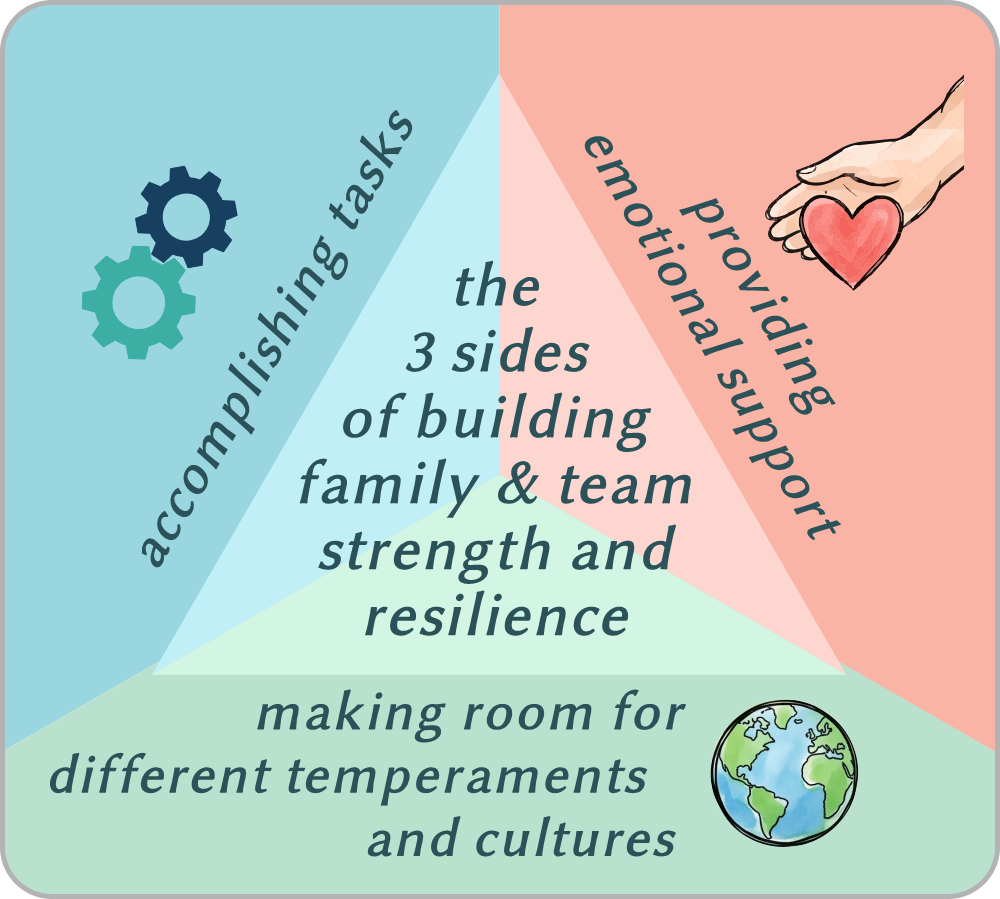
Think about your own life for a moment — not the failures, but the successes. The team at work that functions well probably does all three: the tasks get done, people feel appreciated, and different styles are accommodated rather than steamrolled. The friendship that has lasted for decades probably does all three, even if no one ever named it. You might already know what this balance feels like from your own personal experience. What you may not have had until now is a set of distinct names for the three processes you were already weaving together in those successful relationships.
Now think about the places where things are harder. The partner who handles the household logistics brilliantly and efficiently but never receives any expressions of recognition or gratitude will eventually burn out. The work team that is all warmth and camaraderie but cannot meet a deadline will fall apart under pressure. The family that is great at organizing holidays but terrible at talking about feelings will gradually stop gathering at all, or sit frozen at the dinner table. These are not separate problems. They can be understood as challenges to do a better job of weaving together the three strands.
Therapists and management coaches have done a lot of thinking about the balancing act of task accomplishment and emotional support. Now the third element is starting to receive more attention: building a successful team that includes all sorts of people who have different cultures, talents, temperaments, lifetime experiences, and styles of expression. This variety is a tremendous asset — diverse groups come up with better solutions, avoid more blind spots, and adapt more effectively. This variety is also both our fate in a highly interconnected world, and a fact of family life. (Parents give birth to children with temperaments different from either parent.) This kind of variety does not manage itself. It requires communication across difference, and communication across difference is genuinely challenging. It takes skill, patience, and practice. It would be nice if communicating well with people who are very different from us were like sneezing, which we can all do without any practice at all. But in my experience, it is much more like learning to play the piano. It takes conscious attention and sustained effort.
The skills in this workbook address all three sides of the triangle — the task side, the emotional-support side, and the navigating-variety side — because in real life they are inseparable. The encouraging news is that you do not have to strengthen all three sides at once. Each of the Nine Transformations works on one strand at a time, and the strands reinforce one another: a little more skill at listening makes emotional support come easier; a little more skill at turning complaints into requests makes shared tasks go better. Small gains in one corner of the triangle quietly improve the other two.
So you are already doing this complex three-sided work, often better than you realize. The skills in this book are refinements, not replacements. But a natural question arises: if these skills refine what we are already doing, can we really get better at them — especially if some of our patterns have been running for decades? The answer turns out to be more encouraging than most people expect.
1.4 Conscious Conversations Perspective 4:
You Have Already Proven You Can Learn — and Communication Is a Learnable Skill
Life is full of very challenging tasks. That is simply true. But life is also full of examples of people who get better and better at those tasks — and you yourself are one of those examples. You have mastered many skills in the course of your life journey up to now: standing up, walking, running, learning a vocabulary of thousands of words. It just happened so long ago that you have forgotten both how difficult it was and how successful you were. I am here to remind you of both.
If communication ability were a fixed personality trait — something you are born with or without — you would be stuck. But because it is a learned skill, you can develop it, at any age. The awkwardness you feel when you try something new — really listening instead of planning your reply, asking for what you need instead of hinting or withdrawing — is the same awkwardness a beginning guitarist feels. It is not a sign that you are doing it wrong. It is a sign that you are learning.
The psychologist Carol Dweck has documented something that matters enormously here. People who believe their abilities are fixed (“I’m just not good at talking about feelings”) tend to avoid challenges, because every difficulty feels like proof of a permanent limitation. People who believe their abilities can grow (“I haven’t learned how to talk about feelings yet“) tend to welcome challenges, because every difficulty is simply the next step in learning.
If you have spent years — maybe decades — believing that your communication difficulties are just “who you are,” this reframe may be the most important thing in the entire workbook. You are not a bad communicator. You are an untrained one. And “untrained” is a condition that responds beautifully to practice.
In the Transformation Eight chapter, we will return to Dweck’s work in much greater depth. By that point, you will have had the experience of actually practicing new skills — and discovering for yourself what the growth mindset feels like from the inside, not just as a concept but as a lived experience.
So communication is learnable, and you have the growth mindset available to you. These are genuinely hopeful facts. But an honest question remains, and I would rather show it to you now than let you discover it the hard way: most people who read communication books — even very good ones — feel inspired for a while and then drift back to their old patterns within a few weeks. If the skills are truly learnable, what makes the difference between people who read about them and people who actually change? The answer, it turns out, has very little to do with willpower — and everything to do with an ingredient that, once you see it, changes the whole picture.
1.5 Conscious Conversations Perspective 5:
The Power of Practicing Together
Here is perhaps the most important thing I have learned in thirty years of working in this field: reading a book about communication skills, by itself, does not produce lasting change. Not because the information is bad, but because information alone is not the largest factor in how human beings actually change.
Journalist Alan Deutschman spent years studying what it actually takes for people to make lasting changes in their lives — not what we wish it took, but what the evidence shows.
His inquiry was galvanized by a heartbreaking puzzle. Doctors know that much illness is the result of patients’ own behavior. But even when given the most medically accurate advice — change your habits or you will not survive — many patients do not change. They die instead. That puzzle moved Deutschman to title his book Change or Die, and it sent him on a quest: were there any personal behavior-change programs anywhere that actually worked? And when they worked, why? His findings provide us with significant pointers as we embark on our own quest to become kinder, wiser, and more effective listeners and talkers.
His conclusion, drawn from fields ranging from cardiac rehabilitation to criminal justice, is captured in three words: “Relate, Repeat, Reframe” — each one weaving us into a new web of relationships. Change does not get very far on new information or new willpower alone. It begins to take hold within a web of new relationships — often including an engaging teacher who believes in your capacity to grow and who walks beside you (relates) while you are learning. Then, within a circle of supportive co-learners, you repeat new behaviors until they begin to feel natural. And in dialogue and practice sessions with those supportive co-learners, you gradually reframe your understanding of yourself and what is possible.
This sequence — “Relate, Repeat, Reframe” — is the hidden architecture of every successful behavior change, from quitting smoking to learning a new language to transforming how you handle conflict. And it explains why so many earnest people read books like this one, feel inspired, try some new approaches for a few weeks, encounter resistance or awkwardness, and gradually drift back to their old patterns. That drift is not a character flaw. It is the predictable result of trying to change without the relational support that makes change sustainable, and without enough repeated practice to move new skills from short-term memory into long-term memory. (Our brain is trying to be helpful and not waste effort. It will not move anything into long-term memory unless it receives a signal, such as intense sensation, strong emotion, or repetition. The one signal we can send at will is repetitive practice, and group settings give emotional support for that repetitive practice.)
If you have tried to improve your communication before and felt like you failed, Deutschman’s research offers a very different interpretation: you did not lack willpower or intelligence. You lacked the support structure that makes deep change possible. The missing ingredient was not inside you — it was around you.
And that is genuinely good news, because support structures can be built — by ordinary people, starting small. This is why Transformation Nine of this workbook, Building Your Mutual Support Network Through Practice Partners and Circles of Six, is entirely devoted to helping you find empowering exemplars, nurture co-learning partners, and develop a circle of people to practice with. I encourage you to read that chapter soon — perhaps even before you dive into the skills themselves. You do not need to master anything first. All the communication skills explored here are deeply interwoven, and we develop these capacities together. It is an accident of language and book writing that we have to present them in a list, one at a time.
For now, just hold this thought: as you read through this workbook, keep one eye open for someone you could invite to explore it with you. A spouse, a friend, a coworker, a neighbor. Even one person makes an enormous difference. Two people committed to practicing together can sustain each other through the awkward early stages in ways that no book, however good, can do alone.
So the capacity is real, the growth mindset is available, and companionship is the ingredient that makes practice stick. But there is one more realization — one that took me decades to fully grasp — and it widens the whole picture in a way you may not expect.
1.6 Conscious Conversations Perspective 6:
You Are Already a Communication Skills Trainer
Usually we think of the teacher at the front of the room, and the students sitting quietly in rows of chairs. That may be true for a lot of topics, but it is a deeply misleading picture when applied to communication skills. You are not only a communication skills learner. You are also, right this minute, already a communication skills trainer. And you have been one every day of your life.
This is not motivational rhetoric. It is a simple observation about how human beings work. We are learning from each other all the time. From the moment you wake up until you fall asleep, you are demonstrating to everyone around you one particular way that conversations can unfold. When you interrupt someone, you are teaching the people present that interrupting is normal. When you listen carefully and reflect back what you have heard, you are teaching that careful listening is possible. When you express frustration as an attack, you are modeling one path. When you translate that frustration into a clear request, you are modeling another.
Every interaction you have is, at some level, an instruction and invitation to the people witnessing it — your children, your coworkers, your friends, your partner. Human beings are deeply social, and learn by observation and imitation. So with every interaction, we are also teaching other people how to treat us. Put plainly, some part of what is coming toward us from other people is a reflection of what we ourselves are sending out! While this might seem embarrassing at first, it actually opens an amazing new doorway to relationship change.
One of the most empowering lessons I learned from communication coach Marshall Rosenberg was this: In order to have new conversations, we do not need to wait for the other person to change. We have half the lines in every conversation, and with mindful attention, we can start talking and listening more skillfully and more compassionately no matter what the other person is doing. If someone throws a mudball at you, you do not have to pick it up and throw it back at them, getting yourself even more covered in mud in the process, and voting with your behavior for mudball throwing. We have choices. We can choose how we respond. We can choose how we reach out. This workbook is a map of some of the most powerful choices
In my experience, Marshall (as all his students called him) had translated Gandhi’s very idealistic sounding vision of “be the change you want to see” into the very practical vision of modeling with your own behavior the behavior you want to evoke from the other person — turning the spiral of escalation into a spiral of cooperation.
Hold that picture for a moment: every conversation you have is already shaping the communication culture around you — family, work team, community — whether you mean it to or not. The only real question is whether you will shape it on autopilot or by conscious and compassionate choice. Which brings us, at last, to the practical question this whole opening transformation has been building toward: where, exactly, does a person begin?
1.7 Conclusion: What’s Ahead on This Journey
The chapters ahead each address a specific communication challenge. Some teach practical skills, like listening, self-expression, and translating complaints into requests. Some address the perspectives, attitudes, and orientations that make those skills sustainable, like the growth mindset, the practice of self-forgiveness, and the courage to keep learning even when it is uncomfortable.
Together, the Nine Transformations form a powerful journey — not a rigid sequence, but an interconnected set of practices and attitudes you can return to again and again as your life presents new situations and new relationships to navigate. You can work through them in the order presented. (We have tried to arrange them so that each one prepares you for the next.) But you can also start with whichever transformation speaks most directly to your life right now, and weave the others in as you go along. We each learn differently, and we each have had a different set of needs, frustrations, and successes. That makes following your spontaneous interest an important part of your learning process: you are making your own connections to the material.
In Transformation Eight, we will return to many of the ideas introduced here — the growth mindset, the “born to learn” predicament, the relationship between practice and development — but you will encounter them differently after having worked on Transformations Two through Seven. What feels conceptual now will feel experiential then. That is the spiral this workbook is built on: each pass through the core ideas deepens your understanding, because you bring more lived experience to the encounter.
Each chapter follows a rhythm you will come to recognize: breathe in the idea — take in what the chapter has to show you, let it connect to your own experience, feel the recognition of something you may have already partly known — and then breathe out the practice, trying something small in a real conversation and noticing what happens. That rhythm of taking in and trying out is the heartbeat of the learning process, and it will carry you from chapter to chapter.
And now, the two small first steps I promised at the beginning — one to take today, and one to begin watching for.

The step for today: start a Learning Journal. It can be any kind that meets your needs: a bound book, a digital document, an online notebook, a three-ring binder — even sending yourself an email message each day with that day’s new experiences and understandings. (I really like 3-ring binders because of the way I can go back and add new pages.) Your Learning Journal is your first learning companion — a private, patient place where writing down your experiences allows you to see them from a different angle. That shift in perspective is where conscious learning begins: as mentioned earlier in this chapter, “to learn to do something in a new way, we have to slow down and pay attention to it with a new level of focus.” As your first entry, complete the brief reflection exercise below. It takes about ten minutes, and it will help you connect what you have just read to your own actual life — which is where all the real learning happens.
The step to begin watching for: a practice partner. No action is required yet — just keep one eye open, as you read, for a person you might eventually invite to explore this workbook with you. When you are ready, Transformation Nine will walk you through the invitation, step by step.
1.8 Transformation One Exercise:
Taking Stock of My Journey Toward Conscious Communication
Before you continue reading, please launch your Learning Journal. Take some time to reflect on and write down your responses to any of these questions.
1.—Think of a communication moment that went well recently — a time when you felt genuinely connected with someone, or when a difficult conversation resolved better than expected. What made it work? What were you doing, and what was the other person doing?
2.—Now think of a communication moment that went poorly — a conversation that left you frustrated, hurt, or disconnected. Without blaming anyone (including yourself), what do you wish had gone differently?
3.—What brings you to this workbook? What situation or relationship do you most want to improve?
4.—Alan Deutschman’s research suggests that change begins with new relationships, not just new information. Who in your life might you invite to explore this workbook with you? Even one practice partner can make an enormous difference.

1.9 Transformation One:
References and Recommended Reading
Bales, Robert F. Interaction Process Analysis: A Method for the Study of Small Groups. Addison-Wesley, 1950.
Deutschman, Alan. Change or Die: The Three Keys to Change at Work and in Life. Harper Business, 2007.
Dweck, Carol. Mindset: The New Psychology of Success. Random House, 2006.
Edmondson, Amy C. The Fearless Organization: Creating Psychological Safety in the Workplace for Learning, Innovation, and Growth. Wiley, 2019.
Kegan, Robert. The Evolving Self: Problem and Process in Human Development. Harvard University Press, 1982.
Pearce, W. Barnett. Communication and the Human Condition. Southern Illinois University Press, 1989.
Putnam, Robert D. Bowling Alone: The Collapse and Revival of American Community. Simon & Schuster, 2000.
Richerson, Peter J., and Robert Boyd. Not by Genes Alone: How Culture Transformed Human Evolution. University of Chicago Press, 2005.
Rogers, Carl R. On Becoming a Person: A Therapist’s View of Psychotherapy. Houghton Mifflin, 1961.
Rosenberg, Marshall B. Nonviolent Communication: A Language of Life. 3rd ed., PuddleDancer Press, 2015.
Your notes on Transformation One: Conscious Conversations
- From waiting for your turn to talk…
to genuinely wanting to understand - From half-listening, to full presence
- From the debate stage, to the dialogue
- From “I hear you, but—”, to “Tell me more”
- From confusing acknowledgment with agreement
to the freedom of separating the two - From listening only to respond…
to listening in order to receive - From dismissing what you hear
to restating it in your own words - From focusing on the screen in your hand…
to focusing on the person in front of you - From the silence that merely waits…
to the silence that genuinely attends - From defeating people in conversation…
to engaging the person whose cooperation you may need tomorrow - From a technique you perform…
to a quality of character you grow into - From passive hearing…
to the generous art of listening — one conversation at a time!
2.1 Summary
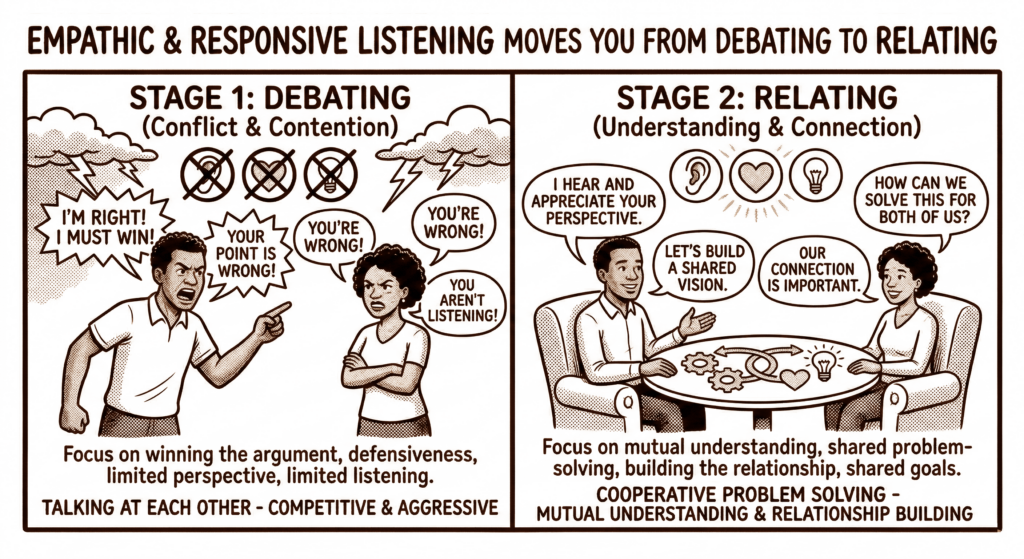
Listen first and acknowledge what you hear, even if you don’t agree with it, before expressing your own experience or point of view.
Doing so accomplishes two things at once: you take in more of the “big picture” of the conversation, and you earn more of your partner’s attention in return. So listen first, and offer a brief restatement of what you have heard — especially the feelings in it — before you express your own needs or position.
The kind of listening recommended here mentally separates acknowledging from approving or agreeing. Acknowledging another person’s thoughts and feelings does not have to mean that you approve of or agree with that person’s actions or way of experiencing, or that you will do whatever someone asks.
2.2 The First Skill — and a Capacity You Already Possess
You already know what good listening feels like — from the receiving end. Think of a time when someone gave you their full, unhurried attention while you talked about something that mattered to you. Not advice. Not a quick fix. Just the experience of being heard — of watching another person’s face and realizing, They’re actually with me right now. If you can remember a moment like that, you already know the most important thing this chapter has to teach: that kind of listening is one of the most powerful gifts one human being can offer another. And you have already, in your own rough way, begun to offer it yourself — every time you set aside what you were about to say and genuinely tried to understand someone else’s experience first.
In Transformation One, we explored the “born to learn” idea: you were born with a magnificent capacity for language, but zero words in your vocabulary. The same is true for communication skills. You were born with the capacity for skillful, responsive listening — and that capacity has been developing, unevenly and without much guidance, your whole life. This chapter is about recognizing what you already partly do, giving it a name, and learning to do it more deliberately and more often.
Of all the skills in this workbook, listening may be the most transformative — and the most underestimated. It is the skill that most quickly changes the emotional temperature of a difficult conversation. It is the skill that most directly addresses the “emotional support” side of the relationship triangle we explored in Transformation One. And it is the skill that, with practice, begins to reshape not just your conversations but also your ability to bring your own thoughts and feelings into focus — more on that later in this chapter.
Here is the question at the heart of everything that follows, and it is worth naming out loud before we go any further: What would it be like to become someone others genuinely trust with their experience — and how far does that one capacity reach? That question may sound large, but the practice at its center is surprisingly small — a brief, spoken reflection that lets a speaker know you have truly followed the story of their experience, something a murmured “yeah” or “uh-huh” can never quite convey. The chapter ahead will show you where this capacity already lives in your life, what sometimes gets in its way, and how a single, learnable distinction can free it to do more than you might expect.
Responsive listening is unusual in that it serves two very different needs at once. In the quiet, everyday life of a relationship, it is the thread that weaves connection — the way we let the people around us know, moment by moment, that they are seen and received. And in the hardest moments — during conflict, misunderstanding, or high-stakes disagreement — it is the practice that most reliably keeps a conversation from spiraling into a deadlock or an explosion. This chapter explores both dimensions, beginning with the quieter one, because it turns out that’s where the deeper power lives.
What follows is both a practical guide and an invitation to see listening in a new light — not as a passive activity, a matter of waiting politely while the other person finishes, but as one of the most active and rewarding things a human being can do. The great twentieth-century psychologist Carl Rogers placed this kind of listening at the very heart of his approach to psychotherapy and called it “active listening.” He was convinced that anyone could learn it, and that it carried a quiet current of emotional support into every conversation where it was practiced. I have re-labeled it “responsive listening,” because so many people picture good listening as completely silent. In truth, the magic lies in small spoken responses — the brief reflections described above. To see how a practice this small can carry so much weight, we begin with what every relationship needs in order to survive.
2.3 Listening and the Three Things Every Relationship Needs
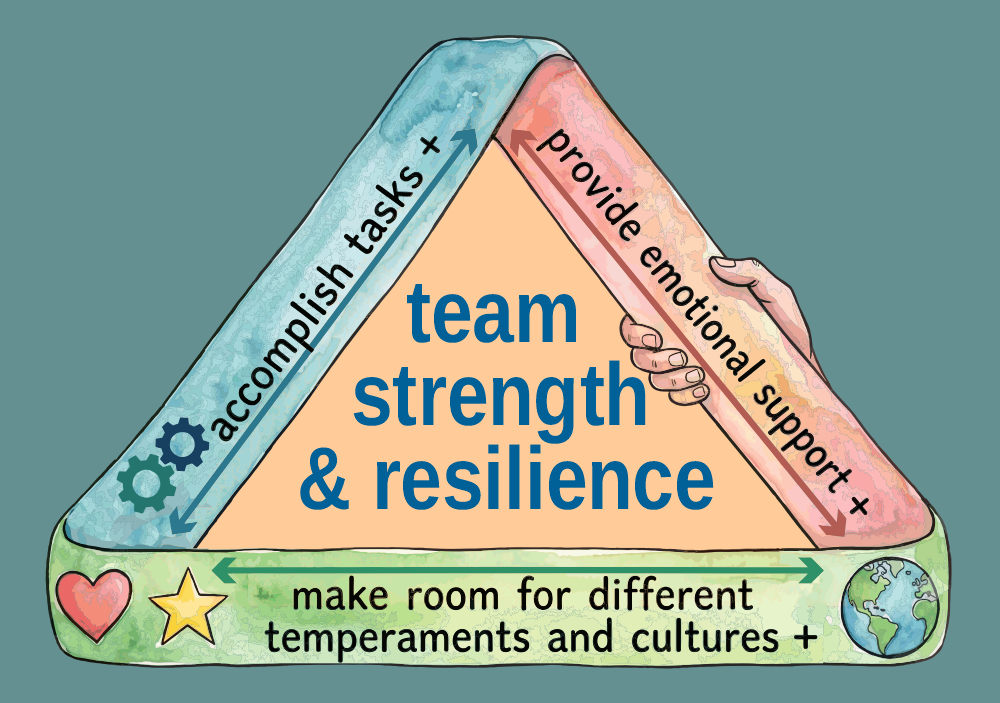
In Transformation One, we explored the insight that every human group — from a couple to an entire organization — needs to do three things at once: accomplish tasks together, support one another emotionally, and accommodate the differences in temperament and experience that its members bring. This team-building triangle analogy has some important messages to bring us. To support our discussion, here is another of our series of posters on this theme.
The Team-Building Triangle
If a team’s strength is the area of the triangle, notice what happens when even one side grows short: the whole central area shrinks, no matter how long the other two sides remain. And, let any one of the three needs be met more deeply and the strength of the whole relationship improves. We will revisit this theme in every chapter as a way of paying more attention to how they interweave in every conversation we have.
Responsive listening plays a central role in meeting all three of the needs described in the triangle graphic. It is the most direct way we give one another emotional support. It is the essential tool for navigating across difference — for genuinely understanding someone whose way of experiencing the world is quite different from our own. And without it, the task side of the triangle quickly suffers. too. First, because responsive listening is the way that team members confirm to one another that they understand and agree on a plan of action. And second, because people who feel unheard will struggle to cooperate with team plans, and will tend to repeat themselves more loudly trying to make people hear their unacknowledged concerns, or simply withdraw and shut down. Definitely not a recipe for excellence!
In every relationship, at home, at work, or in your community, by listening and then repeating back in your own words the essence and feeling of what you have just heard — how things look and feel from the speaker’s point of view — you allow the speaker to feel the satisfaction of being understood, one of the deepest of all human needs. The listening ear is the star of the conversation.

the listening ear is the star of the conversation
Our conversation partners do not automatically know how well we have understood them, and they may not be very good at asking for confirmation from us. When a conversation is tense or difficult it is even more important to listen first and acknowledge what you hear. Otherwise, your chances of being heard by the other person go way down.
Consider a hospital nurse speaking with a frustrated patient:
“I hear that you are very uncomfortable right now, Susan, and you would really like to get out of that bed and move around. But your doctor says your bones won’t heal unless you stay put for another week.”
Susan is much more likely to listen to the statement above than if the nurse had simply said:
“I’m really sorry, Susan, but you have to stay in bed. Your doctor says your bones won’t heal unless you stay put for another week.”
What is missing in this second version is an acknowledgment of Susan’s present experience of frustration. And the nurse in the first version is not just doing her job more skillfully. She is doing all three things simultaneously: attending to Susan’s medical situation (task), acknowledging Susan’s frustration (emotional support), and bridging the difference between Susan’s perspective and the medical reality she cannot yet feel the importance of (navigating difference). All three, in one short exchange. That is the leverage point of skillful listening.
Notice how natural the nurse’s response sounds — how little effort it seems to require. That naturalness is worth pausing over, because it tells us something encouraging: responsive listening is not an exotic technique imported from a laboratory. It is a refinement of something many good communicators already do by instinct. Listen for it in the people around you and you will start noticing it everywhere — a colleague who paraphrases what you just said before offering her own view, a friend who names your feeling before changing the subject, a parent who says “I can see how much that hurt” before saying anything else. These small acts of acknowledgment are the skill this chapter teaches, already alive in the world, waiting to be recognized and practiced more deliberately. Two true stories, as different in scale as two stories could be, show just how far this capacity can reach.
2.4 The Reach of Responsive Listening: Two True Stories
A small miracle of empathy. Psychologist John Gottman describes a moment with his two-year-old daughter, Moriah, on an airplane. She wanted Zebra, her favorite stuffed animal, which was packed in the checked luggage far below. Gottman tried explaining that he couldn’t get it. He tried reasoning with her. He tried distracting her. Nothing worked. She grew more and more upset.
Then he tried something different. He simply acknowledged what she was feeling.
“You wish you had Zebra now.”
“Yeah,” she said sadly.
“And you’re angry because we can’t get him for you.”
“Yeah.”
“You’re tired now, and smelling Zebra and cuddling with him would feel real good. I wish we had Zebra here so you could hold him.”
“Yeah,” she said with a sigh.
Within a few minutes, she was asleep. She wasn’t interested in his excuses, his arguments, or his diversions. But finding out that he understood how she felt made her feel better. Gottman calls it a “memorable testament to the power of empathy.” (The full story appears as Reading 2-1 at the end of this chapter.)
No technique was needed. No special training. Just the willingness to stop trying to fix the situation and start trying to understand the person in it. That willingness — that shift from solving to receiving — is the seed of everything this chapter teaches.
A life-and-death failure to listen. But the same capacity, when it goes unexercised, can have devastating consequences. On a snowy afternoon in Washington, D.C., on January 13, 1982, Air Florida Flight 90 crashed into the 14th Street Bridge and plunged into the icy Potomac River, killing 78 people. The cockpit voice recorder tells a chilling story of communication failure. As the Boeing 737 prepared for takeoff in icy conditions, the first officer noticed that the instrument readings looked wrong:
First Officer: “God, look at that thing. That don’t seem right, does it? Ah, that’s not right.”
Captain: “Yes it is, there’s eighty.”
First Officer: “Naw, I don’t think that’s right. Ah, maybe it is.”
Captain: “Hundred and twenty.”
First Officer: “I don’t know.”
The first officer expressed his doubts repeatedly, but the captain dismissed them without genuinely exploring what his colleague was seeing. There was no moment of “I hear you — what’s our next step?” No acknowledgment, no curiosity, no responsive pause. Critical information was ignored. The opportunity to abort the takeoff was missed. And 78 people died.
This tragedy galvanized the aviation industry into rethinking how flight crews communicate. The resulting reforms — known as Crew Resource Management — placed empathic, responsive listening at the center of cockpit procedure. The lesson extends far beyond aviation: in any high-stakes situation, the failure to genuinely hear what someone is telling you can have catastrophic consequences. (The full account of Flight 90 and its lessons appears as Reading 2-2 at the end of this chapter.)
Two stories, vastly different in scale. But both reveal the same truth: when people feel genuinely heard, something shifts — a child calms, a crisis is averted, a relationship deepens. And when they don’t, things go wrong — sometimes a little, sometimes catastrophically. The capacity is the same in both cases. What makes the difference is whether someone exercises it. Which raises the most useful question this chapter can ask: if the capacity for responsive listening is this natural — if a father on an airplane can stumble into it in a single moment — what keeps it from showing up more often? The answer has two layers, one visible and one hidden, and they are worth looking at in turn.
2.5 What Sometimes Gets in the Way
The first layer is the one we can see: the competition for our attention. Smartphones, notifications, the ambient pull of social media — all of these have made sustained, present-tense attention to another person significantly harder than it used to be. Many of us have developed the habit of half-listening while simultaneously scanning a screen, composing a reply in our minds, or monitoring what’s happening across the room.
Our conversation partners notice this, even when they don’t say so. The experience of being half-listened to is, for most people, only marginally better than the experience of being ignored. It communicates, beneath the surface:
“You are not quite important enough to have my full attention.”
That is rarely the message we intend to send.
One practical response is simply to slow down and make a deliberate choice at the beginning of a conversation:
“I am going to be here, fully, for the next few minutes.”
Put the phone face-down. Turn away from the screen. Make eye contact. These small acts of physical commitment have a surprisingly large effect on the quality of the listening that follows — and on how the other person feels about the conversation. You have almost certainly done this already, more than once — chosen to set a distraction aside and give someone your full presence. Every time you made that choice, you were already practicing the first move of responsive listening. I make a practice of turning my cellphone ringer off, and telling the person I am with “I am turning my phone off. You have my undivided attention.”
But distraction, however real, is only the outer layer. The deeper friction — the one that explains why even an undistracted, well-meaning person can struggle to listen — is not out in the world at all. It is inside us. When someone tells us something we disagree with — a complaint about us, a view we think is wrong, a feeling we believe they shouldn’t be having — a quiet instinct warns us that to acknowledge what they are saying is to concede it: to agree, to approve, to give ground we may not want to give. So we clamp down. We withhold even the smallest sign that we have heard, for fear that hearing will be mistaken for agreeing.
If you have felt that bracing — that flicker of resistance when you are asked to really hear someone you disagree with — you are not a poor listener. You are an ordinary human being meeting an ordinary human obstacle. And the encouraging news is that this obstacle very nearly dissolves the moment we see one distinction clearly. That distinction — the heart of everything in this chapter — is waiting in the next section.
2.6 The Power of Simple Acknowledging
The practice of responsive listening described here separates acknowledging the thoughts and feelings a person expresses from approving, agreeing, advising, or persuading.
For many people, this distinction is genuinely surprising — because in everyday conversation, acknowledging and agreeing are fused together in our minds like a two-for-one package deal at the supermarket. The effect is that if John feels that any acknowledgment of Fred’s experience implies agreement and approval, John will not acknowledge any of Fred’s experience. Fred tries harder and harder to be heard, and John tries harder and harder not to hear. This, of course, is a recipe for a stalemated argument.
But acknowledging another person’s thoughts and feelings still leaves you with all of your options:
- You still have the option of agreeing or disagreeing with that person’s point of view, actions, or way of experiencing.
- You still have the option of saying yes or no to a request.
- You still have the option of saying more about the matter being discussed.
Most of the the people we are talking with in the course of our daily lives want both: to be understood and acknowledged on the one hand, and to be approved and agreed with on the other. With practice, you can learn to respond first with a simple acknowledgment. As you do this, you may find that you can give your conversation partners half of what they want, even if you can’t give them all of what they want. In many conflict situations, that will be a giant step forward. Your conversation partners will also be more likely to acknowledge your position and experience, even if they don’t sympathize with you. This mutual acknowledgment can create an emotional atmosphere in which it is easier to work toward agreement or more gracefully accommodate disagreements.
Here are three examples of acknowledgments that do not imply agreement:
Counselor to a drug abuse client: “I hear that you are feeling terrible right now and that you really want some drugs to get you through the day. And I want you to know that I’m still concerned this stuff you’re taking is going to kill you.”
Mother to seven-year-old: “I know that you want some more cake and ice cream, Jimmy, because it tastes so good, but you’ve already had three pieces and I’m really worried that you’ll get an upset tummy. That’s why I don’t want you to have any more.”
Union representative to company owner’s representative: “I understand from your presentation that you see XYZ Company as short of cash, threatened by foreign competition, and not in a position to agree to any wage increases. Now I would like us to explore contract arrangements that would allow my union members to get a wage increase and XYZ Company to advance its organizational goals.”
In each case, the listener’s acknowledgment of his or her conversation partner’s experience or position increases the chance that the conversation partner will be willing to listen in turn.
As Marshall Rosenberg reports in his book, Nonviolent Communication: studies in labor-management negotiations demonstrate that the time required to reach conflict resolution is cut in half when each negotiator agrees, before responding, to repeat what the previous speaker had said.
Because so much of communication is about coordinating our life activities with the life activities of others, we would do well to resist two very popular (but terrible) models of communicating: arguing a case in court and participating in a public debate. In courts and debates, each side tries to make its own points and listens to the other side only to tear down the other side’s arguments (and perhaps make them look thoughtless). Since the debaters rarely have to reach agreement or get anything done together outside of the courtroom or debate stage, it doesn’t seem to matter how much ill will their hostile conversational style generates. Don’t try this at home!
Most of us are in a very different situation. We spend most of our lives trying to arrange agreement and cooperative, coordinated action. So we need to be concerned with engaging people, not defeating them. In business — and in family life, too — the person we defeat today will often be the person whose cooperation we need tomorrow.
Responsive listening offers us a different path. Once people feel that their messages and feelings have been heard and understood, they start to relax and they themselves have more attention available for listening. That is the quiet miracle at the center of responsive listening: by acknowledging first, you create the conditions in which you yourself can finally be heard. Look at how far this single distinction has carried us. The capacity that Gottman stumbled into on an airplane — the willingness to receive before responding — turns out to be a practice anyone can learn, and its reach extends from a two-year-old’s tantrum to a union negotiation table. Something this simple, practiced more often and more deliberately, can change the emotional atmosphere of an entire relationship.
If that sounds straightforward, it is — in principle. But the experience of actually doing it, especially when emotions are running high, requires more than understanding. It requires practice. The following suggestions can help you develop that practice.
2.7 Suggestions for Practicing Responsive Listening
The simplest acknowledgment is to reassure your conversation partner with a word or two that you have heard and understood whatever they are experiencing. For example, saying, “You sound really happy — or sad — about that,” is often enough to make someone feel genuinely met.
As you listen to the important people in your life, give very brief summaries of the experiences they are talking about, and name the want or feeling that appears to be at the heart of the experience:
“So, you were really happy about that…”
“So, you drove all the way over there and they didn’t have the part they promised you on the phone. What a let-down.”
“Sounds like you wanted a big change in that situation…”
“Oh, no! Your dog got run over. You must be feeling really terrible…”
The point here is to empathize, not to give advice. If you added to that last statement, “That total SLOB of a driver!!! You should sue them! People REALLY need to pay for their mistakes —” you would be taking over the conversation and leading the person away from their own feelings and toward your reactions. The ear that listens without hijacking the conversation is a rare and precious gift.
As a general rule, do not just repeat another person’s exact words. Summarize their experience in your own words. But in cases where people actually scream or shout something, sometimes you may want to repeat a few of their exact words in a quiet tone of voice to let them know that you have heard it just as they said it.
If the emotion is unclear, make a tentative guess: “So it sounds like maybe you were a little unhappy about all that…” The speaker will usually correct your guess if it needs correcting — and that correction is itself a step forward in the conversation.
Listening is an improvisational art. The purpose of learning and practicing basic patterns is to become so familiar with them that you can improvise easily to meet the needs of the current conversation. Pay attention to whether the person speaking accepts your summaries by saying things such as “yeah!”, “you got it,” “that’s right,” and similar responses. These small signals tell you whether your listening is being received as accurate.
Think of your voice like a tuning fork: when you summarize, try to gently match the emotional frequency the other person is broadcasting. If they are devastated, a quiet, softer tone shows you understand. If they are thrilled, a brighter tone shares their energy. But this resonance only works if it’s authentic. If you cannot relate to their feelings at all, simply aim for a tone of steady, supportive respect. Whatever you do, avoid an emotionally flat, monotone delivery. Responding like an automated machine reading back a list of facts is jarring and unsupportive. And if you find that you cannot muster even basic, respectful attention, it is completely okay to admit you are tapped out and ask to pause the conversation. You are a companion on life’s journey, with both personal strengths and limits. That puts you in a different relationship to your conversation partner than being a psychotherapist or social worker with formal responsibilities.
Such compassionate listening is a powerful resource for navigating through life, and it also makes significant demands on us as listeners. We may need to learn how to hold our own ground while we restate someone else’s position — that takes practice. We also have to be able to listen to people’s criticisms or complaints without becoming disoriented or totally losing our sense of self-worth. That requires cultivating a deeper sense of self-worth, which is no small project. In spite of these difficulties, the results of compassionate, responsive listening have been so rewarding in my life that I have found it to be worth all the effort required. And there is one more reward, quieter than the rest and easy to overlook: with enough practice, this skill stops being something you do and slowly becomes part of who you are.
2.8 How Listening Becomes Character
We have been calling listening a “skill,” and it is one. But the word can mislead us, because a skill sounds like a tool — something you pick up when you need it and put away when you’re done. Responsive listening turns out to be more than that. Each time you practice it, you are not only doing something. You are quietly becoming someone.
When you pause, reflect back, and genuinely try to understand, you are — in that very moment — being an attentive person. When you stay present with someone in distress instead of rushing in to fix or redirect, you are being a compassionate person. And the way we are, moment after moment, is the raw material from which a character is slowly made. Practice this often enough and you will not merely become a more skilled listener; you will become someone other people seek out — because in your company they feel a little less alone, a little more understood. Seen this way, every small act of listening is also a small step on a long and worthy journey: the slow growth, across a lifetime, into a more patient and generous human being.
But there is something more immediate going on as well — something the long view of character can make easy to miss. As you practice paying careful attention to another person’s thoughts and feelings, you are simultaneously building the awareness you need to recognize your own. The psychiatrist and neuroscientist Daniel Siegel calls this capacity mindsight — the ability to perceive the internal world of your own mind and the minds of others — and his research points to a finding that may surprise you: these are not two separate abilities. They are two aspects of a single capacity, developed through the same kinds of interpersonal experience and grounded in the same neural circuitry. When you listen empathically to a friend describing a frustration she can barely articulate, you are exercising the very same awareness you will need when you sit down to ask yourself, What am I actually feeling right now?
The developmental psychologist Lev Vygotsky proposed a principle that illuminates why this is so: every higher psychological function — including the ability to observe and name your own inner states — appears first as something that happens between people, and only later becomes an internal capacity. A child who is asked, with genuine curiosity, What are you feeling? eventually learns to ask herself that same question. And this process does not stop in childhood. Each time you reflect back what someone is experiencing — each time you name a feeling they hadn’t yet put into words — you are not only offering them a mirror. You are deepening, in yourself, the very awareness you will need in your own most important moments. So the practice of responsive listening gives the listener two gifts at once: the slow formation of a more compassionate character, and the more immediate growth of the self-knowledge that grounds every honest conversation.
This is also the most reassuring thing I know to say about the awkwardness of your first attempts. That awkwardness is not a sign that you are “naturally a bad listener.” It is simply the feeling of a beginner — the normal feel of a capacity stretching beyond its familiar range — and every listener you have ever admired began exactly where you are now. Untrained is a condition that responds to practice. The difficulty of listening well is not a flaw in the practice or a flaw in you. In a real sense, it is the practice — and meeting it, one conversation at a time, is exactly how an ordinary person becomes an extraordinary listener.
2.9 Listening Inward: A Preview
If listening to others builds the capacity for self-observation — and the research strongly suggests it does — then a practical question follows: is there a way to make that connection deliberate? The answer is yes, and the framework is already waiting for you in Transformation Four.
Many of us are far better listeners to our friends than to ourselves. We can sense when a colleague is frustrated or a child is afraid, yet we go for days without pausing to ask: What am I feeling right now? What do I need? What am I hoping for? When we skip that question, we arrive in important conversations not yet knowing what we want to say — because we haven’t yet “checked in” with what is going on inside us. In Transformation Four you’ll explore a simple framework, the Five I-Messages, that maps this inner landscape: what you observe, what you feel, why you feel it, what you want, and what good outcome you are hoping for. It was designed to help you speak more clearly to others, but it turns out to be just as valuable for helping you listen to yourself.
And here is a surprise that many learners discover: it is often easier to begin by coaching someone else through the five dimensions — listening for what they are observing, what they are feeling, what needs are driving those feelings, what they want, and what positive outcome they are hoping for — than to do the internal inventory required to express your own. The outward practice is the training ground for the inward one. As you gently help another person unfold the full picture of their experience, you are learning the landscape of the five dimensions at a level that no amount of reading about them can provide. And when it comes time to ask yourself those same five questions, they will feel familiar — because you have already been living inside them while listening to someone else.
This is one of the reasons Transformation Nine, on building a mutual support network, matters so deeply to the kind of learning this workbook asks of you. When you find a practice partner or a small circle of co-learners and take turns coaching each other through the Five I-Messages, you are not just gaining motivational support for a solitary project. You are entering the developmental pathway itself. Each conversation of mutual listening — where you coach a partner through their five messages and they coach you through yours — deepens both partners’ capacity for self-awareness. Transformation Nine names the principle at the heart of this: in this particular kind of learning, we can only receive as much help as we are willing to give. That is not a moral exhortation. It is a developmental fact. The giving is the learning.
So the listening ear you are developing in this chapter is not only a gift you offer to others. It is the very practice through which you build the awareness to know your own mind — and when you offer that practice to a fellow learner, you deepen it for both of you. Outward listening and inward listening are not two separate skills. They are one capacity, aimed in two directions, growing from a single root. We will return to this theme when we reach the Five I-Messages in Transformation Four and the mutual support structures of Transformation Nine.
2.10 What Lies Ahead: Listening as the Foundation
The six transformations that follow this one — on self-expression, explaining conversational intent, translating complaints into requests, asking open-ended questions, expressing appreciation, and embracing continuous learning — all depend on the foundation you’re building here. You cannot express yourself well to someone who has never been listened to. A sincere question carries with it a silent promise to listen to the answer. The other skills grow more naturally the more deeply the listening skill takes root. Think back, too, to the triangle of team survival from the start of this chapter — task, emotional support, and the bridging of difference. Responsive listening is the one practice that strengthens all three sides at once, which is why it sits beneath everything else in this book.
As you practice listening more carefully, you will probably find that your conversation partners begin to listen more carefully in return. This is one of those rare cases where the more you give, the more you receive — not because people are keeping score, but because being genuinely heard tends to lower people’s defensiveness and open their attention. The quality of both sides of the conversation rises together.
You are already, in a deeply important sense, a listening teacher to the people around you. Every time you put the phone down and turn toward someone who is speaking, you are demonstrating to everyone present that full presence is possible — and, as we explored in the previous section, you are also deepening your own capacity for self-awareness in the very act of offering it. That is a lesson worth teaching, and a gift worth receiving. And it begins with this: listen first.
One last thought before the exercises. Reading this chapter has been a kind of in-breath — taking in a new way of seeing and letting it settle. But listening is never learned by only reading about it; the understanding comes fully alive on the out-breath, in real conversations where you actually try the small responses described here. Breathe in the idea; breathe out the practice. That gentle in-and-out is the rhythm of every transformation in this book, and you will feel it return again and again. So think of the two exercises that follow not as an appendix to the chapter but as its natural exhale — the moment where reading quietly becomes doing.
2.11 Listening Exercises
Exercise 1: Active Listening Practice….Find a practice partner. Bring your Learning Journal. With your partner, take turns telling events from your lives. As you listen to one another, sum up their overall experience and feelings in brief responses during the telling. After each exchange, ask your partner: “Did I get that right? Is there anything important I missed?” After you have finished this exercise session, make a quiet time to reflect on both the successes and the snags. Make notes in your Learning Journal about both.
Exercise 2. Learning from the Past with the Tools of the Present….Think of one or more conversations in your life that went badly. Imagine how those conversations might have gone better with more responsive listening. in your Learning Journal, write down your alternative version of the conversation. In class or group exercise settings, explore these possibilities with your exercise partner(s).
Exercise 3: Your Notes on the Listening Chapter Readings….Please read the two short articles on the following pages, Zebra! and Lessons from an Airline Accident. In your Learning Journal, explore how you could apply these ideas and lessons in your own life?
2.12 First Reading on the Topic of Listening — Zebra!
Psychologist John Gottman describes his discovery that empathic listening really works:
I remember the day I first discovered how Emotion Coaching — my approach to empathic listening — might work with my own daughter, Moriah. She was two at the time and we were on a cross-country flight home after visiting with relatives. Bored, tired, and cranky, Moriah asked me for Zebra, her favorite stuffed animal. Unfortunately, we had absentmindedly packed the well-worn critter in a suitcase that was checked at the baggage counter.
“I’m sorry, honey, but we can’t get Zebra right now. He’s in the big suitcase in another part of the airplane,” I explained.
“I want Zebra,” she whined pitifully.
“I know, sweetheart. But Zebra isn’t here. He’s in the baggage compartment underneath the plane and Daddy can’t get him until we get off the plane. I’m sorry.”
“I want Zebra! I want Zebra!” she moaned again. Then she started to cry.
By now I was getting “do something” looks from the passengers, from the flight attendants, from my wife seated across the aisle. I looked at Moriah’s face, red with anger, and imagined how frustrated she must feel. Then it dawned on me: I couldn’t get Zebra, but I could offer her the next best thing — a father’s comfort.
“You wish you had Zebra now,” I said to her.
“Yeah,” she said sadly.
“And you’re angry because we can’t get him for you.”
“Yeah.”
“You’re tired now, and smelling Zebra and cuddling with him would feel real good. I wish we had Zebra here so you could hold him.”
“Yeah,” she said with a sigh.
“I’m so sorry,” I said, watching the tension leave her face.
She rested her head against the back of her safety seat. She continued to complain softly a few more times, but she was growing calmer. Within a few minutes, she was asleep.
Although Moriah was just two years old, she clearly knew what she wanted — her Zebra. Once she began to realize that getting it wasn’t possible, she wasn’t interested in my excuses, my arguments, or my diversions. My validation, however, was another matter. Finding out that I understood how she felt seemed to make her feel better. For me, it was a memorable testament to the power of empathy.
From The Heart of Parenting: How to Raise an Emotionally Intelligent Child, by John M. Gottman with Joan DeClaire. New York: Simon & Schuster, 1997, pp. 69–70.
2.13 Second Reading on the Topic of Listening— Empathic Listening: Lessons from
an Airline Accident
(March 2026 revision)
On a snowy afternoon in Washington, D.C., on January 13, 1982, Air Florida Flight 90 crashed into the 14th Street Bridge, plunging into the icy Potomac River. This tragic accident, which claimed the lives of 78 people, serves as a stark reminder of the critical importance of effective communication and empathic listening, especially in high-stakes situations.
The Fatal Flight
As the Boeing 737 prepared for takeoff from Washington National Airport, the weather conditions were far from ideal. A snowstorm had closed the airport earlier that day, and even after reopening, a moderate snowfall continued with temperatures hovering around 24°F (-4°C). These challenging conditions set the stage for a series of communication failures that would ultimately lead to disaster.
The cockpit voice recorder reveals a chilling conversation between Captain Larry Wheaton and First Officer Roger Pettit. As they went through their pre-flight checklist, a critical error occurred:
First Officer: “Engine anti-ice?”
Captain: “Off.”
This brief exchange highlights a fundamental breakdown in communication. The first officer, following procedure, asked about the engine anti-ice system. The captain’s response, while clear, was fatally incorrect. In icy conditions, this system should have been activated to prevent ice buildup on crucial engine components. The first officer, perhaps out of excessive deference to his superior officer, does not stop to question the captain’s wrong answer. Each of them made a serious mistake at that moment. We will never know all the factors at play in this situation, but the size of the tragedy that followed galvanized an effort to create communication procedures that would prevent this kind of mistake.
Ignored Warnings
As the plane began its takeoff roll, the first officer noticed several anomalies in the instrument readings. The transcript of the cockpit voice recorder paints a picture of growing concern:
First Officer: “God, look at that thing. That don’t seem right, does it? Ah, that’s not right.”
Captain: “Yes it is, there’s eighty.”
First Officer: “Naw, I don’t think that’s right. Ah, maybe it is.”
Captain: “Hundred and twenty.”
First Officer: “I don’t know.”
This exchange reveals a critical failure in empathic listening. The first officer repeatedly expressed his doubts about the instrument readings, but the captain dismissed these concerns without truly acknowledging or exploring them. This lack of responsive listening meant that vital information was ignored, and an opportunity to abort the takeoff was missed.
The Consequences of Poor Communication
The result of these communication failures, in combination with the failure to follow regulation de-icing procedures, was catastrophic. The plane, struggling with ice-laden wings and insufficient engine power, barely became airborne before crashing into the 14th Street Bridge and plunging into the Potomac River. The NTSB (National Transportation Safety Board) investigation concluded that the probable cause of the accident included “the flight crew’s failure to use engine anti-ice during ground operation and takeoff, their decision to take off with snow/ice on the airfoil surfaces of the aircraft, and the captain’s failure to reject the takeoff during the early stage when his attention was called to anomalous engine instrument readings.”
The Importance of Empathic Listening
This tragedy underscores the vital importance of empathic and responsive listening, especially in high-pressure situations. Empathic listening goes beyond merely hearing words; it involves actively seeking to understand the speaker’s perspective, acknowledging their concerns, and responding in a way that shows true comprehension.
In the case of Flight 90, if the captain had practiced empathic listening, he might have responded differently to the first officer’s concerns. Instead of dismissing them, he could have acknowledged the observations and explored them further. For example:
First Officer: “God, look at that thing. That don’t seem right, does it?”
Captain: “I hear you see a bad reading. What’s our next step?”
This type of response would have opened up a dialogue, potentially leading to a more thorough examination of the instruments and possibly a decision to abort the takeoff. The practice of empathic listening could have created a cockpit environment where both pilots felt empowered to express and explore their concerns fully.
Five Lessons from a Tragedy
The Air Florida Flight 90 disaster led to significant changes in pilot training, with a greater emphasis on crew resource management and improved communication within the cockpit. But the lessons from this tragedy extend far beyond the aviation industry. They teach us about the power of empathic listening in all aspects of our lives.
Acknowledge and validate concerns: When someone expresses worry or doubt, take the time to acknowledge their feelings and explore their perspective. This doesn’t mean you have to agree, but it shows respect and opens the door for deeper understanding.
Create an environment of open communication: Foster a culture where all team members feel comfortable expressing their thoughts and concerns without fear of dismissal or ridicule.
Practice active listening: Pay full attention to the speaker, ask clarifying questions, and summarize what you’ve heard to ensure understanding.
Set aside hierarchy when safety is at stake: In critical situations, valuable input can come from anyone, regardless of their position or rank.
Encourage questioning of assumptions: Create an environment where it’s not only acceptable but also encouraged to question procedures and challenge assumptions when something doesn’t seem right.
A Difficult but Life-Saving Lesson
The 78 lives lost in the crash of Air Florida Flight 90 offer us a difficult but profoundly important lesson. Every challenging human encounter, whether in a cockpit, a boardroom, or a family dinner table, carries with it the potential for misunderstanding and conflict. But it also presents an opportunity for connection, understanding, and potentially life-changing (or life-saving) communication.
In our daily lives, when faced with disagreements or conflicts, we can pause and ask ourselves: “Am I truly listening? Am I seeking to understand, not just to respond?” By doing so, we not only improve our relationships and decision-making but also potentially prevent disasters both large and small.
References for this reading
This article was researched and written with the assistance of multiple AI systems.
“Air Florida Flight 90.” Wikipedia, Wikimedia Foundation, https://en.wikipedia.org/wiki/Air_Florida_Flight_90.
National Transportation Safety Board. “Aircraft Accident Report: Air Florida, Inc., Boeing 737-222, N62AF, Collision with 14th Street Bridge Near Washington National Airport, Washington, D.C., January 13, 1982.” NTSB-AAR-82-8, 1982.
2.14 Suggestions for More Reading and Research on the Topic of Listening
Tell Me More, an essay by Brenda Ueland, explores the transformative power of listening to friends and family members.
Compassionate Listening: An Exploratory Sourcebook About Conflict Transformation, by Gene Knudsen Hoffman (1919–2010). Hoffman was both a Quaker peace activist and a pastoral counselor. In the course of her lifetime she took the practice of compassionate listening out of the quiet environs of the Quaker meeting house, out from behind the closed doors of counseling sessions, and on to the stage of the world’s greatest conflicts. Her many peacemaking journeys during her lifetime made her a legend in the peacemaking community.
The Empathic Circle: How Listening to Others Teaches Us to Listen to Ourselves. By Dennis Rivers with Claude.AI Explores the well-researched but still provocative idea that we do not first know ourselves and then learn to understand others; in the course of human development, we learn to understand others first, and self-knowledge grows out of that soil. The empathic listening conversation nurtures each participant in different ways.
2.15 References and Recommended Reading for this Chapter
Please note: Because the chapters of this workbook are often distributed as separate study documents,
a reference to a given book or article will appear in every chapter where it is needed.
Edmondson, Amy C. The Fearless Organization: Creating Psychological Safety in the Workplace for Learning, Innovation, and Growth. Wiley, 2019.
Gottman, John M., with Joan DeClaire. The Heart of Parenting: How to Raise an Emotionally Intelligent Child. Simon & Schuster, 1997.
Hoffman, Gene Knudsen, Cynthia Monroe, and Leah Green. Compassionate Listening: An Exploratory Sourcebook. New Conversations Initiative, n.d. https://communication-skills.net/pdf/compassionate_listening.pdf.
Rivers, Dennis, with Claude.AI. “The Empathic Circle: How Listening to Others Teaches Us to Listen to Ourselves.” Communication Skills.net, 2026,
https://communication-skills.net/library/the-empathic-circle.pdf.
Rogers, Carl R. Client-Centered Therapy: Its Current Practice, Implications, and Theory. Houghton Mifflin, 1951.
Rogers, Carl R. On Becoming a Person: A Therapist’s View of Psychotherapy. Houghton Mifflin, 1961.
Rosenberg, Marshall B. Nonviolent Communication: A Language of Life. 3rd ed., PuddleDancer Press, 2015.
Siegel, Daniel J. Mindsight: The New Science of Personal Transformation. Bantam Books, 2010.
Tannen, Deborah. The Argument Culture: Moving from Debate to Dialogue. Random House, 1998.
Ueland, Brenda. “Tell Me More.” Ladies’ Home Journal, Nov. 1941. Reprinted at http://communication-skills.net/library/Tell_Me_More.pdf.
Vygotsky, Lev S. Mind in Society: The Development of Higher Psychological Processes. Edited by Michael Cole et al., Harvard University Press, 1978.
Your notes on this chapter

- From launching into conversations
to inviting people into them - From assuming availability to asking for it
- From ambushing with feelings
to preparing the ground for honesty - From unclear purpose to shared understanding
- From forcing a role on someone to requesting the partnership you need
- From talking at people to beginning a dialogue with them
- From surprise attacks to respectful openings
- From “you need to hear this”
to “would you be willing to explore this with me?” - From the coercion of suddenness
to the generosity of an invitation - From autopilot collisions to conscious departures
- From monologue disguised as conversation
to genuine two-way engagement - From eruption to invitation — one conversation at a time
3.1 Summary
Why do so many important conversations go wrong before they have even really begun? And what is the one overlooked step that can turn a conversational ambush into a collaborative invitation?
To help your conversation partner cooperate with you, and to head off needless misunderstanding, begin your important conversations by inviting the other person to join you in the particular kind of conversation you want to have. The more a conversation is going to mean to you, the more it matters that your partner can see the big picture. When you need to have a long, complex, or emotion-laden conversation with someone, it makes a remarkable difference if you briefly explain your intention first — and then invite the other person’s consent before you begin.
This chapter explores why this practice of declaring intent and inviting consent makes such a profound difference, what it sounds like when it is done well, what quietly keeps us from doing it — and how to begin practicing it in your own life, one conversation at a time.
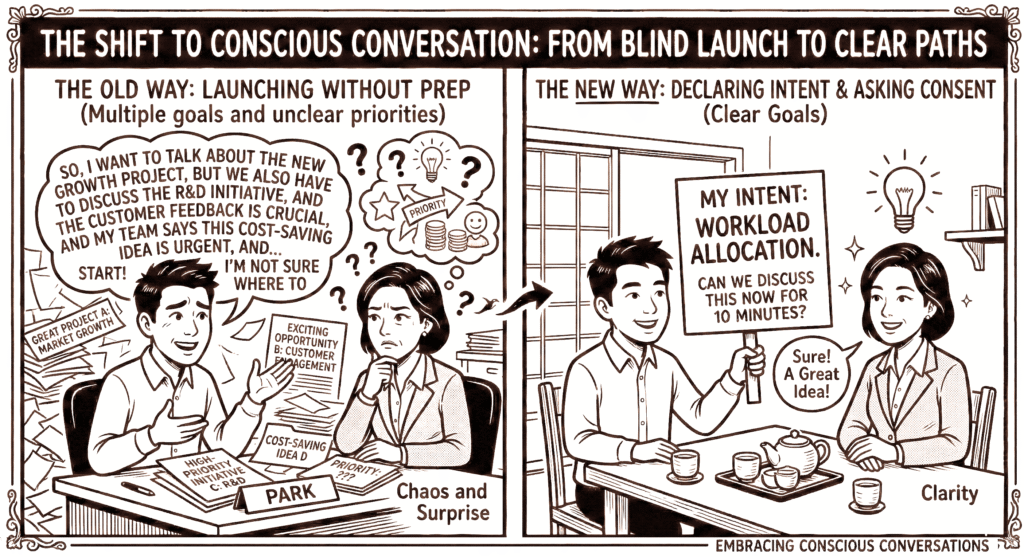
3.2 The Mini-Conversation Before the Conversation
I have always been a go-along-to-get-along sort of person, which meant that making a complaint or starting a hard conversation was an especially difficult business for me. I worked out the ideas in this chapter by running a great many small experiments in how to begin a conversation — and I was continually surprised at how easy it became.
One episode sticks in my mind. I was in a large health-food market hunting for my favorite snack, broccoli, which I like to munch raw, dipped in salad dressing. You can imagine my disgust when I found the store’s broccoli crawling with tiny insects and dusted with some sort of thick white insect powder. Get me out of here! But instead of bolting, I walked over to the customer service counter and decided to put my new interpersonal navigation tools to work.
Stepping up to the person behind the counter, I said, in my most diplomatic voice, “I would like to make a complaint.” That one sentence let her get emotionally ready for the kind of conversation that was coming. “Yes,” she said, in a confident voice. “How can I help?” Then I said — with a little of my surprise and disgust showing in my tone — “There are bugs in the broccoli!” She was not knocked off balance by my feeling, because she already knew a complaint was on its way. She simply answered, again confidently, “We’ll take care of it right away.”
Many experiments like that one taught me something I now consider among the most practical skills in this entire workbook: the importance of the mini-conversation before the conversation. Before you launch into any important exchange — especially one involving strong feelings, a significant request, or the possibility of conflict — there is a brief, crucial step that can make the difference between connection and collision. You explain the kind of conversation you would like to have, and you invite the other person’s consent to have it. This is Transformation Three, and of all the skills in this workbook, it may be the one that produces the most immediate, visible results. How does it sound?
3.3 What This Skill Sounds Like in Practice
Many good communicators already do this by instinct. Listen for it and you will start noticing it everywhere:
“Hi, Steve. I need to ask for your help on my project. Got a minute to talk about it?”
“Maria, do you have a minute? I’d like to talk with you about the schedule change. Is that OK?”
“Sit down for a minute and let me tell you what happened…”
“Hello, Mr. Sanchez. I’m not completely comfortable about the safety conditions on this job. Can we talk about it for a few minutes?”
“Hi, Jerry, this is Mike. I want to talk to you about Fred. He’s in jail again. Is this a good time?”
Notice what each of these openings accomplishes. In a few seconds, the speaker does something that would otherwise take much longer to negotiate through body language, tone, and guesswork. They tell the other person, in effect: here is what I need to talk about, here is roughly how much time and energy it will take, and I am asking your permission before I begin.

~~~ Where do I want to go on The Island of Many Possible Conversations? ~~~
This is what I mean by the mini-conversation before the conversation. It is brief. It is respectful. And it changes everything that follows. The underlying principle is simple: the bigger the request that is on its way, the clearer the invitation needs to be. The more we are going to ask on another person, the more important it is to let them get ready.
These examples may sound almost too simple to qualify as a “skill.” But something this easy to demonstrate turns out to be remarkably powerful in practice. Which raises the obvious question: why does so small a step make so large a difference?
3.4 Six Reasons This Makes Such a Difference
When we combine an explanation of intent with an invitation to consent, we help a conversation along in six distinct ways — and each one connects to something deeper about how human relationships and groups actually work.
The first element is related to the theme of Transformation One: shifting from cultural autopilot to conscious conversations. It is completely human and OK to have several needs at the same time. But human language can only handle one topic at a time, and most human listeners can only process one topic at a time. So, in order to have our most important need addressed by others, it is important for us each to take a moment before important conversations and sort out what is most important to us. To put it bluntly: if we don’t know where we want to go, other people will have a hard time helping us get there.
Second, cultural bridge-building. Here we bump into something close to a universal truth about conversational intentions: although now and then we may stumble into getting what we want, most of the time getting what we really want depends on first being clear, with ourselves, about what we really want, and then being clear with others. How do we do that? Isolated cultural groups work out their own unique ways of signaling conversational starts and stops: body language, throat-clearing, shouting “Hey!“, facial expressions, all learned in childhood by simple imitation. The world we live in today, however, often mixes together people from many different cultures. In this more varied world we can’t rely on our listeners to understand our particular informal gestures. Hence, to get the cooperation of other people in meeting our needs and goals, we need respectful, specific and consciously voiced ways making contact. The explanation of intent and invitation to consent explored here is a creative effort in that direction.
Third, we give our listeners a real chance to consent — or to decline. A person who has agreed to take part will take part more fully. This is no small thing. It connects directly to the three-sided insight at the heart of this workbook (Transformation One): every human group needs to accomplish tasks together, support one another emotionally, and accommodate its members’ different temperaments. Some people need a moment to shift gears before an emotional conversation. Some take in difficult news better when they know it is coming. When you invite consent, you are honoring those differences rather than steamrolling over them.
Forth, we help our listeners see the big picture. Decades of research in linguistics and communication studies confirm that grasping a person’s overall conversational intention is crucial to understanding their specific words (Grice 1975; Cohen et al. 1990). If I know you are about to ask for my help, I hear your words very differently than if I fear you are about to criticize me. The big picture frames everything that follows inside it. This practice works in both directions. As we clarify the big picture in our own minds in order to explain it to another person, we also clarify it for ourselves.
Fifth, we help our listeners understand the role we are asking them to play. Do we need a fellow problem-solver? A giver of emotional support? A sounding board? An advice-giver? A decision-maker? These are very different roles, and conversations go far better when we ask someone to play just one major role at a time. This connects back to the balance of task and emotional support we explored in Transformation One: if your partner thinks you want practical advice when what you really need is to be heard, you will both leave the conversation frustrated — not from any bad intention, but from a simple mismatch of expectations. This is another process that works both ways. In coming to clarity about my most important reason to have a conversation, I am clarifying the role I am going to play: a story sharer, a help requester, a instruction giver or receiver, etc. As I express my intent by saying, “Hey! Lemme tell ya about this great restaurant I want to last week!”, my listener will usually understand the corresponding conversational role.
Sixth, to be invited into a conversation is an act of respect. A person who has consciously agreed to talk is far more likely to pay attention and cooperate than someone who feels pushed into an undefined conversation by the sheer momentum of another person’s talking.
Consider it from the receiving end. When someone erupts at you — pouring out a complaint or an emotional disclosure with no warning — how does your body respond? If you are like most people, you tense. Your guard goes up. You are in no position to listen well, because you are too busy working out whether you are under attack. Now imagine the very same conversation beginning instead with: “I have something important I’d like to talk about. It’s about what happened yesterday, and I think it might take about fifteen minutes. Is now a good time, or would later be better?” The content is identical. The experience is entirely different. The second version treats you as a partner rather than a target. It generates goodwill — the quiet trust that your needs and your availability will be taken into account — and that goodwill is exactly the currency we need for creative problem-solving, genuine empathy, and agreements that actually hold.
3.5 Specifics on Clarifying Your Intentions for Yourself
Before you can explain your intentions to others, you will need to clarify them for yourself. This is worth a quiet moment or two before any important conversation.
Ask yourself: What do I actually need from this conversation? To share information? Solve a problem? Express a feeling? Make a request? Repair a relationship? Sometimes our surface intentions hide deeper ones. I might believe I want to argue about the dishes when what I really need is reassurance that my partner still values the life we share.
Consider the context, too. What is the other person likely to be feeling right now? How much time and emotional energy will this conversation ask of them? Am I requesting something small, or something that will take real effort on their part?
And here is a question worth borrowing from Carol Dweck’s work on the growth mindset, which we explore in depth in Transformation Eight: What would a successful version of this conversation look like? Not a fantasy in which you win and they lose — but a genuine exchange in which both people feel heard, feel respected, and end up closer to a workable outcome. Holding that picture in mind, even briefly, can change the way you open.
Once you have reflected on these questions, you can shape a clear intention, drawing on the list of fulfilling intentions in the next section:
“I’d like to share my experiences and feelings about what happened at work this week.”
“I’d like to explore some possibilities for our summer plans — I don’t need a decision, just your thoughts.”
“My intention is to resolve the conflict we’ve been having about the budget. I think it will take about half an hour.”
“I’d like to express my appreciation for something you did that meant a lot to me.”
A good intention is specific, positive, and expresses the feeling of “I want to do my part here.” rather than “You should do more of your part here.” With your own intention clear, a natural question arises: just how many kinds of conversations are there? You may be surprised how wide a range of doors you can learn to open.
What follows is a tour of this new territory, expressed in words that will feel familiar to speakers of English and other European languages. The aim here is not to build rigid categories but to suggest many of the “flavors” of intention we can distinguish in everyday talking and listening.
The idea from linguistics that in order to understand someone’s utterances, we need to know what kind of conversation they are trying to have with us, is probably a universal truth. Just exactly how this duet of intent and consent gets worked out (or doesn’t) will vary widely from one culture to the next. What follow therefore is not a list of rules, it is a list of possibilities.
3.6 An Exploratory List of Fulfilling Conversational Intentions
As you explore this practice and grow familiar with the many kinds of conversational intention, you will find it easier to invite someone into one of a wide range of conversations, to accept someone else’s invitation, to say “no” or renegotiate an invitation, to gently ask a person to clarify what kind of conversation they are trying to have with you, and to steer clear of conversations that are negative, self-defeating, or self-destructive.
What follows is a list of roughly thirty fulfilling conversational intentions. Don’t try to memorize it; it is a reference, not a test. Browse it the way you would browse a restaurant menu — not to order everything, but to discover possibilities you did not know were on offer. Some will feel natural and familiar. Others may feel surprising or even uncomfortable. The uncomfortable ones are often the most valuable to explore, because they mark the edges of your conversational comfort zone.
Although few conversations are exactly alike, for the sake of exploration we can group most English and European language conversations into roughly forty overlapping types of intention. I count about thirty of these as fulfilling (and about twelve as unfulfilling). As you read, feel free to add your own, and add the positive conversational intentions specific to your culture or ethnic group.
Imagine each sentence beginning with: “Right now I’d like to take about [number] minutes and…”
- …tell you about my experiences and feelings — with no implied requests or complaints toward you, or so that you will understand the request, offer, or concern I want to raise.
- …hear what’s happening with you.
(More specific: hear how you are doing with a particular topic.) - …entertain you with a story.
- …explore some possibilities concerning a particular topic — requiring your empathy but not your advice or permission.
- …plan a course of action for myself — with your help, advice, and/or permission, or with you as listener and witness only.
- …coordinate and plan our actions together concerning…
- …express my affection for you, or my appreciation of you concerning…
- …express support for you as you cope with a difficult situation.
- …make a request about something you have done or said. (For better resolution of conflicts, translate complaints into requests — see Transformation Five.)
- …confirm my understanding of the experience or position you just shared. (This usually continues with “I hear that you…,” “Sounds like you…,” “So you’re feeling kind of…,” or “Let me see if I understand you…”)
- …resolve a conflict that I have with you about…
- …negotiate or bargain with you about…
- …work with you to reach a decision about…
- …give you permission or consent to… / get your permission or consent to…
- …give you some information about… / get some information from you about…
- …give you some advice about… / get some advice from you about…
- …give you directions, orders, or work assignments / get directions or orders from you.
- …make a request of you — for action, time, information, an object, money, a promise, etc.
- …consent to or decline a request you have made to me.
- …make an offer to you — for action, information, an object, a promise, etc.
- …accept or decline an offer you have made to me.
- …persuade or motivate you to adopt a particular point of view.
- …persuade or motivate you to choose a particular course of action.
- …forgive you for… / ask for your forgiveness concerning…
- …make an apology to you about… / request an apology from you about…
- …offer an interpretation of what something means to me / ask for your interpretation.
- …offer an evaluation of how good or bad I think something is / ask for your evaluation.
- …change the subject of the conversation and talk about…
- …have some time to think things over.
- …leave or end this conversation so that I can…
3.7 First Exercise: Practicing the Conversation Before the Conversation
With a practice partner (or on your own, in your journal), try starting each of the conversations on the list in section 3.6. Begin with: “Right now I’d like to take about [number] minutes and…” Notice which conversations feel easy to start and which feel more challenging. The challenging ones are often the most valuable to explore.
In your Learning Journal, or in the space below, record your thought and feelings about this exploration of positive conversational intentions:
3.8 When People Say No — and Why That’s Not the End
If this practice produces such good results, and is so simple to perform, why don’t people start their conversations this way? Here is the explanation I find most convincing.
When we explain our intent and invite consent, we give up something: the familiar elements of conversational coercion and surprise that quietly do our work for us whenever we just launch into whatever we want to say. In asking plainly for what we need, we make ourselves more vulnerable — because the person can now say no. That, it seems to me, is the real reason a step this simple is so often skipped. It is not that we never thought of it, or can’t imagine it. It is that simply erupting spares us a risk that inviting forces us to take: the risk of hearing “no.” To begin our important conversations differently, we have to make a quiet peace with that possibility.
At first glance, the risk of being turned down feels like a very legitimate worry to a person with something important to talk about. But here is what I have learned: a “no” to an invitation is almost never a permanent refusal. It is often a “not now,” or a “not like this.” And knowing how to respond in those moments can turn what felt like a dead end into a stronger connection.
When someone says “I’m too busy right now,” acknowledge their situation and offer an alternative. “I understand. Would later this week work? Or I could send you a note with my thoughts, and we could talk once you’ve had a chance to consider them.” You have respected their time and kept the door open.
When someone responds with emotional resistance — “I don’t want to talk about it,” or “You always twist my words” — validate the feeling first. “I hear that you’re frustrated, and I understand that. Would it help if we each wrote down our thoughts separately first? Or would you feel more comfortable talking with someone else present?” You are not forcing the conversation. You are offering a gentler path into it.
When someone makes a counterproposal — “I don’t have an hour, but I could do fifteen minutes” — be flexible and prioritize. Focus on the most important points, and schedule a follow-up if you need more time. The very willingness to adapt demonstrates the cooperative spirit this whole workbook is about.
When someone says “Maybe tomorrow,” agree to postpone, but pin down a specific time. “Of course. How about after dinner tomorrow, around seven?” Without a real commitment, “tomorrow” has a way of becoming “never.”
In each of these situations, the act of negotiating when and how to have a conversation is itself a form of communication. How you handle it sets the tone for the conversation to come and can even deepen the relationship before the real exchange begins. You are practicing patience, flexibility, and respect — the very qualities you are cultivating throughout this workbook. So the fear, it turns out, was pointing at a door, not a wall. But there is one more thing to settle before you extend an invitation to anyone else.
3.9 Intentions Worth Avoiding
Browsing the above list of fulfilling intentions can expand your sense of what is possible. But to see the whole picture — and to understand what you are growing away from as well as what you are growing toward — it helps to look honestly at the conversational intentions that create suffering rather than connection.
To be realistic about how people actually behave, I have included a second, shorter list — what I call conversational intentions that create problems for both participants.
- To lie, deceive, or mislead (on extremely rare occasions partly redeemed by good overall intentions, but usually not)
- To threaten with physical harm
- To hurt or abuse
- To punish (creates resentment, avoidance, and a desire for revenge)
- To blame (focuses on the past instead of the present and future)
- To control or coerce — to force or influence someone against their will and consent
- To manipulate — to influence someone without their knowledge and consent
- To demean, humiliate, or shame — to try to make someone look bad in the eyes of others, or to make people doubt themselves or feel bad about themselves
- “Stonewalling”: to deny the existence of a problem in the face of strong evidence and sincere appeals from others
- To hide what is important to me from you, if you are an important person in my life
- To suppress or invalidate someone’s emotional response to an event or situation — as in “Don’t cry!”, or the even more coercive “You stop crying or I’ll really give you something to cry about!”
- To withdraw from interaction in order to avoid the consequences of something I have done
These intentions and the actions that flow from them are unfulfilling because, at the very least, we would not want anyone to do these things to us. And when we begin conversations with intentions like these, we teach and encourage others to do the same — or we teach them to avoid contact with us altogether.
In our time, television, movies, popular music, and books offer us a steady supply of ready-made examples of every item on that list, along with displays of extraordinary sarcasm, cruelty, and violence. So in developing our own positive personal style of interaction, we may have to mindfully out-maneuver what amounts to a kind of cultural conditioning in favor of cruelty and coercion and against cooperation, respect, and kindness.
There are many moral arguments to be had about these matters, and I leave the deep questions of morality to you. I would, however, point out three of the most serious practical liabilities of these coercive and demeaning intentions.
It comes back to you. The first liability is that whatever we do to others, we teach others to do back to us — in conversation and in life generally. I watched this play out chillingly over a period of years as a stressed-out, single-mother friend of mine used sarcasm to discipline her bright ten-year-old son. The ten-year-old soon became a teenager who spoke to his mother with the same withering sarcasm she had used on him. He spent the rest of his teen years living with another family, because their relationship had become unsustainable. (Notice the “already a trainer” insight from Transformation One at work here: she was training him in sarcasm, though it was the last thing she intended. Every interaction is a lesson, whether we mean it to be or not.)
People leave. The intentions on that list can offer a little short-term satisfaction as ways of venting anger or frustration. But the second drawback is that anyone who can avoid being the target of such behavior probably will not stick around to be coerced or demeaned. And if someone truly cannot leave, no one in the relationship will be happy.
Very bad things can happen. Recent history offers tragedies that show how catastrophe can grow out of coercive conversation. An engineer warned managers at the Challenger rocket launch site that cold weather would cause flexible parts of the rocket to harden and fail; the managers stonewalled, the rocket was launched, and the astronauts aboard died when it exploded. A similar story about the tragic consequences of not listening comes to us in the record of an Air Florida airliner that crashed on takeoff from a snowy Washington, D.C., airport. Nearly everyone aboard was killed. The captain had adamantly ignored the first officer’s stated concerns about taking off with too much ice on the wings. (See the reading in Transformation Two for more on this disaster.) And it has become a recurring American sorrow that teenagers relentlessly humiliated at school have returned to murder their classmates and teachers.
3.10 Second Exercise: Conversational Intentions to Grow Away From
In your Learning Journal please explore the following questions. To what degree do you find yourself relying on these kinds of conversations to influence the people in your life? What possibilities for change do you see? To what degree are you — or were you — an unwilling participant in such conversations? And what new possibilities open up as you become more aware of conversational intentions, both your own and other people’s?
If you find yourself leaning heavily on these negative behaviors to navigate life with others, or repeatedly running into them in the people around you, please consider three actions:
- begin practicing the positive conversation openers described in section 3.8 above, to expand your conversational navigation skills;
- start keeping a private journal about when and how your conversations become painful;
- seek professional help from a therapist, counselor, or communication-skills coach.
Having explored both what we are growing toward and what we are growing away from, we can take stock of what this one small practice actually opens up in your life.
3.11 Summing Up: The New Possibilities That Open When You Invite
As you become more consciously familiar with the range of positive conversational intentions available to you, you may find yourself empowered in ways that surprise you. You will find it easier to:
- Invite someone into one of a wide range of conversations, depending on your own wants and needs or the needs of the situation.
- Accept someone’s conversational invitation with greater clarity and a fuller willingness to take part.
- Say “no” — declining or renegotiating someone’s invitation — without guilt.
- Gently prompt another person to clarify what kind of conversation they are trying to have with you, and how much time and attention they need.
These new abilities are real, and they tend to arrive faster than people expect. But none of them stands alone. Each one reaches back to skills you have already begun to build and forward to others still ahead — and seeing those connections is the last thing that helps a new practice take root.
3.12 Looking Forward — The Spiral of How This Transformation Connects to All the Others
Think back, for a moment, to how you learned to talk at all. First came single words, and then, slowly, a feel for how words combine into something larger. Learning to communicate well as an adult has a similar shape — except that now the building blocks are not words but whole conversational moves: inviting, declining, appreciating, requesting, repairing, asking for time to think. You are assembling a repertoire. And one of the surest ways to make a new move feel like your own is to notice how it connects to the others you are gathering. So before we close, let’s see how this one move — explaining your intent and inviting consent — reaches back to everything we have explored and forward to everything still to come.
The “born to learn” connection (Transformation One). Most of us were never taught to name our conversational intentions; our cultural autopilot simply left the step out. Recognizing that gap — without shame — is the first step toward filling it. You didn’t fail to learn this because something is wrong with you. You didn’t learn it because it wasn’t in your environment. Now it is.
The listening connection (Transformation Two). When you explain your intent, you make it easier for the other person to listen, because you have handed them the big picture that lets them hear your specific words in context. And when they respond — even if the answer is “not now” — you have a fresh chance to practice the responsive listening of Transformation Two. These two skills are natural partners.
The three-sided triangle (Transformation One). When you explain your intent and invite consent, you address all three sides of the triangle that every human group needs. You clarify the task (“here’s what I’m hoping to accomplish”), you offer emotional respect (“I care enough about you to ask”), and you make room for different temperaments (“I know you may need a moment to get ready for this”). One small practice, serving all three needs at once.
Becoming the kind of person who invites. When you consistently explain your intentions respectfully and invite consent generously, you are doing more than using a technique. In those moments you are a respectful, generous person — someone who meets others as partners rather than targets. Each invitation is a small act of goodwill, and small acts like these, repeated across the years, are the quiet raw material from which a considerate character is slowly made.
The “already a trainer” insight (Transformation One). Every time you model the habit of explaining your intent and inviting consent, you teach everyone who witnesses it that conversations can begin this way. Your children absorb a new template. Your coworkers glimpse a different possibility. Your friends notice that you have treated them with a kind of respect they may rarely have met. You are training the people around you — this time consciously — in a better way to begin the conversations that matter.
The peer-learning connection (Transformation Nine). Explaining intent and inviting consent is itself a skill worth practicing with a Purpose Partner or a Circle of Six. It feels awkward at first — most new skills do. Having someone to practice with, to role-play difficult openings, and to reflect with afterward makes the learning faster, deeper, and more lasting. If you are working through this workbook with a companion, this is a wonderful skill to grow together.
Seen all at once, this is the spiral: a single small move that draws on nearly everything before it and quietly strengthens nearly everything that follows. Practice it, and you are not only opening better conversations — you are becoming someone who knows, in your bones, how many kinds of conversation are possible, and how to begin the one you need.
May all your conversations be lighter and clearer!
3.13 References and Recommended Readings for this Chapter
Please note: Because the chapters of this Workbook are often
distributed as separate study documents, we reference a given
book or article in every chapter where a reference is needed.
Austin, J. L. How to Do Things with Words. Clarendon Press, 1962.
Bales, Robert F. Interaction Process Analysis: A Method for the Study of Small Groups. Addison-Wesley, 1950.
Cohen, Philip R., et al., editors. Intentions in Communication. MIT Press, 1990.
Deutschman, Alan. Change or Die: The Three Keys to Change at Work and in Life. Harper Business, 2007.
Dweck, Carol. Mindset: The New Psychology of Success. Random House, 2006.
Edmondson, Amy C. The Fearless Organization: Creating Psychological Safety in the Workplace for Learning, Innovation, and Growth. Wiley, 2019.
Grice, H. P. “Logic and Conversation.” Syntax and Semantics, Vol. 3: Speech Acts, edited by P. Cole and J. Morgan, Academic Press, 1975, pp. 41–58.
Hamilton, Diane Musho, et al. Compassionate Conversations: How to Speak and Listen from the Heart. Shambhala, 2020.
Rogers, Carl R. On Becoming a Person: A Therapist’s View of Psychotherapy. Houghton Mifflin, 1961.
Rosenberg, Marshall B. Nonviolent Communication: A Language of Life. 3rd ed., PuddleDancer Press, 2015.
Your notes on this chapter
Your notes on this chapter
More Clearly and Completely
A From-To Prologue to Conversational Completeness
- From not knowing what you feel to pausing long enough to find out
- From speaking in shorthand to saying what you mean
- From assuming people know what you’re feeling to saying it out loud
- From complaints about the other person to clear descriptions of your experience
- From demands to requests that people can say yes to
- From leaving out the reasons to sharing them
- From “you always” and “you never” to “when I saw… I felt…”
- From hiding the hoped-for good outcome to naming it
- From reacting before you understand yourself
to the art of looking inward and then speaking outward — one conversation at a time
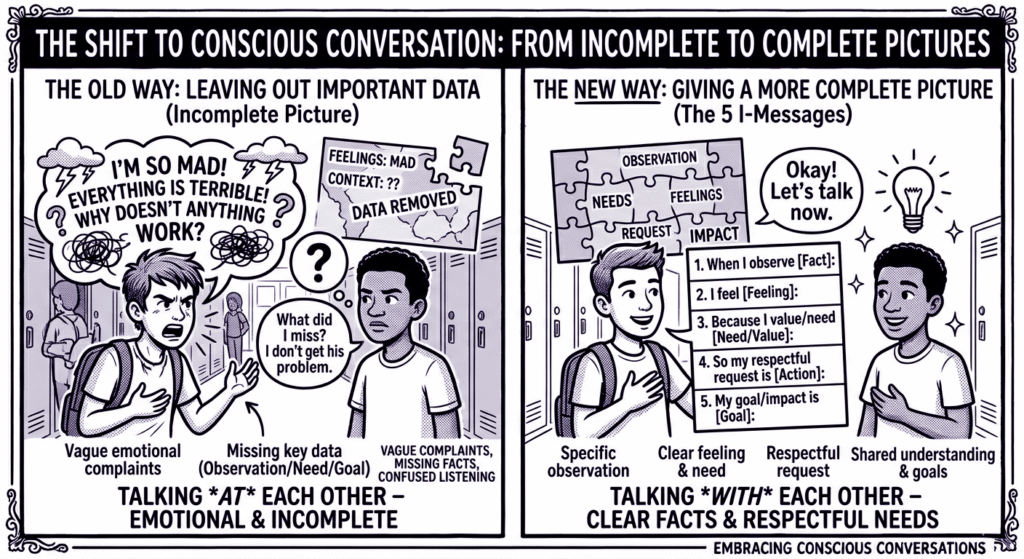
4.1 Summary
Careful self-observation allows for compassionate and effective self-expression. The more important the conversation you are in, the truer this becomes.
In order to understand yourself more clearly — and to be understood by others in ways that lead to agreements meeting more of everyone’s needs — it helps to begin with a clearer picture of your own experience. A conversation requires you to translate the elements of your experiencing into a kind of story, and the more demanding the conversation, the more self-inquiry and careful composing that story requires. I have to be able to make some reasonable sense out of my own experience before anyone else will be able to.
A good way to start is to sort your experience into five “baskets”: what you are observing, what you are feeling, why you are feeling it, what you want to ask for, and what good outcome you are hoping for.
This chapter introduces those five baskets as the Five I-Messages — a map of experience. These five dimensions are always present inside you, whether or not you have sorted them out and whether or not you express them. Before the Five I-Messages are a communication tool for reaching out to someone else, they are a self-observation tool: a way of asking yourself, What is actually going on inside me right now? In many situations — especially intense ones — we may not know everything we are feeling, or what we are wanting, until we have paused long enough to ask. We can be feeling many things, and wanting many things — all the more reason to pause and sort it out. The inward turn toward clarity comes first. The outward expression follows from it.
At the heart of everything that follows is a question worth sitting with: What opens up when you slow down enough to notice what you’re actually feeling, needing, and hoping for — and what becomes possible when you can share what you find there with honesty and care?
4.2 A Capacity You Already Possess
You have already done this — perhaps more often than you realize. Think of a time when you were upset and, instead of reacting immediately, you paused. Maybe you stepped out of the room for a moment, or took a slow breath, or simply waited — and in that pause, something came into focus. You noticed that underneath the anger was something else: fear, or sadness, or a need you hadn’t named. And when you finally spoke, you spoke from that deeper place. Maybe you said something like, “I’m not angry about the dishes — I’m feeling overwhelmed because I had a terrible day and I was hoping we could make dinner together tonight.” And your partner’s face changed, and you could see that for the first time they actually understood what was going on inside you.
If you can remember a moment like that — a moment when you looked inward before speaking outward, and the conversation went better because of it — you already know the most important thing this chapter has to teach. The pause to notice is the foundation. The expression that follows is built on it.
This chapter is about recognizing what you’ve already glimpsed, giving it a name and a map, and learning to do it more deliberately and more often. In Transformation One, we explored the “born to learn” idea: you were born with a magnificent capacity for language, but zero words in your vocabulary. The same is true for self-awareness and self-expression. You were born with the capacity to observe your own inner experience and to share it honestly — and that capacity has been developing, unevenly and without much guidance, your whole life. What follows is a way of seeing what you already partly do, so that you can do it more often and with greater confidence.
If the capacity is already there — if you’ve already had moments when pausing to notice produced clearer expression and deeper understanding — then a natural question arises: What keeps us from doing this more often? What is it about everyday conversation that makes us skip the inward pause and compress away exactly the information our listener most needs?
4.3 The Art and Process of Saying Enough
Having a conversation is like baking a series of cakes. Nearly every important speaking turn involves a creative mixing together of several ingredients. Here is an ingredient list I have found helpful:
1) Self-needs at once: the need to be aware of what is actually going on in your own heart and mind, the need to translate that awareness into a story your listener can follow,
the need to be clear and appropriate to the occasion,
and the need to be reasonably brief.
All four are legitimate. Any one of them can make or break a conversation. And we face them all, in every important conversation, every day of our lives.
When a surgeon says “Scalpel” in an operating room, brevity is everything. When a parent shouts “Stop!” to a child running toward traffic, the message needs to be instant. In emergencies, abbreviation saves lives.
But the same abbreviation instinct that serves us so well in urgent moments quietly undermines us in the conversations that matter most: the talk with your partner about something that’s been bothering you for weeks, the meeting with a colleague where a project is going off the rails. In those moments, our instinct to compress — to get to the point quickly, to leave out the parts that feel embarrassing or complicated or not quite clear to us yet — produces exactly the misunderstandings and hurt feelings we were hoping to avoid.
Human communication works by leaving many things unsaid and depending on the listener to fill in the missing information. A receptionist says to a counselor, “Your two o’clock is here” — a sentence which, on the face of it, makes no sense at all. She means “Your client, who made an appointment with you for two o’clock this afternoon, has arrived in the waiting room,” and the counselor knows that. It is amazing how much of the time this abbreviating works just fine.
But in situations of conflict, ambiguity, or strong feeling, our shorthand can fail in at least three ways. First, our listeners may fill in completely different details than the ones we intended. Second, they may get the details but miss the significance. Third, we may leave out important parts of our experience that we find embarrassing, not quite clear to us yet, or that we imagine will evoke a hostile reaction. And here is the crucial point: we often don’t realize what we are leaving out. The shorthand feels so familiar that it feels like the whole message.
But there is a deeper reason we abbreviate, and it goes beyond the efficiency of language. In many situations, we leave things out because we haven’t yet noticed or understood them in ourselves. We arrive in important conversations not yet knowing what we actually feel, or what we actually want, because we haven’t paused to ask. The psychologist Carl Rogers pointed to the roots of this: many of us learned early in life that it wasn’t safe to say what we really felt, and we became experts at not noticing our own feelings — not just at hiding them from others, but at hiding them from ourselves. The encouraging truth that Rogers spent his career demonstrating is that as adults we have new cognitive resources, resources we did not have when we first learned to speak and listen. As adults we can close the missing information gap — and the closing begins not with better expression but with better self-observation.
So we are dealing with two creative layers: the practical layer, where language naturally compresses the content and arranges the story, and the awareness layer, where we haven’t yet noticed what we’re compressing away. If that is the creative challenge of important conversations, what would a map of those inner dimensions look like — one that could guide both the inward noticing and the outward sharing?
4.4 The Five I-Messages: A Map for Looking Inward and Speaking Outward
In recent decades, psychologists and communication educators have developed a much clearer picture of what people tend to leave out when they compress — and what needs to go back in. The social workers who developed the Minnesota Couples Communication Program called their model the “Awareness Wheel” — and the name is telling, because it puts awareness at the center, not expression. The Five I-Messages I offer here are closely related. They map five dimensions of experience that are always happening inside you, whether or not you are aware of them and whether or not you express them.
Before the Five I-Messages are a communication tool, they are a self-inventory — a way of pausing to ask yourself: What am I actually seeing or reacting to? What am I actually feeling? What need or interpretation is driving this feeling? What do I actually want right now? What good outcome am I hoping for? In many situations — especially the intense ones where self-expression matters most — we genuinely don’t know the answers to these questions until we have paused long enough to ask. The conflict resolution expert William Ury recommends a practice he calls “going to the balcony” — stepping back briefly from a tense situation to sort out your own thoughts and feelings before re-engaging. The Five I-Messages are what you do while you’re on the balcony. They are the questions you ask yourself up there.
And then, when you come back downstairs, the same five dimensions become a guide to expression — a way of sharing what you’ve found with your listener, so that they can actually understand you. They are called I-Messages because each one is a statement about your own experience rather than a judgment about someone else. Here they are:
(1) What you are seeing or hearing — a simple description of the facts, without evaluation.
(2) What emotions you are feeling — glad, sad, angry, scared, delighted, frustrated, concerned.
(3) What needs, wants, or interpretations are driving those feelings — the “because” that connects the situation to your emotional response.
(4) What you are ready to ask for right now — a specific, doable request for action, information, or commitment.
(5) What positive results you envision — the good outcome that would follow if your request is met.
Consider the difference. The shorthand version of a message might be: “Stop that racing!” The five-message version — the version that becomes possible only after the speaker has paused to notice what she is actually experiencing — gives the listener a full picture:
Table 4.1: The Five I-Messages
| The Five I-Messages | express: | Example (nurse to young patient): |
|---|---|---|
| seeing, hearing… | 1. What are you seeing, hearing or otherwise sensing? (facts only) | “John, when I see you rolling down the hall in your wheelchair really fast… |
| and feeling… | 2. What emotions are you feeling? | …I feel REALLY concerned. |
| because I… | 3. What interpretations, wants, needs, memories or anticipations of yours support those feelings? | I am imagining you might hurt yourself and maybe someone else, too, or knock something over… |
| and now I want… | 4. What action, information or commitment do you want now? | …so what I need right now is for you to promise me that you will slow down… |
| so that… | 5. What positive results will that action lead to? (no threats) | …so that you can get out of here in one piece and I can stop worrying about a collision.” |
Notice what happens when the nurse expresses all five dimensions. John doesn’t just hear a command. He hears what the nurse is observing, what she’s feeling, why she’s feeling it, what she needs from him, and what good will come of it. But notice, too, what had to happen inside the nurse first. She had to pause long enough to notice that what she was feeling was concern, not anger. She had to identify the interpretation driving the feeling — her worry about a collision. She had to clarify what she actually wanted from John, and what good outcome she envisioned. The self-observation came first. The expression followed from it.
Now look at how the same observation produces completely different messages depending on the speaker’s inner experience:
Table 4.2: Five I-Message Examples (Please read across the rows.)
| 1. When I saw/heard… | 2. I felt… | 3. because I… | 4. and now I want… | 5. so that… |
|---|---|---|---|---|
| When I saw the bear in the woods with her three cubs… | …I felt overjoyed!… | …because I needed a picture of bears for my wildlife class… | …and I wanted the bear to stand perfectly still… | so I could focus my camera. |
| When I saw the bear in the woods with her three cubs… | …I felt terrified!… | …because I remembered that bears with cubs are very aggressive… | …and I wanted to get out of there fast… | so that the bear would not pick up my scent. |
| When I saw the dishes in the sink… | …I felt happy… | …because I guessed that you had come back from your trip to Mexico… | …and I want you to tell me all about the Aztec ruins you saw… | …so that I can liven up some scenes in the short story I’m writing. |
| When I saw the dishes in the sink… | …I felt irritated… | …because I want to start cooking dinner right away… | …and I want to ask you to help me do the dishes right now… | …so that dinner will be ready by the time our guests arrive. |
The same three cubs, the same dishes — but completely different inner experiences, because Message Three is different. If the speaker had skipped the self-observation and simply reacted — “Bears!” or “The dishes again!” — the listener would have no idea what the speaker was actually feeling, why, or what they needed. The Five I-Messages give the listener the full picture. But only if the speaker has first given themselves the full picture.
The Five I-Messages, then, are both a self-inventory and a communication tool — a framework for noticing what’s happening inside you and then sharing it. But if you’ve been reading carefully, you may already be raising an objection: “Are you really suggesting I run through all five of these questions every time I open my mouth?” That’s a fair concern — and the answer involves understanding something about skill development that most communication programs never discuss.
4.5 The Developmental Journey: From Scales to Jazz
People who learn structured communication formulas sometimes complain that using them sounds robotic. Their partners roll their eyes. And so they abandon the whole thing. I understand that frustration. And I want to suggest that what’s happening is not a failure of the method. It’s a confusion between a training protocol and a way of life.
Think of learning to play the piano. When you’re a beginner, you practice scales — every note, deliberately, one at a time. It sounds mechanical because it is mechanical. You’re learning where all the keys are. But once you’ve done those scales hundreds of times, your hands know. You can improvise. The scales aren’t the performance. They’re the foundation that makes the performance possible.
The Five I-Messages work the same way — and here the self-observation dimension is especially important. I see three stages:
Stage One: Unconscious abbreviation. This is where most of us start. We haven’t yet learned to observe our own experience carefully, so we express it in shorthand without realizing what we’re leaving out. When misunderstandings arise, we blame the other person for not getting it.
Stage Two: Conscious expansion. This is the training stage — the scales. You deliberately pause to notice all five dimensions of your experience, and you deliberately practice expressing all of them, even when it feels excessive. Write one five-message self-inventory a day in a journal. Practice with a partner. Work through the exercises at the end of this chapter. This stage is about training your awareness — learning to feel the five dimensions so that you know where all the “keys” are, inside yourself and in your conversations.
Stage Three: Informed brevity. Having internalized all five dimensions through practice, you return to something that looks like ordinary conversation — brief, natural, fluid. But it’s fundamentally different from Stage One, because now your brevity is chosen rather than automatic. You can feel when something important is missing — either in your own self-awareness or in what you’re sharing. When a conversation starts going sideways, you can pause and ask yourself: “Which of the five am I not noticing? Which one does my listener need right now?” And you supply just that piece.
If you’re in Stage Two right now, doing your scales, please don’t be in a hurry to skip ahead. The scales are what make the jazz possible.
With that developmental arc in view, here is a brief look at each of the five messages — each one presented as both something to notice in yourself and something to share with your listener.
4.6 A Closer Look at Each Message
Message One: What you are seeing, hearing, or sensing. The self-observation question: What actually happened? What did I actually see or hear? Begin with what you observed rather than how you feel about it. Be specific — time, place, actions — and describe rather than diagnose. Avoid words that label or judge, and generalizations like “you always” or “you never.” “When I saw the big coffee stain on the rug…” is far easier to hear than “When you ruined my day with your disgusting antics…”
Message Two: What emotions you are feeling. The self-observation question: What am I actually feeling right now? Use specific emotion words: glad, angry, delighted, sad, afraid, frustrated, hopeful, concerned. Be wary of feeling words that actually describe someone else’s actions: “I feel ignored” or “I feel manipulated” are indirect accusations, not feelings. “I feel ignored” probably means “I’m feeling sad because I want more of your attention.” Noticing the real emotion underneath the accusation is one of the most valuable things self-observation can do.
Message Three: What needs, wants, or interpretations are driving your feelings. The self-observation question: Why am I feeling this way? What want, need, memory, or interpretation of mine is generating this emotion? This is the dimension people compress away most often — and it’s the one that requires the deepest self-observation. A large part of your emotional response to any situation is generated by your own wants, memories, and interpretations, not just by what happened. Noticing this is an act of emotional maturity: you’re taking responsibility for your inner world rather than asking your listener to guess at it.
Message Four: What you are ready to ask for right now. The self-observation question: What do I actually want? What specific action, information, or commitment would help? Ask for specific, doable actions rather than emotional states. Translate “be more supportive” into concrete verbs: “please listen,” “please sit with me,” “please tell me what you think.”
Message Five: What positive results you envision. The self-observation question: What good would come of getting what I’m asking for? If you can’t articulate the positive outcome, you may not yet understand your own needs clearly enough — and that’s a signal to spend more time on the balcony. When you can name the good outcome, you give your listener a reason to care about your request. You point the relationship toward mutual appreciation rather than guilt or fear.
With practice, these five messages — noticed inwardly, shared outwardly — serve all three sides of the relationship triangle we explored in Transformation One: task, emotional support, and the bridging of difference. A complaint collapses all five dimensions into a single burst of blame. The Five I-Messages weave all three together, because the speaker has first noticed what’s happening inside and then shared it openly. That’s their hidden strength — and it connects this skill to every other transformation in this workbook.
4.7 The Spiral: How this Transformation Connects to Positive Processes in Human Development
The listening connection (Transformation Two). In Transformation Two, section 2.8, we previewed the idea that outward listening and inward listening are not two skills but one, aimed in two directions. The Five I-Messages make that insight concrete: the same framework you use to observe your own experience can guide your listening to others. When someone is upset, you can listen for the five dimensions: What are they observing? What are they feeling? What need is driving the feeling? What do they want? What outcome are they hoping for? This is “listening with five ears” — and it makes you a profoundly better listener, because you know what to listen for. To help you develop this practice, you will find a Five-Part Listening Inventory among the exercises at the end of this chapter.
Shifting from a language of accusation to a language of invitation. When we were little, we were outweighed and outmaneuvered by most of the people around us. Each of us started out as the littlest player on the team. In response, we developed a vocabulary of protest and accusation — “You did something really awful…,” “You hurt me!,” “You’re bad!” — because as little beginners in life, we were in no position to understand differences in needs or to negotiate for more satisfying outcomes. We experienced every unmet need as entirely the other person’s fault. Every situation was simple: they were doing it to us.
Now, as adults, we have a whole new range of cognitive resources available to us, and with them a whole new range of possible responses. The fact that other people have different needs and experiences from our own is now a moment to be explored in conversation rather than a crime to be exposed and denounced. The goal of that conversation is to work out some way of cooperating that will meet more of the needs of both people. The Five I-Messages embody this shift. They help me explain my experience in language you might be able to identify with: I saw that, then I felt this way, because I was needing something different, and now I want to ask for this, so that we can both… The accusatory “you” language is gone, replaced by an invitation for each person to express their experience and for the conversation partners to invent a more satisfying way of cooperating. That shift, from accusation to invitation, is a major step in the unfolding of human maturity.
Becoming the kind of person who pauses to notice. We have been calling self-observation and self-expression “skills,” and they are. But there is a quieter truth underneath the skills that is worth naming. Each time you pause to notice what you’re actually feeling rather than firing off the shorthand — each time you ask yourself why you’re feeling it before blaming someone else for it — each time you name a request instead of swallowing it or wrapping it in accusation — you are not only doing something. You are quietly becoming someone: a person who arrives in conversations already knowing what they feel and need, a person whose words make others feel safe enough to listen, whose honesty invites honesty in return. And the way we are, moment after moment, is the raw material from which a character is slowly made. Practice this often enough and you will not merely become more self-aware or more articulate. You will become someone other people trust with their own experience — because in your company they discover that honesty and kindness can occupy the same sentence.
4.8 Transformation Four Exercises: Looking Inward, Speaking Outward
Reading this chapter has been a kind of in-breath — taking in a new way of seeing what self-observation and self-expression can do when they work together. But no one ever learned to observe themselves more carefully or express themselves more fully by reading about it; the understanding comes alive only on the out-breath, in real journal entries and real conversations where you actually pause, notice, and speak. Breathe in the idea; breathe out the practice. That gentle rhythm will return in every chapter of this book.
May you discover, one pause at a time, the enormous difference that looking inward makes — for what you say, and for how people hear you!
Exercise A: Daily Self-Inventory.
Each day for a week, choose one moment from your day — a conflict, a frustration, a delight — and write a five-message self-inventory in your journal. Don’t worry about whether you will ever say these words to anyone. The practice here is noticing: What did I observe? What did I feel? What need or interpretation was driving the feeling? What did I want? What good outcome was I hoping for? Use the worksheet on the following page.
Exercise B: Paired Practice.
With a practice partner, take turns describing a recent experience using all five messages. After each person speaks, the listener reflects back what they heard, using the listening skills from Transformation Two. Then ask: “Did I get that right? Is there anything important I missed?”
Exercise C: Taking Stock.
- Think of a recent conversation that went badly. Which of the five dimensions were you not noticing in yourself? What might have changed if you had paused to observe them before speaking?
- Which of the five dimensions comes most naturally to your awareness? Which one do you tend to overlook? (Many people find that Message Three — the needs and interpretations behind their feelings — is the one they notice least.)
- Where are you in the three-stage developmental journey? Stage One, reacting without noticing? Stage Two, deliberately practicing both the self-observation and the expression? Or Stage Three, starting to sense intuitively which dimension needs attention?
- Who in your life might you invite to practice this skill with you? Even one practice partner can make an enormous difference — see Transformation Nine: Widening Circles.
Exercise D: Five-Part Listening Inventory.
The Five I-Messages are not only a self-expression tool — they are equally powerful as a listening tool. When someone is telling you about a difficult experience, use the Five-Part Listening Inventory on the following pages to guide your attention. As you listen, ask yourself: What is this person describing that they observed? What feelings are they expressing? What need or interpretation seems to be driving those feelings? What are they asking for? What outcome are they hoping for? After they have finished speaking, reflect back what you heard, dimension by dimension. You may be surprised how much more your conversation partner feels understood — and how much more clearly you understand them — when you listen with all five ears.
4.9 A Five I-Messages Worksheet
A guide to both self-observation and self-expression — first notice what you are experiencing, then practice sharing it with others.
Use this form to explore your experience more carefully and express it more completely. Photocopy this page, print from PDF, or download printable copies at communication-skills.net.
| 5 Elements of my experiencing: (Self-Observation) |
Expressing what I find — helping people understand me better (Self-Expression) |
|---|---|
| 1. What actions, events and/or sensations am I seeing, hearing, doing, remembering or otherwise sensing? (Start with facts only) | As I (or when I) see (hear, remember, take action about)… |
| 2. What basic emotions am I feeling (glad, sad, mad, delighted, frustrated, proud, sorry, ashamed, grateful, etc.) about those actions/events? | … I feel (or felt)… |
| 3. What interpretations, evaluations, wants, hopes, needs and/or dreams of mine help to evoke and support my feelings? | … because I… |
| 4. What action, information, discussion, help or commitment would I want to receive, or would I like to ask for, now? | … and now I want (want to request)… |
| 5. What positive results or personal fulfillment do I envision that action, discussion, information or commitment leading to? | …so that I can… so that we can… in order for me/us to… |
4.10 A Five-Part Listening Inventory
A guide to listening for all five dimensions — helping you understand more fully what another person is experiencing, and helping them feel more deeply heard.
Use this form while listening to someone describe a difficult or important experience. Photocopy this page, print from PDF, or download printable copies at communication-skills.net.
| 5 Elements of the other person’s experiencing: (Listening for…) |
What I think I’m hearing — reflecting back to check (Responding with…) |
|---|---|
| 1. What actions, events, or sensations is this person describing? What did they actually see, hear, or experience? | “It sounds like what happened was…” |
| 2. What emotions are they expressing or conveying? What feelings am I picking up on? | “And you’re feeling…” |
| 3. What needs, wants, interpretations, or hopes seem to be driving their feelings? | “…because you…” (or “…because it matters to you that…”) |
| 4. What are they asking for? What action, information, or commitment do they seem to need right now? | “And what you’d like is…” |
| 5. What positive outcome are they hoping for? What good result do they envision? | “…so that…” |
4.11 References for this Chapter
A note on inspirations: Many scholars and psychotherapists have been developing frameworks for more complete self-awareness and interpersonal communication since Dr. Thomas Gordon first published Parent Effectiveness Training in 1962. My deep appreciation goes to him for being one of the first great popularizers of communication skills training in the United States.
The work of Marshall Rosenberg (Nonviolent Communication) helped me understand Messages One through Four.
The work of Sharon and Gordon Bower (Asserting Yourself) helped me understand Message Five, and the importance of describing hoped-for positive outcomes.
The work of scholars John Grinder and Richard Bandler helped me understand how people “delete” various aspects of their experience from their awareness and their expressed communication.
The “Awareness Wheel” of the Minnesota Couples Communication Program showed how scholars and researchers have been working to overcome the self-awareness and messages-left-out problem. The very name of their model — the Awareness Wheel — reflects the insight that self-observation is the foundation of self-expression.
William Ury’s concept of “going to the balcony” in conflict resolution provided a vivid image for the pause between self-observation and self-expression. My small contribution has been to suggest that the Five I-Messages are what you do while you’re on the balcony.
Bandler, Richard, and John Grinder. The Structure of Magic, Vol. 1. Science and Behavior Books, 1975.
Bower, Sharon Anthony, and Gordon H. Bower. Asserting Yourself: A Practical Guide for Positive Change. Addison-Wesley, 1976.
Gordon, Thomas. Parent Effectiveness Training: The Proven Program for Raising Responsible Children. Harmony Books, 2000.
Miller, Sherod, et al. Connecting with Self and Others. Interpersonal Communication Programs, 1988.
Rogers, Carl R. On Becoming a Person: A Therapist’s View of Psychotherapy. Houghton Mifflin, 1961.
Rosenberg, Marshall B. Nonviolent Communication: A Language of Life. 3rd ed., PuddleDancer Press, 2015.
Ury, William. Getting Past No: Negotiating in Difficult Situations. Bantam Books, 1993.
into Specific, Success-focused Requests

- From swallowing your needs to voicing them
- From criticizing what went wrong to asking for what would go right
- From “you never…” to “would you be willing to…?”
- From vague dissatisfaction to specific, doable requests
- From demands that provoke resistance to invitations that inspire cooperation
- From assuming people should know to helping them understand
- From the guaranteed resentment of silence to the possibility of satisfaction
- From hiding behind complaints to standing in your need
- From the fear of “no” to the surprising frequency of “yes”
- From the big tool for big problems to the quick tool for everyday friction
- From suffering alone to asking together — one conversation at a time
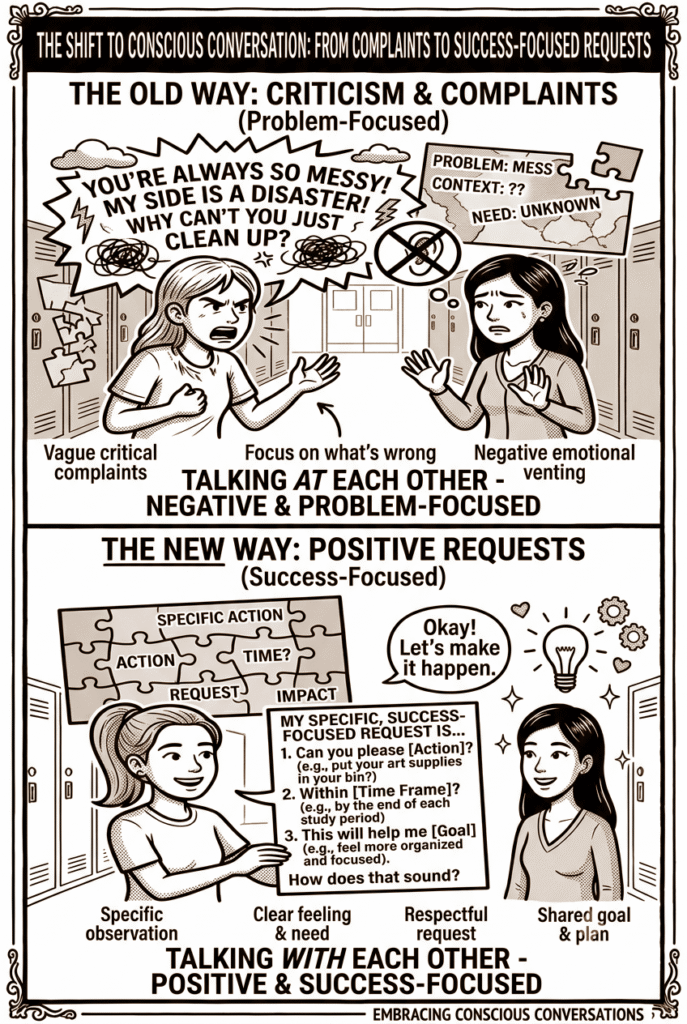
5.1 Two Tools, Not One
If you’ve been working through this workbook, you’ve just completed something substantial. In Transformation Four, you learned the Five I-Messages — a comprehensive model for expressing the full landscape of your inner experience: what you’re observing, what you’re feeling, what needs and interpretations are driving those feelings, what you’re asking for, and what positive outcome you envision. That’s a powerful instrument. When a conversation involves layers of feeling, tangled history, and high stakes — the talk with your partner about something that’s been eroding the relationship for months, the meeting where a project has gone badly off the rails — you need all five dimensions. You need the full orchestra.
But here’s something I’ve learned from decades of watching people try to use structured communication tools: most of the friction in daily life doesn’t call for the full orchestra. It calls for a quick, clear duet.
Your coworker keeps scheduling meetings over your lunch break. Your teenager leaves their shoes in the hallway where you trip over them every night. Your neighbor’s dog barks at six in the morning. Your spouse arrives twenty minutes late without calling. These aren’t five-message situations. They’re small, specific, fixable problems. And if you deploy the full Five I-Messages model every time your roommate leaves the milk out, something unfortunate happens: the very weight of the tool creates a new problem. Your roommate doesn’t hear a reasonable request about milk. They hear a therapy session. They feel ambushed by a level of emotional processing that the situation doesn’t warrant. And you feel ridiculous, because you can sense that you’re bringing a fire truck to blow out a birthday candle.
This matters more than it might seem. One of the most common reasons people abandon structured communication tools is precisely this mismatch. They learn a comprehensive model, try to apply it to everything, feel awkward when it’s too much for a small moment, and conclude that “this communication stuff doesn’t work in real life.” But the problem isn’t the tool. The problem is using the wrong tool for the job.
So this chapter is about the other tool — the quick one. The one you can use in thirty seconds, without turning a small problem into a State of the Union address. It’s built from the last two elements of the Five I-Messages — Message Four (the specific request) and Message Five (the positive vision) — but freed from the full model so they can travel light.
The formula is simple:
“Would you be willing to [specific action]… so that [positive result]?”
That’s it. Two parts. A clear request and a brief explanation of why it matters. Pruning shears instead of a chainsaw. And as you’ll discover in this chapter, this small tool — used consistently, with courage and care — can transform the texture of your daily life.
But if the formula is this simple, why don’t most of us use it naturally? Why do we default, instead, to something far less effective — and far more damaging? The answer has to do with a paradox that sits at the very heart of how we communicate when we’re frustrated.
5.2 The Paradox of the Unhappy Silence
There is a peculiar paradox at the heart of human communication, one that creates a vast amount of unnecessary suffering in our families, our workplaces, and our communities. We often find it significantly easier to criticize someone for not meeting our needs than to simply ask them to meet those needs in the first place.
Consider the husband who complains for years that his wife “never listens,” yet has never once paused to say, “I need you to put down your phone and look at me when I’m talking about something important to me.” Consider the manager who grumbles to peers about an employee’s “lack of initiative,” yet has never actually requested, “I’d like you to bring me three ideas for improving our process at next week’s meeting.”
Why do we do this? Why do we choose the indirect, often toxic path of complaint over the direct, constructive path of the request? The answer lies in the profound vulnerability that asking requires of us. In the economy of emotional risk, complaints feel cheap, while requests feel expensive.
When we complain, we position ourselves as the judge: elevated, protected, and righteous. The logic of the complaint allows us to maintain an illusion of self-sufficiency: “I don’t really need anything from you; I am simply pointing out that you are doing it wrong.” This protective stance shields our ego. If I don’t ask, you can’t say “no.” If I only criticize your failure, I remain the authority on what is right.
However, this safety comes at a terrible price.
This connects directly to the “born to learn” predicament we explored in Transformation One. Remember: you absorbed your communication habits by watching and imitating the people around you when you were too young to know what was going on. And for most of us, the models we absorbed included a great deal of complaining and very little clear requesting. Our parents complained about the neighbors. Our teachers complained about our behavior. The adults around us expressed their frustrations through criticism, sarcasm, sighing, and silence — but rarely through direct, vulnerable, specific requests that explained what they needed and why.
So if you find it hard to ask for what you need, that’s not a personal failing. It’s a gap in what you inherited. You weren’t born knowing how to translate your frustrations into requests. You were born to learn how to do it — and learning it is exactly what this chapter is for.
So the pattern is clear: we default to complaint because it’s what we absorbed growing up, and because it feels emotionally safer than asking. But “safer” is a misleading word here. If complaining protects our ego in the short term, what does it cost us in the long term — in our relationships, our workplaces, our daily satisfaction? The costs turn out to be far higher than most of us have stopped to calculate.
5.3 The Cost of Silence
Marshall Rosenberg, founder of the Nonviolent Communication movement, observed an ongoing tragedy of missed opportunities in his decades of conflict resolution work: we criticize people for not giving us what we ourselves are afraid to ask for.
When we hide our own needs behind walls of criticism, we deny others the opportunity to actually help us. We create a spiral of mutual accusation. Because human conversation is driven by imitation — a criticism from one partner, no matter how justified it feels, tends to evoke a counter-criticism from the other — the conversation can descend into a debate about who is “worse,” rather than a collaboration on how to make things better.
But the deeper tragedy of the unexpressed request is not just that our needs go unmet. It is that the relationship remains shallow. By refusing to ask, we choose the guaranteed resentment of silence over the possibility of satisfaction. We may find ourselves choosing to be “right” about our unhappiness rather than risking the vulnerability required to be happy.
Think about this in terms of the three things every relationship needs, which we explored in Transformation One. Every human group — from a couple to an entire company — needs to accomplish tasks together, support one another emotionally, and accommodate different temperament types. A complaint attacks all three sides of that triangle simultaneously. It frames the task as someone else’s failure. It withdraws emotional support by adopting the posture of a judge. And it refuses to bridge the gap between different perspectives, instead insisting that the other person’s way of seeing things is simply wrong.
A clear request, by contrast, serves all three sides. It names a specific action that would help (task). It reveals your need, which is an act of trust (emotional support). And it invites the other person into your perspective without demanding they abandon their own (navigating difference). The request is a bridge. The complaint is a wall.
The cost of silence, then, is not just an unmet need. It is a relationship that stays walled off, a triangle that weakens on every side. But if the cost is this clear, why do so many of us still choose complaint over request? Not because we don’t understand the cost — most of us sense it, at least dimly. We choose complaint because of something deeper: the act of asking requires a kind of courage that our egos find genuinely frightening.
5.4 The Courage of Agency
If complaining is an act of defense, a genuine request is an act of self-revelation. When I ask you for something, I am admitting three truths that our egos find dangerous:
I have a need. I cannot meet this need entirely on my own. And your response matters to me.
This is why asking takes courage. It requires us to step out from behind the wall of the complaint and stand, undefended, in our need.
It is important to acknowledge that this fear is not “all in your head” — it is in your body. For many people, the thought of making a difficult request triggers a tightening in the chest and a quickening of the pulse. Our nervous systems often treat the risk of social rejection much like they treat physical danger. Neuroscientific research confirms this: the brain regions that activate during physical pain overlap significantly with those that activate during social rejection. Being told “no” actually hurts.
But we can learn to reframe the act of asking. Researcher Brené Brown suggests that while we are taught to see vulnerability as weakness, it is actually the foundation of courage, empathy, and connection. When we make a request, we are asserting our right to take up space in the world. We are treating the other person not as an adversary to be coerced, or a parent who should “just know” what we need, but as a competent adult who can handle our request and make their own decision.
There is a profound respect in the direct request. It says, “I trust you enough to show you my need. I believe you are someone who might want to help.”
And here is the connection to Transformation Eight’s deeper insight: every time you practice translating a complaint into a request, you are not just using a communication technique. You are, in that moment, being a more constructive person. You are exercising the adverb constructively — and over time, as Transformation Eight explores, the adverbs of your conversations become the adjectives of your character. The person who consistently translates complaints into requests gradually becomes a constructive person. Not because they decided to be constructive in the abstract, but because they practiced constructiveness in hundreds of small, specific moments. This is how character is built: one conversation at a time.
So the courage to ask is real courage — it requires us to stand in vulnerability and trust the other person with our need. But there is one specific fear that makes this courage harder than almost anything else: the fear that the other person will say “no.” For many of us, that fear is so powerful that it stops us before we even open our mouths. What would happen if we looked at that fear more carefully — and discovered that our predictions about it are almost always wrong?
5.5 The Fear of “No” — and the Surprising Frequency of “Yes”
Even with the understanding that asking requires vulnerability, and even knowing what silence costs us, the fear remains: What if they say no?
It is vital to prepare for the “no.” One of the deepest sources of our fear is the catastrophic meaning we ourselves assign to rejection. When someone declines our request, we often hear far more than a refusal of a task. We hear, “You don’t matter.” We hear, “Your needs are unreasonable.”
Learning to hear “no” simply as “no” — as information about the other person’s current capacity rather than a judgment of your worth — is one of the most liberating skills a person can develop. A “no” to a request is not a “no” to the relationship. It is often just a “no” to this specific strategy at this specific time. And if you’ve included the “so that” explanation, a “no” to your specific request still leaves the door open for alternative strategies that serve the same goal.
But here is the encouraging news: our fear of “no” is often statistically unfounded. Research by social psychologist Vanessa Bohns at Cornell University has consistently found that we dramatically underestimate other people’s willingness to say yes. In study after study, people predicted that only about 30% of strangers would agree to help them; in reality, the compliance rate was typically above 50%. We are so focused on the possibility of rejection that we fail to recognize how often people are genuinely glad to help when simply asked.
You have probably experienced this yourself. Think of a time when someone made a clear, reasonable request of you — not a demand, not a guilt-trip, but a genuine request that explained what they needed and why. Chances are, you wanted to help. Most people do. We are wired for cooperation. We just need to be asked.
So the fear of “no” is real — rejection activates the same brain regions as physical pain — but the fear is dramatically out of proportion to the actual likelihood of rejection. Most people want to help. The problem is that we never give them the chance. Now that we have faced the emotional obstacles — the inherited habit of complaint, the cost of silence, the vulnerability of asking, and the exaggerated fear of “no” — we are ready for the practical question: How do we ask? What does a well-crafted request actually sound like, and what makes the difference between a request that inspires cooperation and one that provokes resistance?
5.6 The Mechanics of the Quick Tool
Once we have gathered the courage to speak, how do we ask? Courage without skill can sometimes lead to blunt demands or confusing ultimatums. The quick tool has two parts, and getting both right makes the difference between a request that inspires cooperation and one that provokes resistance.
Part One: The Specific Action Request
A common mistake when trying to stop complaining is to make requests that are actually just complaints in disguise.
The complaint says: “You’re so lazy.”
The vague request says: “I want you to be more responsible.” (This is still a criticism of their character.)
The specific action request says: “Would you be willing to take out the recycling every Tuesday night, so it doesn’t pile up on the back porch?”
Do you see the progression? The specific action request focuses on the present and the future. It uses verbs (actions a person can do) rather than adjectives (labels that define who they are). This distinction matters enormously. When we use labels like “lazy,” “inconsiderate,” or “unreliable,” we suggest that the other person’s behavior is a fixed character trait about which they can do little. We are directly undermining our own goal of motivating them to do something different.
By focusing on a specific action — “Would you fix the faucet in Apartment #4 by five o’clock?” — we bypass the debate about personality, focus on a solvable problem, and cast the other person in a positive role: as a problem-solver rather than a problem-maker.
Use positive language wherever possible. “Please drive slower” works better than “Don’t drive so fast.” Even in safety situations where you must use “do not’s,” work to accompany each prohibition with a positive action version. If the law requires you to say “NEVER MIX A WITH B,” you can reframe that as a positive message: “KEEP THE TEAM SAFE: Always store A and B separately. NEVER MIX A WITH B.” The prohibition tells people what to avoid. The positive version tells them what to do — which is what their brain actually needs in order to comply.
Part Two: The “So That…” Explanation
The second part of the quick tool is the explanatory clause. We need to link our request to a vision of success. This often takes the form of a “so that…” phrase:
“Please drive slower…” (the request)
“…so that I can feel safe and relaxed in the passenger seat.” (the vision)
Research in social psychology reveals that people respond significantly more positively to requests that include a reason. When we explain our “why,” we treat the listener as a social equal worthy of being informed, rather than a subordinate who must simply obey. We invite them into our world. And something remarkable happens: the explanation turns the listener into a problem-solving partner.
If you say, “I need you to arrive at 6:00 PM,” and they can’t make it, the conversation ends in failure. But if you say, “I need you to arrive at 6:00 PM so that we can finish the project before the weekend,” they understand the underlying goal. If they can’t arrive at 6:00, they might say, “I can’t get there by 6:00, but I can email you my part of the project by 5:30.” The shared vision allows for creative alternatives. The “so that” turns a rigid demand into a flexible collaboration.
Other versions of the explanatory clause include: “It would help me to do X if you would do Y,” or “In order to…” or simply “because…” Any phrasing that gives your listener a window into why this request matters to you will dramatically increase the likelihood of cooperation.
So the quick tool has two working parts: a specific action request (using verbs, not adjectives, focused on the future rather than the past) and a “so that” explanation that invites the listener into your reasoning. Together, they transform what might feel like a demand into a collaborative invitation. But knowing the formula is only half the skill. The other half is learning to translate — to hear the complaint that’s running through your mind and convert it, in real time, into a request the other person can actually act on. That translation skill is what we turn to next.
5.7 The Translation Skill: From Complaint to Request
Learning this skill requires you to become a translator. You must learn to translate your own internal grumbling into communicable requests — and, just as importantly, to translate other people’s complaints into possible requests when they haven’t yet learned to do it themselves.
Here is the pattern:
| The Internal Complaint | → | The Translated Request (Specific Action + “So That…” Vision) |
|---|---|---|
| “Don’t be so inconsiderate!” | → | “Please close the door quietly, so that Aunt Mary can continue to sleep.” |
| “Somebody ought to order paper.” | → | “Would you order two reams of paper today, so that we don’t run out during the presentation?” |
| “You never help me!” | → | “Could you wash the dishes tonight, so that I can finish this report and we can watch a movie together?” |
| “This team has no communication!” | → | “Could we start each Monday with a fifteen-minute check-in, so that everyone knows what the priorities are for the week?” |
| “You’re always late!” | → | “Would you be willing to call me when you’re going to be more than ten minutes late, so I don’t worry?” |
Notice what happens in each translation. The complaint is about the past — about what went wrong, about who is at fault. The request is about the future — about what could go right, about what would help. The complaint assigns a character label (“inconsiderate,” “lazy,” “unreliable”). The request names an action anyone could take. The complaint leaves the listener defensive and stuck. The request gives them a concrete way to succeed.
Translating other people’s complaints. This is an underappreciated skill. When someone is complaining to you — or about you — and you can hear the unspoken request buried inside their frustration, you have the power to move the conversation upward. Instead of responding to the criticism with a counter-criticism (which is what our autopilot wants us to do), you can say something like: “It sounds like you’re asking me to… Is that right?” or “I hear that you need… Would it help if I…?”
This simple act of translation can interrupt the downward spiral of mutual accusation and redirect the conversation toward problem-solving. And it is one of the most generous things you can do in a difficult moment — not because you’re surrendering your own position, but because you’re helping the other person find their way from pain to request, which is a journey they may not know how to make on their own.
You now have both pieces of the quick tool: the formula (specific action + “so that”) and the translation skill (converting complaints into requests, both your own and other people’s). But a tool is only as good as the judgment with which it’s used. The quick tool is designed for everyday friction — but not every situation is everyday friction. How do you know when the quick tool is enough, and when you need to reach for something more comprehensive?
5.8 When the Quick Tool Isn’t Enough
I want to be honest about the limits of this chapter’s approach, because understanding when a tool is not the right one is just as important as knowing how to use it.
The quick tool — specific request plus “so that” explanation — works beautifully for everyday friction: the small, specific, fixable problems that make up most of our daily frustrations. But some situations are more than everyday friction. Some situations involve deep feelings, tangled history, unspoken needs that you can barely articulate to yourself, and dynamics that have been building for weeks or months or years. For those situations, you need the full Five I-Messages from Transformation Four. You need to go slow. You need to unpack all five dimensions of your experience and share them with care.
Here’s a rough guide for choosing between the two tools:
| Situation | Use the Quick Tool | Use the Full Five I-Messages |
|---|---|---|
| The problem | Specific and recent | Involves layers of feeling or history |
| Your feelings | Manageable — you can name what you need | Complex — you’re not entirely sure what you need |
| The relationship | Generally healthy | Feels strained or fragile |
| The fix | A single concrete action would resolve it | The conversation itself is likely to be emotionally intense |
And use Transformation Two (listening) and Transformation Three (explaining your conversational intent) as preparation for either one. In particular, if you’re using the full model for a serious conversation, the skills from Transformation Three — explaining what kind of conversation you want to have and inviting consent — become essential. You wouldn’t walk into a doctor’s office and launch into a description of your symptoms without the doctor knowing you’re there for an appointment. Similarly, serious emotional conversations deserve a respectful opening.
The two tools are not in competition. They’re complementary. Think of them as different instruments in the same toolkit. The carpenter who owns both a finish hammer and a sledgehammer doesn’t have to decide which one is “better.” They just need to know which one the moment requires.
So you now have two tools for two kinds of situations, and a way to tell them apart. But there is something larger at work here than your own conversations. Every time you use either tool — the quick request or the full Five I-Messages — you are doing something beyond solving the immediate problem. You are demonstrating, to everyone within earshot, that there is an alternative to the complaint. And that demonstration has a reach you may not have considered.
5.9 You Are Already Teaching Others How to Ask
In Transformation One, we explored a surprising truth: you are not only a communication skills learner. You are also, already, a communication skills trainer. Every interaction you have is, at some level, a demonstration to the people witnessing it — your children, your coworkers, your friends, your partner — of how conversations can unfold.
This insight applies directly to the skill of translating complaints into requests. Every time you model that translation — every time your children hear you say “Would you be willing to put your shoes in the closet, so that nobody trips in the dark?” instead of “How many times do I have to tell you about your shoes!” — you are teaching them that there is an alternative to complaint. You are giving them a template they will carry into their own relationships, their own workplaces, their own families.
And every time you translate someone else’s complaint into a request — “It sounds like you’re asking me to call when I’ll be late. I can do that” — you are modeling something even more powerful. You are showing that it’s possible to hear the need inside the criticism, and to respond to the need rather than the attack. That is an extraordinary skill. And it spreads, the way all communication patterns spread: not through instruction, but through the contagion of example.
This is what the Transformation Eight chapter means when it says that the adverbs of our conversations become the adjectives of our character. When you consistently respond to complaints constructively (adverb), you gradually become a constructive person (adjective). When you consistently ask for what you need courageously (adverb), you gradually become a courageous person (adjective). The skill and the character are not separate things. The skill is the doorway through which the character trait walks.
5.10 The Spiral: How This Transformation Connects to All the Others
The “born to learn” connection (Transformation One). Most of us inherited communication patterns heavy on complaint and light on clear requesting. That’s not a character flaw — it’s a gap in what we absorbed from our environment. Recognizing that gap without shame is the first step toward filling it. You didn’t fail to learn this skill because something is wrong with you. You didn’t learn it because it wasn’t in your environment. Now it is.
The listening connection (Transformation Two). Sometimes the most powerful thing you can do when someone is complaining is not to defend yourself, but to listen carefully enough to hear the unspoken request inside the complaint — and then reflect it back. “It sounds like you need me to…” This combination of listening and translating is one of the most effective conflict de-escalation skills there is.
The conversational intent connection (Transformation Three). When a request involves a sensitive topic, use the skills from Transformation Three to prepare the ground: “I have a request I’d like to make about how we handle the morning routine. Is now a good time to talk about it?” The request itself is the content. The conversational invitation is the container. Both matter.
The Five I-Messages connection (Transformation Four). This chapter’s quick tool — specific request plus “so that” explanation — is drawn from Messages Four and Five of the Five I-Messages model. For everyday friction, the quick tool is all you need. For deeper conversations, return to the full model and include all five dimensions. Knowing when to use which tool is itself a skill that develops with practice.
The “already a trainer” connection (Transformation One). Every request you make in the presence of others teaches them that asking is possible. Every translation of someone else’s complaint teaches them that there is a path from frustration to solution. You are already a communication skills trainer. The question is whether you will train people in the art of complaint or the art of the request.
The peer learning connection (Transformation Nine). The “Complaint Translation Journal” described in the exercises below is excellent material for Practice Partners and Circles of Six. Sharing your translations with a co-learner — comparing notes on what was hard, what worked, what surprised you — deepens the learning enormously. And it reminds you that you’re not doing this alone. You don’t have to be. That’s the promise of Transformation Nine on creating support circles.
5.11 The Request You’ve Been Afraid to Make
When we make clear, specific requests, we are building a new kind of relationship with the people in our lives. When we complain, we put them in an impossible position: we draw their attention to how they have failed us, at the very moment when we need them to be creative in imagining how they could meet our needs.
When we make requests — “Would you be willing to call me when you’re going to be late, so I don’t worry?” — we give them a concrete way to succeed with us. We make it possible for them to be the good partner, colleague, or friend they likely want to be.
Leaving the safety of the complaint requires a new kind of courage. But the alternative — a life of unexpressed needs and frustrations buried beneath layers of resentment — will cost you far more in terms of emotional distance from the people who mean the most to you.
The request you have been afraid to make is waiting. Perhaps today is the day to make it.
5.12 Transformation Five Exercises — Translating Complaints into Requests
Exercise 5.1: The “Complaint Translation” Journal
Goal: To practice the skill of turning negative judgments into positive action requests.
For three days, carry a small notebook or use the notes app on your phone. Whenever you catch yourself grumbling — internally or out loud — write down the complaint. Next to it, write the “Translated Request” using the formula: Specific Action + “So That…” (Positive Result). At the end of three days, review your translations. Which ones surprised you? Which requests might you actually be willing to make?
Exercise 5.2: The “Cost of Silence” Audit
Goal: To use logic to overcome the emotional fear of asking.
Pick one request you have been afraid to make. Then, in your learning journal or notes app, write down three things:
The Fear: “What am I afraid will happen if I ask?” (e.g., They will get angry. They will think I’m needy.)
The Cost of Silence: “What is guaranteed to happen if I don’t ask?” (e.g., I will stay resentful. I will withdraw. The problem will repeat indefinitely.)
The Comparison: Look at both sides. Often, the certainty of the cost of silence is heavier than the possibility of the feared outcome. The fear is a maybe. The cost of silence is a guarantee.
Exercise 5.3: The Micro-Request Gym
Goal: To build your “asking muscle” by starting with low-stakes situations.
Make one small request per day for a week, gradually increasing the emotional stakes:
Days 1–2 (Strangers): Ask someone for the time. Ask a barista for a specific table. Request a substitution at a restaurant.
Days 3–4 (Colleagues or acquaintances): Ask someone to repeat a sentence you missed. Ask to borrow something small. Request a brief schedule change.
Days 5–7 (Loved ones): Ask for a small comfort. (“Would you give me a hug before we start cooking dinner? It helps me shift gears from work.”) Ask for help with something specific. Make a request you’ve been putting off.
After each request, notice how you felt before and after. Did you survive the ask? Was the response what you feared?
Exercise 5.4: The “So That…” Experiment
Goal: To test the power of explanatory clauses.
Take a routine request you make often (e.g., to a child: “Put on your shoes,” or to a colleague: “Send me the file”). For one week, add a “so that…” explanation to every request. Observe whether the cooperation rate changes. In your learning journal or notes app, keep notes on what you notice.
Exercise 5.5: Choosing the Right Tool
Goal: To practice the judgment of when to use the quick tool and when to use the full Five I-Messages.
Think of three current frustrations in your life — one small, one medium, one large. For each one, decide: does this call for the quick tool (specific request + “so that…”) or the full Five I-Messages from Transformation Four? Write out your approach for each. With your practice partner, share your thinking and ask for their perspective.
5.13 References and Recommended Reading for this Chapter
Please note: Because the chapters of this Workbook are often distributed as separate study documents, a reference to a given book or article will appear in every chapter where it may be needed.
Bohns, Vanessa K. “You’re Already More Persuasive Than You Think.” Harvard Business Review, vol. 93, no. 9, 2015, pp. 120–123.
Brown, Brené. Daring Greatly: How the Courage to Be Vulnerable Transforms the Way We Live, Love, Parent, and Lead. Gotham Books, 2012.
Eisenberger, Naomi I., et al. “Does Rejection Hurt? An fMRI Study of Social Exclusion.” Science, vol. 302, no. 5643, 2003, pp. 290–292.
Fisher, Roger, William Ury, and Bruce Patton. Getting to Yes: Negotiating Agreement Without Giving In. 2nd ed., Penguin Books, 1991.
Palmer, Amanda. The Art of Asking: How I Learned to Stop Worrying and Let People Help. Grand Central Publishing, 2014.
Rosenberg, Marshall B. Nonviolent Communication: A Language of Life. 3rd ed., PuddleDancer Press, 2015.
Ury, William. Getting Past No: Negotiating Your Way From Confrontation to Cooperation. Bantam, 1991.
Weeks, Dudley. The Eight Essential Steps to Conflict Resolution. Tarcher/Putnam, 1994.
“Your questions are the quest you’re on” (Sam Keen)

- From questions that demand a verdict to questions that invite a thought
- From “Are you going to do it?” to “How are you feeling about it?”
- From the habit of confirming what you already believe to the courage of finding out what you don’t yet know
- From yes-or-no to tell-me-more
- From asking in order to judge to asking in order to understand
- From self-blame to curious self-inquiry
- From helplessness to the question that finds a foothold
- From problem-saturated stories to the sparkling moments you forgot to notice
- From asking what’s broken to asking what’s already working
- From suppressed curiosity to reclaimed inquiry
- From questions that close people down to questions that open them up — one conversation at a time
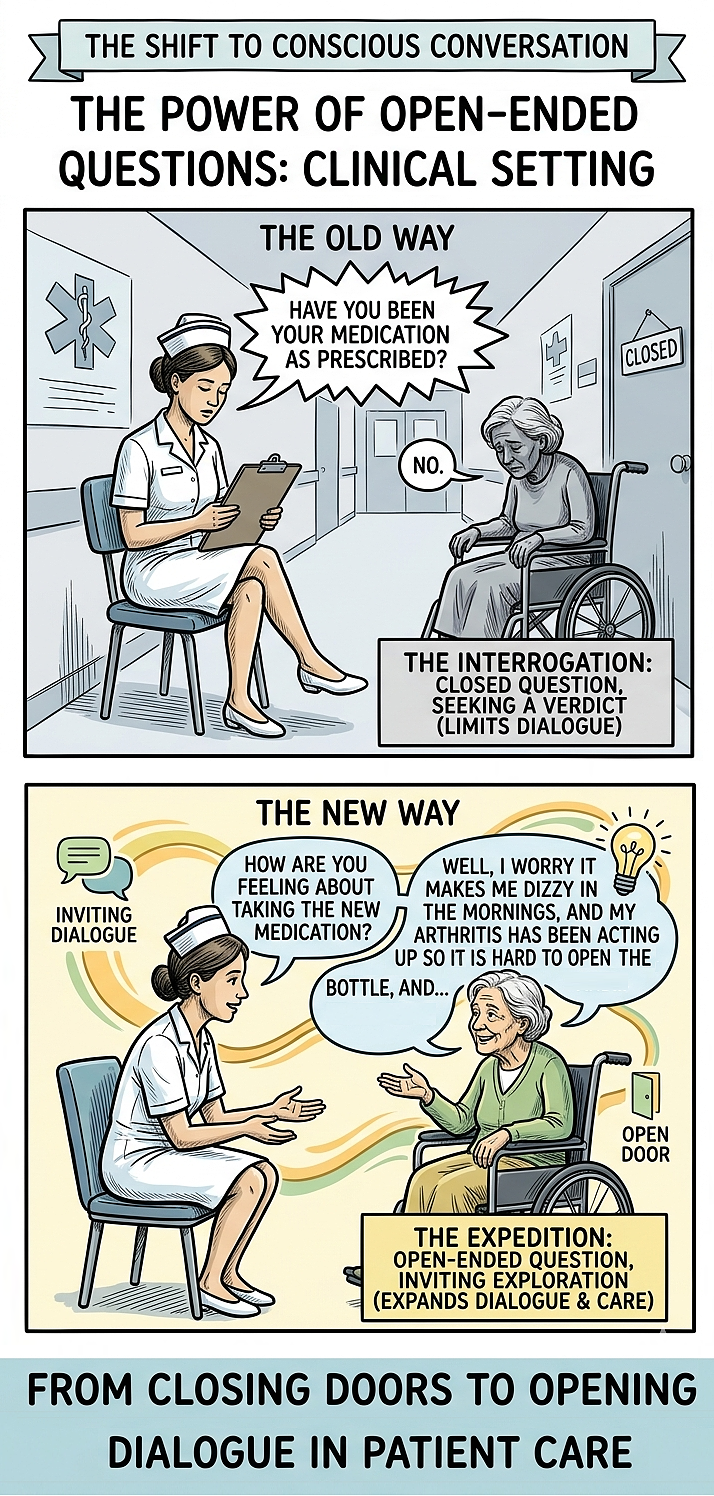
6.1 Summary
What opens up when you begin asking questions that genuinely invite people to think and feel out loud? More than you might expect — and the practice itself is within reach of anyone willing to try.
Open-ended, creative questions invite your conversation partners to share more of what they actually think, feel, and know — which gives you a far richer picture than any yes-or-no question can provide. This matters in quiet conversations and in crises alike: people who feel free to voice their real concerns, doubts, and insights give you access to information and cooperation that closed questions will never reach.
This chapter explores what creative questioning looks like when it is done well, why so simple a shift in how you ask makes so large a difference, and how ten families of questions — drawn from psychotherapy, negotiation, philosophy, narrative practice, and the arts — can become part of your own conversational repertoire. And the inquiry arrives somewhere personal: by the end, the chapter will invite you to pick one question and live with it for a week — because questions are not tools you memorize. They are companions you travel with.
6.2 A Capacity You Already Possess
You already know what a good question feels like — from the receiving end. Think of a time when someone asked you something that made you stop and think, really think, before answering. Not a quiz question and not an interrogation. Something more like: “What matters most to you about this?” or “How did that feel from where you were standing?” or even just “Tell me more.” Maybe it was a friend who asked the right question at the right moment and something you hadn’t been able to say suddenly came into words. Maybe it was a teacher who asked a question that changed the direction of your thinking for years. Maybe it was a quiet moment with someone you trusted, when a single open question unlocked something you didn’t know you needed to say.
If you can remember a moment like that, you already know the most important thing this chapter has to teach: the right question, asked with genuine curiosity, is one of the most powerful gifts one human being can offer another. And you have already, in your own rough way, been offering it — every time you asked “What do you think?” instead of “Don’t you agree?”, every time you responded to someone’s struggle with curiosity rather than advice, every time you let a question sit in the air long enough for the other person to find their own answer.
In Transformation One, we explored the “born to learn” idea: you were born with a magnificent capacity for language, but zero words in your vocabulary. The same is true for the art of questioning. You were born with a deep, natural curiosity — every small child is proof of that — and that curiosity has been developing, unevenly and without much guidance, your whole life. This chapter is about recognizing what you already partly do, giving it a name, and learning to do it more deliberately and more often.
Here is the question at the heart of everything that follows: What opens up when you begin asking questions that invite people to think and feel out loud — and how far does that shift in how you ask reach into every conversation you have? The shift itself is almost embarrassingly simple: replacing questions that demand a verdict with questions that open a door. But its effects — on your relationships, on your capacity to navigate conflict, and on your own inner life — turn out to reach far beyond what a simple change in wording would seem to promise. To see why, it helps to begin with a scene you will probably recognize.
6.3 What Opens Up When You Ask Differently
Consider two versions of the same question between two people deciding something together:
“Honey, do you want to go ahead and rent that apartment we saw yesterday?”
versus:
“Honey, how do you feel about us renting that apartment we saw yesterday?”
The first question suggests yes or no, leans toward yes, and does not invite discussion. The second opens a wide range of responses — including concerns you need to hear before you can make a good decision together. The content is identical. The shape of the question is entirely different. And that shape — open or closed — determines what your partner feels free to say.
Many good communicators already do this naturally. Listen for it and you will start noticing it everywhere: the doctor who asks “How has this been affecting your daily life?” instead of “Is it bothering you?”; the manager who asks “What would you need to make this project work?” instead of “Can you get it done by Friday?”; the parent who asks “What’s your plan for getting everything done tonight?” instead of “Don’t you think you should do your homework first?” In each case, the open question does something the closed one cannot: it invites the other person to think, to share what they actually know, and to become a genuine partner in the conversation rather than a witness being cross-examined.
Here are a few more translations, because seeing several at once makes the pattern easier to carry into your own life:
| Closed (Yes/No) | Open-Ended Alternative |
|---|---|
| “Do you like it?” | “How did that land for you?” |
| “Do you agree?” | “What do you think?” |
| “Do you really think that’s the right thing to do?” | “What were you hoping for?” |
| “Aren’t I right?” | “Help me understand your view.” |
| “Have you been taking your medication?” | “How’s the medication working for you these days?” |
| “Don’t you think you should do homework first?” | “What’s your plan for getting everything done tonight?” |
When you are under time pressure, it is tempting to push toward quick yes-or-no answers. But pressing forward without addressing people’s real concerns has played a key role in many on-the-job accidents and tragedies. People who couldn’t voice their reservations — or weren’t asked — have been present at some of the most costly mistakes in human history. (In Transformation Two, we explored one of the most vivid: the Air Florida flight that crashed because a captain’s closed, dismissive responses silenced a first officer who was trying to say something was wrong.) Open questions are not a luxury. In some settings, they are a matter of survival.

Open-ended questions open the door
to new possibilities and new problem resolutions
These translations may look almost too simple to qualify as a “skill.” But something this easy to demonstrate turns out to be remarkably powerful in practice. Which raises a natural question: if the skill of asking openly is this simple, and if most of us have already experienced it in rough form, what would happen if we went further — if we learned to ask not just openly, but creatively? That is where the deeper territory of this chapter begins.
6.4 The Courage to Be Curious
Open-ended questions are the first step. Creative questions are the next. And the difference between the two is a shift not just in wording but in posture — a movement from the need to be right toward the courage to be curious.
Consider:
| The Verdict Question | The Inviting Question |
|---|---|
| “Why are you always such a jerk?” | “How could we work together to solve this?” |
| “How could I have been so stupid?” | “What could I learn from this?” |
| “How am I going to nail that slob?” | “What would be best for me here?” |
| “How can I do this without anybody finding out?” | “If I do this, what kind of person will that make me?” |
Psychologists Carl Rogers and Abraham Maslow recognized this shift as one of the hallmarks of human growth: a movement from defending what you already believe toward genuinely wanting to find out what you don’t yet know. Carol Dweck’s research on the growth mindset shows the same pattern — people with a fixed mindset ask questions to confirm what they already believe; people with a growth mindset ask questions to discover what they haven’t yet seen. The questions on the left side of the table above are fixed-mindset questions. The ones on the right are growth-mindset questions. And the encouraging news is that the shift from left to right is not a matter of talent or temperament. It is a learnable practice.
Donald Schön, who studied creative professionals across many fields, described questions as something like a grappling hook thrown into the unknown — we throw the hook and pull ourselves toward the future. But we need to learn how and where to throw, so we pull ourselves toward a better future rather than a worse one. That is the art this chapter explores.
And there is something deeper still. The philosopher Sam Keen put it directly: your questions are the quest you’re on. No questions — no journey. Timid questions — timid trips. In many relationships and institutions, the freedom to ask certain questions is quietly restricted. We sense — from tone, from silence, from atmosphere — which questions are not welcome. Learning to ask creative questions is therefore not just a skill. It is an act of reclamation — a quiet returning to yourself of the curiosity you were born with.
If you’ve been working through this workbook, you may already sense why this capacity sits where it does. In Transformation Two, you learned to listen responsively — to give someone the experience of being genuinely heard. In Transformation Three, you learned to open conversations with an invitation rather than an eruption. In Transformations Four and Five, you learned to express your own experience more fully and to translate complaints into requests. Creative questioning is the natural next step: it is how you turn toward another person’s experience and say, in effect, I am genuinely curious about what you see, feel, and know. Listening is receiving. Questioning is reaching out. Together they form a single gesture of attention.
So the shift from closed questions to open ones is already valuable. But the shift from routine questions to creative ones opens a far wider territory — a territory we can map. What follows are ten families of questions, each drawn from a different tradition, each opening a different door. Think of them not as a list to memorize but as a toolkit you will carry — and choose from — for the rest of your life.
6.5 A Word Before You Begin
What follows are ten clusters of questions drawn from psychotherapy, negotiation, narrative practice, philosophy, and the arts. Each cluster serves a different purpose. Each opens a different door. And they are arranged in a sequence that builds: the first three are questions you ask yourself; the next two are questions you bring to difficult situations; the sixth asks about the person you are becoming; the seventh and eighth help you discover strengths you may have overlooked; and the last two deepen your connection with others. You can enter at any point, but walking through them in order lets each family prepare the ground for the next.
Don’t try to memorize them. Choose one. Live with it for a week. Write it on a card by your mirror or in the notes app on your phone. Let it accompany you through your days. At the end of the week, notice what you see that you might have missed. Then come back and choose another. Over a few months, you will have genuinely lived with most of these — not just read them.
6.6 Ten Families of Questions Worth Carrying
Family 1: Questions That Ground You in What You’re Actually Feeling
How does this feel to me? What am I experiencing right now?
These come from the Gestalt therapy tradition, and they shift your attention from analysis to lived experience. The next time you feel vaguely uneasy — before reaching for an explanation — try asking yourself: How does this actually feel in my body right now? You will be surprised how often the answer you get is more useful than any story you could have invented. This is where creative inquiry begins: with the honest acknowledgment of your own experience, the same self-awareness at the heart of Transformation Four’s Five I-Messages.
If you can learn to pause and ask this question of yourself, you are ready for a second one — the question you ask after the feeling has been noticed.
Family 2: Questions That Turn Stumbles into Stepping Stones
How could I have done that differently? What could I learn from this mistake or painful experience?
These questions replace self-blame with curiosity. The goal is not to let yourself off the hook — it is to extract the lesson without the shame. Every failure contains information. These questions help you get at it. They are the growth mindset in action: instead of “How could I have been so stupid?” (a verdict), you ask “What would I do differently next time?” (an inquiry). The first question closes the conversation with yourself. The second one opens it.
But what if the stumble is not a one-time event — what if it is a pattern, something that keeps happening? That calls for a different kind of question entirely.
Family 3: Questions That Interrupt the Helplessness Spiral
What kind of explanations do I give myself when bad things happen? How easy would it be for me to see this as temporary, specific to one area, and partly beyond my control?
Martin Seligman’s research on learned helplessness and explanatory style shows that over-generalizing — “this will always be this way, everywhere, and it’s all my fault” — is a key driver of depression and paralysis. These questions interrupt that spiral. They invite you to ask whether the catastrophic story you are telling yourself is the only story available. Often it is not. These questions are best practiced on yourself first, before trying them with others, because they require the kind of honest self-inquiry that only you can do.
The first three families are questions you direct inward — tools for your own clarity. The next two take that clarity outward, into situations where other people are involved and where the stakes may be high.
Family 4: Questions for When Conflict Is in the Room
What is the most important thing I want from this situation? What solutions might bring everyone more of what they want? What is my best alternative if we can’t agree? What kind of self-fulfilling prophecy do I want to set in motion here?
These are the heart of principled negotiation, drawn from the work of Fisher, Ury, and Patton. The last question is especially powerful: what you expect shapes your behavior, and your behavior shapes what you get. Hostile questions produce defensive answers. Curious questions invite thoughtful ones. This is directly related to what you learned in Transformation Five about the courage of making requests — the same vulnerability that turns a complaint into a request can turn a hostile interrogation into a genuine inquiry.
Conflict, though, is not the only arena where creative questions do their best work. Sometimes the most productive question is the one that leaves the literal and reaches for the imaginative.
Family 5: Questions That Unlock Creative Possibilities
What possibilities would open up if we looked at this situation as if it were a garden… a river… a jazz improvisation? What does this remind me of — and what does that suggest?
Donald Schön showed that metaphors unlock what literal description misses. When a group of engineers working on synthetic paintbrush bristles got stuck, they broke through by asking “What if the bristle were a kind of pump?” The analogy opened a design space that logical analysis had missed entirely. Try several metaphors for whatever you are facing. Notice which one opens the most doors. This is how architects, engineers, and artists think — and it is available to anyone willing to play. Creative questioning, at its best, is a form of disciplined play.
The first five families are questions about situations — about what you feel, what you can learn, what might resolve a conflict, what a metaphor might reveal. The sixth family shifts the lens to something larger: the person you are becoming through the questions you choose to ask.
Family 6: Questions About the Person You’re Becoming
If I do what I’m thinking about doing, what kind of person will that make me? What sort of person do I seem to be becoming? What sort of person do I want to become?
These may be the most quietly powerful questions in the entire set. They come from social constructionist theory: our sense of self is the ongoing story we tell to make sense of our actions. Every choice either supports or weakens the story we want to be living. These are the questions that transform practical decisions into questions about character — not through moralizing, but through genuine inquiry. Sit with them slowly. They don’t rush.
If these questions point you toward the person you are becoming, the next two families help you discover the person you already are — the strengths and successes you may have forgotten to notice.
Family 7: Questions That Recover Your Hidden Moments of Success
When did we get along well — when this problem wasn’t there? How did that work and what did it feel like? What were the turning points? Reviewing those moments, what kind of future might be possible?
These come from narrative therapy, which observes that our self-stories tend to leave out the moments that don’t fit our dominant — usually problem-saturated — narrative. We remember the fights and forget the repairs. We remember the failures and forget the times we got it right. These questions deliberately bring the “sparkling moments” back into view. When someone is stuck in a problem story, helping them find even one moment of success can shift the whole conversation. And that shift connects directly to the next family — the one that asks not just what went right, but how can we grow more of it?
Family 8: Questions That Grow What’s Already Working
What did you most appreciate about how this went? What has been working well, even in the midst of this difficulty? What strengths have you brought that you might not have fully recognized?
These come from David Cooperrider’s Appreciative Inquiry tradition, and they carry one of the most important insights in this entire workbook: what you consistently ask about tends to grow — for better or worse. A group that asks only “What’s broken?” gets more awareness of brokenness. A group that asks “What’s already working, and how do we do more of it?” gets more of whatever is already working. These questions are the natural bridge to Transformation Seven, on expressing appreciation. One sincere appreciative question can shift the emotional tone of an entire conversation, especially in a group that has been stuck in problem-focus.
The last two families bring the art of questioning into its most relational form — the questions you ask when you genuinely want to understand another person’s experience and help them find their way.
Family 9: Questions That Deepen Any Conversation
Would you be willing to tell me more about that? I’d love to understand your experience — how did this feel from where you were standing? What haven’t I asked you that you wish I would?
Carl Rogers found that feeling genuinely heard — not evaluated, not analyzed, but heard — was itself therapeutic. These are the open-ended questions from section 6.2 in their most relational form. The difference between an information-gathering question and an inviting question lives in tone and genuine curiosity, not wording alone. And the last one — “What haven’t I asked you that you wish I would?” — may be the most powerful question in any close relationship. It is an act of hospitality: a door you open that the other person did not know was there.
Family 10: Questions That Help Someone Find Their Foothold
Of everything you’re facing right now, what is the one thing that matters most? If you could only change one thing, what would it be? What do you most need from me right now — to listen, to help problem-solve, or something else?
These come from solution-focused therapy and crisis counseling. Sometimes the most compassionate move is not to open things up wider — it is to help someone find the one foothold they need when they are overwhelmed. The last question — asking explicitly what kind of support they want — is an act of care that most people have never experienced. And notice how naturally it connects back to Transformation Three: you are explaining the kind of conversation you are offering and inviting the other person’s consent to have it. The skills in this workbook are not isolated tools. They are a single repertoire, and they strengthen one another every time you practice any one of them.
6.7 Living with the Questions
Knowing about these ten families is one thing. Making them your own is another. Here are three approaches, each suited to a different pace of learning. You do not need to do all three. Choose the one that fits your life right now.
The Slow Read. Go through the ten families one at a time. Pause at each. Ask yourself: “Is there a situation in my life right now where this might be useful?” Jot it down. Don’t answer the question — just notice what it opens. This approach is for people who like to let ideas settle before they act on them.
The Weekly Practice. Pick one question. Just one. Write it on a card or in your notes app. Carry it with you for a week. At the end of the week, write down one or two things you noticed that you might not have seen without it. Next week, pick another. Over a few months, you will have genuinely lived with most of these — not just read them. This is the approach I most recommend, because questions are companions, not tools. They do their deepest work when you live with them long enough for them to surprise you.
The Practice Pair. If you are working with a partner or small group (see Transformation Nine), each person picks one question that speaks to something real in their life. In turns, share: which question, why it resonates, what it illuminates. Others listen without advice, then reflect back what they heard. You will find that other people’s questions often illuminate your own life in unexpected ways — and that the act of listening to someone else explore a question deepens your own capacity for inquiry.
6.8 The Spiral: How Creative Questions Reach into Everything
By now you may have noticed how many threads from earlier chapters weave through these ten families of questions. That is not a coincidence. Creative questioning is not an isolated skill — it is the connective tissue of the entire repertoire you are building. Before we close, let’s see those connections clearly, because seeing them is what helps a new practice take root.
The listening connection (Transformation Two). A creative question is an invitation to speak. But the question is only half the gift; the other half is what you do with the answer. Every open question you ask creates a moment that calls for the responsive listening of Transformation Two — the kind of listening where you reflect back what you heard so the other person knows they have been received. Questioning and listening are not two separate skills. They are two halves of a single gesture of attention.
The conversational intent connection (Transformation Three). The very act of asking a question is a way of framing a conversation — of telling your partner what kind of exchange you are inviting. “What do you think?” sets a very different stage than “Don’t you agree?” When you choose your questions consciously, you are practicing the meta-communication of Transformation Three: explaining, through the shape of your question, what kind of conversation you are hoping to have.
The self-expression connection (Transformation Four). Many of the ten families — especially Families 1, 2, 3, and 6 — are questions you ask yourself, and they serve the same purpose as the Five I-Messages: they help you identify what you are actually feeling, what needs and interpretations are driving those feelings, and what you want to do about them. Creative self-questioning is the inward face of the self-expression you practiced in Transformation Four.
The request connection (Transformation Five). Family 4 and Family 10 are, in essence, the requesting skills of Transformation Five in question form. Instead of making a request outright, you ask the other person what would help, what they need, what solution might work for both of you. The request becomes an inquiry — and the inquiry often produces a better request than you could have formulated on your own.
The appreciation connection (Transformation Seven). Family 8 — the appreciative questions drawn from Cooperrider’s work — is the natural on-ramp to Transformation Seven on expressing gratitude and appreciation. When you ask “What’s already working?” you are practicing the appreciative stance that the next chapter will develop into a full practice.
The “already a trainer” connection (Transformation One). Every time you model open, creative questioning, you teach everyone present that conversations can be curious rather than adversarial, exploratory rather than defensive. Your children learn that questions can be invitations. Your coworkers see that curiosity is strength, not weakness. You are already a communication skills trainer. The question is whether you will train people in interrogation or in inquiry.
The peer learning connection (Transformation Nine). The ten families of questions are superb material for Purpose Partners and Circles of Six. Sharing which question spoke to you, what you noticed during your week of living with it, and what surprised you — this kind of reflective practice deepens the learning enormously. And it reminds you that you are not doing this alone. You don’t have to be. That is the promise of Transformation Nine on creating mutual support circles.
Seen all at once, this is the spiral: a single shift in how you ask — from verdict to invitation, from closed to open, from routine to creative — that draws on the listening of Transformation Two, the invitations of Transformation Three, the self-awareness of Transformation Four, the courage of Transformation Five, and the appreciation of Transformation Seven — and that quietly strengthens them all in return. Practice it, and you are not only asking better questions. You are becoming the kind of person whose curiosity makes the world a little larger for everyone around you.
One last thought before the exercises. Reading this chapter has been a kind of in-breath — taking in a new way of seeing what questions can do when they are asked with genuine curiosity. But no one ever learned all they need to know about questioning more creatively just by reading; the understanding comes fully alive only on the out-breath, in real conversations where you actually try the open, inviting questions described here. Breathe in the idea; breathe out the practice. That gentle rhythm will return in every chapter of this book. So think of the exercises that follow not as an appendix to the chapter but as its natural exhale — the moment where reading quietly becomes doing.
6.9 Radical Questions for Critical Times
A contribution from philosopher Sam Keen
By Sam Keen (1931–2025) — Our thanks goes to Sam Keen for permission to include this.
This chapter began with questions that open up conversations. It closes with questions that open up a life. The philosopher Sam Keen spent decades exploring what happens when a person dares to ask the questions that most of us leave unasked. His reflection that follows is not a technique. It is a capstone — a reminder that the art of questioning reaches far beyond communication skills, into the deepest territory of what it means to be a human being who is still growing. Here is Sam Keen’s vision of questions and questioning:
Your questions are the quest you’re on. No questions — no journey. Timid questions — timid trips. Radical questions — an expedition to the root of your being.
Cross-Examining the Self: What is happening to me? What comes next? What do I really desire? What have I not brought forth that is within me? What does my dream-self know that “I” don’t?
Questions for I and Thou: Whom do I love? By whom am I loved? How intimate are we? What clandestine emotions keep us from being authentic with each other? When is it time to say goodbye?
Probing the Commonwealth: Who is my neighbor? For whom, beyond my family, do I care? Can I be just, loving, merciful — and still be loyal to my profession, my country? If we measured success by Gross National Happiness, how would everything change?
Keen’s questions remind us that creative inquiry is not only a conversational tool. It is a way of being in the world — a stance toward life that keeps possibility alive. The questions you choose to carry are, in a very real sense, the life you choose to live.
6.10 Transformation Six Exercises
Exercise 6A: Translating Your Own Questions
Goal: To practice the fundamental shift from closed to open-ended questions in your own life.
Find three yes-or-no questions that you have recently asked someone — or wanted to ask. Write each one down. Then, next to it, write an open-ended alternative using the translations in section 6.2 as models. For each pair, ask yourself: what information might the open-ended version reveal that the yes-or-no version would miss? What problems does the yes-or-no version create that the open version avoids?
Exercise 6B: The Weekly Question Companion
Goal: To experience what it is like to live with a question rather than just read about one.
Choose one question from any of the ten families — whichever one speaks to something real in your life right now. Write it on a card, tape it to your bathroom mirror, or put it in your notes app. Carry it with you for a full week. At the end of the week, in your learning journal, write down: Which question did you choose? Why? What did you notice during the week that you might not have noticed without it? What surprised you?
Exercise 6C: The Appreciation Question Experiment
Goal: To test the power of appreciative questions in a real conversation.
In one conversation this week — with a partner, a friend, a coworker, or a family member — ask one question from Family 8: “What did you most appreciate about how this went?” or “What has been working well, even in the midst of this difficulty?” Notice what happens to the emotional tone of the conversation. In your learning journal, write down what you asked, what the other person said, and how the conversation shifted.
Exercise 6D: The “What Haven’t I Asked?” Experiment
Goal: To practice the most relational question in the toolkit.
In a conversation with someone you care about, find a natural moment to ask: “What haven’t I asked you that you wish I would?” Then listen — really listen, in the responsive way described in Transformation Two. In your learning journal, write down what happened. Was the question hard to ask? What did you learn?
Exercise 6E: Sharing Questions with a Practice Partner
Goal: To deepen your practice through reflection with another person.
If you are working with a practice partner or a Circle of Six (see Transformation Nine), each person picks one question from the ten families that speaks to something real in their life. In turns, share: which question you chose, why it resonated, and what it illuminated. Others listen without advice, then reflect back what they heard. Compare notes on which families of questions felt most natural and which felt most challenging. What does that tell you about the kind of questioner you are — and the kind you might become?
6.11 Suggested Additional Readings on Creative Questioning
Adams, Marilee G. Change Your Questions, Change Your Life: 12 Powerful Tools for Leadership, Coaching, and Results. 4th ed., Berrett-Koehler, 2022. Written as a fable, this book outlines the “Question Thinking” model with twelve questions for personal and professional change.
Finlayson, Andrew. Questions That Work: A Resource for Facilitators. OD Practitioner Press, 2001. A “questioning manifesto” for professional life — practical, sharp, and immediately usable.
Grace, Sean. The Art of the Question: A Guide to Short-Term Question-Centered Therapy. Routledge, 2015. A comprehensive exploration of how effective inquiry leads to better decisions and deeper relationships.
Leeds, Dorothy. The 7 Powers of Questions: Secrets to Successful Communication in Life and at Work. Perigee, 2000. Seven ways questions improve relationships, uncover opportunities, and get more from every encounter.
Rivers, Dennis. Twelve Thought Questions for Deeper Reading: A Guide for Independent Study. OneEarth.University Creative Commons Publications, 2025. A learning toolkit for independent students and study groups. Available as free PDF at:
https://oneearth.university/twelve-thought-questions/
6.12 References and Recommended Reading for this Chapter
Please note: Because the chapters of this Workbook are often distributed
as separate study documents, we reference a given book or article in every
chapter where a reference may be needed.
Adams, Marilee G. Change Your Questions, Change Your Life. 4th ed., Berrett-Koehler, 2022.
Cooperrider, David L., and Diana Whitney. Appreciative Inquiry: A Positive Revolution in Change. Berrett-Koehler Publishers, 2005.
Dweck, Carol. Mindset: The New Psychology of Success. Random House, 2006.
Fisher, Roger, William Ury, and Bruce Patton. Getting to Yes: Negotiating Agreement Without Giving In. 2nd ed., Penguin Books, 1991.
Keen, Sam. Hymns to an Unknown God: Awakening the Spirit in Everyday Life. Bantam, 1994.
Maslow, Abraham. Toward a Psychology of Being. 2nd ed., Van Nostrand, 1968.
Rogers, Carl R. On Becoming a Person: A Therapist’s View of Psychotherapy. Houghton Mifflin, 1961.
Rosenberg, Marshall B. Nonviolent Communication: A Language of Life. 3rd ed., PuddleDancer Press, 2015.
Schön, Donald A. The Reflective Practitioner: How Professionals Think in Action. Basic Books, 1983.
Seligman, Martin E. P. Learned Optimism: How to Change Your Mind and Your Life. Vintage, 2006.
White, Michael, and David Epston. Narrative Means to Therapeutic Ends. Norton, 1990.
Your notes on this chapter
“Radiating the Four Heart Beams”

- From noticing only what’s broken to seeing what is wonderfully together
- From the necessary attention to problems to the transformative attention to gifts
- From taking the air, the water, the sunlight for granted to receiving them with wonder and delight
- From the silent expectation that people should perform their jobs well
to the voiced recognition when they do - From gratitude as a private feeling to appreciation as a communal act of witness
- From the fear that joy will be taken away to the courage of letting yourself feel it
- From encouragement as cheerleading to encouragement as seeing someone’s becoming
- From “you’re great” to “when you did that, here’s how it met my needs”
- From the exhaustion of a life defined by what’s wrong
to the replenishment of a life that also sees what’s right - From isolated self-improvement
to the shared practice of noticing grace — together
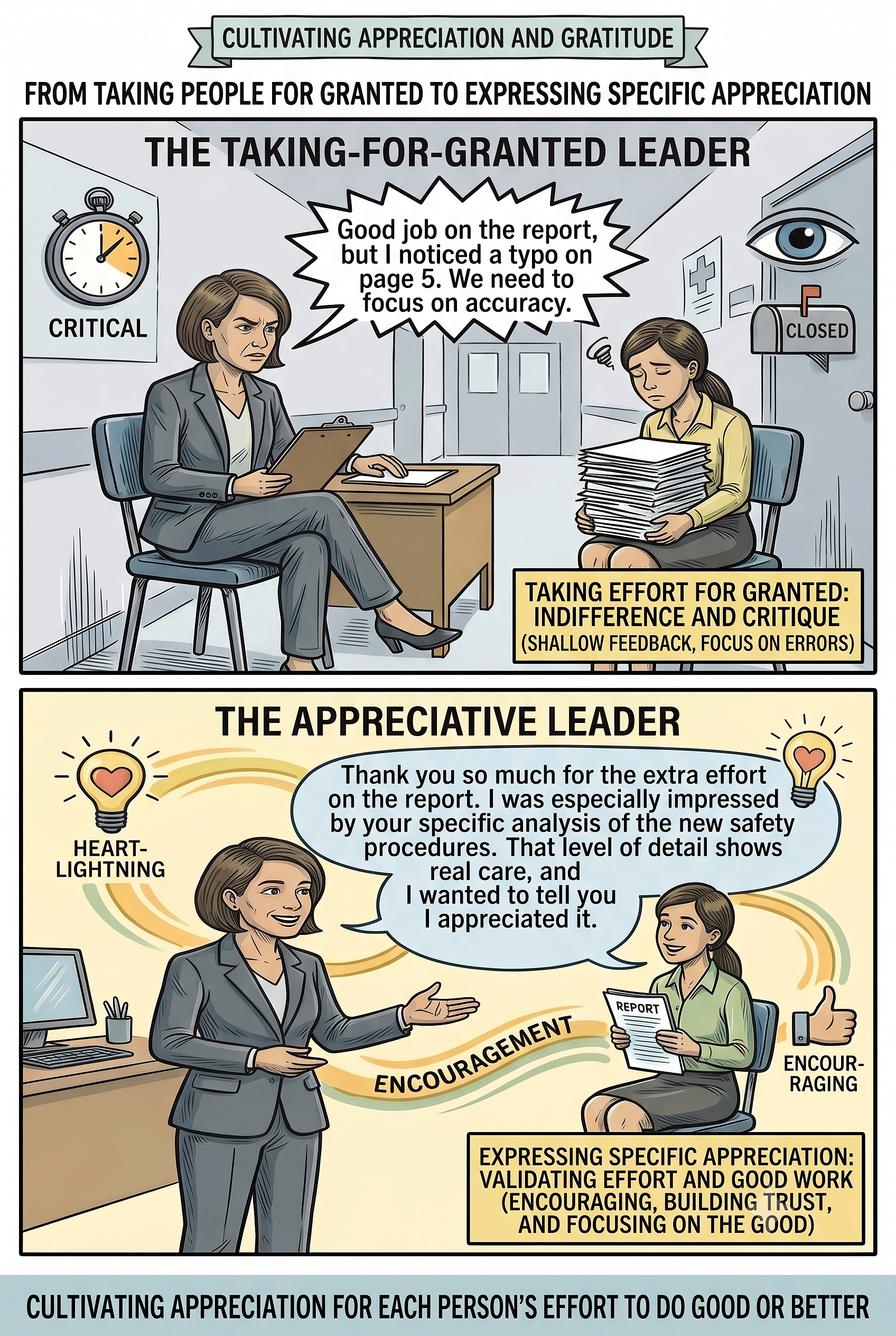
7.1 Summary
In order to build more satisfying relationships with the people around you, and to live a richer life yourself, develop the practice of expressing more of what I call the four heart beams: gratitude, appreciation, encouragement, and delight.
Because life continually requires us to attend to problems and breakdowns, it is very easy to see in life only what is broken and needs fixing. But satisfying relationships — and a happy life — require us to notice and respond to what is delightful, excellent, kind, skillful, and generous: to work well done, to food well cooked, to kindness extended to strangers, to beauty encountered along the way.

Hand Over Heart — Universal Gesture of Gratitude
Public Domain Image — AI + Dennis Rivers
This chapter explores both the deep reasons why appreciation and gratitude matter so profoundly (Part One) and the practical skills for expressing them in ways that strengthen your relationships and nourish your own heart (Part Two). At the heart of this exploration is a question worth sitting with: What opens up when you begin saying out loud what you see that is good — and how far does that one practice of noticing grace reach into your relationships, your character, and even your experience of being alive?
It is appreciation and gratitude that make a relationship strong enough to accommodate differences and bounce back from disagreements. And it is the practice of noticing grace — in all its forms — that keeps us from being swallowed up by the necessarily narrow focus of problem-solving.
PART ONE: EXPLORING THE ATTITUDE OF THE GRATEFUL HEART
Sections 7.2 through 7.9
7.2 A Capacity You Already Possess
You already know what gratitude feels like — from the inside. Think of a time when someone did something that genuinely moved you, and you said so. Maybe your neighbor brought soup when you were sick, and you told her how much it meant — not just “thanks,” but really told her. Maybe a coworker stayed late to help you finish something, and you paused the next morning to say, “I want you to know how much that mattered to me.” Maybe it was something quieter: a moment when you watched the sun come through the window and felt, without needing to explain it, that life was giving you something you hadn’t earned and didn’t want to take for granted.
If you can remember a moment like that — a moment when you noticed something good and let yourself feel it fully enough to say so — you already know the most important thing this chapter has to teach. That practice of noticing and naming what is good is one of the most powerful things a human being can do — for the people around you, for your relationships, and, as you’ll see, for your own heart. And you have already, in your own rough way, been doing it: every time you thanked someone and meant it, every time you told a friend what you admired about them, every time you let yourself be moved by beauty instead of rushing past it.
In Transformation One, we explored the “born to learn” idea: you were born with a magnificent capacity for language, but zero words in your vocabulary. The same is true for the practice of appreciation. You were born with the capacity for gratitude, delight, and generous recognition — and that capacity has been developing, unevenly and without much guidance, your whole life. This chapter is about recognizing what you already partly do, giving it names and structure, and learning to do it more deliberately and more often — because as you’ll discover, this is probably the most powerful and rewarding of all the transformations in this workbook.
The practice itself is surprisingly straightforward: noticing what is working, feeling it, and telling someone. But its effects — on your closest relationships, on your workplace, on your children, and on your own inner life — turn out to be among the most dramatic findings in the social sciences. To see why, it helps to begin with a curious feature of human attention that makes this practice both necessary and difficult.
7.3 The Attention That Almost Misses the Gifts
Think about the last time you walked into your home. Did you notice the roof keeping rain off your head? The floor holding you up? The light switch that worked when you flipped it? Almost certainly not. And that’s not because you’re ungrateful. It’s because human consciousness is built to notice what’s broken, what’s threatening, what needs fixing. The things that are working — the air in your lungs right now, the friend who has been faithful for twenty years, the colleague who quietly does excellent work — become invisible precisely because they are functioning.
The philosopher Martin Heidegger thought about this at length. He observed that our tools and our world disappear from our awareness when they are working smoothly. We notice the hammer only when it breaks. We notice our health only when we lose it. We notice a relationship only when it’s in crisis. This isn’t a character flaw. It’s a structural feature of how attention works. It served our ancestors well — the early human who noticed the rustling in the grass survived; the one who was busy admiring the sunset did not.
But here’s the cost. If our attention is perpetually drawn toward breakdown, we are at risk of becoming profoundly out of touch with what you might call the thousand forms of grace that support everyday life — the air, the water, the sunlight, the accumulated gifts of human culture, the daily kindnesses of people around us. None of this is of our own doing. All of it sustains us. And our built-in bias toward breakdown means that, without deliberate practice, we may sleepwalk through the very gifts that make our lives possible.
That is why gratitude and appreciation are not luxuries. They are correctives to a profound structural bias in human attention — a bias that, left unchecked, can leave us feeling impoverished in the midst of abundance, lonely in the midst of love, and exhausted by a world that seems to offer nothing but problems. And correcting that bias is one of the most demanding practices in this workbook — not because the skill is difficult (as you’ll see in Part Two, it is surprisingly straightforward), but because you are asking your consciousness to do something it was not designed to do automatically: to turn toward what is working, what is beautiful, what is kind, and to linger there long enough to feel it and say so.
The encouraging news is that you already have the raw materials. You already notice good things sometimes — a beautiful morning, a kindness received, a moment of real connection. What this chapter offers is a way to do that noticing more often, more deliberately, and more expressively — so that the people in your life actually feel the warmth you carry but may not yet have learned to put into words.
If this bias is truly structural — wired into the very architecture of human attention — then a natural question arises: Does correcting it actually make a measurable difference? Or is this just a beautiful philosophical observation with no practical consequence? The answer, as it turns out, is among the most dramatic findings in the social sciences.
7.4 The Research: What Happens When Appreciation Is Present — and When It Isn’t
Couples. Researcher John Gottman and others have found that the determining factor in the long-term success of love relationships is the ratio of appreciations to criticisms. The magic ratio appears to be approximately five expressions of appreciation for every one expression of criticism or displeasure. Couples who fell below this ratio were significantly more likely to divorce. Couples who maintained it were significantly more likely to stay together — and to be happy together.
This means that the emotional atmosphere of a relationship is determined not primarily by how well you handle conflict (though that matters) but by how much positive recognition flows between two people on an ordinary day. The five-to-one ratio is not about grand romantic gestures. It’s about the small, daily acts of noticing and naming what your partner does well, what you enjoy about them, what you’re grateful for — counteracting the breakdown bias, one small expression at a time.
Bringing up children. The child development research of Betty Hart and Todd Risley produced a strikingly parallel conclusion regarding parent-child interaction. They found that children who are the most curious, creative, self-starting, and enthusiastic about learning come from homes where approvals and expressions of interest in what the child is doing exceed prohibitions and corrections by a ratio of about three to one. (The emphasis here is on expressions of interest as much as overt approval — simply paying positive attention to what a child is doing communicates volumes.)
The most important implication of their research is that appreciation nurtures. Just as plants need sunshine in order to grow, people need positive recognition. Appreciation is the sunshine of both human interaction and human development.
Creating successful organizations. In his book Bringing Out the Best in People, management consultant Aubrey Daniels argues that recognition and appreciation are the most powerful motivators available — more powerful than money, status, or fear. And yet most organizations operate on the assumption that people should simply do their jobs without being thanked, creating a chronic appreciation deficit that drains morale and drives away the very people every organization most needs to keep.
The evidence, then, is not ambiguous. Across marriages, families, workplaces, and spiritual traditions, the same finding appears: when positive recognition is present in sufficient measure, human beings flourish. When it is absent, they wither — slowly, invisibly, and often without understanding why.
And yet. If the evidence is this clear — if the five-to-one ratio is as robust as Gottman found it to be — then why aren’t we all swimming in gratitude? The breakdown bias described in the previous section explains why we fail to notice what is good. But surely something more than forgetfulness is at work. There is another obstacle, deeper and more personal, that explains why we sometimes refuse to feel gratitude — even when we notice it perfectly well.
7.5 The Vulnerability of Joy
The researcher Brené Brown, in her book The Gifts of Imperfection, describes a phenomenon she calls foreboding joy — the experience of feeling a rush of happiness and then immediately bracing for disaster. You watch your child sleeping peacefully and your mind floods with images of everything that could go wrong. You receive good news and think, “This can’t last.” You feel a swell of love for your partner and your next thought is about loss.
Brown’s research reveals that many of us unconsciously believe that if we let ourselves feel too much joy, we are making ourselves vulnerable to a greater fall. We rehearse disaster as a way of protecting ourselves — and in doing so, we numb ourselves to the very experiences that would nourish us most.
This has profound implications for the practice of gratitude. To feel genuinely grateful — not just to say the words, but to let the feeling land — is to acknowledge that something good has happened and that it could be taken away. Every expression of gratitude is, at some level, an act of courage: the courage to say “this matters to me” in a world where what matters to us can be lost.
Brown found that the antidote to foreboding joy is not steeling yourself against loss. It is the practice of gratitude itself. The people in her research who were most resilient in the face of difficulty were not the ones who had learned to suppress their joy. They were the ones who had learned to pause in moments of happiness and deliberately feel thankful. The practice of gratitude, it turns out, doesn’t make you more vulnerable. It makes you more able to bear what comes.
If you recognize yourself in this description — if you find it difficult to let yourself simply enjoy a good moment without immediately worrying about what might follow — know that you are not alone, and that the practice of gratitude described in this chapter is, among other things, a gentle way of learning to let joy in without running from it.
So the breakdown bias pulls our attention toward what is wrong, and our emotional armor defends us against feeling what is right. But is there something even deeper at work? Is there a layer beneath both attention and emotion — a layer where the very stories we tell about our lives keep the barriers to gratitude firmly in place?
7.6 Stories, Suffering, and the Themes We Live By
When bad things happen — and they will — we are often left feeling bewildered. A marriage falls apart. A job disappears. Someone we trusted betrays us. The sheer chaos of painful experience can feel unbearable, and so we do what human beings have always done: we reach for an explanation. We try to make sense of the pain by telling ourselves a story about what it means and why it happened.
The psychologist Martin Seligman spent decades studying exactly this process, and what he discovered can change a life. Seligman found that when something goes wrong, we tend to answer three questions about it, usually without realizing we are doing so: Is this permanent? (“Things will never get better.”) Is this pervasive? (“This ruins everything.“) And is this personal? (“Something is fundamentally wrong with me.“) People who habitually explain bad events as permanent, pervasive, and personal tend to fall into what Seligman called learned helplessness — a state in which a person stops trying, not because they are lazy or weak, but because their own explanation of events has convinced them that trying won’t help.
If you recognize yourself in that description, please be gentle with yourself. Learned helplessness is not a character flaw. It is a deeply human response to pain. The stories we told ourselves in difficult times were the best sense we could make with what we had. They were survival strategies, and they deserve our recognition for getting us through.
But Seligman also discovered something full of hope. He found that explanatory style is not fixed. It can be gently, patiently shifted — not by pretending that bad things didn’t happen, but by questioning the scope of our conclusions. He called this process learned optimism, and it does not mean putting on a happy face. It means learning to ask ourselves better questions — the same creative questioning you explored in Transformation Six. When we catch ourselves thinking, “Nothing ever works out for me,” we can pause and ask: Is that really true? Or have some things worked out, and one important thing has just gone very badly? With great inner kindness, we can begin to recognize the themes that have helped us make sense of life up to now — they were the best we could do at that moment. But this is a new moment.
We have now looked at three layers of what makes gratitude difficult. The first is structural: human attention is wired for breakdown. The second is emotional: even when we notice something good, we may armor ourselves against the vulnerability of enjoying it. The third is narrative: the stories we have built to survive our pain may have become so all-encompassing that they filter out the evidence of grace. None of these obstacles is a character flaw. Each was, in its season, a strategy for getting through. But here is the good news: if the obstacles to gratitude are learned — learned attention patterns, learned emotional defenses, learned narrative themes — then they can also be gently unlearned and replaced. The experience of pain shrinks our field of attention; the practice of gratitude expands it. Not by force, not by pretending that suffering isn’t real, but by the simplest possible practice: beginning to say yes.
7.7 Receiving Each Day as a Gift
Brother David Steindl-Rast’s invitation, in his book Gratefulness, the Heart of Prayer, to “receive each day as a gift” is not a demand that we ignore suffering. It is a practice of attention — a deliberate widening of the lens to include what the breakdown bias would otherwise hide. Steindl-Rast suggests that all spiritual virtues radiate from one central experience: gratefulness. What if the deepest spiritual practice is simply to pay attention to what we have been given? One possible first step is to think of any days in your life that have felt like gifts or blessings, and to write about them in your learning journal — the way many native tribes carry in a little pot some burning embers from their last campfire, to help them start their next campfire in a new place.
Saying thank you as a way of saying yes to life. Another step in cultivating a grateful heart is to look for small ways to say thank you to total strangers — the server who pours your water, the person who holds the door. These are tiny acts, but they are not trivial. Each one is a small “yes” to the web of cooperation that makes daily life possible. For many of us, our long engagement with the problems of the world has required us to say “no” a great deal. The world’s problems need our “no.” But our hearts need our “yes” in order to stay engaged with life.
Expressing gratitude in the middle of a difficult life. Learning to notice what is good, beautiful, and kind — even in the midst of difficulty — is not a betrayal of one’s struggle. It is a refusal to let the struggle consume everything. A dear friend of mine, bedridden for years with a debilitating disease, learned to find sustaining comfort in the stars that shine through her windows at night, and in the garden outside her window. She did not pretend that her illness was a gift. But she refused to let it blind her to the gifts that remained. As the wise and kind author Judith Viorst observed in her book, Necessary Losses, the difficulties of our lives challenge us to become deeper people. This is not an easy attitude to adopt, and in my view it should never be imposed on anyone from outside. But for those who find their way to it, it can be profoundly liberating.
These first steps — saying thank you to a stranger, writing down a blessing, letting a good moment simply be good without bracing for disaster — are the beginning of a practice. But as you try them, you may notice something: the word “gratitude” starts to feel too small. Thanking the server who pours your water feels different from the catch in your throat when you watch a stranger help someone in need, which feels different again from the fierce hope you feel when you see someone learning to do something difficult. Are these all “gratitude”? Or are they distinct experiences — each with its own gift to give?
7.8 The Four Heart Beams: A Taxonomy of Noticing
I have spent many years using the phrase “gratitude, appreciation, encouragement, and delight,” knowing that they overlapped a lot. But it took a while for me to see that they were both connected and different — four distinct experiences and practices, each with its own inner posture and its own gift to offer. Understanding the differences can help you develop all four, rather than relying primarily on whichever one comes most naturally.
Gratitude is the warm recognition that someone has met a need of yours — and the impulse to let them know you felt it. Your neighbor brought soup when you were sick. Your partner listened when you needed to talk. Your colleague covered for you during a difficult week. Gratitude flows along the channel of your own experience: I received something good, and I want you to know. It is personal, specific, and relational. It strengthens the bond between giver and receiver.
Appreciation is something larger. I feel gratitude toward someone who meets my particular need. But I feel appreciation toward someone who meets the needs of others — not necessarily mine at all. When I watch a stranger help an elderly person across a busy street, no need of mine has been met. When I learn about someone who spent years restoring a damaged wetland, I wasn’t personally affected by the damage or the restoration. And yet something in me responds — something that wants to say so.
That impulse to say so is worth examining. On whose behalf am I speaking? On behalf of the human community. On behalf of the web of life. Appreciation, understood this way, is an act of witness. It says: “I saw what you did. It mattered. Not just to me — to us.” And when you express appreciation publicly, you are inviting everyone within earshot to notice. You are expanding the community’s capacity to see grace.
Delight is the spontaneous overflow of joy in the presence of something beautiful, excellent, or alive. It is less about meeting needs and more about being moved. The first crocus of spring. A child’s unselfconscious laughter. A piece of music that makes you catch your breath. Delight asks nothing and explains nothing. It simply says: I am moved, and I want to share this aliveness with you. Delight is perhaps the most purely generous of the four heart beams, because it flows outward from joy itself, asking nothing in return.
Encouragement is forward-looking. Where gratitude and appreciation respond to what has already been done, and delight responds to what is, encouragement responds to what is becoming. It says: “I see you struggling toward something good, and I want to strengthen your resolve.” Encouragement is not cheerleading — not the empty “You can do it!” that costs the speaker nothing. Real encouragement requires that you actually see the person: where they are, what they’re reaching for, and what it’s costing them. It says: “I see the effort. I see the direction. I believe in what you’re becoming.”
Each of these four heart beams is a different corrective to the breakdown bias described in section 7.2. Gratitude corrects the tendency to take personal gifts for granted. Appreciation corrects the cultural blindness to acts of goodness that don’t involve us directly. Delight corrects the habit of rushing past beauty on the way to the next problem. And encouragement corrects the isolation of someone who is trying to grow but can’t yet see their own progress.
Together, they form a practice of attention that can gradually, gently shift the balance of your inner life from one dominated by what’s wrong to one that also — regularly, deliberately, joyfully — notices what’s right. But how wide can this practice reach?
7.9 Gratitude as Reciprocity: The Ecological Vision
Up to this point, we have been exploring gratitude primarily in the space between human beings. But there is a tradition — much older than psychology — that understands gratitude on a far wider scale. In her luminous book Braiding Sweetgrass, botanist and Potawatomi tribal member Robin Wall Kimmerer describes gratitude not as a personal emotion but as a practice of reciprocity — a way of staying in right relationship with the living world that sustains us. Kimmerer’s central insight is that we are recipients before we are agents. We didn’t make the air. We didn’t make the water. We didn’t weave the web of photosynthesis that turns sunlight into the food on our tables. When we extend our practice of noticing beyond the human world — to the rain that fills our reservoirs, the bees that pollinate our food, the trees that clean our air — we begin to inhabit a universe that is not merely a collection of resources to be managed, but a web of gifts to be received with care and reciprocated with attention.
All of Part One has been about why — why gratitude matters, what blocks it, and how wide its reach can be. Now we turn to how. What words, what structure, what practice makes an expression of gratitude land — not as flattery, not as vague warmth, but as genuine recognition that the other person feels in their bones?
PART TWO: THE HOW OF APPRECIATION AND GRATITUDE
The Practice of Expressing What You See and How You Feel About It
7.10 The Inner Structure of Appreciation: Three-Part Messages
To express gratitude in a meaningful way, a person needs to actually feel grateful — and that is what Part One of this chapter has been about: the opening. Now we turn to the practical craft of saying what you see, and here, the work we did in Transformation Four on the Five I-Messages gives us a powerful framework.
In Transformation Four, we explored the Five I-Messages as a way of understanding what we need to tell people in order for them to understand us better. Those same five messages can be used to give focused and meaningful expressions of appreciation. However, I have found that most expressions of appreciation do not need Messages Four and Five (the request and the envisioned positive outcome). Most expressions of appreciation need only the first three messages — and these three are enough to make an expression of gratitude feel complete, personal, and deeply received. I call these Three-Part Appreciations.
Here is the structure:
| Part | What You Express |
|---|---|
| Part One: Action | What the other person did — the specific action you are responding to. (Parallel to Message One of the Five I-Messages.) |
| Part Two: Feeling | How that action helped you feel — the emotion it evoked in you. (Parallel to Message Two.) |
| Part Three: Need Met | What need or value of yours was fulfilled by that action. (Parallel to Message Three.) |
Here are some examples of Three-Part Appreciations in action:
| Action (What you did) | Feeling (How I felt) | Need Met (Because I…) |
|---|---|---|
| “When you stayed late to help me finish the report…” | “…I felt so relieved and supported…” | “…because I really needed to know I wasn’t alone with that deadline.” |
| “When you asked me how my doctor’s appointment went…” | “…I felt really touched…” | “…because it meant you were thinking about me even when I wasn’t in front of you.” |
| “When you stood up for that new employee in the meeting…” | “…I felt proud to work with you…” | “…because I care about fairness and it’s not always easy to speak up.” |
| “When you cooked dinner on a night you knew I was exhausted…” | “…I felt so cared for…” | “…because I needed to feel like someone was looking out for me.” |
Notice that the third example is an expression of appreciation rather than gratitude — the speaker wasn’t the one being helped. The speaker is saying thank you on behalf of a value they hold (fairness) and on behalf of the new employee who may not have been in a position to say it themselves. This is the communal witness function of appreciation in action.
The Three-Part Appreciation gives you a practical structure for the wide emotional territory we explored in Part One. But does the form of the message really matter? After all, isn’t “You’re wonderful!” a perfectly good expression of gratitude? To understand why it isn’t — and why the Three-Part Appreciation is so much more powerful — we need to look at the difference between sharing your experience and passing judgment.

A Thousand Faces of Gratitude — Public Domain Image
7.11 “I-Statement” Appreciations versus Positive Judgments
One very important aspect of Three-Part Appreciations is that the appreciator is sharing the details of her or his experience of another person’s action. These are quite different from statements like “You are so wonderful!” or “You’re the best!” or “That was great!” Even though these are positive judgments, they have several hidden limitations.
First, even positive judgments put the recipient in the position of being judged and the praise-giver in the position of judge — today’s positive judge can easily become tomorrow’s negative one. The Three-Part Appreciation avoids this dynamic entirely, because you are describing your own experience rather than evaluating the other person.
Second, notice how in “You are so wonderful”-type statements the person doing the appreciating has disappeared. There is no “I feel” to anchor them. They could be coming from anyone. The Three-Part Appreciation, by contrast, is unmistakably personal: it requires you to show up, to name what you felt and why.
Third, “You are wonderful”-type statements are vague. The person being appreciated has to figure out what they did that was so wonderful. The Three-Part Appreciation does that work for them: it points to the specific action, names the specific feeling, and explains the specific need that was met. This specificity is what makes the difference between an appreciation that produces a brief, pleasant glow and one that the recipient remembers for years.
7.12 The Three Things Every Relationship Needs — and How the Four Heart Beams Serve Them All
In Transformation One of this workbook, we explored the insight that every human group — from a couple to an entire organization — needs to do three things at once: accomplish tasks together, support one another emotionally, and accommodate the differences in temperament and experience that its members bring. Let one side of this triangle weaken, and the other two follow.
The four heart beams serve all three sides of this triangle. Gratitude and appreciation strengthen the emotional support side directly — they are among the most powerful ways we show people that they matter to us, and that their contributions matter to the community. Encouragement serves the task side by helping people persist through the difficult middle of any learning process — including the process of learning the very skills in this workbook. And delight serves the differences side in a way that may not be immediately obvious: when you express delight in something another person has created, said, or done, you are honoring their particular way of being in the world. You are saying, “Your way of seeing things has given me something I couldn’t have found on my own.” That is one of the deepest forms of accommodating difference.
Think of appreciation as the emotional savings account of any relationship. When the account is full — when both parties feel regularly seen, thanked, and celebrated — the relationship can absorb the withdrawals that disagreements inevitably make. When the account is empty, even a small conflict can feel like a catastrophe. The five-to-one ratio is Gottman’s way of measuring the balance in that account. And the four heart beams are four different ways of making deposits.
7.13 The Spiral: How This Transformation Connects to All the Others
If you’ve been reading this workbook in sequence, you’ll recognize that the practice of gratitude, appreciation, encouragement, and delight draws on almost everything we’ve explored so far — and points toward everything that’s coming.
The “born to learn” connection (Transformation One). Most of us were never taught to express appreciation with specificity and depth. Our cultural autopilot defaults to either silence or vague positive judgments (“Great job!”). You didn’t fail to appreciate people because something is wrong with your heart. You didn’t learn the skill because it wasn’t in your environment. Now it is — and every time you express appreciation in the presence of others, you are expanding the community’s capacity to see grace. Your children absorb a new way of attending to the world. Your coworkers see that it is possible to name what’s working, not just what’s broken.
The listening connection (Transformation Two). The deepest appreciations often begin with the deepest listening. When you have truly heard someone — heard their struggle, their hope, their effort — your appreciation can name what it actually cost them to do what they did. That kind of appreciation is not flattery. It is recognition.
The self-expression connection (Transformation Four). The Three-Part Appreciation is built directly on the Five I-Messages model. If you have practiced Transformation Four, you already have the skills you need. The only difference is the direction of attention: instead of expressing what’s wrong, you are expressing what’s right.
The request connection (Transformation Five). In Transformation Five, you learned to translate complaints into requests. In this chapter, you are learning the complement: to translate silent appreciation into spoken gratitude. Both require the same courage — the courage to reveal that something matters to you.
The questions connection (Transformation Six). Some of the most powerful open-ended questions are questions of appreciation: “What’s working well here?” “What are you most proud of?” “What do I not know about what it took for you to do that?” These questions open doors that complaint-driven questions cannot.
Becoming the kind of person who sees grace. Each time you pause to notice what is good, to feel it fully, and to say so — each time you choose the courage of gratitude over the safety of silence — you are not only doing something. You are quietly becoming someone: a person whose attention is generous, whose presence makes others feel seen, whose way of moving through the world leaves a trail of warmth. Practice this often enough and you will not merely become a more skilled appreciator. You will become someone other people want to be around — because in your company they feel visible, valued, and more alive.
The peer learning connection (Transformation Nine). The practice of appreciation is wonderful material for Purpose Partners and Circles of Six. Sharing what you noticed and appreciated during the week, practicing Three-Part Appreciations with a co-learner, and expressing gratitude to your practice partners for their companionship on this journey — all of these deepen the learning and strengthen the bonds that make sustained practice possible. You don’t have to develop a grateful heart alone.
Seen all at once, this is the spiral: a single practice of noticing grace — in its four forms of gratitude, appreciation, delight, and encouragement — that draws on the listening of Transformation Two, the invitations of Transformation Three, the full self-expression of Transformation Four, the courage of Transformation Five, and the creative questioning of Transformation Six — and that quietly strengthens them all in return.
Reading this chapter has been a kind of in-breath — taking in a new way of seeing what gratitude, appreciation, encouragement, and delight can do when they are practiced with care. The understanding comes truly alive on the out-breath, in real conversations where you actually pause to notice what is good and say so. Breathe in the idea; breathe out the practice. Think of the exercises that follow not as an appendix to the chapter but as its natural exhale — the moment where reading quietly becomes doing.
7.14 Transformation Seven Exercises
Exercise 7A: Events to Be Grateful For
Goal: To widen your attention toward what has been good in your life.
Set aside at least fifteen minutes and write down the ten happiest events in your life, or as many as you can think of. This can include both specific events (such as a child being born) and ongoing experiences (such as a long friendship, or a teacher who believed in you). This is not a test. There is no right answer. The act of remembering and writing is itself the practice.
When you are finished, read the list slowly. Let each memory arrive fully. Notice what you feel. If you are working with a practice partner, consider sharing your list and listening to theirs. The experience of witnessing another person’s gratitude is itself a form of grace.
Exercise 7B: Three-Part Appreciation Practice
Goal: To practice expressing appreciation with the specificity and personal presence that makes it land.
Using the structure described in section 7.9, compose several Three-Part Appreciation messages intended for family members, friends, and/or co-workers. Be specific. Be personal. Name the action, the feeling, and the need it met.
Write at least one each day for a week. You may choose to deliver some of these directly to the person; you may choose to keep some in your journal. Both are valuable. The practice of composing the appreciation develops the muscle of noticing; the practice of delivering it strengthens the relationship.
Exercise 7C: The Gratitude Journal
Goal: To train your attention to notice what is good, even on ordinary days.
Each evening for one week, write down three things from the day that you are grateful for. They can be large or small: a conversation that went well, a meal you enjoyed, a moment of beauty, a kindness received or witnessed. The key is specificity — not “I’m grateful for my family” but “I’m grateful that my daughter laughed at dinner tonight when she told us about the frog in the school parking lot.”
At the end of the week, read through all your entries. What patterns do you notice? What kinds of things appear most often? What kinds of things are conspicuously absent? What does this tell you about where your attention naturally goes — and where it might be invited to go?
Exercise 7D: The Four Heart Beams Check-In
Goal: To develop all four forms of positive recognition, not just the one that comes most naturally.
Review the four heart beams described in section 7.7: gratitude, appreciation, delight, and encouragement. Which comes most naturally to you? Which feels most unfamiliar or difficult? Over the next week, try to express at least one example of each. Pay particular attention to the one that feels hardest — that is probably the one you most need to develop.
Exercise 7E: Appreciation as Communal Witness
Goal: To practice the wider form of appreciation — saying thank you on behalf of something larger than yourself.
This week, look for an act of goodness or kindness that was not directed at you — something done for someone else, for a community, or for the natural world. Write a Three-Part Appreciation for it, even if you never deliver it. Notice what it feels like to say thank you on behalf of something larger than yourself.
If you feel moved to deliver the appreciation — to the person who did the kind act, or publicly in a meeting, a letter, or a social media post — notice what happens. You may find that the act of public appreciation creates ripples you did not expect.
Exercise 7F: Taking Stock
Goal: To reflect on where you are in developing a grateful heart.
Please take some time to reflect on and write down your responses to these questions:
1. Think of someone in your life who has made a significant positive difference for you, but whom you have never properly thanked. What would a Three-Part Appreciation to that person sound like? Would you be willing to deliver it?
2. Where do you notice the breakdown bias operating most strongly in your life — in your marriage, your workplace, your relationship with your children, your inner self-talk? What would it look like to gently counteract it with one of the four heart beams?
3. Do you recognize the pattern of “foreboding joy” described in section 7.4? If so, how does it show up in your life? What would it feel like to practice letting the joy land without bracing for disaster?
4. Carol Dweck’s growth mindset (explored in Transformation Eight) reminds us that awkwardness is not a sign that we’re doing it wrong — it’s the normal feel of a capacity stretching beyond its familiar range. Where do you notice a voice telling you that expressing appreciation will feel forced or sentimental? What would the growth mindset say instead?
5. Who in your life might you invite to practice this skill with you? Even one practice partner can make an enormous difference — see Transformation Nine.
7.15 References and Recommended Reading for this Chapter
Please note: Because the chapters of this Workbook are often
distributed as separate study documents, we reference a given
book or article in every chapter where a reference may be needed.
Brown, Brené. The Gifts of Imperfection: Let Go of Who You Think You’re Supposed to Be and Embrace Who You Are. Hazelden Publishing, 2010.
Bruner, Jerome. Actual Minds, Possible Worlds. Harvard University Press, 1986.
Daniels, Aubrey C. Bringing Out the Best in People: How to Apply the Astonishing Power of Positive Reinforcement. McGraw-Hill, 2000.
Deutschman, Alan. Change or Die: The Three Keys to Change at Work and in Life. Harper Business, 2007.
Dweck, Carol. Mindset: The New Psychology of Success. Random House, 2006.
Gottman, John M., with Nan Silver. The Seven Principles for Making Marriage Work. Harmony Books, 2015.
Hart, Betty, and Todd R. Risley. Meaningful Differences in the Everyday Experience of Young American Children. Paul H. Brookes Publishing, 1995.
Heidegger, Martin. Being and Time. Translated by John Macquarrie and Edward Robinson, Harper & Row, 1962.
Kimmerer, Robin Wall. Braiding Sweetgrass: Indigenous Wisdom, Scientific Knowledge, and the Teachings of Plants. Milkweed Editions, 2013.
Rosenberg, Marshall B. Nonviolent Communication: A Language of Life. 3rd ed., PuddleDancer Press, 2015.
Seligman, Martin E. P. Learned Optimism: How to Change Your Mind and Your Life. Knopf, 1991.
Steindl-Rast, David. Gratefulness, the Heart of Prayer: An Approach to Life in Fullness. Paulist Press, 1984.
Viorst, Judith. Necessary Losses: The Loves, Illusions, Dependencies, and Impossible Expectations That All of Us Have to Give Up in Order to Grow. Simon & Schuster, 1986.
Your notes on this chapter
THE NINE TRANSFORMATIONS COMMUNICATION SKILLS WORKBOOK
TRANSFORMATION EIGHT
Shifting Evolutionary Gears
Adopting the Continuous Learning Stance
A From-To Prologue
- From waiting for life to shove you in the right direction to choosing your direction before the shove arrives
- From the fixed mindset (“I’m just not good at this”) to the continuous learning stance (“I haven’t learned this yet — and I’m going to”)
- From hiding your mistakes to embracing them as the raw material of learning
- From thinking your habits are the enemy to realizing they are the instrument
- From hoping things will work out to building the skills that make things work out
- From isolated self-improvement to the shared practice of growing — together
- From the new-at-life person you have been to the more deeply developing person you are becoming
8.1 The Inward Turn
If you have been working through the Transformations in this workbook, you have already done something remarkable. You have been trying new things in real conversations with real people, where real feelings are at stake. You have practiced listening without interrupting, experimented with translating a complaint into a request, asked a question that invited someone to think out loud. Some of those experiments probably went well. Some probably didn’t. And every one of them demonstrated something important about you: you can do this. You have the capacity to notice a pattern, try something different, and learn from what happens.
This chapter is about that capacity — where it comes from, why it is more powerful than you may realize, and what happens when you decide to use it on purpose. It is the inward turn of the workbook: a chapter about the learner rather than the skills. The next chapter — Transformation Nine — will take the outward turn, exploring how learning partnerships and practice companions make this inner shift sustainable over the long haul. For now, the question is an inward one: What opens up when you decide to become a conscious learner — someone who chooses their own direction before life demands it — and what kind of person are you becoming, one conversation at a time?
8.2 What Continuous Learning Actually Means
Here is something puzzling about human beings. We have an extraordinary capacity — perhaps unique among all living creatures — to learn new skills before a crisis forces us to. We can watch someone else’s marriage struggle and decide to learn to listen better before our own is in trouble. We can observe a colleague get fired for poor communication and choose to develop those skills while our job is still secure. And yet, most of the time, we don’t. We wait. The ancient default — wait for the crisis, then scramble — runs deep, and it persists like an old habit that hasn’t yet been replaced.
The fact that you are reading this workbook means you have already begun to override that default. You are already doing the extraordinary thing: choosing to develop before life demands it. That choice is what I am going to call the continuous learning stance.
Why “continuous”? Because people around the world have discovered, over many decades and even centuries, that if you want to get really good at a complex task — whether it’s flying an airplane, performing brain surgery, or playing the violin — you enter into a continuous learning relationship with that activity. Pilots don’t wait for a midair emergency to reflect on their skills. Surgeons don’t wait until a patient is in danger to study a new technique. They learn all the time, from everything — from the small corrections, the near-misses, the quiet moments when something went slightly better or slightly worse than expected.
The organizers and managers of what is called Continuing Professional Education (CPE) are applying, in very local ways, a much broader truth about human life. Some tasks are complex enough that they call for continuous learning — an always-open, never-finished process of getting better. And it happens that interpersonal communication is right up there, in terms of complexity, with brain surgery and playing the violin. Human beings are complex. Problem-solving conversations, conflict resolution negotiations, giving comfort to another person in the face of tragedy, even just coordinating the needs of three or four people of different ages living under a single roof — all of these are complex processes. And complex tasks go better with continuous learning. This workbook invites you to do for all the conversations of your life what the best professionals do for their work: keep learning, keep reflecting, keep growing — not because you are failing, but because so much more is possible, and because your family, your work, and your world need you at your very best.
And here is why continuous learning, practiced the way this chapter describes, is genuinely radical.First, it lowers the threshold of paying attention. Most of us learn only from the dramatic moments — the argument that went terribly wrong, the relationship that finally ended. But the many small moments of an ordinary day have just as much to teach us: a slight tension in a conversation, a question you answered too quickly, a moment when you started to say something appreciative and then didn’t. If we set our threshold so high that only a crisis counts as a learning opportunity, we miss all the valuable material woven into daily experience, and we will inadvertently help ourselves to an ongoing supply of crises.
Second, continuous learning is anticipatory rather than reactive. We are not waiting to trip on a barrier in order to ask where the barriers are. We are not waiting to accidentally stumble into a great job or a great life. Instead, we are walking through the day with our learning eyes open, looking at the path that opens before us, and asking: What could this moment teach me?How could I bring more of my best self to this moment? Stephen Covey observed that some of the most important things in life will never become an emergency until it is too late to do anything about them. Taking a daily walk to keep your heart healthy will never feel like an emergency. Spending some listening time with your kids every day will never feel like an emergency, but research suggests that the degree of influence you have on your children’s behavior is directly proportional to the amount of time you spend with them. The list goes on. Communication skills are exactly like this. At home, it rarely seems like a crisis. Most of the time we can muddle through. But we sacrifice a great deal of fulfillment and success along the way. The continuous learning stance says: Don’t wait for the crisis. Build the skills now. More success is possible. How will you learn what you need to know in order to help that success happen?
8.3 The Mirror: Catching Your Fixed-Mindset Sentence
Stanford psychologist Carol Dweck has spent decades studying why some people keep developing throughout their lives while others plateau early and stay stuck. Her answer — the distinction between the fixed mindset and the growth mindset — has transformed how millions of people think about learning. Her book, Mindset: The New Psychology of Success, is a modern classic, and I warmly recommend it.
People with a fixed mindset believe that their qualities are carved in stone — that intelligence, personality, and character are things you either have or you don’t. People with a growth mindset believe that their qualities can be developed through dedication and effort. Mistakes are not verdicts; they are information. You were born with a brain magnificently wired for language but knowing zero words, wired for communication but knowing zero communication skills. Everything you know about talking and listening, you learned. And since you learned it, you can learn to do it differently.
But here is what makes the fixed mindset so hard to see: it almost never announces itself as a theory. It shows up as a quiet sentence — so familiar you barely notice you’re thinking it.
“I’m just not a people person.”
“I’m bad at confrontation — I always have been.”
“Some people are natural listeners. I’m not one of them.”
“That’s just how I am.”
Do you recognize your own version of that sentence? Most of us have one. It lives in the back of the mind, quiet as a closed door, and every time we bump against it we turn away without noticing that we’ve just decided something enormous about our own capacity. The growth mindset simply says: the door you thought was locked is actually just stuck. And the difference between “I can’t do this” and “I haven’t learned this yet” is the difference between a wall and a path.
Professor Dweck’s “growth mindset” names the inner attitude that makes continuous learning possible — the belief that your qualities can be developed. What I am calling the continuous learning stance is what happens when you put that attitude into sustained practice: I am changing — right now, in this conversation, and in the next one. But if communication patterns really are learnable rather than fixed, a practical question arises: What is the mechanism that turns a conscious choice into a lasting change? The answer turns out to be something you already own.
8.4 Your Habit System Wants to Help
Here is something that most books on personal change don’t tell you, and it changes everything. Your brain has an extraordinarily powerful system for forming habits. Walking, breathing, reading these words — you formed habits about all of these things a long time ago, and they work beautifully for you. Most books mention habits only to tell you they are the problem — that you need to break them, fight them, overcome them. I want to tell you something very different. Your brain’s habit-formation system is not the obstacle to change. It is the instrument of change. It learned to walk for you. It learned to talk for you. That system is not your enemy. It is your greatest ally.
The problem is not that you have a habit engine. The problem is that nobody ever told you that you could drive it.
Your habit system has two modes. In its default mode, it forms patterns from whatever you repeatedly do, without asking whether those patterns serve you well. If you repeatedly interrupt people, it builds an interrupting habit. If you repeatedly go silent during conflict, it builds a silence-during-conflict habit. It is not judging you. It is simply turning repeated actions into automatic patterns. But in a second mode — the mode that continuous learning activates — the same system can form patterns from what you choose to practice. Same machinery. Different operator.
Now for the honest part. Your habit system is your ally, but it is an ally with a complication: the default mode has had a head start of many years. The patterns it laid down — your ways of handling conflict, expressing affection, responding to criticism — were built through thousands of repetitions over a lifetime. Those patterns don’t step aside just because you’ve decided to learn something new. They persist, they compete, and they reassert themselves most forcefully under stress — exactly when you need your new skills the most.
So the old habits are not sabotaging you. They are simply better practiced than the new ones. When you practice a new communication skill, you are building a new automatic pattern strong enough to compete with the old one. The old pattern had thousands of repetitions behind it. The new one has to accumulate enough of its own to hold its ground when the pressure is on. Your brain wants to be your friend, but you have to meet it halfway — by showing up, consciously and repeatedly, to practice the response you want to become automatic. And practicing your new habit way past the point where you feel reasonably comfortable with it. Psychologists call this “overlearning”, and it has been exhaustively documented. If you are memorizing some new information, and you repeat it just enough to be able to close the book and recite it accurately, you will not actually remember it for very long. To move that information from short-term memory to long-term memory, you would need to keep on practicing three or four times longer than it took to first repeat it, and then arrange follow-up practice sessions over the coming days and weeks.
You can change deeply ingrained patterns, but not by “getting rid of them”. Your brain will remember your well-practiced old patterns forever. But, and this is really important, you can learn new patterns and practice doing them first. The need for overlearning to change our behavior is a fact of life. It is not a NO to new behavior, but it is a much slower YES than we were hoping for. Our brain is actually trying to help us, by not moving every new experience immediately into long-term memory, and not losing track of behaviors we have practiced a lot. Our brains appear to be concluding that if we have done it a lot, it must be worth keeping. Our brains need our conscious help about what to keep and what to replace.
Following in the footsteps of many teachers and trainers, I recommend that you focus on the new pattern you want to establish. Instead of saying to yourself, “I am going to interrupt less”, it would produce better results if you were to set a goal such as “I’m going to listen for a full two minutes without saying anything. I’ll hold a pen in my hand to remind me. And when I do speak up, the first thing I am going to offer is a brief summary of what the speaker just said.”
Even with all our good efforts, learning almost always involves trial and error, and that means we will make some mistakes. And in those moments you will need something from beyond the realm of practice: a deeper acceptance for trial and error as an essential part of the continuous learning life.
8.5 Self-Forgiveness: Learning’s Necessary Partner
Consider learning to shoot a basketball. You throw the ball toward the basket. Sometimes it goes in; much of the time it does not. If you concluded, the first time the ball missed, that you were a terrible player and deserved to be punished for your badness, I guarantee you would never learn to make it go in. Focusing on your badness means you are not watching the ball. It is only by observing your own performance — did it go left? right? what did your body feel like when you threw? — that you can learn to throw better.
Here is the continuous learner’s way to think about this: a creature that learns through trial and error cannot afford to punish itself for the errors. The errors are not the problem. They are the information. They are how the habit system knows what to adjust. Self-punishment doesn’t help this process. It interferes with it, because a mind consumed with shame cannot observe itself clearly and plan its next move.
When your carefully practiced new response vanishes and the old automatic one takes its place, that is not evidence that you are failing. It is evidence that your old habits have had a long head start and the new patterns haven’t been practiced enough to compete under pressure. It is a timing problem, not a character problem.
No one criticizes a baby for weighing five pounds. Why, then, would you criticize yourself for being at the beginning of a learning process that has no end? Learning complex skills means starting over a thousand times and getting used to it — enjoying the small steps rather than cursing yourself for not making giant leaps. Good things in nature happen slowly. So I suggest that you adopt an attitude of compassionate forgiveness toward yourself for all the mistakes you have made and will make, and commit deeply to learning what each mistake has to teach you. If we get in the habit of learning from our many small mistakes, we will probably make fewer big ones.
(A note of caution: the attitude of forgiveness I recommend here is central to the teaching of many great psychologists and spiritual teachers. However, if someone you are close to is violent or is abusing drugs or alcohol, please see a counselor right away to help you set appropriate boundaries. Forgiveness and healthy boundaries are not opposites — they are partners.)
8.6 The Open Horizon: What You Are Becoming
As you continue to practice — listening more carefully, expressing yourself more fully, asking better questions, offering more appreciation — you may notice that something is happening beyond skill development. The way you listen today is shaping the kind of listener you are becoming. The way you handle conflict this week is shaping the kind of person you will be next year. Over time, through thousands of conversations, the qualities you practice become the qualities you embody.
I want to leave you with this thought. In the short run, our conversations express who we are. But in the long run, our conversations create who we are, as we continually practice particular ways of relating to others. Each of us has it within our power to make each conversation an opportunity to become a more aware, more skillful, more compassionate person. Not a perfect person. A growing one. Direction, not perfection. And that is the most natural thing in the world. It is what we were born to do.
(For a fuller exploration of the directions of personal growth that emerge through better conversations — drawing on the work of Carl Rogers, Abraham Maslow, and many other scholars and teachers — please see my companion article, [TITLE AND LINK TO ARTICLE ON COMMUNICATION AND EVOLVING PERSONHOOD].)
8.7 The Spiral: How This Transformation Connects to All the Others
If you’ve been reading this workbook in sequence, you may notice that the continuous learning stance has been quietly present in every chapter — not as a named idea, but as a lived posture. Every time you tried something new and noticed what happened, you were practicing it. Now that it has a name, you can see it at work everywhere: in the deliberate attention of responsive listening (Transformation Two), in the conscious pause before explaining your conversational intent (Transformation Three), in the courage required to express what is actually happening inside you (Transformation Four), in the moment you catch a complaint and redirect it into a request (Transformation Five), in the shift from closed questions to open, creative ones (Transformation Six), and in the rewired attention that lets you notice what is good and say so (Transformation Seven). Each of these skills is continuous learning in action — choosing a deliberate response over an automatic one, and letting the habit system build the new pattern through practice.
Everything in this chapter has been about the inner dimension of continuous learning — understanding your habit system, forgiving yourself, practicing deliberately. But decades of research on lasting personal change show that the inner shift is very difficult to sustain alone. The next chapter introduces the practice of building learning partnerships — the relationships and structures that keep the continuous learning stance alive over the long haul. The inner work of this chapter makes that outer work possible. The outer work of the next chapter makes this inner work sustainable. You don’t have to walk this road alone.
8.8 Transformation Eight Exercises: Your Continuous Learning Journal
Reading this chapter has been a kind of in-breath — taking in a new way of seeing your own capacity to grow. But understanding the continuous learning stance and living it are two different things, and the understanding comes alive only on the out-breath, in real practice. Breathe in the idea; breathe out the practice.
The practice for this chapter is to begin — or deepen — a learning journal. Think of your journal as your first learning companion: a patient listener available twenty-four hours a day, ready to help you observe your own communication experience with the curiosity and self-forgiveness this chapter has described. Your journal can be any format that works for you: a bound book, a digital document, an online notebook, even a series of messages to yourself. What matters is that it becomes a regular practice — a place where you slow down and pay attention to what you are doing and learning. Give each of the six Transformations its own section. When you notice something — a moment when you listened well, a time when you caught a complaint and turned it into a request, a conversation where an open-ended question opened up something unexpected — you have a place to record it. Your journal becomes a map of your own developing competence, visible to you in a way that your busy daily life cannot show you.
May you discover, one conversation at a time, the astonishing reach of what you can learn — and the person you are becoming along the way!
Exercise 8.1: Reflection Questions for Your Learning Journal
Please take some time to reflect on and write down your responses to these questions.
1. Look back at the six communication skills you’ve been practicing (Transformations Two through Seven). Which one has produced the most noticeable change in your conversations or relationships? What happened?
2. Think of a moment when you caught yourself falling back into an old communication pattern — and then chose differently. In the language of this chapter, you were taking the wheel from your autopilot. What did that feel like? What made it possible?
3. Can you identify a specific area of your communication life where you’ve been operating from a fixed mindset — telling yourself “I’m just not good at this”? What would it look like to shift toward the continuous learning stance: “I haven’t learned this yet — and I’m going to”?
4. Think about your habit system as an ally rather than an enemy. What is one communication habit you would like to build — not a bad habit to break, but a good habit to create? What would it take to practice it often enough that it starts to become automatic?
5. What does self-forgiveness look like for you, specifically? Can you think of a recent communication mistake that you could revisit — not to judge yourself, but to learn from? What information does the mistake contain?
6. Think about a communication challenge you can see coming — not one that has already arrived, but one that is on the horizon of your life. A conversation you know you’ll need to have. A relationship that is slowly drifting. A workplace situation that is gradually getting worse. What skill would help you meet that challenge before it becomes a crisis? That is your continuous learning agenda, and you can start working on it today.
7. Complete this sentence: “The kind of communicator and person I am becoming, one conversation at a time, is someone who…”
References and Recommended Reading for this Chapter
Please note: Because the chapters of this Workbook are often distributed as separate study documents, we reference a given book or article in every chapter where a reference may be needed.
Bandura, Albert. Self-Efficacy: The Exercise of Control. W. H. Freeman, 1997.
Covey, Stephen R. First Things First. Free Press, 1994.
Dweck, Carol. Mindset: The New Psychology of Success. Random House, 2006.
Edmondson, Amy C. The Fearless Organization: Creating Psychological Safety in the Workplace for Learning, Innovation, and Growth. Wiley, 2019.
Maslow, Abraham H. Toward a Psychology of Being. 2nd ed., Van Nostrand Reinhold, 1968.
Rogers, Carl R. On Becoming a Person: A Therapist’s View of Psychotherapy. Houghton Mifflin, 1961.
Rogers, Carl R. A Way of Being. Houghton Mifflin, 1980.
Rivers, Dennis. “What Kind of Person Am I Becoming? What Kind of People Are We Becoming Together?” 1999. Available at communication-skills.net.
Schön, Donald A. The Reflective Practitioner: How Professionals Think in Action. Basic Books, 1983.
Building and Sustaining Your Learning Partnerships — Purpose Partners and Circles of Six
A From-To / Many-View Prologue
- From solitary study and unilateral first efforts…
to building and sustaining actual mutual learning partnerships - From practicing skills for my own benefit…
to becoming a co-learner and an encouraging companion - From learning alone…
to growing together - From solitary self-improvement…
to mutual accompaniment and transformation - From lonely willpower…
to supported practice - From the fear of mistakes…
to the embrace of trial-and-error exploration - From fragile new habits cultivated in isolation…
to a resilient way of being, supported by a web of peer companions

9.1 Deepening the Life that Lives Between Us
This chapter is about building a mutual support network so that you can keep working on your cooperative communication skills. But why should anyone need such support at all? We learn plenty of things from a good how-to book and never think to gather companions for the task. Two answers come to mind.
My first answer is that developing better communication skills is one part of a larger, lifelong undertaking — becoming a kinder and wiser person, the kind who helps bring out the best in everyone around them. That is a long road, and without a few encouraging companions on it, most people lose heart and quietly abandon the journey.
My second answer is that if you live in a culture that celebrates coercion, cruelty, and violence, you will need all the help you can get to steer your own life toward cooperation, kindness, and creative problem-solving. (According to the American Psychiatric Association, by the age of eighteen the average child in the United States will have seen roughly 16,000 simulated murders and 200,000 acts of violence.)
Put those two answers together and you reach a conclusion that is equal parts good news and bad news. The good news is that you genuinely can learn new communication and social-navigation skills. The bad news is that it will not be as easy as any of us would like, because the old ways of doing things carry enormous momentum — they are encouraged and reinforced at every turn.
So before we turn to the practical work of building a support network, I want to point out three inner resources you already carry — resources you may not be fully aware of — that can help keep you on the path.
Resource One: Your Adult Brain
Here is something Carl Rogers helped me understand, which I will put in my own words. Most of the communication patterns we would most like to change were not character flaws and never were. They were intelligent solutions — solutions a very small child worked out, under real pressure, using the only tools a very small child had. A toddler who cannot yet reliably say “I’m frightened, please stay close” learns instead to cling, to wail, to maneuver. That was not weakness. It was competence. It was the best available answer to a genuine problem, devised by someone with almost no other options.
But you are not that child anymore. You have abilities now that the child never had. You can speak in full sentences. You can reason about cause and effect. You can tolerate hearing the word “no” without feeling that the world is ending. You can simply ask for what you need, directly, instead of trying to maneuver someone into giving it to you without your having to ask. The old patterns persist not because something is wrong with you, but because no one ever told you that the emergency they were built for is long over. You don’t need them anymore. You outgrew the conditions that required them a long time ago.
Resource Two: You Are Already Deeply Creative — More than You May Realize
Inventing new ways to put words together might sound like a rare and difficult talent, yet you do it constantly. Every day, ordinary life sets unique situations in front of you, and you respond by assembling particular, just-right-for-the-moment sentences — sentences that quite possibly no human being has ever spoken before. Saying new things in new ways is woven into every human language, because meeting new situations is woven into every human life. And here is one of the genuinely strange paradoxes of our species: even people who seem hopelessly stuck in unhappy communication ruts are remarkably inventive in adapting that unhappy style to one fresh situation after another. The Nine Transformations approach is not asking you to suddenly become creative. It is inviting you to take the creativity you already practice all day long and aim it on purpose.
Resource Three: You are in charge of the conversational roles you play, and you can change them
Conversations carry not only shared words but shared scripts, and we absorb both early in life. So when Freddy shouts, “Dennis, you’re a jerk!”, I know exactly what the script calls for: “Not as big a giant jerk as you, Freddy!”
One of the most wonderful and amazing attitude changes that I learned from the pioneering communication skills trainer Marshall Rosenberg was this: We are not obligated to follow every conversational script we are invited into! We can respond in ways that take better care of both ourselves and the other person, even if the other person is angry and/or confused. This is one of the most important lessons I have learned in my entire life. I could have said, “Wow, Freddy, you sound REALLY angry with me. What’s going on?” I could have made any of a hundred other creative responses, each one of which would have opened up some new possibilities for connection. In Transformation One, we explored the contrast between conversations on cultural autopilot and conversations guided by conscious choice. This awakening to creative possibilities is an example and extension of Resource One — Your Adult Brain, explained above. By the time you were five years old, you knew a lot of words and could make sentences, but you were not ready to reorganize conversational scripts in the direction of creative problem-solving. As an adult, you ARE ready now! Conscious participation is your get-out-of-autopilot-jail card.
You have everything you need to begin. Let’s explore what you will need in order to last.
9.2 Following the Evidence About How Change Happens
Let me start with the plain truth, because you have probably already lived it.
Knowing what to do in a conversation and actually doing it, in the heat of a real and emotionally charged exchange, turn out to be very different things. You may have read a chapter, understood it completely, seen exactly how it could improve your most important relationships — and then, in the moment that counted, stumbled over your words, felt awkward, watched your good intentions evaporate, and quietly slipped back into the old familiar pattern. If that has happened to you, I want to be direct: you were never failing. You were attempting, largely on your own, something that by its very nature almost no one sustains on their own. And there is now a substantial body of research that explains exactly why — and exactly what has been missing.
In Transformation One, I mentioned Alan Deutschman’s book Change or Die. Studying people and organizations facing changes so urgent that their lives or livelihoods depended on them, Deutschman found that lasting change follows a specific pattern, which he summarized in three words: relate, repeat, reframe. And here is the finding that should interest every well-meaning educator and organizer, because so many of us underestimated it for so long: successful change almost never came from a lone individual gritting their way through by willpower. It came through relationships — not one, but three different kinds of relationship, working side by side. Although I list them in order below, they really operate in parallel.
Relate. Lasting change begins in connection with someone who gives you permission to grow — a person who embodies, in their own conduct, the truth that a very different way of behaving is genuinely possible, made possible by a very different vision of what a human being can become. The most famous of these change exemplars, people like Gandhi and Martin Luther King, Jr., showed entire societies that an entirely different world was possible. (There is an honest difficulty buried in this first key, which I will return to shortly: what if no such permission-giving mentor appears in your neighborhood, or what if you cannot afford one? Hold that question; it has a good answer.)
Repeat. We are deeply shaped by what the people around us actually do. If the people around us are smoking, drinking, or routinely yelling at each other, simple imitation makes us very likely to do the same. (When I was a young man in the Navy, I took up smoking little plastic-tipped cigars that were popular in my unit — something I had never done before and never did again afterward. The unit was my practice group; I just hadn’t chosen what it was teaching me.) Practicing new behaviors inside a supportive group lets us build new habits and steer around the old influences. A new peer practice group becomes the place where the repetition happens.
Here I want to add something to Deutschman’s account of the repeat step, because it connects to a discovery memory researchers made on an entirely separate track — and it may be the most quietly liberating fact in this whole chapter.
It is the phenomenon called overlearning. Repeat something — a poem, say — just enough times to recite it perfectly right now, and you still will not hold onto it for long. In the moment it genuinely feels learned; but that feeling, for most of us, is unreliable. To keep the poem for many days, memory researchers have found, you have to practice it roughly one and a half to two times beyond the point where you could first recite it — and to make it a permanent possession, you need short renewal sessions spread across the months that follow.
Sit with what this means. Your built-in sense of “I’ve got this” fires far too early. So if you tried a new way of listening two or three times, felt that you understood it, and then watched it desert you during a stressful Tuesday afternoon — of course it did. It was never anchored. There was nothing wrong with your effort and nothing wrong with you. You had simply cleared the lowest bar, recognition and single recall, and mistaken it for mastery, exactly as every human brain is built to do. Oh — no wonder it didn’t stick.
This is a large part of the hidden power of ongoing practice groups. Groups like AA meetings work, in part, because they let participants renew and deepen their grip on ideas and practices that seem firmly stored but are not yet as firmly held as anyone would hope. The group meets again next week. There will be another round of practice. Your companions are expecting you. That social fabric carries you well past the stopping point that, on your own, you would almost certainly have accepted as “good enough” — and overlearning is where competence under pressure is actually built.
Reframe. Deep change is not only about new behaviors; it is about new vision and a new vocabulary. Our practice companions become our new-vision companions. A new way of acting has to be woven into a new story about who we are and where our lives are going — a new map of what is possible. We do that weaving in conversation with other people. Alone, the new story stays thin; in company, actively expressed, it thickens into something we can actually live inside.
Now that you have started your lifelong journey with the Nine Transformations of this workbook, you are in a position to recognize Deutschman’s framework not as abstract theory but as a description of some of what you have already been experiencing. The moments when a new skill felt most real were probably moments when you were practicing with, or in the warm presence of, someone who supported the effort. The moments when you drifted back to autopilot were probably the isolated ones, with no one to reflect with and no one with a commitment to learn these skills expecting you next week.
This chapter is about deliberately building the relational support that Deutschman’s research shows is essential — not as an add-on to the skills you have been learning, but as the very environment in which those skills can take root and flourish.
9.3 You Are Not the Only One
But there is something that can keep a person from ever stepping into that environment in the first place — a quiet feeling that stops a great many people from seeking out a learning companion at all, and keeps others from taking part fully even once they have found one.
It is the corrosive suspicion that you should already know how to communicate well, and that needing to practice is evidence that something is wrong with you. After all, you have been talking to people your entire life. Shouldn’t you be good at it by now? The very fact that you are reading a workbook about communication can come to feel like an admission of failure rather than an act of courage.
Researchers who study the emotions of learning have a name for this: competence shame — the belief that your difficulty with something other people seem to handle effortlessly is proof of a personal deficiency. And here is what the research consistently shows, in words I would like you to read slowly: almost everyone feels this way, and almost everyone believes they are the only one who does.
Irvin Yalom, who spent decades studying how groups heal and teach, gave a name to the moment this illusion breaks. He called it universality — the discovery that the struggle you thought was uniquely yours is in fact a common human experience. It happens when someone else in the room describes, out loud, the exact difficulty you have been silently carrying, and something in your chest loosens. Yalom found that universality was often the first healing force to operate in any group, because until it does, nothing else can take hold. A person who believes they are uniquely broken will not risk practicing, will not accept feedback, will not let themselves be seen learning.
This matters for a reason that goes well beyond comfort. Researchers studying shame and learning — from Helen Block Lewis and June Tangney onward — have shown that shame is one of the most powerful inhibitors of learning we know of. A person who feels ashamed of a difficulty hides it, from others and from themselves. They stop asking questions. They pretend to have mastered what they have not. They avoid the very situations where learning would happen. Dissolving the shame removes an obstacle that most people never even recognize as an obstacle — because they experience it not as a barrier but as a fact about themselves.
A practice group dissolves this isolation simply by existing. When you sit in a circle with several other people who are all working on the same skills, you see with your own eyes that intelligent, capable, good-hearted adults find this hard too. The inner monologue shifts. “What is wrong with me?” becomes “This is genuinely difficult, and we are in it together.” The shame does not merely shrink. It transforms into something warmer. It becomes solidarity.
So if you have been hesitating to seek out a learning companion because you feel embarrassed about needing one, please hear this: that very feeling is one of the strongest reasons to reach out. The companionship is precisely where the feeling finally loosens its grip.
9.4 Resilience Grows in Relationship
Letting go of that private shame does more than make you feel better. It points to something researchers have learned about resilience itself — something that overturns the whole solitary model of self-improvement.
We tend to think of resilience as an individual trait: a kind of inner toughness that some lucky people are simply born with, and that the rest of us either have or lack. The psychologist Linda Hartling has documented something quite different, and far more hopeful. Resilience is not a trait. It is a relational capacity. It grows — and it can only grow — through participation in what she calls growth-fostering relationships.
What this means for us is direct and important. The resilience you will need for this work — the steadiness to keep pursuing a more compassionate way of communicating in a culture that too often rewards dominance and contempt — is not something you can manufacture alone by sheer willpower. Left entirely to our own devices, most of us eventually become overwhelmed by the sheer volume of hostility around us, and quietly give up on the dream of a more cooperative way of relating. It is in the act of accompanying others, and being accompanied, that we find a way to sustain what would otherwise seem impossible: kindness in the face of cruelty, empathy in the face of contempt.
So the practice group is not a crutch for people who are too weak to change on their own. It is the place where the strength to keep going is made. You are not borrowing resilience from the group to cover a deficit in yourself. You are growing your own resilience in the only soil where it grows.
Which raises an honest and somewhat deflating question — the one that stops a great many people before they take a single step.
9.5 But What If No One Is There?
Deutschman’s first key, relate, assumes you can find a permission-giving mentor and a willing group. But what if you can’t? His examples often feature a charismatic figure — a visionary doctor, an inspiring program director — who supplies that initial, empowering, you-can-do-it relationship. What if no such person appears in your neighborhood? What if you live somewhere that nobody seems interested in learning to communicate more cooperatively? What if you simply cannot find, or afford, a charismatic mentor at all?
I want to name this plainly, because it is a real problem and you deserve an honest answer rather than a cheerful evasion. But notice carefully what kind of problem it is. This is a problem about your circumstances — about who happens to live near you and what is available to you right now. It is not a problem about you. The obstacle here is the empty chair, not any emptiness in yourself.
And the answer begins with a quiet reversal of expectation. If no one is coming to organize our growth for us, then the people we have been waiting for turn out to be ourselves — and one another. There are, as it happens, two companions you can begin to gather this very day, before you have found a single living partner.
9.6 Assembling Your Circle of Empowering Ancestors
The first companion you can gather today, alone, is what I call your circle of empowering ancestors.
Throughout human history, certain individuals have demonstrated — through their lives, their struggles, and their integrity — that it is possible to live with extraordinary compassion and courage even in the face of overwhelming cruelty. They did not merely talk about a different way of living. They lived it, often at great personal cost, and in doing so they left the rest of us a gift: the evidence that such a life is actually possible.
Consider a few. Mahatma Gandhi showed that an entire empire could be confronted through disciplined nonviolence and moral courage. Harriet Tubman demonstrated that one person’s fierce compassion could lead hundreds out of bondage, risking her life again and again for people she had never met. Marie Curie modeled a life of relentless curiosity that broke through the barriers of her era. Martin Luther King, Jr. articulated a vision of the Beloved Community that insisted on including everyone — even his opponents — within the circle of human dignity. Nelson Mandela emerged from twenty-seven years of imprisonment and chose reconciliation over revenge, a quality of forgiveness that changed a nation. Rachel Carson, facing both terminal illness and the hostility of powerful industries, wrote the book that awakened a civilization to its responsibility toward the living world.
These individuals lived differently, in part, so that we could live differently. They are also, if you think about it, exactly the permission-giving mentors that Deutschman’s relate step calls for — and they are freely available to anyone, in any town, at any hour, regardless of who happens to live next door.
Here is the practice. Take some time, perhaps in your journal, perhaps in quiet reflection, to identify the people whose lives give you permission to be more compassionate, more courageous, more honest in your communication. They might be figures from history, from your own cultural or spiritual tradition, from your family, or from your own experience. They might be living people you admire. The tradition does not matter. What matters is that their example awakens something in you — a sense that a different way of relating to others is not merely desirable but genuinely possible.
Write their names down. Learn their stories. Let their struggles and their triumphs become part of your inner landscape. When the surrounding culture tells you that kindness is weakness, or that domination is the only road to success, let these ancestors remind you of a deeper truth: you are not alone in your aspiration. You belong to a long lineage of people who chose compassion in the face of cruelty, and that lineage gives you permission to do the same. This inner circle can sustain you in the days before you find living companions — and it will deepen your practice long after you do.
9.7 We Are the Ones We Have Been Waiting For
The second companion follows naturally from the first. If we cannot wait for a charismatic leader to appear and organize our learning for us, then we must learn to organize it ourselves. We must become companions to one another.
This insight has deep roots. It lives in the African American tradition as the saying we are the ones we have been waiting for. It appears in contemporary scholarship under the name radical accompaniment — the practice of walking alongside others as equals, each person at once giving and receiving support, rather than waiting for experts to descend from above. Mary Watkins, in Mutual Accompaniment and the Creation of the Commons, documents how this kind of accompaniment has powered some of the most durable change movements in the world.
So the answer to the empty chair is not to keep waiting for the right person to walk in and fill it. The answer is that you don’t find a group so much as you seed one — by reaching toward one other person as an equal, offering exactly the companionship you hope to receive. This is the heart of the whole matter, and the simplest place to begin is with a single other human being. The rest of this chapter is about how.
9.8 Purpose Partners: The Power of Two
There is something uniquely powerful about a committed partnership of two. The intimacy of a pair creates conditions that no larger group can replicate: deep mutual knowledge, the freedom to speak with complete honesty, rapid trust-building, and a degree of mutual accountability that is difficult to evade or dilute.
This is not a new discovery; paired learning runs deep across human cultures. In the Jewish tradition, havruta — studying sacred texts in pairs — has been central to learning for millennia; the two partners challenge each other’s interpretations and hold each other to genuine engagement. Buddhism speaks of the kalyana mitra, the noble companion or spiritual friend who can see what we cannot see in ourselves. Celtic Christian spirituality cherished the anam cara, the soul friend. And in Alcoholics Anonymous, the sponsor relationship — one person who has walked the path accompanying another who is just beginning — has proven to be one of the most effective structures for sustained behavior change ever devised. In Powers of Two, Joshua Wolf Shenk documents how a remarkable share of history’s creative breakthroughs came not from lone geniuses but from pairs — Lennon and McCartney, Marie and Pierre Curie, Wozniak and Jobs — partnerships whose power was often invisible precisely because our culture is so enchanted with the myth of the solitary hero.
What all these traditions share is the recognition that two people can do together what neither can do alone — not because either is deficient, but because of the generative power of genuine mutual engagement. Two people can hold a mirror for each other. Two people can notice each other’s blind spots. Two people can sustain each other’s courage when the surrounding culture pushes back.
The three-note chord of every partnership
One of the most helpful ways to understand a purpose partnership comes from a simple observation: with every person we meet, we actually have at least three parallel relationships at once, like a chord of three notes played together.
There are areas where your partner knows more than you, has lived more than you have lived. There, you are the student, and gratitude is the natural response. There are areas where the two of you know and have experienced roughly the same, where you are companions and co-explorers, and curiosity is the natural stance. And there are areas where you know more, have lived more — where life invites you to offer yourself as a gentle mentor, not a superior, but a servant of the other’s learning.
In a competitive culture, there are powerful rewards for attending only to the third note — the areas where we know more. But a real purpose partnership asks you to keep all three notes sounding: receiving as well as giving, learning as well as teaching, being vulnerable as well as being strong. That balance is itself one of the deepest communication practices there is — and it is the living form of the principle at the center of this whole chapter: we can only receive as much companionship as we are willing to give.
Finding and sustaining a purpose partner
Finding a partner. Look first among the people you already know — a friend, a colleague, a family member, a neighbor — for someone who shares your interest in communicating more skillfully. Your partner does not need to be at the same point on the journey as you; some difference in experience can enrich the partnership. What matters is mutual willingness: both people agreeing to show up, to practice, and to be honest. If no one in your immediate circle seems interested, reach out through community organizations, libraries, faith communities, or online. A simple invitation is usually enough: I’m working through a communication skills workbook and looking for a practice partner — would you like to explore it together?
Establishing a rhythm. The single most important factor in sustaining a partnership is consistency. Agree on a regular time — weekly is ideal, every two weeks at minimum — and protect it. Twenty minutes of focused, honest conversation can be worth more than an occasional two-hour marathon. In person, by phone, or by video — the medium matters far less than the regularity.
Structuring your time. A simple structure many pairs find useful: begin with a brief check-in, then each partner takes a turn sharing a recent communication experience — something that went well, something that was hard, something they are trying to change. While one shares, the other practices the listening skills from Transformation Two — reflecting back, acknowledging feelings, resisting the urge to fix or advise unless asked. Then trade roles. Close by each naming one thing to practice before the next meeting.
Navigating difficulty. Partnerships are not immune to the very challenges this workbook addresses. You may find your partner’s temperament quite different from your own — and that is valuable, even when it is uncomfortable, because it means you are practicing across difference, which is exactly what cooperative communication asks of us. When conflicts arise, treat them as practice: use the skills from Transformations Four and Five, expressing yourself clearly and translating complaints into requests. And if the partnership is not working despite good-faith effort, it is entirely all right to acknowledge that honestly, express gratitude for what you shared, and part with kindness.
Growing beyond the pair. Many of the most effective peer networks began as a single pair that gradually expanded. When your partnership feels established, you might invite others — to form additional pairs, or to seed a small circle. Your team of two can become the seed of something larger.
9.9 Circles of Six: Small-Group Co-Learning
If the power of a partnership lies in intimacy, depth, and accountability, the power of a small circle lies in diversity. A circle of four to six people — what I will call a Circle of Six, though the exact number can vary — brings together enough different temperaments, histories, and communication styles that the group itself becomes a living laboratory for the very skills this workbook teaches.
In a circle, you will almost certainly meet someone whose way of communicating challenges you — someone who processes more slowly or more quickly than you do, who leads with feeling where you lead with analysis, whose cultural background shapes their expression in unfamiliar ways. This is not a problem to be solved. It is the point.
Recall the three-sided insight at the heart of this workbook, which we first explored in Transformation One: every human group, from a couple to a whole company, has to do three things at once. It has to accomplish its tasks together, it has to support its members emotionally, and it has to make room for different temperament types. Let any one of the three collapse, and the others soon follow. This is not a theory; it is one of the most consistently confirmed findings in the social sciences, from Robert Bales’s pioneering small-group research in the 1950s through Amy Edmondson’s contemporary work on teams. A Circle of Six is a microcosm of exactly this challenge — and learning to balance task, emotional support, and difference, in real time, with real people, gives you a felt experience of cooperative communication that goes far deeper than anything you could absorb from reading alone.
Why safety comes first
Amy Edmondson has spent decades studying what makes teams effective, and her central finding is this: the single most important factor is psychological safety — the shared belief that the group is a safe place for interpersonal risk-taking. In a psychologically safe group, members feel free to admit confusion, ask the naive-sounding question, acknowledge a mistake, and try a new behavior without fear of humiliation.
This matters enormously here, because the skills we are practicing all require a kind of nakedness. Sharing a feeling, making a request, offering honest feedback, listening to someone whose view is very different from yours — each of these involves real risk. And this is the gift a good circle gives that no book and no amount of private determination can: a safe, face-saving place to be clumsy. In a well-run circle, stumbling is expected, looking foolish is normal, and getting something only half right is not failure — it is exactly what everyone came to do. The circle becomes a kind of greenhouse, where tender new ways of relating can take root in sheltered conditions before they have to survive in the open weather of your most important relationships.
Psychological safety does not arise by itself. It is built through explicit agreements, through every member modeling it, and through gentle honesty when the group drifts from its values. It helps to say so out loud from the very first meeting: We are going to try things that feel awkward. We are going to make mistakes. That is not failure — that is the work.
A quiet bonus: learning to see yourself
There is one more gift the circle gives, almost as a side effect. The earlier Transformations ask you to do something genuinely difficult — to participate in a conversation and observe yourself participating, at the same time. That doubled awareness is hard to develop alone, because when you are inside a charged exchange, the observing part of your mind keeps getting swept into the current. But when you take a turn as a listener or coach for someone else in the circle — noticing what they are doing well, gently offering what they might try — you get to practice that observing mind from the outside, with room to breathe, because you are not the one in the hot seat. Over time, that capacity migrates home. You begin to notice, in real time, how you are listening and expressing yourself. We learn to see ourselves, in part, by first learning to see others clearly.
Starting and running a circle
Gather your people. Start with your purpose partner, if you have one, and invite two to four more. Four to six is the sweet spot — fewer than four and you lose the diversity that makes circles valuable; more than eight and it becomes hard for everyone to take part in a single meeting.
Hold a first meeting focused on connection. Before diving into workbook content, spend the first meeting simply getting to know one another. What brings each person here? What challenges are you facing? What do you hope for? End by confirming the next meeting time and reviewing your working agreement.
Establish a consistent rhythm. As with partnerships, consistency is the lifeblood of a circle. Meet at the same time each week or every two weeks, and put it on the calendar as a recurring commitment. Circles that meet only when someone gets around to organizing it rarely survive past the second month.
Rotate responsibilities. If one person does all the organizing and facilitating, they will burn out. Share the roles of facilitator, timekeeper, and coordinator. The rotation itself gives everyone practice in group leadership — a valuable communication skill in its own right.
A sample meeting (about 75–90 minutes).
- Opening check-in (10–15 min). Go around the circle; each person briefly shares how they are arriving. The others listen without comment. This simple ritual builds the habit of attentive listening.
- Skill focus (20–30 min). Work with one skill or passage from the workbook. Read it aloud, discuss what resonates and what feels hard, or work an exercise together, taking turns practicing while others observe and offer supportive feedback.
- Practice and sharing (20–30 min). Members share recent real-life experiences — moments they tried something new, moments old patterns reasserted themselves. The group practices its listening, asks open-ended questions (Transformation Six), and expresses appreciation for the courage it takes to be honest (Transformation Seven). This is where the learning comes alive.
- Closing (10–15 min). Each person names one thing they want to practice before next time and one thing they appreciated today. Confirm the next meeting and facilitator.
Online, in person, or hybrid. This workbook has been used by people on every continent, and many readers have no local access to others interested in this work. The good news is that online circles can be highly effective. Video calls allow the face-to-face connection the practice requires, and time zones can be navigated. The key principles — consistency, psychological safety, structured meetings, shared responsibility — apply just as fully on a screen as in a living room.
9.10 A Working Agreement for Purpose Partners and Circles
Whether you are forming a pair or a circle, a few words of shared agreement do something quietly powerful: they turn good intentions into a commitment people can actually rely on, and they give everyone the same clear picture of what they are saying yes to. Here is a suggested starting place; adapt it freely to your own needs.
In order to deepen our communication skills and support one another’s growth, we agree to:
Meet regularly. We will meet every __________ for approximately ________ minutes, using this workbook as one of our primary learning resources.
Listen with care. We will practice the listening and self-expression skills described in this workbook with one another — not perfectly, but sincerely. We will treat each meeting as an opportunity to practice, not merely to discuss.
Hold confidence. We will keep in confidence whatever personal experiences people share in our meetings. The struggles and the successes shared here stay here, unless someone gives explicit permission to share their story.
Share responsibility. We will take turns with facilitation and coordination, so that the work of sustaining our group never falls on any one person’s shoulders.
Be honest and kind. We will speak honestly about our experiences, including our difficulties, and receive one another’s honesty with respect and compassion. When we disagree or feel uncomfortable, we will treat those moments as chances to practice the very skills we are learning.
Reassess periodically. We will check in every _______ months to ask whether our partnership or circle is meeting our needs, and we will adapt in good faith. If the group is no longer serving its purpose, we will say so honestly, and either change course or close with gratitude.
9.11 Beginning the Journey: Reach Out to One Person
With the why settled, the structures sketched, and an agreement in hand, only one thing remains — at once the smallest and the largest thing in this whole chapter. You have to reach out.
You do not need to have everything figured out before you begin. You do not need to have mastered the previous seven Transformations before you deserve a companion. You do not need to feel confident, or articulate, or ready. The entire point is that we develop these capacities together, in the company of others who are also still learning.
So start where you are. Reach out to one person. Just one. Tell them what you are working on. Invite them to explore it with you.
And notice what that single act actually is. That reaching-out — that small, brave gesture across the distance between two human beings — is itself a practice of everything this workbook teaches. It is listening. It is declaring your intent and inviting consent. It is expressing yourself clearly. It is making a request. It is asking an open-ended question. It is expressing appreciation for another person’s willingness to walk with you. You will never make a more fitting first repetition than this one.
9.12 Sustaining the Journey — and a Word About the People at Home
A partnership or a circle is a living thing, and living things need tending.
Renew regularly. Every two or three months, step back together and ask: Is this working? What should we keep? What should we change? Groups that adapt survive; groups that rigidly hold patterns that have stopped serving them do not.
Welcome newcomers thoughtfully. If your group decides to grow, create a simple way of bringing new members in — perhaps a brief orientation conversation with an existing member before their first meeting.
Let endings be graceful. Some circles are meant for a season, not forever. If members’ needs change, or the circle has done its work, or the energy has genuinely faded despite good-faith effort, it is better to close with gratitude for what was shared than to force continuation out of obligation. Many circles end and, in ending, give birth to new ones.
And now a harder truth, which it would be dishonest to leave out — and which I want to frame with the same understanding we began this chapter with.
When you begin to communicate differently, the people closest to you may not welcome it. Your family — the people who raised you, and often the people you live with now — has a way of coping with life: a set of habits, unspoken rules about what gets talked about and what doesn’t, an established way of handling conflict or avoiding it. You grew up inside those patterns; they feel less like choices than like the air itself. When you start listening differently, expressing yourself differently, asking different kinds of questions, you are, in effect, coping with life in a new way — and the people around you may experience that not as growth but as an implied criticism. Who do you think you are? Why can’t you just be normal?
Here is the part I most want you to hold onto. This reaction is not malice, and it does not mean the people you love are bad people. It is the same thing we talked about at the very beginning of this chapter, now operating at the level of a whole family rather than a single child. Family systems, like all human systems, lean toward equilibrium; when one member changes, the system feels the wobble and, usually without anyone intending it, exerts a gentle pressure to pull that member back. Their resistance, like your own old patterns, is a competent-but-outgrown solution — the family’s best available way, learned long ago, of staying stable. It deserves the same compassion you are learning to offer yourself.
This is also the deepest reason the companionship of this chapter matters over the long haul. Your family is one reference group — the group whose reactions tell you what is “normal.” Your purpose partner and your circle become a second one. When the pull of the old patterns feels overwhelming, that second community supplies a countervailing gravity: people who are also trying to change, who understand the difficulty, and who can remind you, when you most need it, that the discomfort you feel is a sign of growth, not a sign of error. Without that second community, even the most genuine inner change tends, over time, to erode under the steady pressure to revert. With it, your new way of being is not merely tolerated but valued — and that valuing, slowly, gives you the strength to hold your ground in the relationships that matter most.
In Transformation One, we saw that every interaction is, in effect, an instruction to the people around us. In Transformation Eight, you committed to making conscious communication a lifelong process rather than a passing project. Now, in this final Chapter about peer support, we complete the circle. By seeking companions for the journey, you create the relational environment in which all of your work, on all the Transformations, can take deeper root and flourish.
You already have everything you need to begin. You are already a communication trainer, already influencing everyone around you with every conversation. The only question left is whether you will do it with growing awareness, skill, and compassion — and whether you will find good company for the journey.
We are the ones we have been waiting for. Let us begin.
9.13 Next Steps for Life as a Shared Learning Journey
As you complete this particular journey through the Nine Transformations Workbook and continue the adventure of building your support network and becoming a supportive learning companion to others, I strongly recommend that you adopt your Learning Journal as your first companion. At this important moment, take some time to reflect on and write down your responses to these questions as your first entry. These explorations are your first next steps.
- Who are the empowering ancestors — living or historical — whose lives give you permission to pursue more compassionate communication? Write down at least three names, and briefly note what each one models for you.
- Think of one person in your life who might be willing to explore this workbook with you as a Purpose Partner. What would you say to invite them?
- What is your biggest concern about reaching out to someone? Where might that concern have come from — and what, in your life now, might help you move through it?
- Look back at your vision, early in this workbook, of communicating more skillfully six months from now. How has that vision changed or deepened as you have worked through the Transformations? What feels more possible now than it did at the beginning?
- What is one concrete step you will take this week to begin building your learning companionship?
References for This Transformation
Bales, Robert F. Interaction Process Analysis: A Method for the Study of Small Groups. Addison-Wesley, 1950.
Brown, Brené. Daring Greatly: How the Courage to Be Vulnerable Transforms the Way We Live, Love, Parent, and Lead. Gotham Books, 2012.
Deutschman, Alan. Change or Die: The Three Keys to Change at Work and in Life. Harper Business, 2007.
Edmondson, Amy C. The Fearless Organization: Creating Psychological Safety in the Workplace for Learning, Innovation, and Growth. Wiley, 2019.
Hartling, Linda M. “Strengthening Resilience in a Risky World: It’s All About Relationships.” Wellesley Centers for Women Research and Action Report, vol. 24, no. 1, 2003, pp. 4–7.
Holzer, Elie, with Orit Kent. A Philosophy of Havruta: Understanding and Teaching the Art of Text Study in Pairs. Academic Studies Press, 2013.
Lewis, Helen Block. Shame and Guilt in Neurosis. International Universities Press, 1971.
Rogers, Carl R. On Becoming a Person: A Therapist’s View of Psychotherapy. Houghton Mifflin, 1961.
Shenk, Joshua Wolf. Powers of Two: Finding the Essence of Innovation in Creative Pairs. Eamon Dolan / Houghton Mifflin Harcourt, 2014.
Tangney, June Price, and Ronda L. Dearing. Shame and Guilt. Guilford Press, 2002.
Watkins, Mary. Mutual Accompaniment and the Creation of the Commons. Yale University Press, 2019.
Yalom, Irvin D., with Molyn Leszcz. The Theory and Practice of Group Psychotherapy. 5th ed., Basic Books, 2005.