Challenge Three: Expressing Yourself More Clearly and Completely
More Clearly and Completely
A From-To Prologue to Conversational Completeness
- From not knowing what you feel to pausing long enough to find out
- From speaking in shorthand to saying what you mean
- From assuming people know what you’re feeling to saying it out loud
- From complaints about the other person to clear descriptions of your experience
- From demands to requests that people can say yes to
- From leaving out the reasons to sharing them
- From “you always” and “you never” to “when I saw… I felt…”
- From hiding the hoped-for good outcome to naming it
- From reacting before you understand yourself
to the art of looking inward and then speaking outward — one conversation at a time
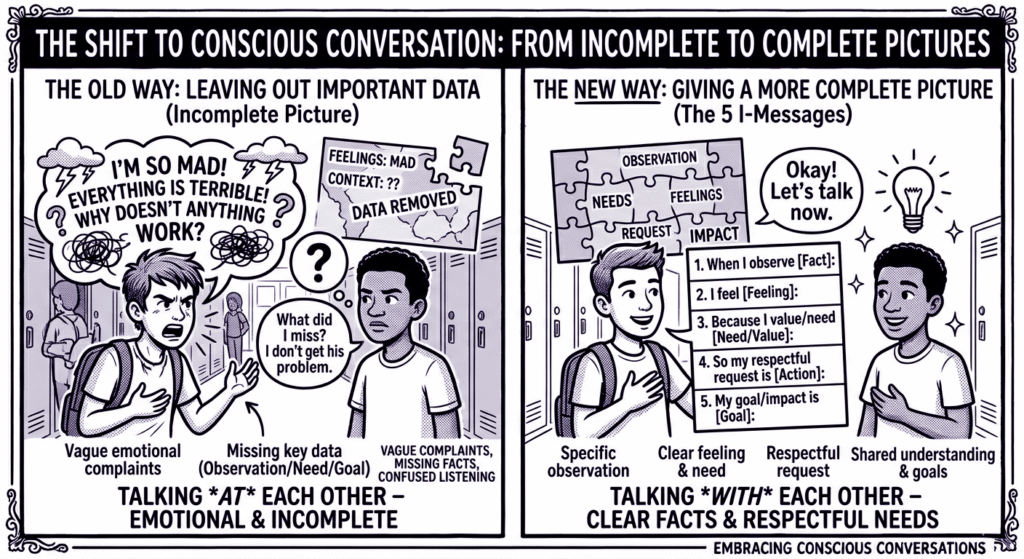
3.1 Summary
Careful self-observation allows for compassionate and effective self-expression. The more important the conversation you are in, the truer this becomes.
In order to understand yourself more clearly — and to be understood by others in ways that lead to agreements meeting more of everyone’s needs — it helps to begin with a clearer picture of your own experience. A conversation requires you to translate the elements of your experiencing into a kind of story, and the more demanding the conversation, the more self-inquiry and careful composing that story requires. I have to be able to make some reasonable sense out of my own experience before anyone else will be able to.
A good way to start is to sort your experience into five “baskets”: what you are observing, what you are feeling, why you are feeling it, what you want to ask for, and what good outcome you are hoping for.
This chapter introduces those five baskets as the Five I-Messages — a map of experience. These five dimensions are always present inside you, whether or not you have sorted them out and whether or not you express them. Before the Five I-Messages are a communication tool for reaching out to someone else, they are a self-observation tool: a way of asking yourself, What is actually going on inside me right now? In many situations — especially intense ones — we may not know everything we are feeling, or what we are wanting, until we have paused long enough to ask. We can be feeling many things, and wanting many things — all the more reason to pause and sort it out. The inward turn toward clarity comes first. The outward expression follows from it.
At the heart of everything that follows is a question worth sitting with: What opens up when you slow down enough to notice what you’re actually feeling, needing, and hoping for — and what becomes possible when you can share what you find there with honesty and care?
3.2 A Capacity You Already Possess
You have already done this — perhaps more often than you realize. Think of a time when you were upset and, instead of reacting immediately, you paused. Maybe you stepped out of the room for a moment, or took a slow breath, or simply waited — and in that pause, something came into focus. You noticed that underneath the anger was something else: fear, or sadness, or a need you hadn’t named. And when you finally spoke, you spoke from that deeper place. Maybe you said something like, “I’m not angry about the dishes — I’m feeling overwhelmed because I had a terrible day and I was hoping we could make dinner together tonight.” And your partner’s face changed, and you could see that for the first time they actually understood what was going on inside you.
If you can remember a moment like that — a moment when you looked inward before speaking outward, and the conversation went better because of it — you already know the most important thing this chapter has to teach. The pause to notice is the foundation. The expression that follows is built on it.
This chapter is about recognizing what you’ve already glimpsed, giving it a name and a map, and learning to do it more deliberately and more often. In the Introduction, we explored the “born to learn” idea: you were born with a magnificent capacity for language, but zero words in your vocabulary. The same is true for self-awareness and self-expression. You were born with the capacity to observe your own inner experience and to share it honestly — and that capacity has been developing, unevenly and without much guidance, your whole life. What follows is a way of seeing what you already partly do, so that you can do it more often and with greater confidence.
If the capacity is already there — if you’ve already had moments when pausing to notice produced clearer expression and deeper understanding — then a natural question arises: What keeps us from doing this more often? What is it about everyday conversation that makes us skip the inward pause and compress away exactly the information our listener most needs?
3.3 The Art and Process of Saying Enough
Having a conversation is like baking a series of cakes. Nearly every important speaking turn involves a creative mixing together of several ingredients. Here is an ingredient list I have found helpful:
1) Self-needs at once: the need to be aware of what is actually going on in your own heart and mind, the need to translate that awareness into a story your listener can follow,
the need to be clear and appropriate to the occasion,
and the need to be reasonably brief.
All four are legitimate. Any one of them can make or break a conversation. And we face them all, in every important conversation, every day of our lives.
When a surgeon says “Scalpel” in an operating room, brevity is everything. When a parent shouts “Stop!” to a child running toward traffic, the message needs to be instant. In emergencies, abbreviation saves lives.
But the same abbreviation instinct that serves us so well in urgent moments quietly undermines us in the conversations that matter most: the talk with your partner about something that’s been bothering you for weeks, the meeting with a colleague where a project is going off the rails. In those moments, our instinct to compress — to get to the point quickly, to leave out the parts that feel embarrassing or complicated or not quite clear to us yet — produces exactly the misunderstandings and hurt feelings we were hoping to avoid.
Human communication works by leaving many things unsaid and depending on the listener to fill in the missing information. A receptionist says to a counselor, “Your two o’clock is here” — a sentence which, on the face of it, makes no sense at all. She means “Your client, who made an appointment with you for two o’clock this afternoon, has arrived in the waiting room,” and the counselor knows that. It is amazing how much of the time this abbreviating works just fine.
But in situations of conflict, ambiguity, or strong feeling, our shorthand can fail in at least three ways. First, our listeners may fill in completely different details than the ones we intended. Second, they may get the details but miss the significance. Third, we may leave out important parts of our experience that we find embarrassing, not quite clear to us yet, or that we imagine will evoke a hostile reaction. And here is the crucial point: we often don’t realize what we are leaving out. The shorthand feels so familiar that it feels like the whole message.
But there is a deeper reason we abbreviate, and it goes beyond the efficiency of language. In many situations, we leave things out because we haven’t yet noticed or understood them in ourselves. We arrive in important conversations not yet knowing what we actually feel, or what we actually want, because we haven’t paused to ask. The psychologist Carl Rogers pointed to the roots of this: many of us learned early in life that it wasn’t safe to say what we really felt, and we became experts at not noticing our own feelings — not just at hiding them from others, but at hiding them from ourselves. The encouraging truth that Rogers spent his career demonstrating is that as adults we have new cognitive resources, resources we did not have when we first learned to speak and listen. As adults we can close the missing information gap — and the closing begins not with better expression but with better self-observation.
So we are dealing with two creative layers: the practical layer, where language naturally compresses the content and arranges the story, and the awareness layer, where we haven’t yet noticed what we’re compressing away. If that is the creative challenge of important conversations, what would a map of those inner dimensions look like — one that could guide both the inward noticing and the outward sharing?
3.4 The Five I-Messages: A Map for Looking Inward and Speaking Outward
In recent decades, psychologists and communication educators have developed a much clearer picture of what people tend to leave out when they compress — and what needs to go back in. The social workers who developed the Minnesota Couples Communication Program called their model the “Awareness Wheel” — and the name is telling, because it puts awareness at the center, not expression. The Five I-Messages I offer here are closely related. They map five dimensions of experience that are always happening inside you, whether or not you are aware of them and whether or not you express them.
Before the Five I-Messages are a communication tool, they are a self-inventory — a way of pausing to ask yourself: What am I actually seeing or reacting to? What am I actually feeling? What need or interpretation is driving this feeling? What do I actually want right now? What good outcome am I hoping for? In many situations — especially the intense ones where self-expression matters most — we genuinely don’t know the answers to these questions until we have paused long enough to ask. The conflict resolution expert William Ury recommends a practice he calls “going to the balcony” — stepping back briefly from a tense situation to sort out your own thoughts and feelings before re-engaging. The Five I-Messages are what you do while you’re on the balcony. They are the questions you ask yourself up there.
And then, when you come back downstairs, the same five dimensions become a guide to expression — a way of sharing what you’ve found with your listener, so that they can actually understand you. They are called I-Messages because each one is a statement about your own experience rather than a judgment about someone else. Here they are:
(1) What you are seeing or hearing — a simple description of the facts, without evaluation.
(2) What emotions you are feeling — glad, sad, angry, scared, delighted, frustrated, concerned.
(3) What needs, wants, or interpretations are driving those feelings — the “because” that connects the situation to your emotional response.
(4) What you are ready to ask for right now — a specific, doable request for action, information, or commitment.
(5) What positive results you envision — the good outcome that would follow if your request is met.
Consider the difference. The shorthand version of a message might be: “Stop that racing!” The five-message version — the version that becomes possible only after the speaker has paused to notice what she is actually experiencing — gives the listener a full picture:
Table 3.1: The Five I-Messages
| The Five I-Messages | express: | Example (nurse to young patient): |
|---|---|---|
| seeing, hearing… | 1. What are you seeing, hearing or otherwise sensing? (facts only) | “John, when I see you rolling down the hall in your wheelchair really fast… |
| and feeling… | 2. What emotions are you feeling? | …I feel REALLY concerned. |
| because I… | 3. What interpretations, wants, needs, memories or anticipations of yours support those feelings? | I am imagining you might hurt yourself and maybe someone else, too, or knock something over… |
| and now I want… | 4. What action, information or commitment do you want now? | …so what I need right now is for you to promise me that you will slow down… |
| so that… | 5. What positive results will that action lead to? (no threats) | …so that you can get out of here in one piece and I can stop worrying about a collision.” |
Notice what happens when the nurse expresses all five dimensions. John doesn’t just hear a command. He hears what the nurse is observing, what she’s feeling, why she’s feeling it, what she needs from him, and what good will come of it. But notice, too, what had to happen inside the nurse first. She had to pause long enough to notice that what she was feeling was concern, not anger. She had to identify the interpretation driving the feeling — her worry about a collision. She had to clarify what she actually wanted from John, and what good outcome she envisioned. The self-observation came first. The expression followed from it.
Now look at how the same observation produces completely different messages depending on the speaker’s inner experience:
Table 3.2: Five I-Message Examples (Please read across the rows.)
| 1. When I saw/heard… | 2. I felt… | 3. because I… | 4. and now I want… | 5. so that… |
|---|---|---|---|---|
| When I saw the bear in the woods with her three cubs… | …I felt overjoyed!… | …because I needed a picture of bears for my wildlife class… | …and I wanted the bear to stand perfectly still… | so I could focus my camera. |
| When I saw the bear in the woods with her three cubs… | …I felt terrified!… | …because I remembered that bears with cubs are very aggressive… | …and I wanted to get out of there fast… | so that the bear would not pick up my scent. |
| When I saw the dishes in the sink… | …I felt happy… | …because I guessed that you had come back from your trip to Mexico… | …and I want you to tell me all about the Aztec ruins you saw… | …so that I can liven up some scenes in the short story I’m writing. |
| When I saw the dishes in the sink… | …I felt irritated… | …because I want to start cooking dinner right away… | …and I want to ask you to help me do the dishes right now… | …so that dinner will be ready by the time our guests arrive. |
The same three cubs, the same dishes — but completely different inner experiences, because Message Three is different. If the speaker had skipped the self-observation and simply reacted — “Bears!” or “The dishes again!” — the listener would have no idea what the speaker was actually feeling, why, or what they needed. The Five I-Messages give the listener the full picture. But only if the speaker has first given themselves the full picture.
The Five I-Messages, then, are both a self-inventory and a communication tool — a framework for noticing what’s happening inside you and then sharing it. But if you’ve been reading carefully, you may already be raising an objection: “Are you really suggesting I run through all five of these questions every time I open my mouth?” That’s a fair concern — and the answer involves understanding something about skill development that most communication programs never discuss.
3.5 The Developmental Journey: From Scales to Jazz
People who learn structured communication formulas sometimes complain that using them sounds robotic. Their partners roll their eyes. And so they abandon the whole thing. I understand that frustration. And I want to suggest that what’s happening is not a failure of the method. It’s a confusion between a training protocol and a way of life.
Think of learning to play the piano. When you’re a beginner, you practice scales — every note, deliberately, one at a time. It sounds mechanical because it is mechanical. You’re learning where all the keys are. But once you’ve done those scales hundreds of times, your hands know. You can improvise. The scales aren’t the performance. They’re the foundation that makes the performance possible.
The Five I-Messages work the same way — and here the self-observation dimension is especially important. I see three stages:
Stage One: Unconscious abbreviation. This is where most of us start. We haven’t yet learned to observe our own experience carefully, so we express it in shorthand without realizing what we’re leaving out. When misunderstandings arise, we blame the other person for not getting it.
Stage Two: Conscious expansion. This is the training stage — the scales. You deliberately pause to notice all five dimensions of your experience, and you deliberately practice expressing all of them, even when it feels excessive. Write one five-message self-inventory a day in a journal. Practice with a partner. Work through the exercises at the end of this chapter. This stage is about training your awareness — learning to feel the five dimensions so that you know where all the “keys” are, inside yourself and in your conversations.
Stage Three: Informed brevity. Having internalized all five dimensions through practice, you return to something that looks like ordinary conversation — brief, natural, fluid. But it’s fundamentally different from Stage One, because now your brevity is chosen rather than automatic. You can feel when something important is missing — either in your own self-awareness or in what you’re sharing. When a conversation starts going sideways, you can pause and ask yourself: “Which of the five am I not noticing? Which one does my listener need right now?” And you supply just that piece.
If you’re in Stage Two right now, doing your scales, please don’t be in a hurry to skip ahead. The scales are what make the jazz possible.
With that developmental arc in view, here is a brief look at each of the five messages — each one presented as both something to notice in yourself and something to share with your listener.
3.6 A Closer Look at Each Message
Message One: What you are seeing, hearing, or sensing. The self-observation question: What actually happened? What did I actually see or hear? Begin with what you observed rather than how you feel about it. Be specific — time, place, actions — and describe rather than diagnose. Avoid words that label or judge, and generalizations like “you always” or “you never.” “When I saw the big coffee stain on the rug…” is far easier to hear than “When you ruined my day with your disgusting antics…”
Message Two: What emotions you are feeling. The self-observation question: What am I actually feeling right now? Use specific emotion words: glad, angry, delighted, sad, afraid, frustrated, hopeful, concerned. Be wary of feeling words that actually describe someone else’s actions: “I feel ignored” or “I feel manipulated” are indirect accusations, not feelings. “I feel ignored” probably means “I’m feeling sad because I want more of your attention.” Noticing the real emotion underneath the accusation is one of the most valuable things self-observation can do.
Message Three: What needs, wants, or interpretations are driving your feelings. The self-observation question: Why am I feeling this way? What want, need, memory, or interpretation of mine is generating this emotion? This is the dimension people compress away most often — and it’s the one that requires the deepest self-observation. A large part of your emotional response to any situation is generated by your own wants, memories, and interpretations, not just by what happened. Noticing this is an act of emotional maturity: you’re taking responsibility for your inner world rather than asking your listener to guess at it.
Message Four: What you are ready to ask for right now. The self-observation question: What do I actually want? What specific action, information, or commitment would help? Ask for specific, doable actions rather than emotional states. Translate “be more supportive” into concrete verbs: “please listen,” “please sit with me,” “please tell me what you think.”
Message Five: What positive results you envision. The self-observation question: What good would come of getting what I’m asking for? If you can’t articulate the positive outcome, you may not yet understand your own needs clearly enough — and that’s a signal to spend more time on the balcony. When you can name the good outcome, you give your listener a reason to care about your request. You point the relationship toward mutual appreciation rather than guilt or fear.
With practice, these five messages — noticed inwardly, shared outwardly — serve all three sides of the relationship triangle we explored in the Introduction: task, emotional support, and the bridging of difference. A complaint collapses all five dimensions into a single burst of blame. The Five I-Messages weave all three together, because the speaker has first noticed what’s happening inside and then shared it openly. That’s their hidden strength — and it connects this skill to every other challenge in this workbook.
3.7 The Spiral: How This Step Connects to Positive Processes in Human Development
The listening connection (Challenge One). In Challenge One, section 1.8, we previewed the idea that outward listening and inward listening are not two skills but one, aimed in two directions. The Five I-Messages make that insight concrete: the same framework you use to observe your own experience can guide your listening to others. When someone is upset, you can listen for the five dimensions: What are they observing? What are they feeling? What need is driving the feeling? What do they want? What outcome are they hoping for? This is “listening with five ears” — and it makes you a profoundly better listener, because you know what to listen for. To help you develop this practice, you will find a Five-Part Listening Inventory among the exercises at the end of this chapter.
Shifting from a language of accusation to a language of invitation. When we were little, we were outweighed and outmaneuvered by most of the people around us. Each of us started out as the littlest player on the team. In response, we developed a vocabulary of protest and accusation — “You did something really awful…,” “You hurt me!,” “You’re bad!” — because as little beginners in life, we were in no position to understand differences in needs or to negotiate for more satisfying outcomes. We experienced every unmet need as entirely the other person’s fault. Every situation was simple: they were doing it to us.
Now, as adults, we have a whole new range of cognitive resources available to us, and with them a whole new range of possible responses. The fact that other people have different needs and experiences from our own is now a moment to be explored in conversation rather than a crime to be exposed and denounced. The goal of that conversation is to work out some way of cooperating that will meet more of the needs of both people. The Five I-Messages embody this shift. They help me explain my experience in language you might be able to identify with: I saw that, then I felt this way, because I was needing something different, and now I want to ask for this, so that we can both… The accusatory “you” language is gone, replaced by an invitation for each person to express their experience and for the conversation partners to invent a more satisfying way of cooperating. That shift, from accusation to invitation, is a major step in the unfolding of human maturity.
Becoming the kind of person who pauses to notice. We have been calling self-observation and self-expression “skills,” and they are. But there is a quieter truth underneath the skills that is worth naming. Each time you pause to notice what you’re actually feeling rather than firing off the shorthand — each time you ask yourself why you’re feeling it before blaming someone else for it — each time you name a request instead of swallowing it or wrapping it in accusation — you are not only doing something. You are quietly becoming someone: a person who arrives in conversations already knowing what they feel and need, a person whose words make others feel safe enough to listen, whose honesty invites honesty in return. And the way we are, moment after moment, is the raw material from which a character is slowly made. Practice this often enough and you will not merely become more self-aware or more articulate. You will become someone other people trust with their own experience — because in your company they discover that honesty and kindness can occupy the same sentence.
3.8 Challenge Three Exercises: Looking Inward, Speaking Outward
Reading this chapter has been a kind of in-breath — taking in a new way of seeing what self-observation and self-expression can do when they work together. But no one ever learned to observe themselves more carefully or express themselves more fully by reading about it; the understanding comes alive only on the out-breath, in real journal entries and real conversations where you actually pause, notice, and speak. Breathe in the idea; breathe out the practice. That gentle rhythm will return in every chapter of this book.
May you discover, one pause at a time, the enormous difference that looking inward makes — for what you say, and for how people hear you!
Exercise A: Daily Self-Inventory.
Each day for a week, choose one moment from your day — a conflict, a frustration, a delight — and write a five-message self-inventory in your journal. Don’t worry about whether you will ever say these words to anyone. The practice here is noticing: What did I observe? What did I feel? What need or interpretation was driving the feeling? What did I want? What good outcome was I hoping for? Use the worksheet on the following page.
Exercise B: Paired Practice.
With a practice partner, take turns describing a recent experience using all five messages. After each person speaks, the listener reflects back what they heard, using the listening skills from Challenge One. Then ask: “Did I get that right? Is there anything important I missed?”
Exercise C: Taking Stock.
- Think of a recent conversation that went badly. Which of the five dimensions were you not noticing in yourself? What might have changed if you had paused to observe them before speaking?
- Which of the five dimensions comes most naturally to your awareness? Which one do you tend to overlook? (Many people find that Message Three — the needs and interpretations behind their feelings — is the one they notice least.)
- Where are you in the three-stage developmental journey? Stage One, reacting without noticing? Stage Two, deliberately practicing both the self-observation and the expression? Or Stage Three, starting to sense intuitively which dimension needs attention?
- Who in your life might you invite to practice this skill with you? Even one practice partner can make an enormous difference — see Chapter Eight: Widening Circles.
Exercise D: Five-Part Listening Inventory.
The Five I-Messages are not only a self-expression tool — they are equally powerful as a listening tool. When someone is telling you about a difficult experience, use the Five-Part Listening Inventory on the following pages to guide your attention. As you listen, ask yourself: What is this person describing that they observed? What feelings are they expressing? What need or interpretation seems to be driving those feelings? What are they asking for? What outcome are they hoping for? After they have finished speaking, reflect back what you heard, dimension by dimension. You may be surprised how much more your conversation partner feels understood — and how much more clearly you understand them — when you listen with all five ears.
3.9 A Five I-Messages Worksheet
A guide to both self-observation and self-expression — first notice what you are experiencing, then practice sharing it with others.
Use this form to explore your experience more carefully and express it more completely. Photocopy this page, print from PDF, or download printable copies at communication-skills.net.
| 5 Elements of my experiencing: (Self-Observation) |
Expressing what I find — helping people understand me better (Self-Expression) |
|---|---|
| 1. What actions, events and/or sensations am I seeing, hearing, doing, remembering or otherwise sensing? (Start with facts only) | As I (or when I) see (hear, remember, take action about)… |
| 2. What basic emotions am I feeling (glad, sad, mad, delighted, frustrated, proud, sorry, ashamed, grateful, etc.) about those actions/events? | … I feel (or felt)… |
| 3. What interpretations, evaluations, wants, hopes, needs and/or dreams of mine help to evoke and support my feelings? | … because I… |
| 4. What action, information, discussion, help or commitment would I want to receive, or would I like to ask for, now? | … and now I want (want to request)… |
| 5. What positive results or personal fulfillment do I envision that action, discussion, information or commitment leading to? | …so that I can… so that we can… in order for me/us to… |
3.10 A Five-Part Listening Inventory
A guide to listening for all five dimensions — helping you understand more fully what another person is experiencing, and helping them feel more deeply heard.
Use this form while listening to someone describe a difficult or important experience. Photocopy this page, print from PDF, or download printable copies at communication-skills.net.
| 5 Elements of the other person’s experiencing: (Listening for…) |
What I think I’m hearing — reflecting back to check (Responding with…) |
|---|---|
| 1. What actions, events, or sensations is this person describing? What did they actually see, hear, or experience? | “It sounds like what happened was…” |
| 2. What emotions are they expressing or conveying? What feelings am I picking up on? | “And you’re feeling…” |
| 3. What needs, wants, interpretations, or hopes seem to be driving their feelings? | “…because you…” (or “…because it matters to you that…”) |
| 4. What are they asking for? What action, information, or commitment do they seem to need right now? | “And what you’d like is…” |
| 5. What positive outcome are they hoping for? What good result do they envision? | “…so that…” |
3.11 References for this Chapter
A note on inspirations: Many scholars and psychotherapists have been developing frameworks for more complete self-awareness and interpersonal communication since Dr. Thomas Gordon first published Parent Effectiveness Training in 1962. My deep appreciation goes to him for being one of the first great popularizers of communication skills training in the United States.
The work of Marshall Rosenberg (Nonviolent Communication) helped me understand Messages One through Four.
The work of Sharon and Gordon Bower (Asserting Yourself) helped me understand Message Five, and the importance of describing hoped-for positive outcomes.
The work of scholars John Grinder and Richard Bandler helped me understand how people “delete” various aspects of their experience from their awareness and their expressed communication.
The “Awareness Wheel” of the Minnesota Couples Communication Program showed how scholars and researchers have been working to overcome the self-awareness and messages-left-out problem. The very name of their model — the Awareness Wheel — reflects the insight that self-observation is the foundation of self-expression.
William Ury’s concept of “going to the balcony” in conflict resolution provided a vivid image for the pause between self-observation and self-expression. My small contribution has been to suggest that the Five I-Messages are what you do while you’re on the balcony.
Bandler, Richard, and John Grinder. The Structure of Magic, Vol. 1. Science and Behavior Books, 1975.
Bower, Sharon Anthony, and Gordon H. Bower. Asserting Yourself: A Practical Guide for Positive Change. Addison-Wesley, 1976.
Gordon, Thomas. Parent Effectiveness Training: The Proven Program for Raising Responsible Children. Harmony Books, 2000.
Miller, Sherod, et al. Connecting with Self and Others. Interpersonal Communication Programs, 1988.
Rogers, Carl R. On Becoming a Person: A Therapist’s View of Psychotherapy. Houghton Mifflin, 1961.
Rosenberg, Marshall B. Nonviolent Communication: A Language of Life. 3rd ed., PuddleDancer Press, 2015.
Ury, William. Getting Past No: Negotiating in Difficult Situations. Bantam Books, 1993.